Zubeńsko is a village in Komańcza Commune, Sanok County.
Zubeńsko to wieś w gminie Komańcza, w powiecie sanockim.
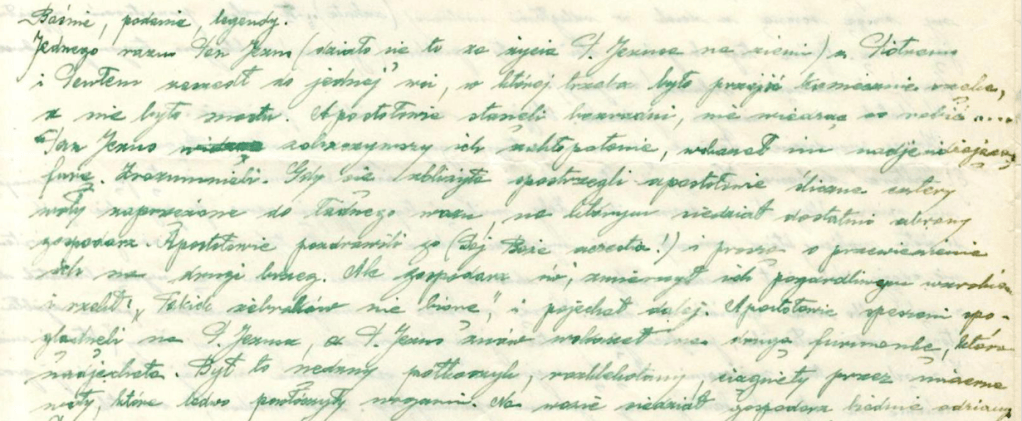

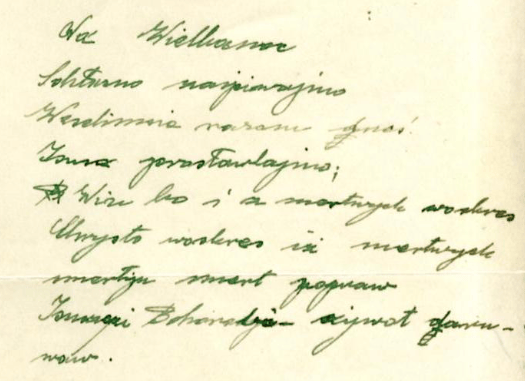
Transcript: Google-Powered
Warning: this transcription may be terrible. It was done electronically by someone who can speak neither Polish nor Ukrainian/Lemko. Do you wish to see it improve? You can help! Contact us.
Uwaga: ta transkrypcja może być fatalna. Została wykonana automatycznie przez osobę, która nie zna ani języka polskiego, ani ukraińskiego/łemkowskiego. Chcesz, żeby była lepsza? Możesz pomóc! Skontaktuj się z nami.
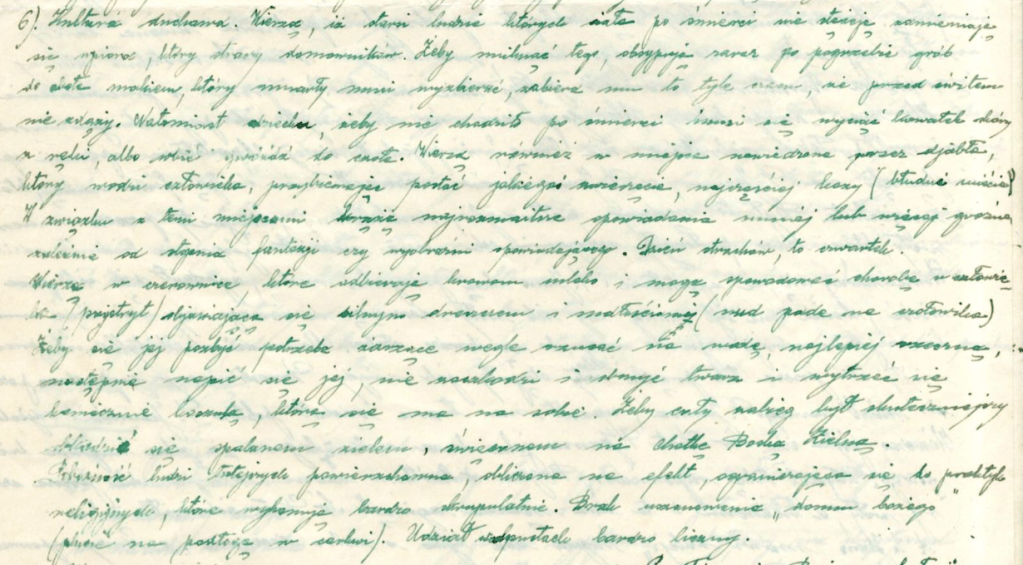
6). Kultura duchowna. Wierzą, iż starsi ludzie których dusza po śmierci nie starzeje zamieniają się w upiora, który dręczy domowników. Żeby uniknąć tego, obsypują zaraz po pogrzebie grób w koło makiem, który zmarły musi wyzbierać, zabiera mu to tyle czasu, że przed świtem nie zdąży. Natomiast dziecku, żeby nie chodziło po śmierci musi się wyciąć kawałek skóry z ręki, albo wbić gwóźdź do trumny. Wierzą również w miejsca nawiedzone przez djabła, który zwodzi człowieka, przybierając postać jakiegoś zwierzęcia, najczęściej kozy (studnie, miedze). W związku z temi miejscami krążą najrozmaitsze opowiadania mniej lub więcej groźne zależnie od stopnia fantazji czy wyobraźni opowiadającego. Dzień strachów, to czwartek. Wierzą w czarownice które odbierają krowom mleko i mogą powodować chorobę u człowieka (u nas prystryt) objawiającą się silnym dreszczem i mdłościami (urod pode ma urokowała) żeby się jej pozbyć potrzeba pierwsze mleko nalać na macę, najlepiej mączną, następnie napić się jej, nie zaszkodzi i zmyć twarz i wytrzeć się koniecznie koszulą, którą się ma na sobie. Żeby cały zabieg był skuteczniejszy chodzić po spalanym zielu, wieczorem na Matkę Boską Zielną. Pobożność ludzi tutejszych powierzchowna, obliczona na efekt, ograniczająca się do praktyk religijnych, które wykonują bardzo skrupulatnie. Brak uszanowania „domu bożego” (siadanie na podłodze w cerkwi). Udział w odpustach bardzo liczny.
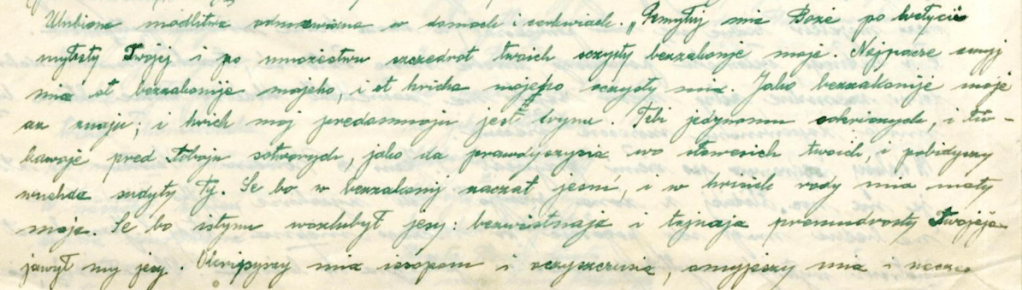
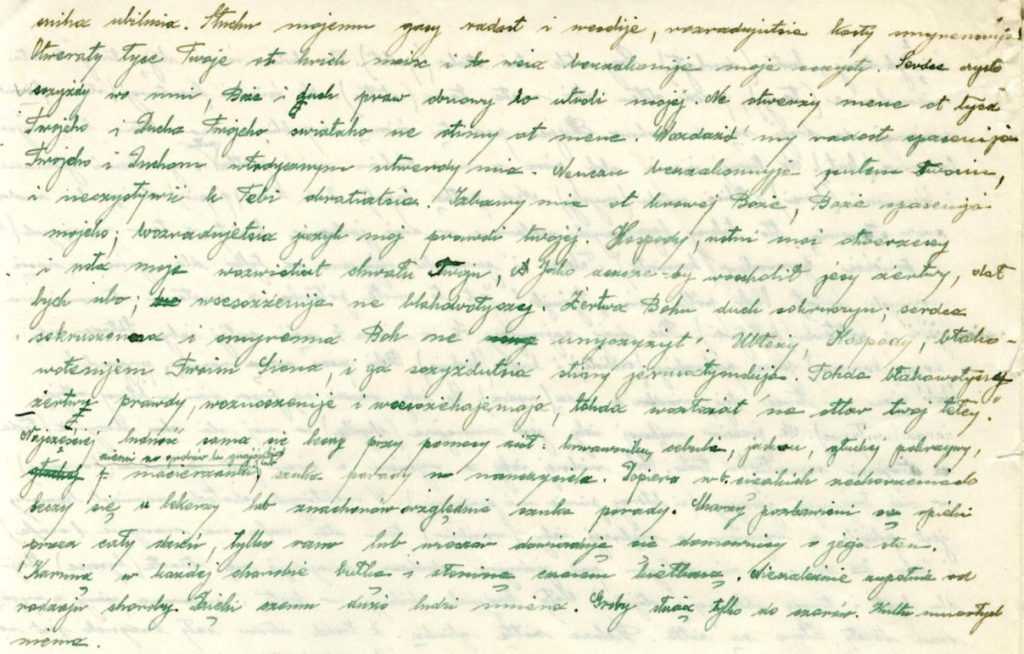
Ulubiona modlitwa odmawiana w rano i wieczór. Pomyłuj mia Boże po wełycis miłosty Twojej i po mnoże stwu szczedrin Twoich oczysty bezzakonije moje. Najpacze omyj mia ot bezzakonija mojeho, i ot hricha mojeho oczysty mia. Jako bez zakonie moje az znaju; i hrich moj preda mnoju jest wynu. Tebi jedynomu sohryszych, i łukawoje pred Toboju sotworych, jako da oprawdiszysia wo słowiesiech Twoich, i pobidyszy wniehda sudyty Ty. Se bo w bezzakonij naczał jesm, i wo hrysich rody mia maty moja. Se bo istynu wozlubył jesy: biezwiestnaja i tajnaja premudrosty Twojejan jawył my jesy. Okrypyszy mia issopom i oczyszciusie, omyjeszy mia i wysze niha ubilnia. Słuchu mojemu dasy radost i weselije, wzw radujetsia kosty smyrennyja. Otwrati lyce Twoje ot hriech moich i wsia bezzakonija moja oczysty. Serdce czysto sozydzy wo mnie, Boże i duch praw obnowywo utrobi mojej. Ne otwerzy mene ot lycaTwojeho i Ducha Twojeho swiataho ne otymy ot mene. Wozdadiż my radost spasenija Twojeho i Duchom władycznym utwerdy mia. Nauczu bezzakonnyja putiem Twoim,i neczestywyi k Tebie obratytsia. Izbawy mia ot krowej Boże, Boże spasenijamojeho; wzwradujetsia jazyk moj prawdi twojej. Hospody, ustni moi otwerzeszi usta moja wozwistiat chwału Twoju. Jako asceby woschotił jesy żertwy, dałbych ubo; wsosożżenija ne błahowolyszy. Żertwa Bohu duch sokruszen; serdcesokruszenno i smyrenno Boh ne unyczyżyt. Ubłaży Hospody, błaho-wolenijem Twoim Siona, i da sozyżdutsia stieny jerusałymskyja. Tohda błahowoly-szy żertwy prawdy, woznoszenije i wsosożżajemoja, tohda wozlożat na ołtar twoj telcy.”
Objaśnienie; Ludność sama się leczy przy pomocy aut: kwasom lecz, cebula, jadom, głuchej pokrzywy,
ziemi no żydów lu gnajonchics maściomantów, szuka porady u nauczyciela. Dopiero w ciężkich zachorowaniach leczą się u lekarzy lub znachorów względnie szukają porady. Starzy pozbawieni są opieki
przez cały dzień, tylko rano lub wieczór dowiadują się domownicy o jego stan.
Karmią w każdej chorobie butla i strawa czasem kiełbasa. Niezależnie zupełnie od
rodzaju choroby. Dziki czosnek dużo ludzi używa. Groby stoją tylko do marca. Matka morderczyni niema.
Baśnie, podania, legendy.
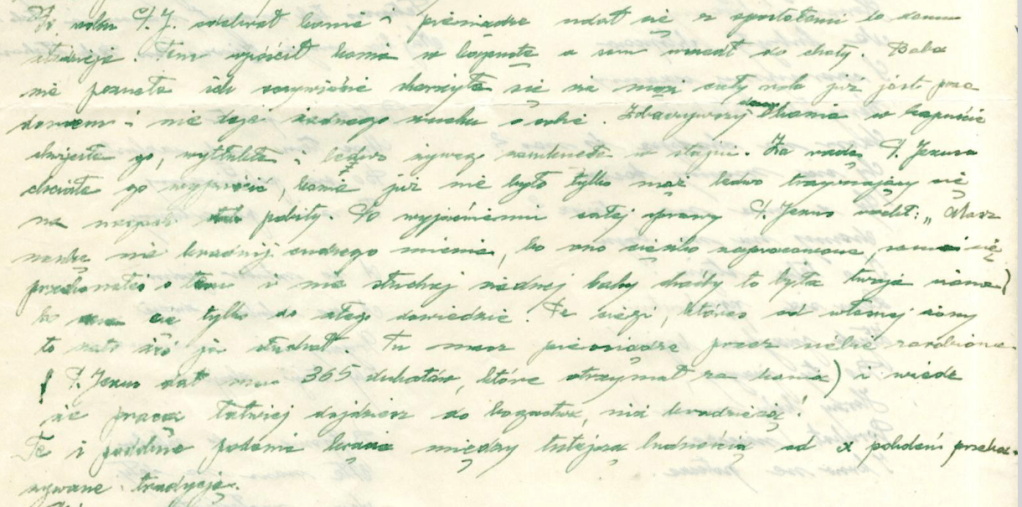
Jednego razu Pan Jezus (działo się to za życia P. Jezusa na ziemi) z Piotremi Janem zaszli do jednej wsi, w której trzeba było przejść kamienie, rzekę,a nie było mostu. A apostołowie stanęli bezradni, nie wiedząc co robić…Pan Jezus widząc zobaczywszy ich zakłopotanie, wskazał im nadjeżdżającą furę. Zrozumieli. Gdy się zbliżyła spostrzegli apostołowie śliczne cztery konie zaprzężone do ładnego wozu na którym siedział dostatnio ubrany gospodarz. Apostołowie pozdrowili go (Daj Boże szczęścia!) i proszą o przewiezienie ich na drugi brzeg. Ale gospodarz ów, zmierzył ich pogardliwym wzrokiemi rzekł „Takich żebraków nie biorę!” i pojechał dalej. Apostołowie z pewnym spoglądnęli na P. Jezusa, a P. Jezus znów wskazał na drugą furmankę, która nadjechała. Był to nędzny półwózek, rozklekotany ciągnięty przez marne szkapy, które ledwo poruszały nogami. Na wozie siedział gospodarz biednie odziany.
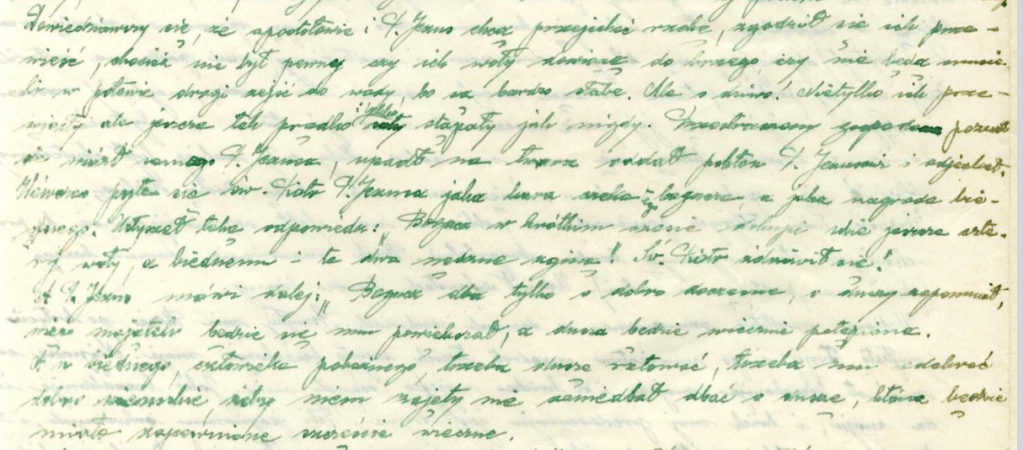
Dowiedziawszy się, że apostołowie i P. Jezus chcą przejść rzekę, zgodził się ich przewieźć, chociaż nie był pewny, czy ich wątłe czółno do innego brzegu ich dowiezie.W połowie drogi wejść do wody, bo są bardzo słabi. Ale o dziwo! Nie tylko ich przewiozły ale jeszcze tak prędko stąpały jak nigdy. Nieodgadniony gospodarz poznał w nim samego P. Jezusa, upadł na twarz, oddał pokłon P. Jezusowi i odjechał.Wkrótce pyta się św. Piotr P. Jezusa jaka kara czeka bogacza a jaka nagroda ubogiego. Usłyszał taką odpowiedź: Bogacz w krótkim czasie kupi sobie jeszcze cztery woły, a biednemu i te dwa jedne zginął Św. Piotr zdziwił się! A P. Jezus mówi dalej: Bogacz dba tylko o dobro doczesne, o duszy zapomniał,jego majątek będzie się mu powiększał, a dusza będzie wiecznie potępiona.A u biednego człowieka pobożnego trzeba duszę ratować, trzeba mu zabrać dobro ziemskie żeby niem zajęty nie zaniedbał dbać o duszę, która będzie miała zapewnione szczęście wieczne.
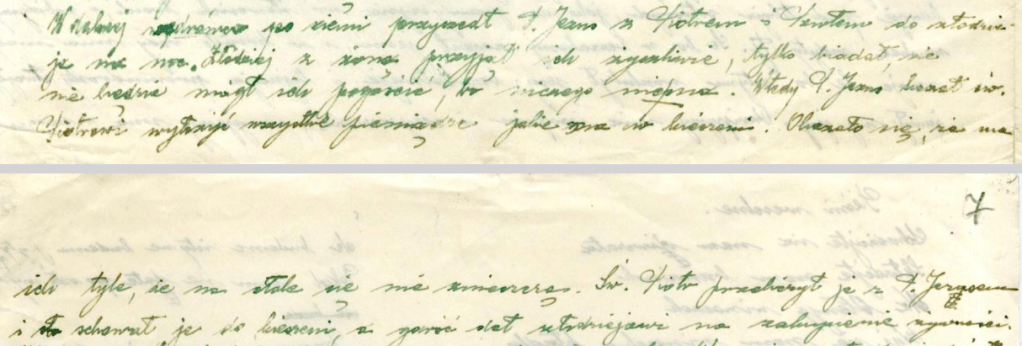
W dalszej wędrówce po ziemi przyszedł P. Jezus z Piotrem i Pawłem do złodzieja na noc. Złodziej z żoną przyjął ich życzliwie, tylko biadał, że nie będzie mógł was ugościć, bo niczego nie ma. Wtedy P. Jezus kazał św.Piotrowi wytrząść wszystkie pieniądze jakie ma w kieszeni. Okazało się, że ma ich tyle, że na stole się nie zmieszczą. Św. Piotr przeliczył je z P. Jezusem i schował je do kieszeni, a garść dał gospodarzowi na zakupienie żywności.
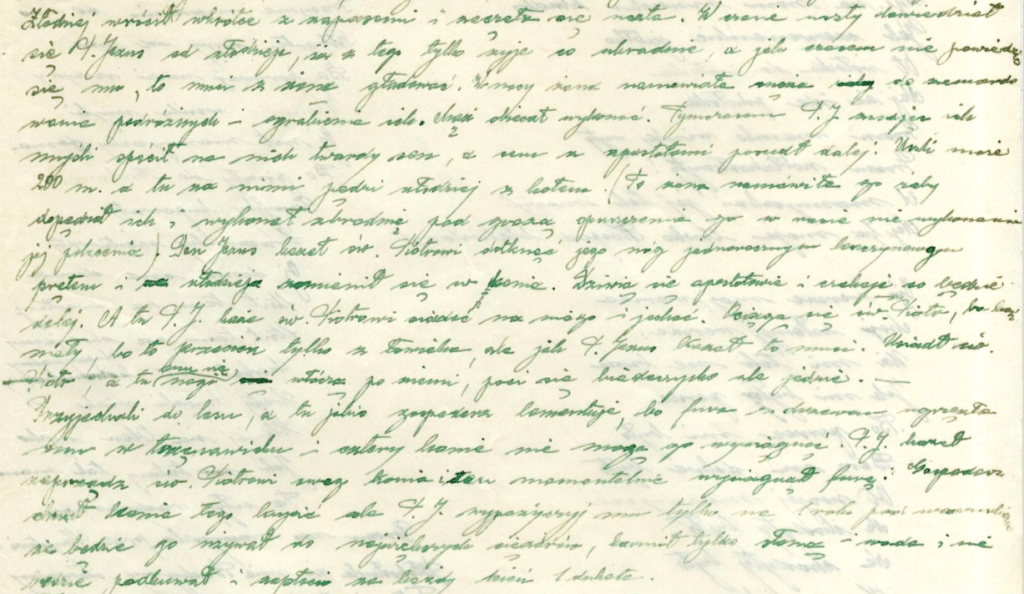
Złodziej wrócił wkrótce z napojami i ugościł acz mało. W czasie uczty dowiedział się P. Jezus od złodzieja, że z tego tylko żyje co ukradnie, a gdy czasem nie powiedzie się mu, to musi ze swemi głodować. W nocy żona namawiała męża aby po mordowaniu podróżnych – ograbiwszy ich. Mąż chciał wykonać. Tymczasem P. J. znając ich myśli spuścił na nich twardy sen, a sam z apostołami poszedł dalej. Uszli może 290 m. a tu za nimi pędzi złodziej z batem. To żona namówiła go żeby dopędził ich, i wykonał zbrodnię pod grozą opuszczenia go w razie niewykonania jej zlecenia. Pan Jezus kazał św. Piotrowi dotknąć jego nóg jednorocznym leszczynowym prętem i złodziej zamienił się w konia. Dziwią się apostołowie i czekają co będzie dalej. A tu P. J. każe św. Piotrowi siadać na niego i jechać. Wzdryga się św. Piotr, bo koń mały, bo to przecież tylko człowiek, ale jak P. Jezus kazał to musiał. Usiadł św. Piotr, a tu (noga) ziemia pod nim, poci się biedaczysko ale jedzie. Przyjechali do lasu, a tu jakiś gospodarz lamentuje, bo fura w dymie ugrzęzła tzn. w trzęsawisku i cztery konie nie mogą jej wyciągnąć. P. J. kazał wyprowadzić św. Piotrowi swego konia i ten momentalnie wyciągnął furę. Gospodarz chciał konia tego kupić ale P. J. wypożyczył mu tylko na 1 rok pod warunkiem, że będzie go używał do najcięższych ciężarów, karmił tylko słomą i wodą i nie będzie podkuwał i nocyma na każdy dzień 1 dukata.
W. sędzia P. J. odebrał konia i pieniądze udał się w spowrotem do domu stamtąd. Ten uwiązał konia w kapuście a sam wszedł do chaty. Baba mu poczęła ich oczywiście skarżyć się na swój cały los już jeść pracował i nie daje żadnego ruchu sobie. Zdający konia w kapuście śmiejecie go, myślicie, będzie żywy zamknięty w stajni. Za radą P. Jezusa strzeżcie go wejrzawszy, konia już nie było tylko mąż ledwo trzymający się na nogach też pobity. Po wyjaśnieniu całej sprawy P. Jezus rzekł: „Stare mężu nie kradnij cudzego mienia, bo ono ciężko zapracowane, pamiętaj przede wszystkim o tem iż nie słuchaj żadnej baby (kiedy to była twoja wina) bo ma on tylko z tego dowiedzieć! Te klęski, które od własnej żony to całe mu już utrudnił. Tu masz pieniądze przez siebie zarobione. (P. Jezus dał mu 365 dukatów, które otrzymał za konia) i wiedz że pracą łatwiej dojdziesz do bogactwa, niż kradzieżą! Te i podobne podania krążą między tutejszą ludnością od x pokoleń przekazywane tradycją.
Pieśni:
Pieśń śpiewana w czasie chrztu:
I.
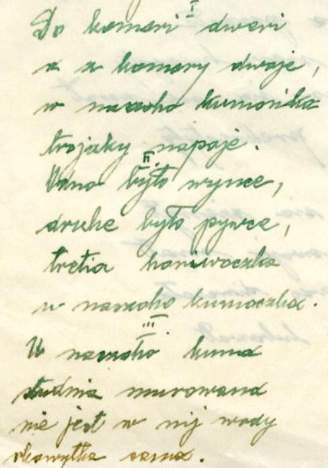
Do komory dweri
a z komory dwoje,
w naszoho kumonka
trojaky napoje.
II.
Odno było wynce,
druhe było pywce,
tretia kanywczka
w naszoho kumonka.
III.
W naszoho kumna
studnia murowana
nie jest w nij wody
wszytka wyssa
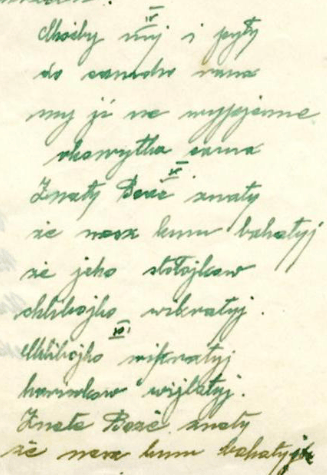
IV.
Choćby strun i języty
do samaho kanca
my jej ne wypuścime
skonczytha sama
V.
Znaty Boże znaty
że nasz kum bahatyj
że jeho stoleckaw
chlibajko wbratyj.
VI.
Chlibajko wbratyj
horiwkaw wijlatyj.
Znaty Boże znaty
że nasz kum bahatyj
VII.
Za kamienow stynow
jest ustana siła
bytyśmy sia chrystyły
daj Boże wesela.
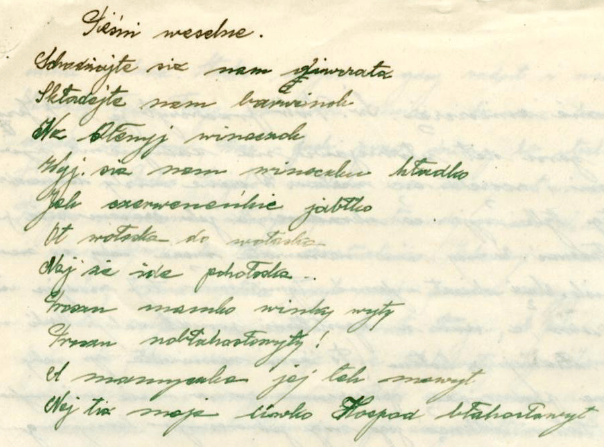
Pieśń weselna.
Schowajcie sie nam stworzenia
Składajcie nam barwinki
Na otuzyj wianeczek
Naj sie nam wianeczek składie
Jak czerwoniuchne jabłko
Ot wesoła do wesołka
Naj sie idzie pohotodza…
Prosam mambo winky wyty
Prosam nołtuhartownyty!
Ot mameczka jej tak mamyt
Naj cia moje dziecko Hospod błahosłanyt
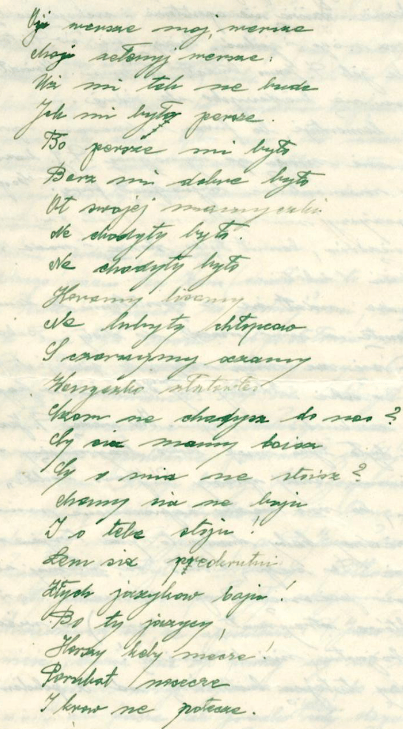
Oj wencu moj, wencu
moj zelenyj wencu.
Uz mi tak ne bude
jak mi było persze.
Bo perve mi było
Barz mi dobre było
Ot mojej mamynki
Ne chodyty było.
Ne chodyty było
Hononny iwany
Wse lubyty chłópcia
I czornymy oczamy
Wencenko otatento!
Chom ne chodysz do nas?
Chy sie mamy boisz
Chy i mną ne stoisz?
Chomy sia ne boju
I o tebe stoju!
Zem sie predostaty
Złych jazykow baji!
Bo ty jazyky,
Horszj koly mecze!
Porezat mecze
I krow ne potece.
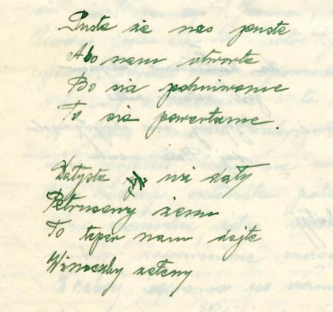
Osta sie nas poste
Abo nam stworte
Bo na pomineme
To na powrotame.
Wsetcy mi raty
Potromny iemo
To teper nam dejte
Winoczby wstewy
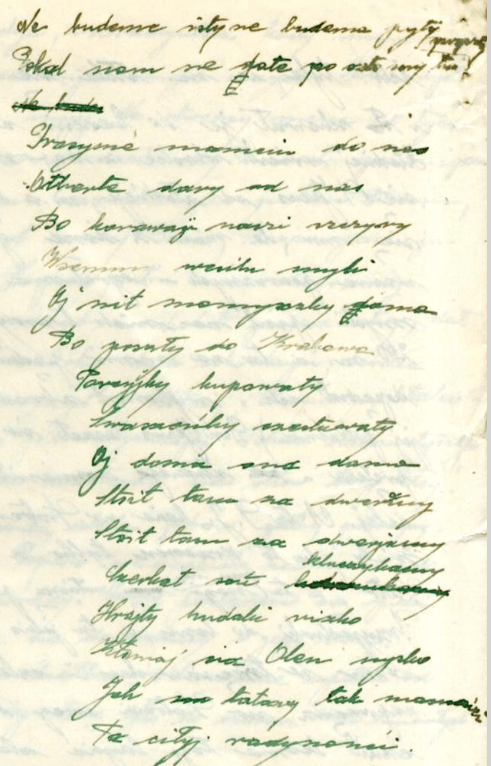
Ne budeme isty ne budeme pyty
Poki nam ne date po ostomy two
Prasyme mamuni do nas
Otrymte dary od nas
Bo korowaj naszi rzyzay
Wszitku weselu mysli
Oj nit mamyczky doma
Bo poszły do Krakowa
Torujeszky kupowaty
I mamonijku swatuwaty
Oj doma ona doma
Stoit tam na dwerzycy
Stoit tam na dwerzycy
Szerbat pije [ ]
Hrajte hudaki nisko
Kłaniaj sia Olen wysko
Jak na tatary tak mamoniju
Ta sity radynonci.
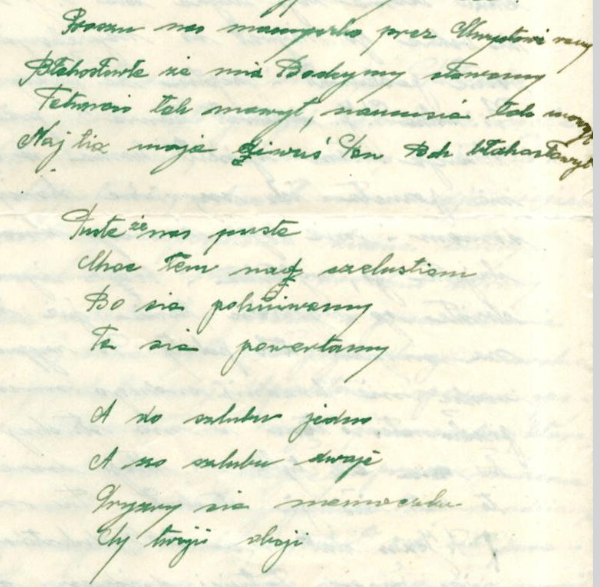
Proczne nas nieporwie przez Chrystusa rany
Błahosławte na mna Bosky my stosowny
Tatusiowi tak marzyć, mamusia tak marzy
Naj liza moja Ziusiś ten tak błogosławny
Puste i nas puste
Choć tem nad zachodem
Bo się pobliniemy
To się powitamy
A na ślubie jedno
A na ślubie dwoje
Trzymaj się nie niebój
Chey twoje stoje
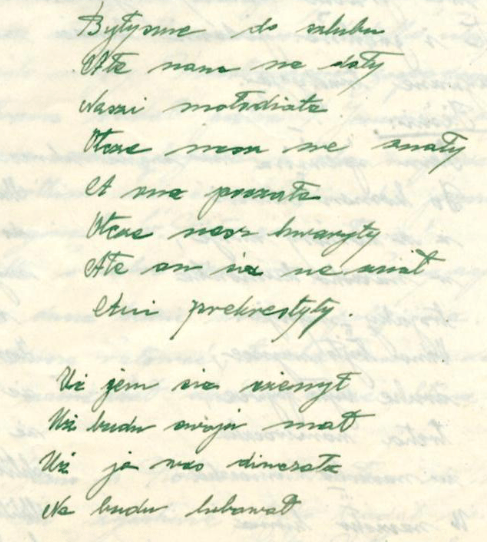
Byłyśmy do ślubu
Ote nam ne dały
Wami mołodiate
Wse mnom ne znaty
Et ma poznate
Wse nas swaryty
Ote on na ne mud
Mui prekrestyty.
Už jem se wienył
Už budu moju mať
Už ja was diewcata
Už budu lubować
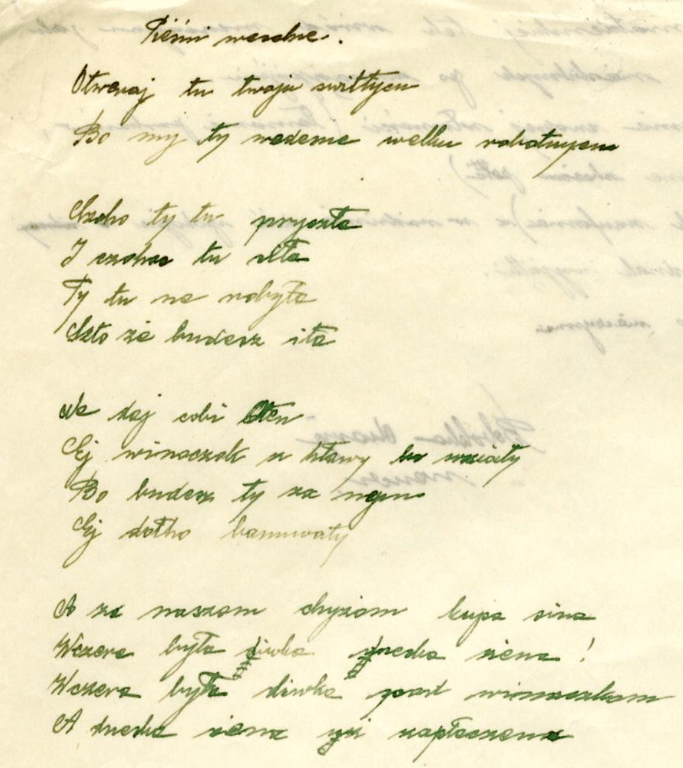
Pieśni weselne
Otweraj tu twoju swittlycu
Bo my ty wedeme welku robotnycu
Chozho ty tu pryszła
I wnosy szła
Ty tu na nobyte
Sato ze budesz iła
We daj sobi dzen
Cły winczok z hławy tu wzaty
Bo budesz ty za nym
Cły sotko łammanty
A na naskom chylom kupa sina
Wczora była diwka dzeniska sena!
Wczora była diwka pod winczokom
A dzeniska sena yż napłakana
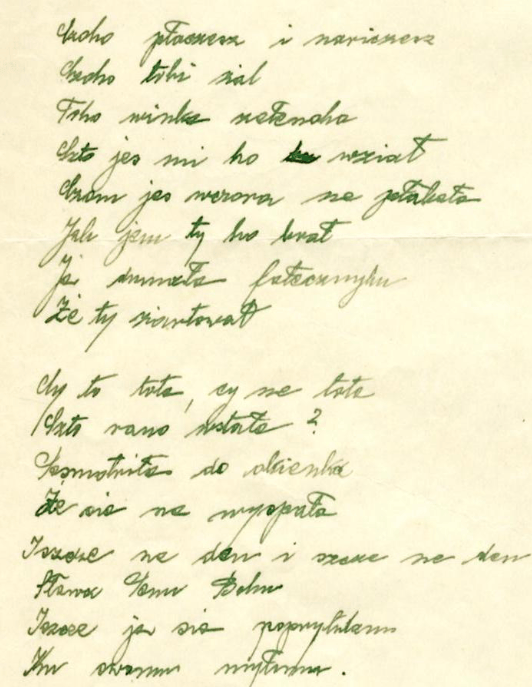
Czeho płaczesz i narzekasz
Czeho tobi żal
Toho ninka netrzeba
Chto jes mi ho wziat
Chram jes wczora ne zobaczył
Jaki jem ty ho brał
Ja umreła fsteczuszku
Że ty rówtował
Czy to toto, czy ne toto
Chto rano fstanie?
Popatrzyła do okienka
Że sie na mypysa
Jeszcze na den i jeszce na den
Sława Panu Bohu
Jeszcze ja sie popytam
Ku swomu mistru.
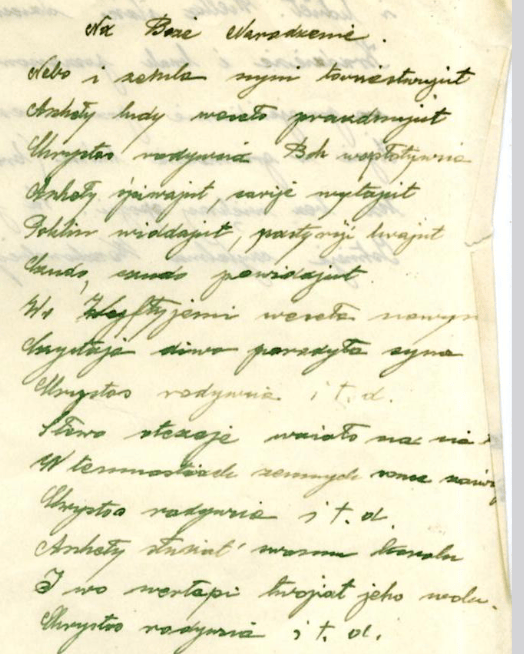
Na Boże Narodzenie.
Nebo i zemla nyni torżestwujut
Anhoły ludy weselo prazdnujut
Chrysztos rodyszsia Boh wopłotiwsia
Anhoły spiwajut, carije wytajut
Pokłon widdajut, pastyrji hrajut
Cudo, cudo powidajut.
Wo Wyfłejemi wesela nowyna
Czystaja Diwo porodyła syna
Chrysztos rodyszsia i t. d.
Słowo otczeje wziało nas na sia [ ]
W temnostach zemnych sonce naw [ ]
Chrysztos rodyszsia i t. d.
Anhoły łetiat’ weselo spiwaju…
I wo wertepi trojat’ jeho wolu.
Chrysztos rodyszsia i t. d.
Na Wielkanoc
Sołunko najswiatyjsze
Woskresnie na rane jsnii!
Twojeje powostawlajmo;
Win bo i z mertwych woskres
Chrystos woskres iz mertwych
smertiju smert’ popraw
I onym u hrobach – żywot darnwow.
English Translation: Google-Powered
Warning: this translation may be terrible. It was done electronically by someone who can speak neither Polish nor Ukrainian/Lemko. Do you wish to see it improve? You can help! Contact us.
Uwaga: to tłumaczenie może być fatalne. Zostało wykonane automatycznie przez osobę, która nie zna ani języka polskiego, ani ukraińskiego/łemkowskiego. Chcesz, żeby było lepsze? Możesz pomóc! Skontaktuj się z nami.
6). Spiritual culture. It is believed that elderly people—whose souls do not age after death—can turn into specters that torment the members of their household. To prevent this, immediately after the funeral, poppy seeds are scattered around the grave; the deceased is compelled to gather them all, a task so time-consuming that they cannot finish before dawn. In the case of a child, to prevent them from returning as a restless spirit after death, a small piece of skin is cut from their hand, or a nail is driven into their coffin. There is also a belief in places haunted by the devil, who misleads people by taking the form of an animal—most commonly a goat (such places include wells or the boundaries between fields). Various tales circulate about these locations, ranging from mildly unsettling to truly frightening, depending on the storyteller’s imagination. Thursday is considered a day associated with such terrors. People also believe in witches who can steal milk from cows and afflict humans with an ailment known locally as prystryt—characterized by intense shivering and nausea (attributed to someone having cast an “evil eye” or urok). To remedy this, one must pour the first milk onto a flatbread (ideally made of flour), consume it, and then wash one’s face, drying it specifically with the shirt one is currently wearing. For added efficacy, one might walk over burning herbs on the evening of the Feast of Our Lady of the Herbs (Assumption Day). The piety of the local people is superficial and performative, limited to religious observances that are nonetheless carried out with great scrupulousness. There is a notable lack of reverence for the “house of God” (for instance, people may sit on the floor inside the church). Participation in religious festivals (odpusty) is very high. Favorite prayer said in the morning and evening. Consider me, O God, after the greatness of Your love, and by the multiplication of Your shades, my pure heart will be broken. Most lamentably, he had my unclean wife, and he had my purity. As without my law I know; and hrich my preda multiplicity is out. Thee, the only sohrysz, and the archaeologist before Toboju, as I will give truth to your words, and you will beat all the sudits. Because I was born without marriage, and my mother had such families. Because he was married to her: the public and secret premudrosty of Youran was revealed to us. We’ll clean it and clean it, we’ll wash it and the upper slaughterhouse. Give joy and joy to my hearing, let’s hear joy and happiness. Your open mouths are mine, and my chaste village is pure. A heart of pure compassion for me, O God, and the spirit of laws will renew my life. I will not open my mind to Your world and Your Spirit, I will not open it to you. Let us be the joy of Your salvation and the strength of the ruling Spirits. Teacher of the non-convict, I have turned to You, and misfortunes have turned towards You. I had a room for a cow, God, God, save me; My tongue repents of your truth. “O Lord, open my lips, and my mouth shall declare Your praise. For if You had desired sacrifice, I would have given it; but You do not delight in burnt offerings. The sacrifice to God is a broken spirit; a broken and humble heart, O God, You will not despise. Do good, O Lord, in Your good pleasure to Zion, and let the walls of Jerusalem be built. Then You shall be pleased with the sacrifices of righteousness, with offerings and whole burnt offerings; then they shall lay young bulls upon Your altar.”
Explanation: The population treats itself using various home remedies—such as fermented grain liquid (kwas), onions, stinging nettles, or ointments—and seeks advice from a local mentor. Only in cases of severe illness do they consult doctors or folk healers. The elderly are left without care throughout the day; household members check on their condition only in the morning or evening. Regardless of the nature of the illness, the sick are fed from a bottle and given solid food—sometimes even sausage—no matter what the ailment may be. Many people use wild garlic. Graves remain visible only until March. There is no such thing as a “murderous mother.”
Fairy tales, folktales, and legends.
Once, during His time on earth, the Lord Jesus—accompanied by Peter and John—arrived at a village where they needed to cross a river, but there was no bridge. The apostles stood there, helpless and unsure of what to do. Seeing their predicament, the Lord Jesus pointed toward an approaching wagon. They understood. As it drew near, they saw four beautiful horses harnessed to a fine carriage, in which sat a well-dressed farmer. The apostles greeted him—”God grant you good fortune!”—and asked if he might take them across to the other side. But the farmer cast a contemptuous look at them and said, “I don’t take beggars like you!”—and drove on. The apostles glanced at the Lord Jesus, who then pointed toward a second wagon that was approaching. It was a wretched, rickety cart, pulled by a pair of sorry-looking nags that could barely move their legs. On the cart sat a poorly dressed farmer.
Upon learning that the Lord Jesus and the apostles wished to cross the river, he agreed to take them, though he was not at all certain his frail vehicle would make it to the other bank. The horses were so weak that they seemed ready to collapse into the water. Yet, to everyone’s surprise, not only did they manage to carry them across, but they moved with a speed and vigor they had never shown before. The mysterious host recognized the Lord Jesus himself; he fell on his face, paid homage to the Lord, and departed. Soon after, Saint Peter asked the Lord Jesus what punishment awaited the rich man and what reward awaited the poor man. He received this reply: “In a short time, the rich man will acquire four more oxen, while the poor man will lose even the two he currently possesses.” Saint Peter was astonished! The Lord Jesus continued: “The rich man cares only for temporal goods and has forgotten his soul; his wealth will grow, but his soul will be eternally condemned. As for the pious poor man, his soul must be saved; his earthly possessions must be taken away, lest he become so preoccupied with them that he neglects his soul—which, in turn, will be assured of eternal happiness.”
Continuing their journey across the earth, the Lord Jesus, accompanied by Peter and Paul, arrived at the home of a thief to spend the night. The thief and his wife welcomed them kindly, though he lamented that he could not properly host them, as he had nothing to offer. The Lord Jesus then instructed Saint Peter to empty all the money from his pockets. It turned out there was so much that it could not all fit on the table. Saint Peter, together with the Lord Jesus, counted the money and tucked it back into his pockets, while handing a handful to the host so that he might purchase some food.
The thief soon returned with drinks and provided what hospitality he could, though it was meager. During the meal, the Lord Jesus learned from the thief that he lived solely by what he stole—and that when his efforts failed, he and his family were forced to go hungry. During the night, a wife urged her husband to murder some travelers and rob them. The husband intended to carry this out; however, the Lord Jesus, perceiving their thoughts, cast a deep sleep upon them and continued on His way with the apostles. They had traveled perhaps 290 meters when the thief came rushing after them, brandishing a whip. It was his wife who had goaded him to catch up and commit the crime, threatening to leave him if he failed to follow her orders. The Lord Jesus instructed Saint Peter to touch the man’s legs with a one-year-old hazel switch, and the thief was instantly transformed into a horse. The apostles, astonished, waited to see what would happen next. The Lord Jesus then told Saint Peter to mount the creature and ride. Saint Peter hesitated—the horse was small, and, after all, it was a human being—but, as the Lord Jesus had commanded it, he had no choice. Saint Peter climbed on; the poor creature struggled, sweating profusely, yet it carried him forward. Upon reaching a forest, they encountered a farmer lamenting because his wagon had become mired in a quagmire—a treacherous bog—from which four horses could not pull it free. The Lord Jesus directed Saint Peter to bring forward his “horse,” which immediately hauled the wagon out. The farmer wished to purchase the animal, but the Lord Jesus only lent it to him for one year, on the conditions that it be used for the heaviest loads, fed nothing but straw and water, never shod with horseshoes, and that the farmer pay one ducat for every night of its use. Having received the horse and the money, the man set off for home. Upon arriving, he tethered the horse in the cabbage patch and went into his hut. His wife immediately began complaining bitterly about her lot in life—how she had to toil just to have something to eat, while he offered no help at all. As for the horse left in the cabbage patch—well, one might imagine it would be safe, as if locked in a stable! But when the man went to check on it, following the Lord Jesus’s advice, the horse was gone, and he himself was left badly beaten. After the whole matter was explained, the Lord Jesus said: “Old man, do not steal what belongs to others, for it has been earned through hard labor. And above all, remember this: do not listen to any woman—especially when the fault is your own—for nothing good will come of it! The misfortunes you have suffered at the hands of your own wife have only made your life more difficult. Here is the money you earned yourself”—the Lord Jesus gave him the 365 ducats he had received for the horse—”and know that you will attain wealth more easily through honest work than through theft!” These and similar tales have circulated among the local people for generations, passed down through tradition.
Songs
Song Sung During a Christening
I.
Into the pantry there is one door,
And out of the pantry, two;
At our godfather’s house,
There are three kinds of drinks.
II.
One was wine,
The second was beer,
The third was a little pitcher [of liquor]
At our godfather’s house.
III.
At our godfather’s house,
There is a brick-lined well;
There is no water in it—
It is all wine.
IV.
Even if [the singing/drinking] stretches
To the very end,
We will not let it go
Until it finishes on its own.
V.
It is clear, O God, it is clear
That our godfather is wealthy,
Because his little table
Is dressed with bread.
VI.
Dressed with bread,
Poured over with spirits;
It is clear, O God, it is clear
That our godfather is wealthy.
VII.
Behind the stone wall
There is great strength;
As we have christened [the child],
Grant, O God, a wedding [in the future].
Wedding Songs (Part 1)
Gather round for us, all creatures,
Bring together periwinkles for us
For this little wreath;
Let our little wreath come together
Like a bright red apple,
From one merrymaker to another,
Let it go in harmony…
We ask, mother, to weave the wreaths,
We ask to bless them!
And her dear mother speaks thus:
“May the Lord bless you, my child.”
Oh my wreath, my wreath,
My green wreath,
Things will never be for me again
As they were before.
For before, it was
Very good for me—
From my dear mother
I did not have to leave.
I did not have to walk [away],
[Only] to gather herbs,
Always loving a lad
With black eyes.
“Oh, beloved sweetheart!
Why do you not come to us?
Are you afraid of my mother,
Or do you not care for me?”
“I am not afraid of your mother,
And I do care for you!
Only I am afraid of getting caught
By evil tongues!
For those tongues
Are worse than swords!
Swords will cut,
And blood will not flow [as painfully as gossip wounds].”
Stay with us, guests,
Or open the door for us,
For if we pass by,
We will turn back.
We are all hungry,
We eat modestly,
So now give us
The wreath-ribbons.
We will not eat, we will not drink,
Until you give each of us a ribbon.
We invite the dear mother to us:
Receive gifts from us,
For our wedding bread is being cut,
Bringing joy to the whole wedding.
Oh, the dear mother is not at home,
For she went to Kraków
To buy little ribbons
And arrange the match for the bride.
Oh, she is at home, she is at home,
She stands there in the doorway,
She stands there in the doorway,
Drinking tea [or soup].
Play, musicians, softly;
Bow deeply, Olena,
To your father and your mother,
And to your whole family.
Ask [blessing] for us through Christ’s wounds,
Bless us, O God, as is fitting;
So the father wishes, so the mother wishes:
“May my child be blessed.”
Let us go, let us go,
Though it is toward sunset;
For if we lose our way,
We will greet each other again.
At the wedding there is one,
At the wedding there are two;
Hold on, do not be afraid,
Let your side stand firm.
We went to the wedding,
They did not give us [drink/entry];
With you, young people,
We will not always be acquainted,
Yet once we know each other,
You always scold us—
Even though he will not
Cross himself [or change his ways].
I have already married,
I will already have my own [wife];
Now, you maidens,
I will no longer court you.
Wedding Songs (Part 2)
Open up your bright parlor,
For we are bringing you a great worker.
Why did you come here
And walk in at night?
You are not here to be beaten,
Yet you will have to work.
Do not let yourself this day
Have the wreath taken from your head here,
For you will weep for it
Your whole life long.
And on our hill there is a pile of hay;
Yesterday she was a maiden, today a wife!
Yesterday she was a maiden under a wreath,
And today she is a wife, already tear-stained.
“Why do you weep and lament?
What do you regret?
This wreath is no longer needed—
Someone has taken it from me.”
“Did you not see yesterday
How I took it from you?
I tied on a kerchief
That suits you well.”
Is it this one, or is it not this one,
Who rises early in the morning?
She looked out the little window
To see if she had washed up.
Another day, and yet another day—
Glory to the Lord God!
Still I will ask
My master [husband].
For Christmas
Heaven and earth today triumph,
Angels and people joyfully celebrate:
Christ is born, God is incarnate!
Angels sing, kings greet Him,
They pay homage, shepherds play,
“A miracle, a miracle!” they proclaim.
In Bethlehem there is joyful news:
The Pure Virgin has given birth to a Son.
Christ is born, etc.
The Word of the Father took upon Himself [our flesh],
In earthly darkness the Sun [shone] upon us.
Christ is born, etc.
Angels fly, joyfully singing,
And in the cave they praise His will.
Christ is born, etc.
For Easter
O Most Holy Sun,
Rise upon us on this bright morning!
Let us glorify Your [Resurrection];
For He is risen from the dead:
Christ is risen from the dead,
Trampling down death by death,
And upon those in the tombs bestowing life.
Sanok Genes seeks to create a database of transcripts and English translations from the “Kultura Duchowa” sections from the 1936 Sanok School Inspectorate Questionnaires. The original documents are held by the Sanok Museum of History and digitized by the Sanok Digital Library. To learn more, see the project description.
Sanok Genes stawia sobie za cel stworzenie bazy danych zawierającej transkrypcje oraz tłumaczenia na język angielski fragmentów dotyczących „kultury duchowej”, pochodzących z kwestionariuszy Inspektoratu Szkolnego w Sanoku z 1936 roku. Oryginalne dokumenty znajdują się w zbiorach Muzeum Historycznego w Sanoku i zostały zdigitalizowane przez Sanocką Bibliotekę Cyfrową. Więcej informacji można znaleźć w opisie projektu.

