Jasiel is a village in Komańcza Commune, Sanok County.
Jasiel to wieś w gminie Komańcza, w powiecie sanockim.

Transcript: Google-Powered
Warning: this transcription may be terrible. It was done electronically by someone who can speak neither Polish nor Ukrainian/Lemko. Do you wish to see it improve? You can help! Contact us.
Uwaga: ta transkrypcja może być fatalna. Została wykonana automatycznie przez osobę, która nie zna ani języka polskiego, ani ukraińskiego/łemkowskiego. Chcesz, żeby była lepsza? Możesz pomóc! Skontaktuj się z nami.
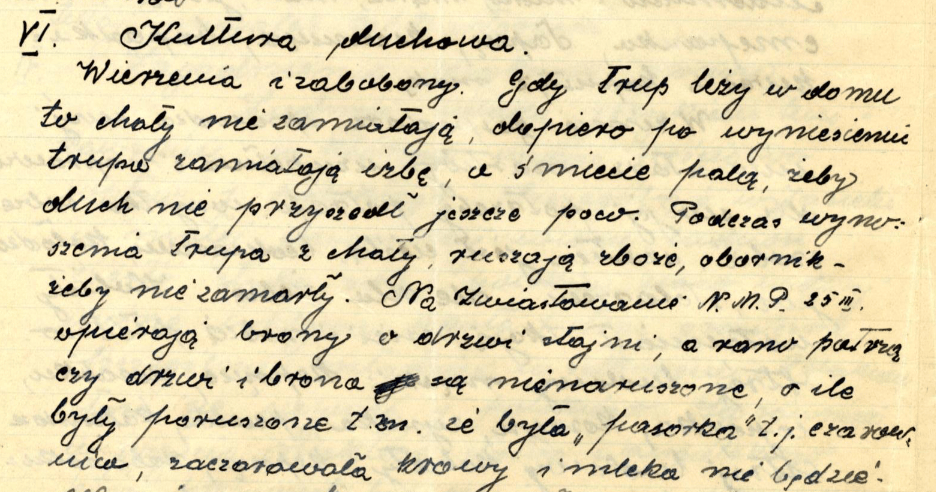
VI. Kultura duchowa.
Wierzenia i zabobony. Gdy trup leży w domu to chaty nie zamiatają, dopiero po wyniesieniu trupa zamiatają izbę, a śmiecie palą, żeby duch nie przyszedł jeszcze poco. Podczas wynoszenia trupa z chaty ruszają zboże, obornik – żeby nie zamarły. Na Zwiastowanie N.M.P. 25/III opierają brony o drzwi stajni, a rano patrzą czy drzwi i brona są nienaruszone, o ile były poruszone t.zn. że była „prasorka” t.j. czarownica, zaczarowała krowy i mleka nie będzie.
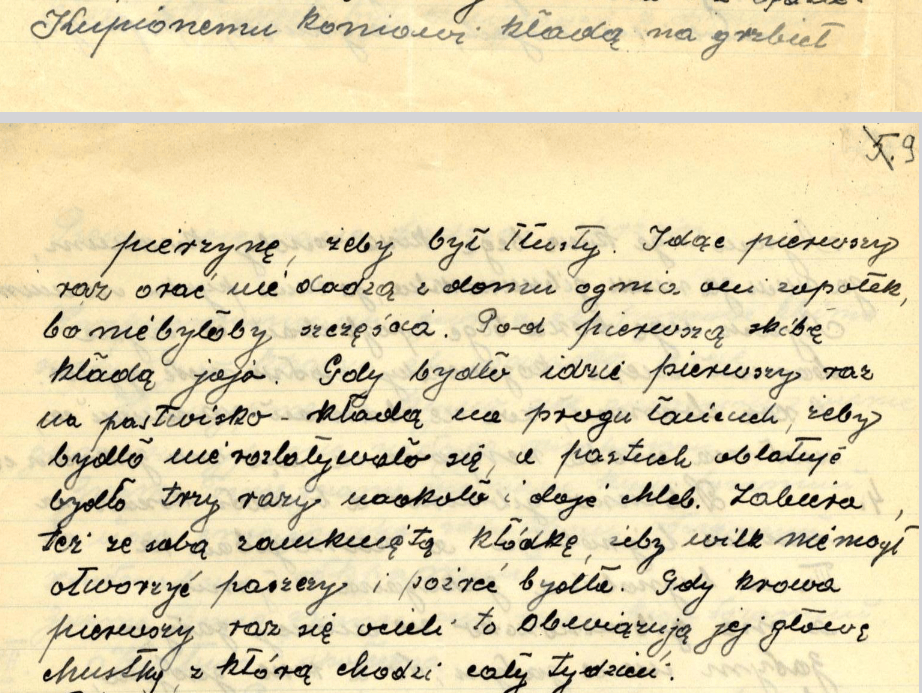
Kupionemu koniowi kładą na grzbiet pierzynę, żeby był tłusty. Idąc pierwszy raz orać nie dadzą z domu ognia ani zapałek,bo nie byłoby szczęścia. Pod pierwszą skibę kładą jaja. Gdy bydło idzie pierwszy raz na pastwisko – kładą na progu łańcuch, żeby bydło nie rozlatywało się, a pasterz oblatuje bydło trzy razy naokoło i daje chleb. Zabiera też ze sobą zamkniętą kłódkę, żeby wilk nie mógł otworzyć paszczy i pożreć bydła. Gdy krowa pierwszy raz się ocieli to obwiązują jej głowę chustką z którą chodzi cały tydzień.
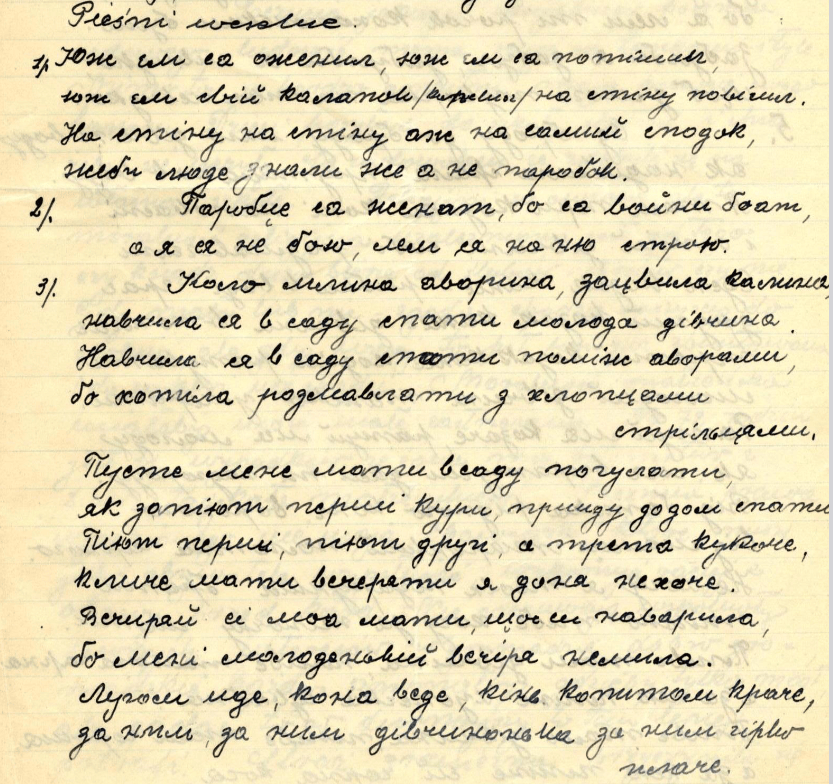
Pieśni weselne.
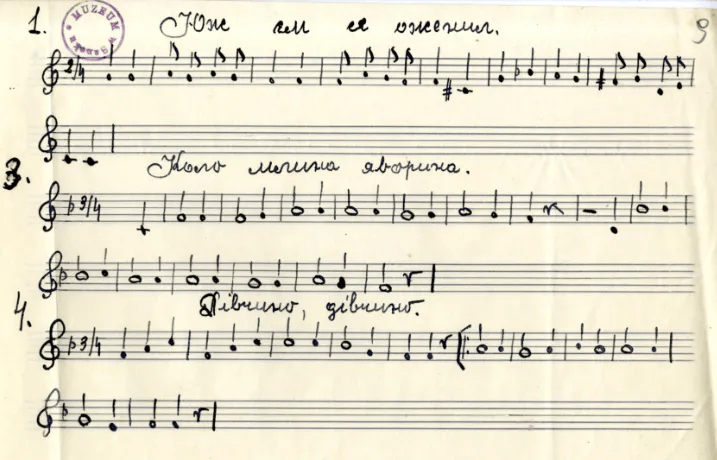
1). Юж єм ся оженив, юж єм ся потішив,
юж єм свій калапок /крепиц/ на стіну повісив.
На стіну, на стіну аж на самий сподок,
жеби люде знали, же я не паробок.
2). Паробци ся женат, бо ся воїни боят,
а я ся не бою, лиш ся на ню строю.
3). Коло млина яворина, зацвіла калина,
навчила ся в саду спати молода дівчина.
Навчила ся в саду спати поміж яворами,
бо хотіла розмавляти з хлопцями стрільцями.
Пусти мене, мати, в саду погуляти,
як запіють перші кури, прийду додом спати.
Піють перші, піють другі, а треті кукоче,
кличе мати вечеряти, а доня не хоче.
Вечерай си, моя мати, що єси наварила,
бо мені, молодонькій, вечеря немила.
Тіло си йде, коня веде, кінь копитом креше,
за ним, за ним дівчинонька, за ним гірко плаче.
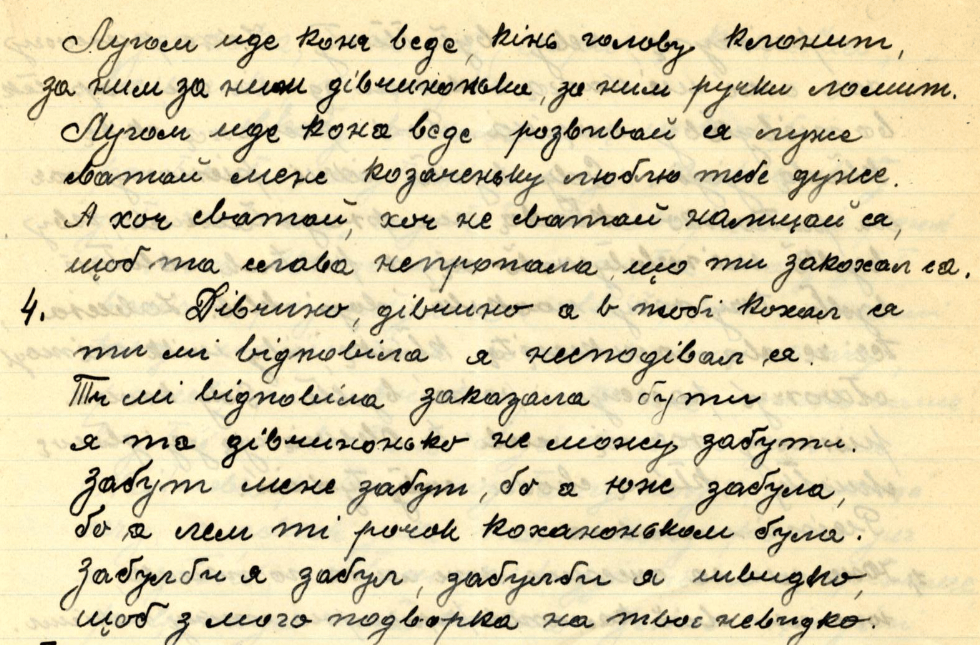
Лугом иде коня веде кінь голову клонит,
за ним за ним дівчинонька за ним ручки ломит.
Лугом иде коня веде розвивайся луже
сватай мене козаченьку люблю тебе дуже.
А хоч сватай, хоч не сватай напишайся,
щоб та слава непропала що ти закохався.
4). Дівчино, дівчино а я в тобі кохался
ти ми відповіла я несподівався.
Ти ми відповіла заказала бути
я та дівчинонько не можу забути.
Забут мене забут, бо я вже забула,
бо я лем ті рочок коханоньком була.
Забув би я забув, забув би я швидко,
щоб з мого подворка на твоє невидко.
- Од броду до броду йшла дівча по воду
як надійшла хвиля трутила ж в воду.
А там три козаки коні наповаєм
і о тій дівчині собі розмавляєм.
Оден козак каже – рибка в воді грає
другий козак каже – дівчина втопляє
третій козак каже ходім рятувати
молодій дівчині тяжко умирати.
Рятуй мя козаче, рятуй мя молоду,
як мя вирятуєш дам ти надгороду.
Від батька рідного коня вороного
від мамці стареньки полотна гарного.
Не хочу я твоїх подарунків брати
тілько тебе хочу за жіночку мати.
Пливе там дівчина, пливе там та гарна
а за нею пливе хустечка єдвабна
Пливе там дівчина, пливе там хороша
а за нею пливе ей чорна коса.
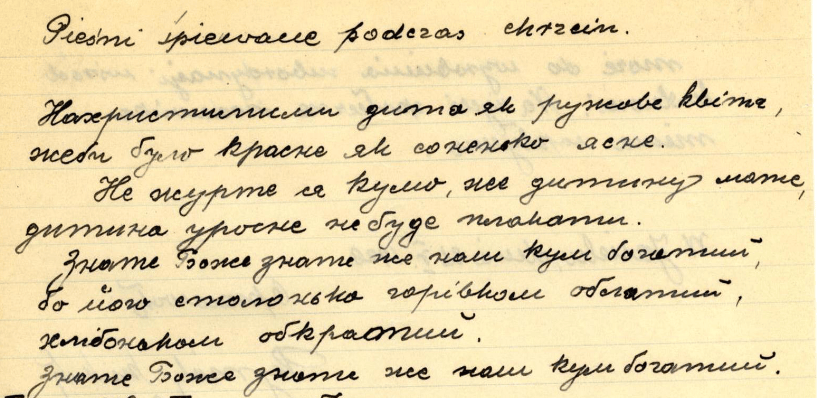
Pieśni śpiewane podczas chrzcin.
Нахрестилими дитя як ружове квіте,
жеби було красне як сонечко ясне.
Не журте ся кумо, же дитину мате,
дитина уросне не буде плакати.
Знате Боже знате же нам кум богатий,
бо його столонько горілком обогатий,
хлібоньком обкрасний.
Знате Боже знате же нам кум богатий.
English Translation: Google-Powered
Warning: this translation may be terrible. It was done electronically by someone who can speak neither Polish nor Ukrainian/Lemko. Do you wish to see it improve? You can help! Contact us.
Uwaga: to tłumaczenie może być fatalne. Zostało wykonane automatycznie przez osobę, która nie zna ani języka polskiego, ani ukraińskiego/łemkowskiego. Chcesz, żeby było lepsze? Możesz pomóc! Skontaktuj się z nami.
VI. Spiritual Culture.
Beliefs and superstitions. When a dead body lies in a house, the dwelling is not swept; only after the body has been removed is the room swept, and the sweepings are burned—to prevent the spirit from returning for any reason. As the body is carried out of the house, the grain and the manure are stirred, so that they do not “die” (lose their vitality). On the Feast of the Annunciation of the Blessed Virgin Mary (March 25th), harrows are leaned against the stable doors; in the morning, it is checked whether the doors or the harrows have been moved—if they have, it means a prasorka (a witch) has been there, has cast a spell on the cows, and there will be no milk.
A featherbed is placed on the back of a newly purchased horse to ensure it stays plump. When heading out to plow for the first time, no fire or matches are allowed to be taken from the house, lest it bring bad luck. Eggs are placed under the first furrow. When cattle are driven to pasture for the first time, a chain is laid across the threshold to keep the herd from scattering; the herdsman circles the cattle three times and offers them bread. He also carries a locked padlock, intended to keep the wolf’s jaws shut so it cannot devour the livestock. When a cow calves for the first time, a kerchief is tied around its head, which it wears for an entire week.
Wedding songs.
1). I have already married, I have already had my fun,
I have hung my bachelor’s hat upon the wall.
Upon the wall, right at the very bottom,
So that people know I am no longer a bachelor.
2). Bachelors get married because they fear the soldiers,
But I have no such fear—I am simply getting ready for her.
3). By the mill stands a sycamore, the guelder-rose has bloomed,
A young maiden has taken to sleeping in the garden.
She has taken to sleeping in the garden among the sycamores,
For she wished to converse with the young riflemen.
“Let me go, Mother, to stroll in the garden;
When the first roosters crow, I shall return home to sleep.”
The first crow, the second crow, and the third calls out,
Mother calls her to supper, but the daughter refuses.
“Eat the supper yourself, Mother—whatever you have cooked—
For to me, a young girl, this meal holds no appeal.”
A man walks by, leading his horse; the horse strikes sparks with its hooves,
And behind him, the maiden follows, weeping bitterly.
He walks through the meadow, leading his horse—the horse bows its head—
And behind him, the maiden follows, wringing her hands.
He walks through the meadow, leading his horse—”Bloom forth, O meadow!”—
“Ask for my hand, young Cossack; I love you dearly.”
“Whether you ask for my hand or not, make it known to all,
So that the word does not fade away—the word that you have fallen in love.”
4). Maiden, O maiden—I fell in love with you,
And you answered me—a surprise I did not expect. You told me to be yours,
but, my dear girl, I cannot forget.
“Forget me, forget me—for I have already forgotten;
I was your sweetheart for only a single year.”
I would forget, I would forget—I would forget quickly,
if only your courtyard couldn’t be seen from mine.
- From ford to ford, a girl went to fetch water;
a wave came along and pushed her into the stream.
And there, three Cossacks were watering their horses,
talking among themselves about this girl.
One Cossack says, “A fish is playing in the water.”
The second Cossack says, “A girl is drowning.”
The third Cossack says, “Let’s go and save her;
it is a hard death for a young girl to die.”
“Save me, Cossack, save me while I am still young;
if you save me, I shall give you a reward.”
“From my own father, a raven-black horse;
from my dear old mother, fine linen cloth.”
“I do not wish to take your gifts;
I only wish to have you as my wife.”
The girl drifts along—the beautiful girl drifts along—
and behind her drifts a silk kerchief.
The girl drifts along—the lovely girl drifts along—
and behind her drifts her long, black braid.
Songs sung during a christening.
They have christened the child, who blooms like a rose,
may she be as radiant as the bright sun.
Do not worry, kuma [godmother], that you have a child;
the child will grow up and will not cry.
God knows—yes, He knows—that our kum [godfather] is a wealthy man,
for his table is rich with horilka [spirits],
and adorned with fine bread. God knows, our best man is rich.
Sanok Genes seeks to create a database of transcripts and English translations from the “Kultura Duchowa” sections from the 1936 Sanok School Inspectorate Questionnaires. The original documents are held by the Sanok Museum of History and digitized by the Sanok Digital Library. To learn more, see the project description.
Sanok Genes stawia sobie za cel stworzenie bazy danych zawierającej transkrypcje oraz tłumaczenia na język angielski fragmentów dotyczących „kultury duchowej”, pochodzących z kwestionariuszy Inspektoratu Szkolnego w Sanoku z 1936 roku. Oryginalne dokumenty znajdują się w zbiorach Muzeum Historycznego w Sanoku i zostały zdigitalizowane przez Sanocką Bibliotekę Cyfrową. Więcej informacji można znaleźć w opisie projektu.

