Serednie Małe is a village in Czarna Góra Commune, Bieszczady County.
Serednie Małe to wieś w gminie Czarna Góra, w powiecie bieszczadzkim.
Transcript: Google-Powered
Warning: this transcription may be terrible. It was done electronically by someone who can speak neither Polish nor Ukrainian/Lemko. Do you wish to see it improve? You can help! Contact us.
Uwaga: ta transkrypcja może być fatalna. Została wykonana automatycznie przez osobę, która nie zna ani języka polskiego, ani ukraińskiego/łemkowskiego. Chcesz, żeby była lepsza? Możesz pomóc! Skontaktuj się z nami.
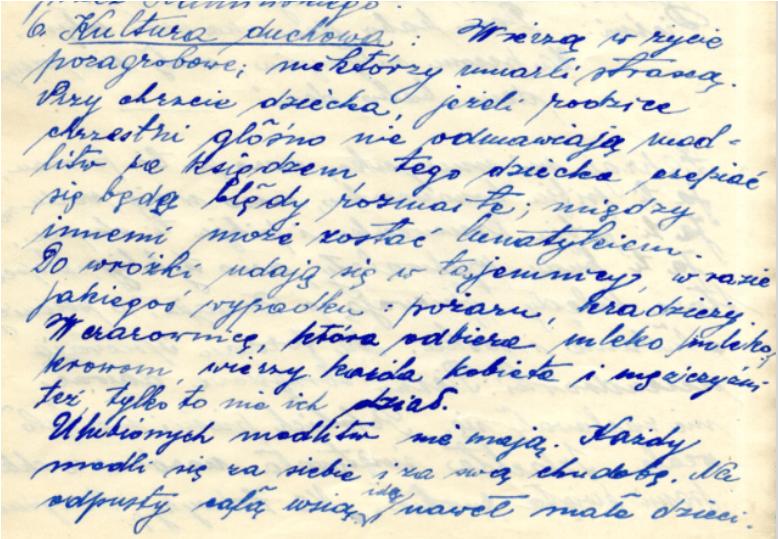
6. Kultura duchowa:
Wierzą w życie pozagrobowe; niektórzy umarli straszą. Przy chrzcie dziecka, jeżeli rodzice chrzestni głośno nie odmawiają modlitw po Księdzu, tego dziecka przepić się będą błędy rozmaite; między innemi może zostać lunatykiem. Do wróżki udają się w tajemnicy, w razie jakiegoś wypadku: pożaru, kradzieży. W czarownicę, która odbiera mleko krowom, wierzy każda kobieta i mężczyźni też tylko to nie ich dział. Ulubionych modlitw nie mają. Każdy modli się za siebie i za swą chudobę. Na odpusty dążą, idą nawet małe dzieci.
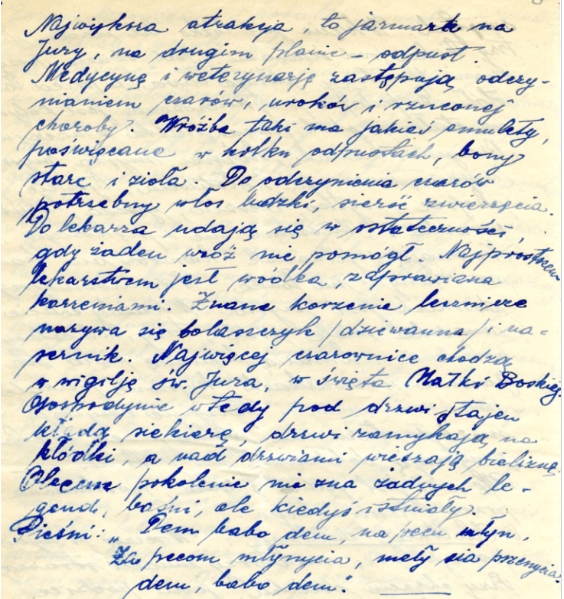
Największa atrakcja, to jarmark na Jury, na drugim planie – odpust.
Medycynę i weterynarję zastępują odczynianiem czarów, uroków i “rzuconej” choroby. Wróżba ptaki ma jakieś amulety, poświęcane w kółko odpustach, bomy, starc i zioła. Do odczynienia czarów potrzebny włos ludzki, sierść zwierzęcia.
Do lekarza udają się w ostateczności, gdy żaden wróż nie pomógł. Najprostszem lekarstwem jest wódka, zaprawiona korzeniami. Znane korzenie Jeremiere nazywa się bolasyk /dziwanna/ i naperstnik. Najwięcej czarownice chodzą w wigilję św. Jura, w święto Matki Boskiej.
Gospodynie wtedy pod drzwi stajen kładą siekierę, drzwi zamykają na kłódki, a nad drzwiami wieszają bieliznę.
Obecne pokolenie nie zna żadnych legend, baśni, ale kiedyś istniały.
Pieśni:
“Dem babo dem, na pecu młyn,
Złe pecom młynycza, meły sia przemyca,
dem, babo dem.”
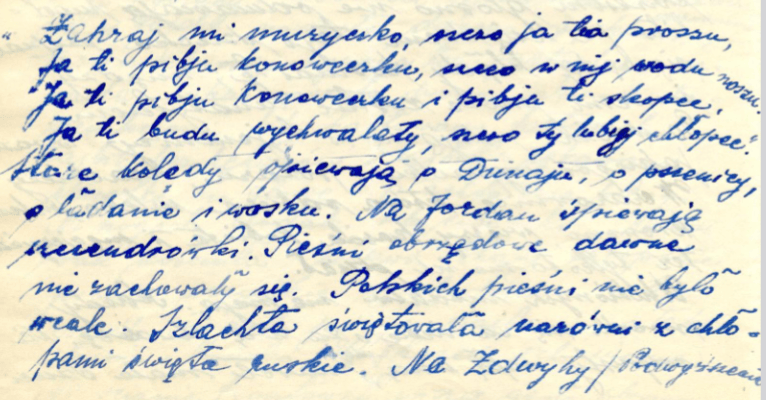
“Zahraj mi muzycko, neso ja te prosu,
Ja ti pribju konoweczku, neso w nij wodu nozu.
Ja ti pribju konoweczku i pribju ti skopce,
Ja ti budu pychwalaty, neso ty lubyj chłopce.”
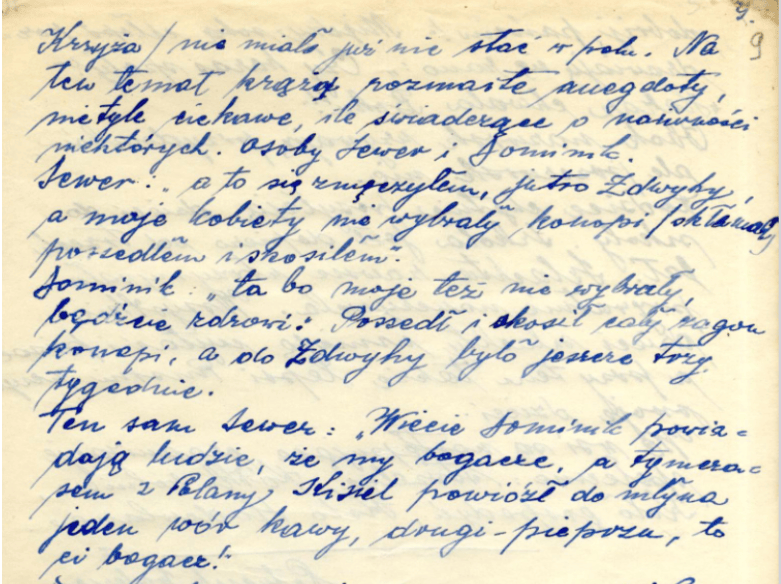
Stare kolędy śpiewają o Dunaju, o pszenicy, o ładanie i wosku. Na Jordan śpiewają szczedrowki. Pieśni obrzędowe dawne nie zachowały się. Polskich pieśni nie było wcale. Szlachta świętowała narówni z chłopami święta ruskie. Na Zdwyhy /Podwyższenie Krzyża / nie miało już nic stać w polu. Na ten temat krążą rozmaite anegdoty, nie tyle ciekawe, ile świadczące o naiwności niektórych. Osoby Sewer i Dominik.
Sewer: “a to się zmęczyłem, jutro Zdwyhy, a moje kobiety nie wybrały konopi / oktawał, poszedłem i skosiłem”.
Dominik: “ta bo moje też nie wybrały, będzie zdrowi: poszedł i skosił cały zagon konopi, a do Zdwyhy było jeszcze trzy tygodnie”.
Ten sam Sewer: “Wiecie Dominik powiadają ludzie, że my bogacze, a tymczasem z Polany Kisiel powiózł do młyna jeden wór kawy, drugi – pieprzu, to ci bogacz!”
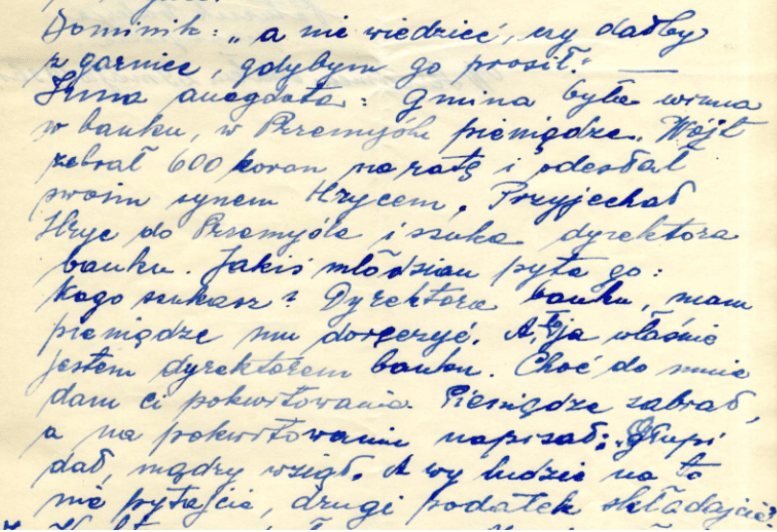
Dominik: „a nie wiedzieć, czy dałby garniec, gdybym go prosił.”
Inna anegdota: Gmina była winna w banku, w Przemyślu pieniądze. Wójt zebrał 600 koron na ratę i odesłał swoim synem Hrycem. Przyjechał Hryć do Przemyśla i szuka dyrektora banku. Jakiś młodzian pyta go: kogo szukasz? Dyrektora banku, mam pieniądze mu doręczyć. A ja właśnie jestem dyrektorem banku. Chodź do mnie dam ci pokwitowanie. Pieniądze zabrał, a na pokwitowaniu napisał: „Głupi dał, mądry wziął, a wy ludzie na to nie pytajcie, drugi podatek składajcie.”
English Translation: Google-Powered
Warning: this translation may be terrible. It was done electronically by someone who can speak neither Polish nor Ukrainian/Lemko. Do you wish to see it improve? You can help! Contact us.
Uwaga: to tłumaczenie może być fatalne. Zostało wykonane automatycznie przez osobę, która nie zna ani języka polskiego, ani ukraińskiego/łemkowskiego. Chcesz, żeby było lepsze? Możesz pomóc! Skontaktuj się z nami.
Spiritual Culture:
They believe in an afterlife; some of the dead return to haunt the living. During a child’s baptism, if the godparents do not recite the prayers aloud along with the priest, the child may become prone to various afflictions—for instance, they might grow up to be a sleepwalker. In the event of a misfortune, such as a fire or a theft, people secretly consult a fortune-teller. Everyone—women and men alike (though it is considered a woman’s domain)—believes in the existence of witches who can steal the milk from cows. They have no particular favorite prayers; each person prays for themselves and for their livestock. They frequently travel to religious festivals (indulgences/pilgrimages), even taking small children along.
The greatest attraction is the fair held on St. George’s Day, with the religious festival itself being of secondary importance.
Medical and veterinary care are often replaced by rituals intended to undo spells, hexes, or “cast” illnesses. Remedies include charms, amulets blessed repeatedly at various religious festivals, and the use of specific herbs. Breaking a spell requires a human hair or an animal’s fur.
A doctor is consulted only as a last resort, once all other healers and fortune-tellers have failed. The simplest remedy is vodka infused with roots—specifically, bolasyk (mullein) and foxglove. Witches are said to be most active on the eve of St. George’s Day and on feast days of the Mother of God.
On these occasions, housewives place an axe in front of the stable doors, lock the doors with padlocks, and hang undergarments above the doorways. The current generation knows no legends or fairy tales, yet they once existed.
Songs:
“Grind, old woman, grind—a mill on the hearth,
The millstone grinds poorly, the grain slips through,
Grind, old woman, grind.”
“Play for me, musician—I bring you millet,
I’ll bring you a small pail, carrying water inside.
I’ll bring you a small pail, and a wooden tub too,
I shall sing your praises, for you are a fine lad.”
Old Christmas carols speak of the Danube, of wheat, of ladanie (incense/resin), and of wax. For the Feast of the Jordan (Epiphany), shchedrivky (ritual songs) are sung. Ancient ritual songs have not survived. There were no Polish songs at all. The gentry celebrated Ruthenian holidays just as the peasants did. By Zdwyhy (the Exaltation of the Holy Cross), nothing was supposed to remain standing in the fields. Various anecdotes circulate on this subject—less interesting for their content than for what they reveal about the naivety of certain individuals. The characters are Sewer and Dominik.
Sewer: “I’m worn out—tomorrow is Zdwyhy, and my women haven’t finished harvesting the hemp yet, so I just went and mowed it down.”
Dominik: “Well, mine haven’t finished either—so be it!” —and he went and mowed down an entire patch of hemp, even though Zdwyhy was still three weeks away.
The same Sewer: “You know, Dominik, people say we’re rich men—but look at Kisiel from Polana; he took a whole sack of coffee to the mill, and another sack of pepper—now that’s a rich man!”
Dominik: “And who knows if he’d even spare a single potful, if I were to ask him.”
Another anecdote: The commune owed money to a bank in Przemyśl. The village head collected 600 crowns for an installment and sent his son, Hryc, to deliver it. Upon arriving in Przemyśl, Hryc began looking for the bank director. A young man asked him, “Who are you looking for?” “The bank director—I have money to deliver to him.” “Well, I happen to be the bank director. Come with me, and I’ll give you a receipt.” He took the money and wrote on the receipt: “A fool gave, a wise man took; don’t ask any questions, people—just pay another tax.”
Sanok Genes seeks to create a database of transcripts and English translations from the “Kultura Duchowa” sections from the 1936 Sanok School Inspectorate Questionnaires. The original documents are held by the Sanok Museum of History and digitized by the Sanok Digital Library. To learn more, see the project description.
Sanok Genes stawia sobie za cel stworzenie bazy danych zawierającej transkrypcje oraz tłumaczenia na język angielski fragmentów dotyczących „kultury duchowej”, pochodzących z kwestionariuszy Inspektoratu Szkolnego w Sanoku z 1936 roku. Oryginalne dokumenty znajdują się w zbiorach Muzeum Historycznego w Sanoku i zostały zdigitalizowane przez Sanocką Bibliotekę Cyfrową. Więcej informacji można znaleźć w opisie projektu.

