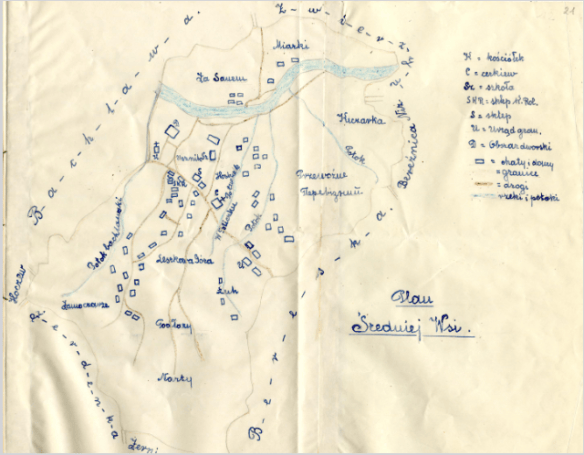
Średnia Wieś is a village in Lesko Commune, Lesko County.
Średnia Wieś– wieś w gminie Lesko, w powiecie leskim.

Transcript: Google-Powered
Warning: this transcription may be terrible. It was done electronically by someone who can speak neither Polish nor Ukrainian/Lemko. Do you wish to see it improve? You can help! Contact us.
Uwaga: ta transkrypcja może być fatalna. Została wykonana automatycznie przez osobę, która nie zna ani języka polskiego, ani ukraińskiego/łemkowskiego. Chcesz, żeby była lepsza? Możesz pomóc! Skontaktuj się z nami.
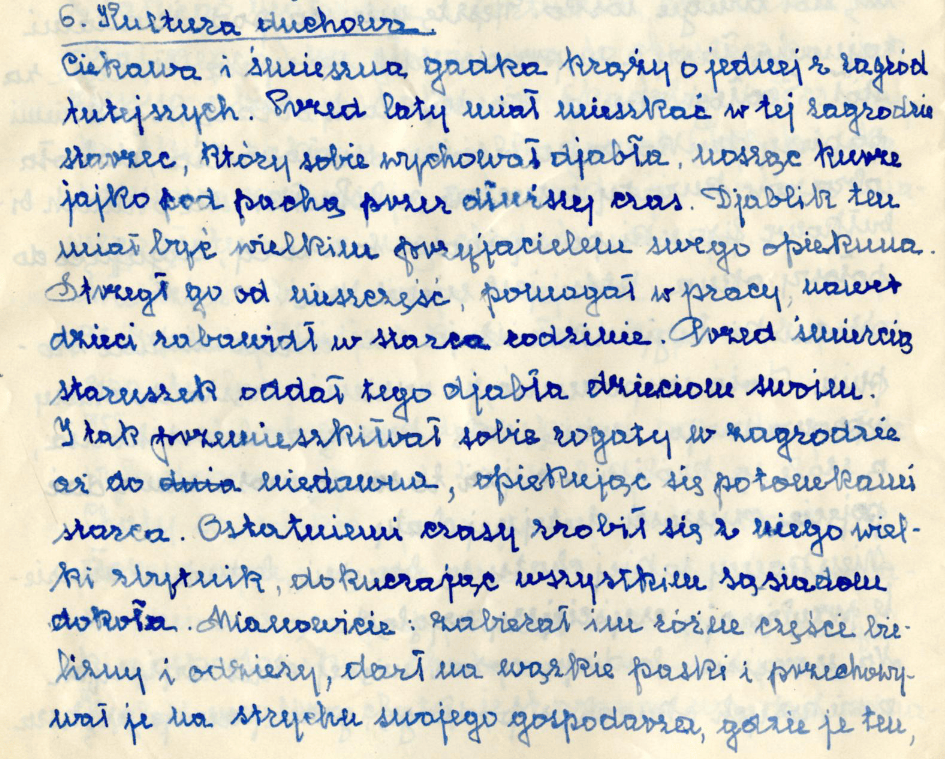
Kultura duchowa.
Ciekawa i śmieszna gadka krąży o jednej z zagród tutejszych. Przed laty miał mieszkać w tej zagrodzie starzec, który sobie wychował djabła, nosząc kurze jajko pod pachą przez dłuższy czas. Djablik ten miał być wielkim przyjacielem swego opiekuna. Strzegł go od nieszczęść, pomagał w pracy, nawet dzieci zabawiał w starca rodzinie. Przed śmiercią staruszek oddał tego djabła dzieciom swoim. I tak przemieszkiwał sobie rogaty w zagrodzie aż do dnia niedawna, opiekując się potomkami starca. Ostatniemi czasy zrobił się z niego wielki zbytnik, dokuczając wszystkim sąsiadom dokoła. Mianowicie: zabierał im różne części bielizny i odzieży, darł na wąskie paski i przechowywał je na strychu swojego gospodarza, gdzie je ten, rzekomo miał widzieć. Sprzykrzyło się to wreszcie gospodarzowi, bo go sąsiedzi zaczęli podejrzewać o kradzież; rozgłosił więc że chce się djabła pozbyć i chętnie go sprzeda.
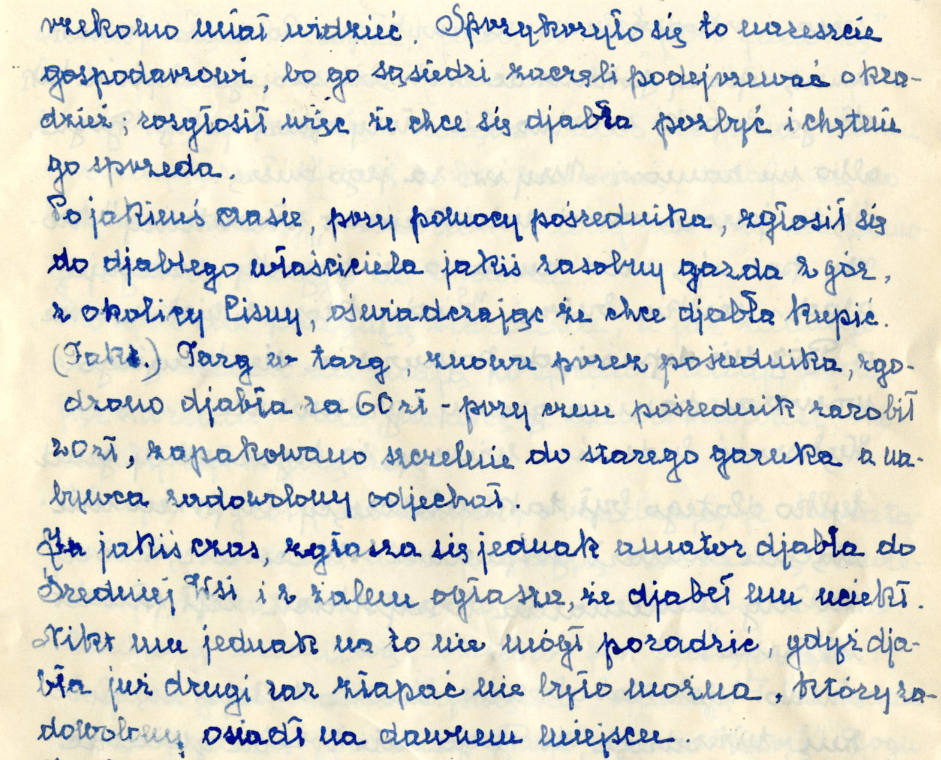
Po jakiemś czasie, przy pomocy pośrednika, zgłosił się do djablego właściciela jakiś zasobny gazda z gór, z okolicy Cisny, oświadczając że chce djabła kupić. (Fakt.) Targ w targ, znowu przez pośrednika, zgodzono djabła za 60 zł – przy czem pośrednik zarobił 20 zł, zapakowano szczelnie do starego garnka a nabywca zadowolony odjechał.
Za jakiś czas, zgłasza się jednak amator djabła do Średniej Wsi i z żalem ogłasza, że djabeł mu uciekł. Nikt mu jednak na to nie mógł poradzić, gdyż djabła już drugi raz złapać nie było można, który zadowolony osiadł na dawnem miejscu.
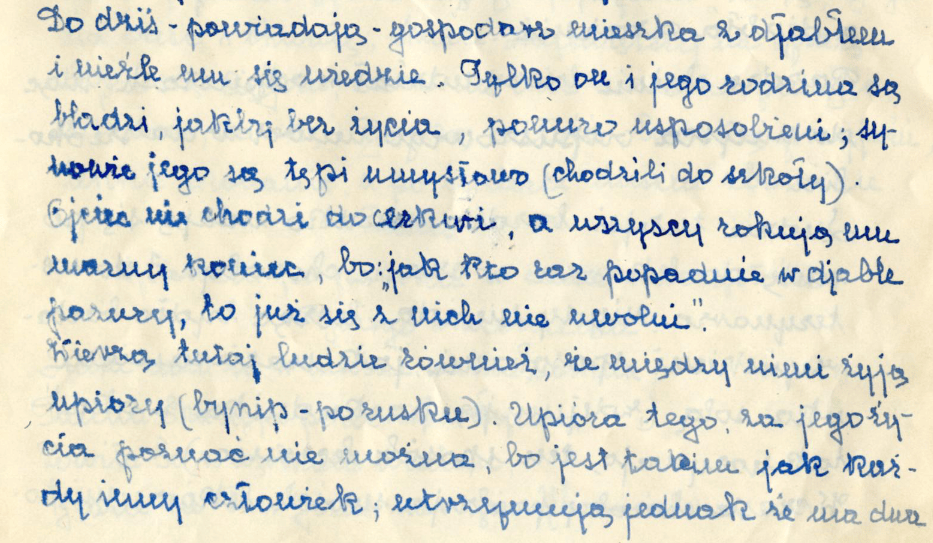
Do dziś – powiadają – gospodarz mieszka z djabłem i nieźle mu się wiedzie. Tylko on i jego rodzina są bladzi, jakby bez życia, ponuro usposobieni; synowie jego są tępi umysłowo (chodzili do szkoły). Ojciec nie chodzi do cerkwi, a wszyscy rokują mu marny koniec, bo „jak kto raz popadnie w djable pazury, to już się z nich nie uwolni”.
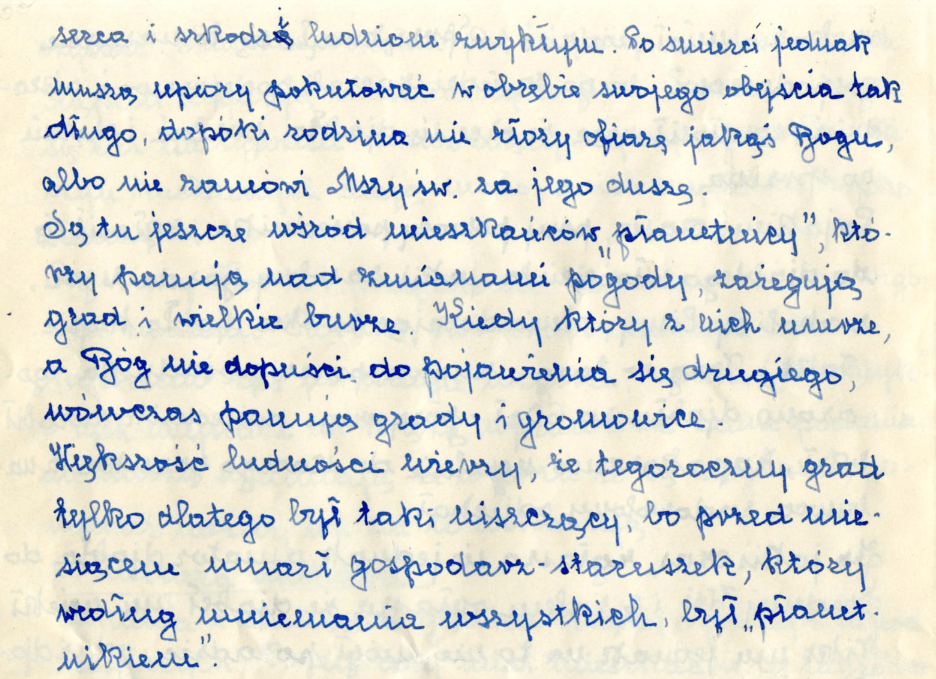
Wierzą tutaj ludzie również, że między niemi żyją upiory (вупір – po rusku). Upiora tego za jego życia poznać nie można, bo jest takim jak każdy inny człowiek; utrzymują jednak, że ma dwa serca i szkodzą ludziom żyjącym. Po śmierci jednak muszą upiory pokutować w obrębie swojego obejścia tak długo, dopóki rodzina nie złoży ofiary jakiejś Bogu, albo nie zamówi Mszy św. za jego duszę.
Są tu jeszcze wśród mieszkańców „płanetnicy”, którzy panują nad zmianami pogody, zarekwiują grad i wielkie burze. Kiedy który z nich umrze, a Bóg nie dopuści do pojawienia się drugiego, wówczas panują grady i gromowice.
Większość ludności wierzy, że tegoroczny grad tylko dlatego był taki niszczący, bo przed miesiącem umarł gospodarz-staruszek, który według mniemania wszystkich, był „płanetnikiem”.
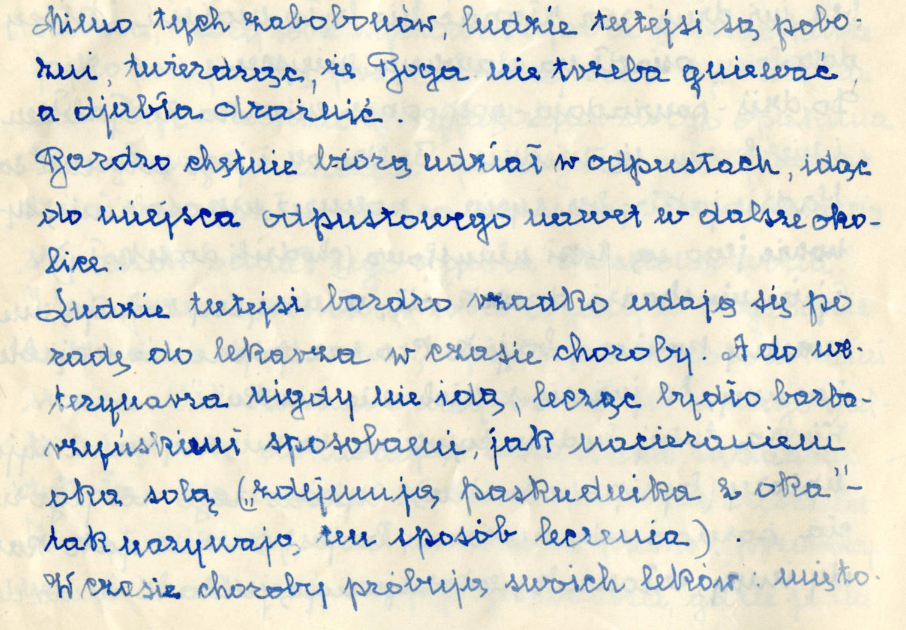
Mimo tych zabobonów, ludzie tutejsi są pobożni, twierdząc, że Boga nie trzeba gniewać, a diabła drażnić.
Bardzo chętnie biorą udział w odpustach, idąc do miejsca odpustowego nawet w dalsze okolice.
Ludzie tutejsi bardzo rzadko udają się po radę do lekarza w czasie choroby. A do weterynarza nigdy nie idą, lecząc bydło barbarzyńskiemi sposobami, jak nacieraniem oka solą (“zdejmują paskudnika z oka” – tak nazywają ten sposób leczenia).
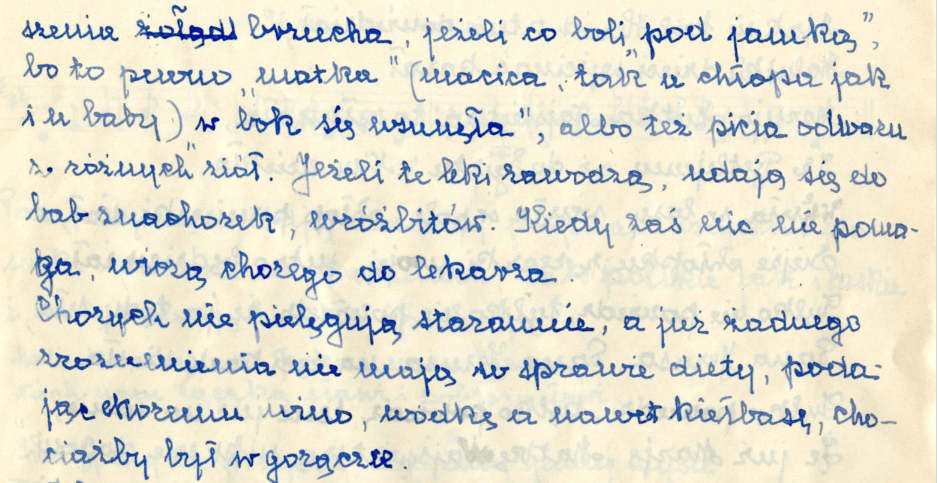
W czasie choroby próbują swoich leków: miasto szanie żołądka brzucha, jeżeli co boli pod jamką”, bo to pewno „matka” (macica, tak u chłopa jak i u baby) w bok się usunęła”, albo też picia odwaru z różnych ziół. Jeżeli te leki zawodzą, udają się do bab znachorek, wróżbitów. Kiedy zaś nic nie pomaga, wiozą chorego do lekarza.
Chorych nie pielęgnują starannie, a już żadnego zrozumienia nie mają w sprawie diety, podając choremu wino, wódkę a nawet kiełbasę, chociażby był w gorączce.
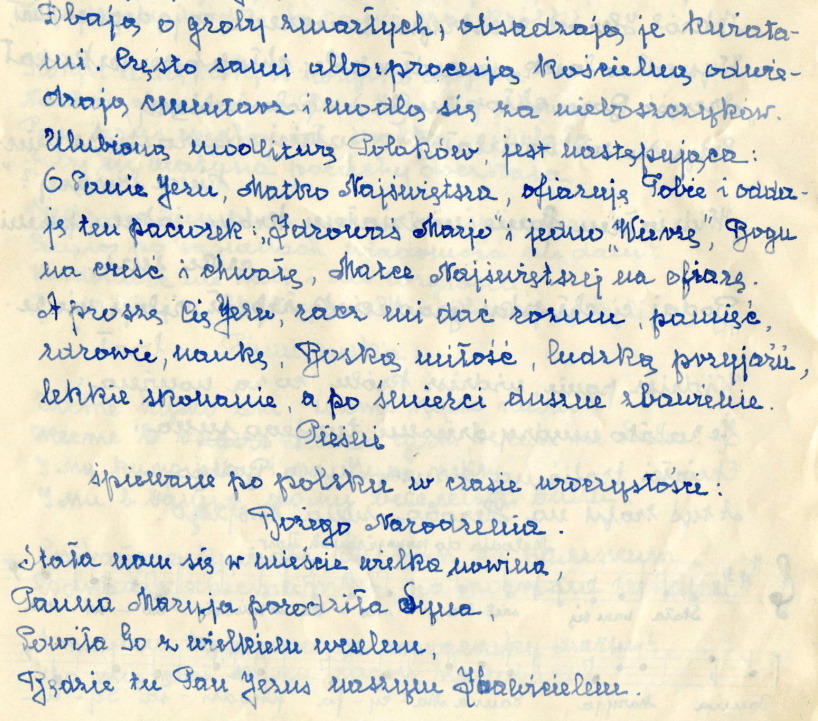
Dbają o groby zmarłych, obsadzają je kwiatami. Często sami albo procesją kościelną odwiedzają cmentarz i modlą się za nieboszczyków. Ulubioną modlitwą Polaków jest następująca:
O Panie Jezu, Matko Najświętsza, ofiaruję Tobie i oddaję ten paciorek „Zdrowaś Maryjo” i jedno „Wierzę”, Bogu na cześć i chwałę, Matce Najświętszej na ofiarę. A proszę Cię Jezu, racz mi dać rozum, pamięć, zdrowie, naukę, Boską miłość, ludzką przyjaźń, lekkie skonanie, a po śmierci duszy zbawienie.
Pieśń
śpiewana po polsku w czasie uroczystości:
Bożego Narodzenia.
Stała nam się w mieście wielka nowina,
Panna Maryja porodziła Syna,
Powiła Go z wielkiem weselem,
Będzie tu Pan Jezus naszym Zbawicielem.
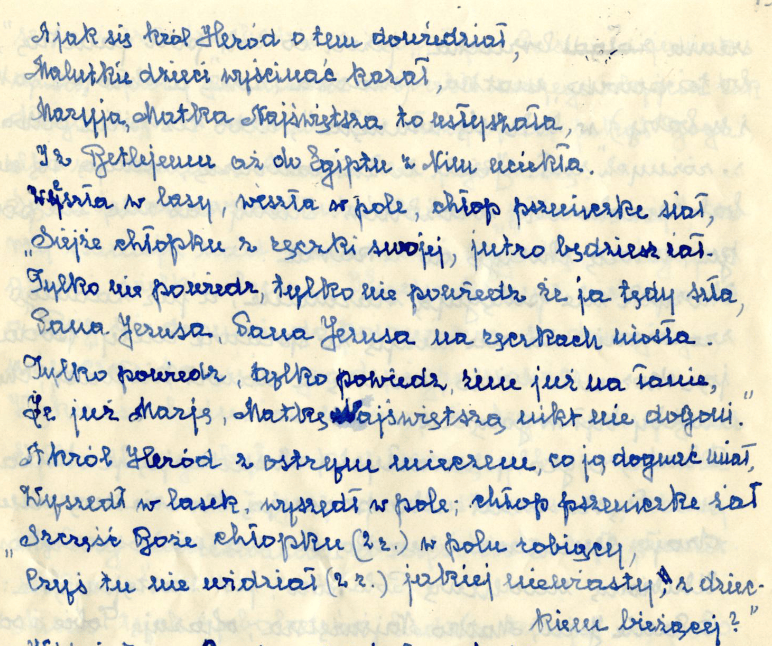
A jak sie król Herod o tem dowiedział,
Malutkie dzieci wycinać kazał,
Maryja, Matka Najświętsza to usłyszała,
I z Betlejemu aż do Egiptu z Nim uciekła.
Weszła w lasy, weszła w pole, chłop pszeniczkę siał,
„Siejże chłopku z rzerki swojej, jutro będziesz żął.
Tylko nie powiedz, tylko nie powiedz że ja tędy szła,
Sama Jerusa, Sama Jerusa na rzerkach niosła.
Tylko powiedz, tylko powiedz, żem już na Sanie,
Że już Maryję, Matkę Najświętszą nikt nie dogoni.”
A król Herod z ostrym mieczem, co ją dogonić miał,
Wyszedł w lasek, wyszedł w pole; chłop pszeniczkę siał
„Szczęść Boże chłopku (2 r.) w polu robiący,
Czyś tu nie widział (2 r.) jakiej niewiasty z dzieckiem bieżącej?”
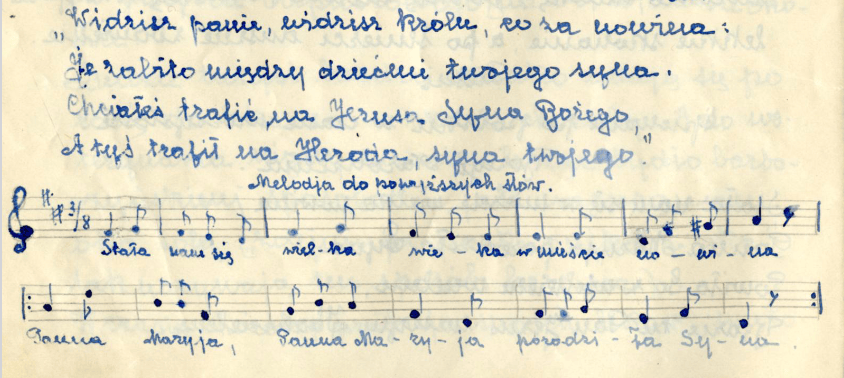
Widzisz panie, widzisz królu, co sa nowiera:
Je rabiło między dziećmi twojego syna.
Chciałeś trafić na Jezusa Syna Bożego,
A tyś trafić na Heroda, syna twojego.
Melodja do powyższych słów.
Stała nam się wielka, wielka w mieście nowina.
Panna Maryja, Panna Maryja porodziła Syna.
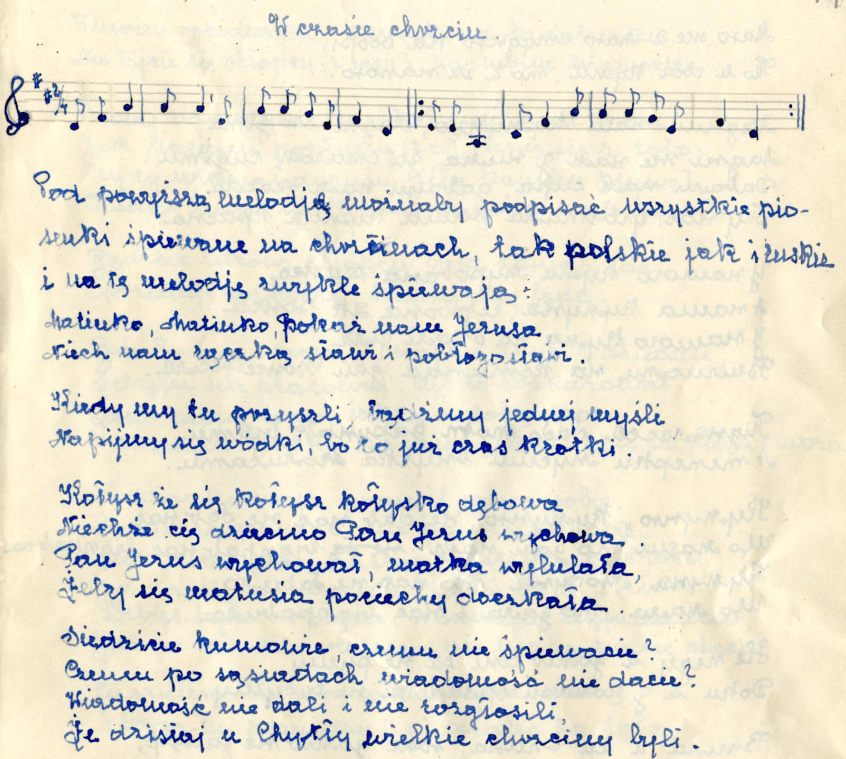
W czasie chrztu
Pod powyższą melodyją można by podpisać wszystkie piosenki śpiewane na chrzcinach, tak polskie jak i ruskie i na tę melodyję zwykle śpiewają:
Matiulko, matiulko poleć nam Jezusa
niech nam rączką slawi i pobłogosławi.
Kiedy my tu przyszli, myśmy jednej myśli
Napijmy się wódki, bo to już czas krótki.
Kołyszże się kołysz kołysko dębowa
Niechże cię dziecino Pan Jezus wychowa.
Pan Jezus wychował, matka wykołysała,
Żeby się matusia pociechy doczekała.
Siedzicie kumowie, czemu nie śpiewacie?
Czemu po sąsiadach wiadomość nie dacie?
Wiadomość nie dali i nie rozgłosili,
Że dzisiaj u Chrzty wielkie chrzciny byli.
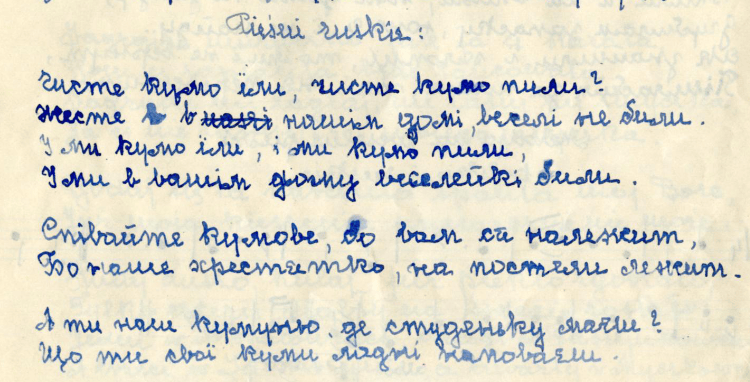
Piesni ruskie:
Чисте кумо їли, чисте кумо пили?
Жесте в вашій хатці досі веселі не были.
У ми кумо їли, і ми кумо пили,
У ми в вашім дому веселейкі были.
Співайте кумове, бо вам ся належит,
Бо наше хрестятко, на постели лежит.
А ти наш кумуню, де студеньку смачн?
Що ти свої куми лядні наповняєш.
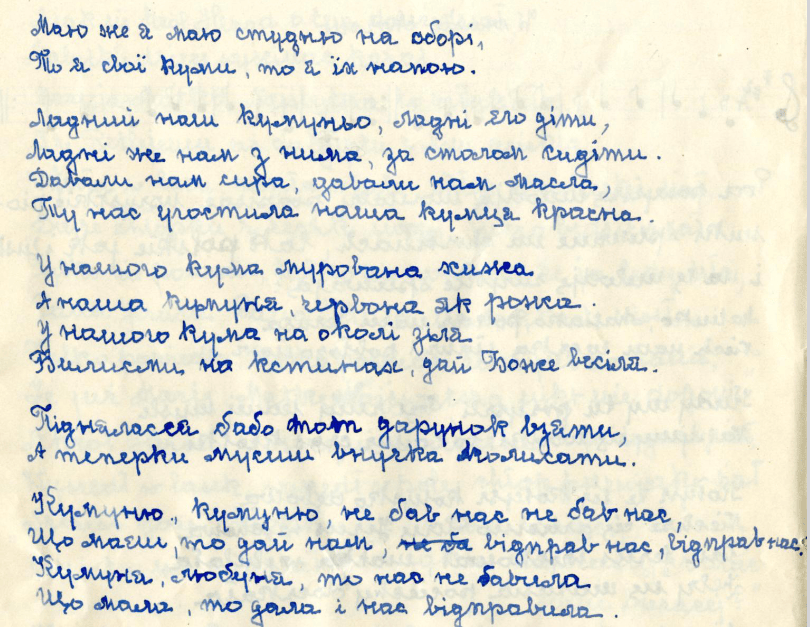
Маю же я маю студню на оборі,
То я свої кури, то я їх напою.
Ладний наш кумуньо, ладні его діти,
Ладні же нам з ними за столом сидіти.
Давали нам сира, давали нам масла,
Ти нас угостила наша кумця красна.
У нашого кума мурована хижа.
А наша кумуня, червона як рожа.
У нашого кума на околі зілля
Виписети на кстинах, дай Боже весілля.
Піднялася бабо тот дарунок взяти,
А теперки мусиш внучка колисати.
У кумуню, кумуню, не бав нас не бав нас,
Що маєш, то дай нам, та ба відправ нас, відправ нас!
Укумуня, любуня, то нас не бавила
Що маєш, то дала і нас відправила.
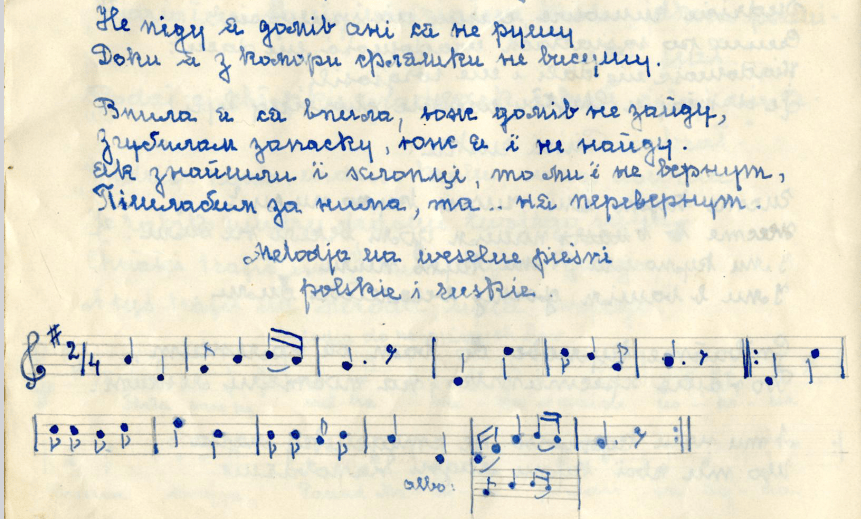
Не піду я додів ані ся не рушу
Доки я з комори срогачки не висушу.
Впила й ся впила, юж домів не зайду,
Згубилам запаску, юж єї не найду.
Як знайдут і хлопці, то ми її не вернут,
Пішлабим за нима, та… ня перевернут.
Melodja na weselne pieśni polskie i ruskie
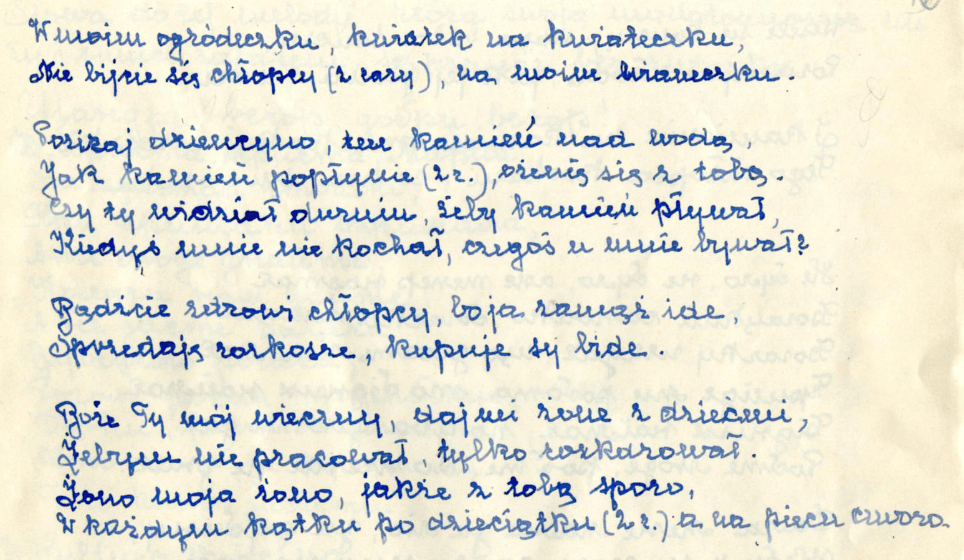
W moim ogródeczku, kwiatek na kwiateczku,
nie bijcie się chłopcy (2 razy), na moim wianeczku.
Spojrzyj dziewczyno, ten kamień nad wodą,
jak kamień popłynie (2 r.), ożenię się z tobą.
Czy ty widział durniu, żeby kamień pływał,
Kiedyś mnie nie kochał, czegoś u mnie bywał?
Bądźcie zdrowi chłopcy, bo ja za mąż idę,
sprzedaję rozkosze, kupuję sy biedę.
Boże Ty mój wieczny, daj mi żonę z dziećmi,
żebym nie pracował, tylko rozkazował.
Żono moja żono, jakże z tobą sporo,
w każdym kątku po dzieciątku (2 r.) a na piecu czworo.
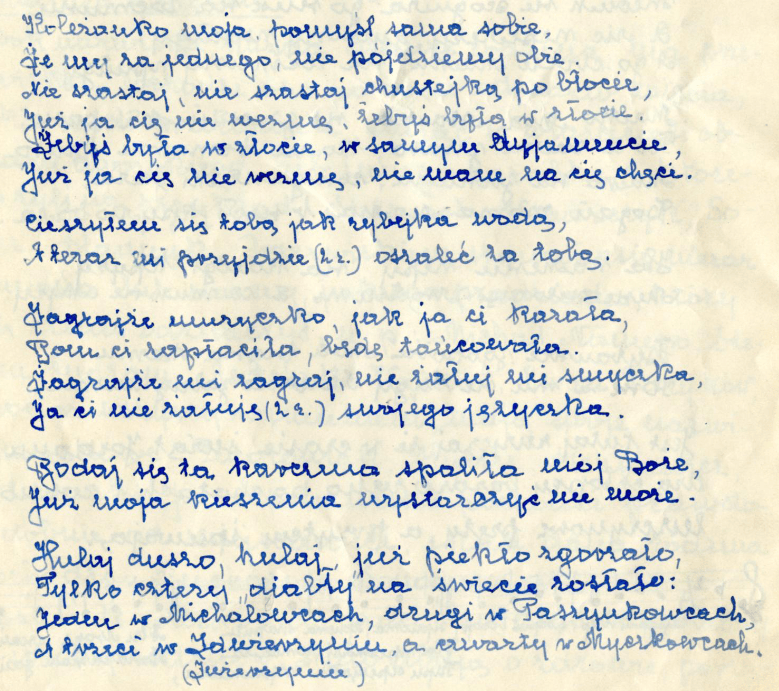
Koleżanko moja, pomyśl sama sobie,
że my za jednego, nie pójdziemy obie.
Nie szastaj, nie szastaj chusteczką po błocie,
już ja cię nie wezmę, żebyś była w złocie.
Żebyś była w złocie, w samym dyamencie,
już ja cię nie wezmę, nie mam na cię chęci.
Cieszyłem się tobą jak rybeńka wodą,
A teraz mi przyjdzie (kr.) oszaleć za tobą.
Zagrajże muzyczko, jak ja ci kazała,
Tom ci zapłaciła, będę tańcowała.
Zagrajże mi zagraj, nie żałuj mi smyczka,
Ja ci nie żałuję (za.) swojego języczka.
Bodaj się ta karczma spaliła mój Boże,
Już moja kieszenia wystarczyć nie może.
Hulaj duszo, hulaj, już piekło zgorzało,
Tylko cztery diaby na świecie zostało:
Jeden w Michałowcach, drugi w Paszykowcach,
A trzeci w Dziewięciu, a czwarty w Myszkowcach.(Dziewięcinie)
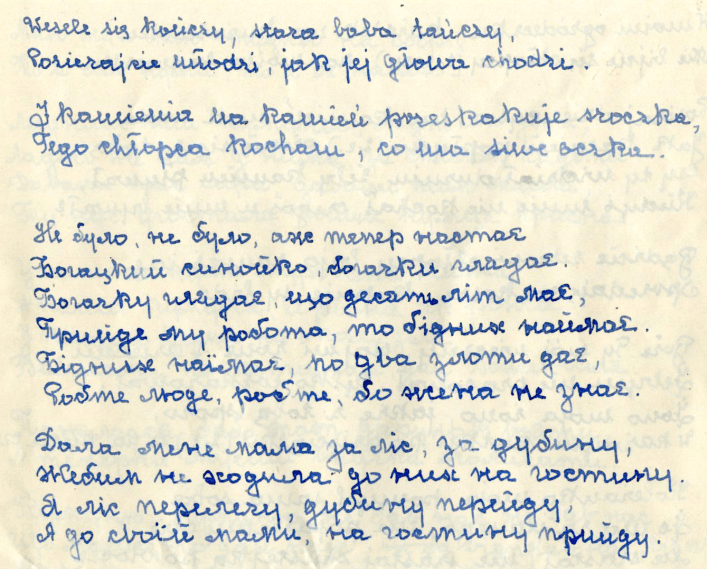
Wesele się kończy, stara baba tańczy,
Pocierajcie urodzi, jak jej głowa chodzi.
Z kamienia na kamień przeskakuje sroczka,
Tego chłopca kocham, co ma siwe oczka.
Не було, не було, аж тепер настає
Богацький синочко, богачки глядає.
Богачки глядає, що десять літ має,
Прийде та робота, то бідних наймає.
Бідних наймає, по два золоти дає,
Робьте люде, робьте, бо жена не знає.
Дала мене мама за ліс, за дубину,
Жобим не зходила до них на гостину.
Я ліс перелечу, дубину перейду,
Я до свої мами на гостину прийду.
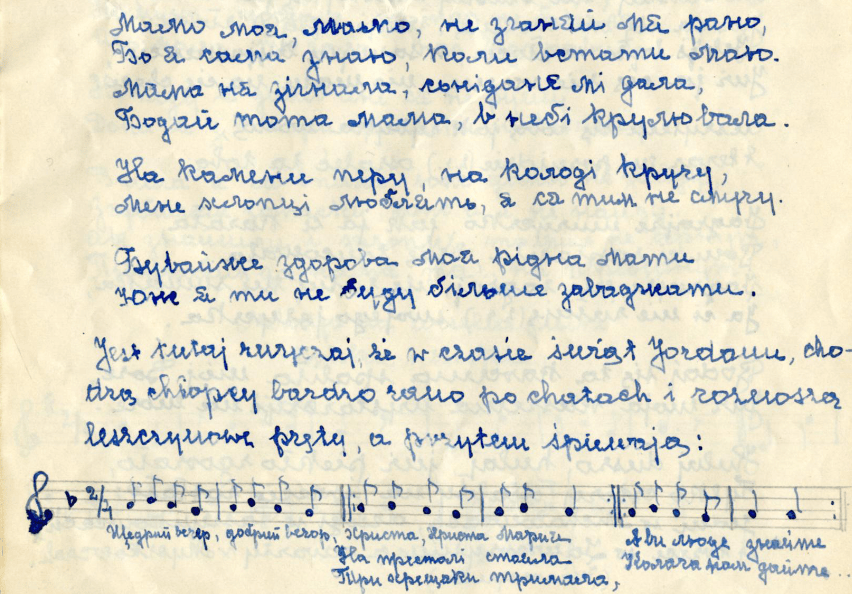
Мамо моя, мамо, не зганяй мя рано,
Бо я сама знаю, коли вставати маю.
Мама ня зігнала, сніданя мі дала,
Бодай тота мама, в небі крульовала.
Два камені перу, на колоді кручу,
мене хлопці люблять, я ся тим не смучу.
Бувайже здорова моя рідна мати
уже я ти не буду більше заваджати.
Jest tutaj zwyczaj że w czasie świąt Jordanu, chodzą chłopcy bardzo rano po chatach i roznoszą leszczynowe pręty, a przytem śpiewają:
Щедрий вечір, добрий вечір,
Христа, Христа Мария
На престолі стояла
Три хрещаки тримала,
А ви люде знайте
Колача нам дайте…
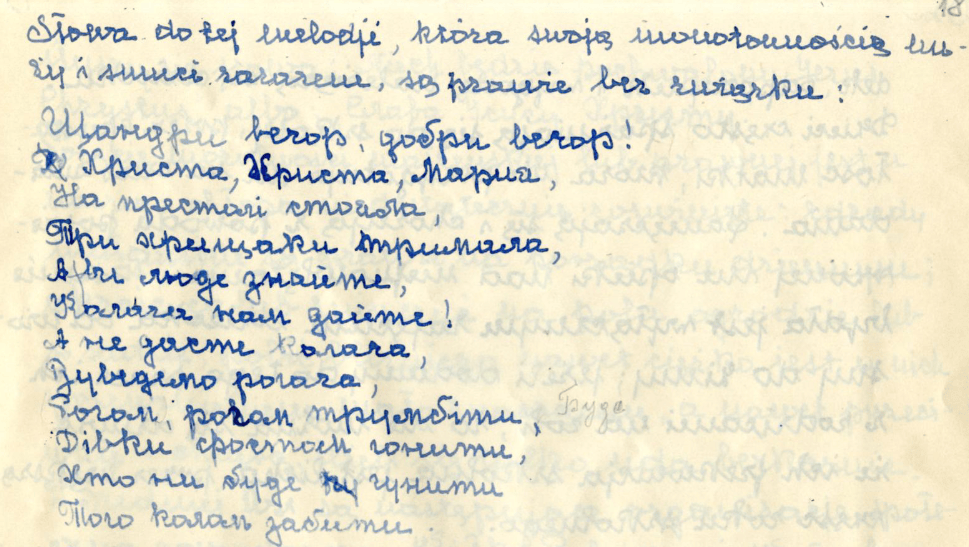
Słowa do tej melodji, która swoją monotonnością nudzi i smuci zarazem, są prawie bez związku:
Щандри вечор, добри вечор!
Христа, Христа, Мария,
На престолі стояла,
Три хрещаки тримала,
А ви люде знайте,
Колача нам дайте!
А не дасте колача,
Зуведемо рогача,
Богом, рогом трумбіти,
Дівки с̧воєиои гонити,
Хто ни буде выгунити
Того колач забити.
English Translation: Google-Powered
Warning: this translation may be terrible. It was done electronically by someone who can speak neither Polish nor Ukrainian/Lemko. Do you wish to see it improve? You can help! Contact us.
Uwaga: to tłumaczenie może być fatalne. Zostało wykonane automatycznie przez osobę, która nie zna ani języka polskiego, ani ukraińskiego/łemkowskiego. Chcesz, żeby było lepsze? Możesz pomóc! Skontaktuj się z nami.
Spiritual Culture.
There is an intriguing and amusing tale circulating about one of the local homesteads. Many years ago, an old man is said to have lived there—a man who raised a devil by carrying a chicken egg under his arm for an extended period. This little devil became a great friend to his guardian; he protected him from misfortune, assisted with labor, and even entertained the children of the old man’s family. Before he died, the old man bequeathed the devil to his children. And so, the horned creature remained on the homestead, looking after the old man’s descendants. In more recent times, however, he became quite the prankster, pestering all the neighbors. He would snatch various items of undergarments and clothing, tear them into narrow strips, and store them in his master’s attic—where the master himself allegedly saw them. Eventually, the master grew weary of this, especially as the neighbors began to suspect him of theft; he therefore announced that he wished to be rid of the devil and was willing to sell him.
Some time later, through an intermediary, a well-to-do farmer from the mountains—near the area of Cisna—came forward, expressing his desire to purchase the devil. (A true account.) After some bargaining, again conducted via the intermediary, a price of 60 zlotys was agreed upon (with the intermediary pocketing 20 zlotys). The devil was packed securely into an old pot, and the buyer departed, well-satisfied. After some time, however, the man who had sought out the devil returned to Średnia Wieś, lamenting that the creature had escaped. There was nothing anyone could do to help him, as it was impossible to catch the devil a second time; the devil, for his part, had simply returned to his former haunt, quite content.
To this day, it is said that the farmer lives with the devil and is doing rather well for himself. Yet, he and his family are pale—as if drained of life—and possess a somber disposition; his sons are dull-witted (though they did attend school). The father never sets foot in the church, and everyone predicts a grim end for him, for “once a person falls into the devil’s clutches, there is no escaping them.”
The local people also believe that upiry (vampires/revenants) live among them. It is impossible to identify such a being while he is still alive, as he appears no different from any other person; it is said, however, that he possesses two hearts and brings harm to the living. After death, these upiry are compelled to do penance within the confines of their own homestead—a state that persists until the family offers a sacrifice to God or commissions a Holy Mass for the soul of the deceased.
Among the inhabitants, there are also those known as płanetnicy—beings who hold sway over the weather, commanding hailstorms and great tempests. When one of them dies—and should God not permit another to take his place—the result is a succession of hailstorms and violent thunderstorms.
Most of the local population believes that this year’s hailstorm was so destructive precisely because an elderly farmer—who, in everyone’s estimation, was a płanetnik—had passed away a month earlier. Despite these superstitions, the local people are devout, maintaining that one should neither anger God nor provoke the devil.
They participate very eagerly in religious festivals (indulgences), often traveling to the designated sites, even those quite far away.
When ill, the local people very rarely seek advice from a doctor. They never consult a veterinarian, instead treating their livestock using barbaric methods—such as rubbing salt into an eye (a practice they describe as “removing the nasty thing from the eye”).
In times of sickness, they rely on their own remedies: they might massage the abdomen—specifically the area below the pit of the stomach—believing that the “mother” (a term used for the uterus, in both men and women) has “shifted to the side.” They also consume decoctions made from various herbs. If these measures fail, they turn to folk healers or fortune-tellers. Only when nothing else works do they take the patient to a doctor.
The sick are not cared for with much diligence; there is, in particular, a complete lack of understanding regarding diet—patients are often given wine, vodka, or even sausage, even when suffering from a fever.
They tend to the graves of the deceased, planting flowers upon them. Frequently, either on their own or as part of a church procession, they visit the cemetery to pray for the departed. A favorite prayer among the Poles is as follows:
“O Lord Jesus, Most Holy Mother, I offer and dedicate to You this ‘Hail Mary’ and one ‘I Believe’ [Apostles’ Creed]—to the honor and glory of God, and as an offering to the Most Holy Mother.” And I beseech You, Jesus, grant me understanding, memory, health, knowledge, Divine love, human friendship, an easy passing, and, after death, the salvation of my soul.
Song Sung in Polish During the Celebration of Christmas
A great piece of news happened to us in the town,
The Virgin Mary gave birth to a Son,
She swaddled Him with great joy,
Lord Jesus here will be our Savior.
And when King Herod found out about this,
He ordered the little children to be slaughtered,
Mary, the Most Holy Mother, heard of this,
And from Bethlehem all the way to Egypt she fled with Him.
She entered the woods, she entered the field, a peasant was sowing wheat,
“Sow, little peasant, from your handful (z rączki), tomorrow you shall reap.
Only do not tell, only do not tell that I walked this way,
Jesus Himself, Jesus Himself I carried in my arms (na rączkach).
Only tell, only tell that I am already on the San [River],
That no one will ever catch up to Mary, the Most Holy Mother.”
And King Herod with a sharp sword, who was to catch up to her,
Went out into the woods, went out into the field; the peasant was sowing wheat:
“God bless you, little peasant (2x), working in the field,
Have you not seen here (2x) some woman running with a child?”
“Look, sir, look, King, what has happened (co się narobiło):
Your own son has been struck down among the children.
You wanted to strike Jesus, the Son of God,
And you struck Herod, your own son.”
Melody to the above words.
A great, great piece of news happened to us in the town,
The Virgin Mary, the Virgin Mary gave birth to a Son.
During a Christening
Under the melody above, one could set all the songs sung at christenings, both Polish and Ruthenian, and to this melody they usually sing:
Dear mother, dear mother, commend Jesus to us,
May He bless and glorify us with His little hand.
Since we have come here, we are of one mind,
Let us drink some vodka, for time is already short.
Rock, oh rock, oaken cradle,
May Lord Jesus raise you, little child.
Lord Jesus raised [you], the mother rocked [you],
So that the dear mother might live to see her joy.
You sit there, godparents, why don’t you sing?
Why don’t you spread the news among the neighbors?
They didn’t give the news and didn’t announce,
That today at the Christening (u Chrzty) there was a grand christening party.
Ruthenian Songs:
Did you eat, dear godmother, did you drink, dear godmother?
That in your little hut you haven’t been merry until now.
We ate, dear godmother, and we drank, dear godmother,
We were very merry in your home.
Sing, godparents, for it is fitting for you,
Because our little godchild is lying on the bed.
And you, our dear godfather, where is your tasty little well?
That you fill up your godmothers so nicely.
I do have, I have a well in the barnyard,
That’s for my chickens, that’s where I water them.
Handsome is our dear godfather, handsome are his children,
Nice it is for us to sit at the table with them.
They gave us cheese, they gave us butter,
You treated us well, our beautiful dear godmother.
Our godfather has a stone/brick cottage (murowana chyża).
And our dear godmother is red as a rose.
Our godfather has herbs around his yard;
You drank at the christening, God grant a wedding [next].
You undertook, grandmother, to accept that gift,
And now you must rock your grandchild.
Oh dear godmother, dear godmother, don’t keep us waiting, don’t keep us waiting,
What you have, give us, and send us off, send us off!
Oh dear godmother, darling, she didn’t keep us waiting,
What she had, she gave, and she sent us off.
I will not go home, nor will I budge,
Until I dry out the pantry’s srohaczka [a traditional sour soup/fermented whey drink].
I got drunk, oh I got drunk, I won’t make it home anymore,
I lost my apron (zapaska), I won’t find it anymore.
If the boys find it, they won’t return it to me,
I would go after them, but… they’ll knock me over.
Melody for Polish and Ruthenian Wedding Songs
In my little garden, flower upon flower,
Do not fight, boys (2x), over my little wreath.
Look, girl, at that stone by the water,
When the stone floats (2x), I will marry you.
Have you ever seen, you fool, a stone float?
If you didn’t love me, why did you visit me?
Farewell, boys, for I am getting married,
I am selling my delights, buying myself misery.
O my eternal God, give me a wife with children,
So that I wouldn’t work, only give orders.
My wife, my wife, how briskly things go with you,
In every corner a little child (2x), and on the stove, four.
My dear friend, think to yourself,
That we cannot both marry the same one.
Do not swish, do not swish your handkerchief in the mud,
I won’t take you anymore, even if you were covered in gold.
Even if you were in gold, in pure diamond,
I won’t take you anymore, I have no desire for you.
I rejoiced in you like a little fish in water,
And now I will have to (short) go crazy over you.
Play, little musicians, just as I ordered you,
Since I paid you, I will dance.
Play for me, play, do not spare your bow,
I do not spare (for) you my little tongue.
May that tavern burn down, my God,
My pocket can no longer afford it.
Revel, my soul, revel, hell has already burned down,
Only four devils are left in the world:
One in Michałowce, the second in Paszykowce,
And the third in Dziewięć [Dziewięcin], and the fourth in Myszkowce.
The wedding is ending, the old woman is dancing,
Look, good people (ludzie), how her head bobs.
From stone to stone hops a little magpie,
I love that boy who has gray eyes.
Ruthenian Wedding Verses:
It wasn’t so, it wasn’t so, until now it comes to be:
A rich man’s son looks for a rich girl.
He looks for a rich girl who is ten years old;
When work comes, he hires the poor.
He hires the poor, gives two zlotys each:
“Work, people, work, for my wife doesn’t know how.”
My mother married me off beyond the forest, beyond the oak grove,
So that I wouldn’t visit them as a guest.
I will fly over the forest, I will cross the oak grove,
I will come to my mother as a guest.
My mother, my mother, don’t wake me early,
For I know myself when I must get up.
Mother woke me up, gave me breakfast,
May that mother reign as a queen in heaven.
I wash two stones, I twist [laundry] on a log,
The boys love me, I am not sad about it.
Farewell and be well, my dear mother,
I will no longer be in your way.
Epiphany (Jordan) Custom
There is a custom here that during the Jordan holidays [Epiphany], boys go very early in the morning from cottage to cottage carrying hazel rods, and while doing so they sing:
Generous evening, good evening,
Christ, Christ, Mary
Stood at the altar,
Held three little crosses,
And you, people, know this:
Give us a kolach [ritual braided bread]…
The words to this melody, which with its monotony bores and saddens at the same time, are almost disconnected:
Generous evening, good evening!
Christ, Christ, Mary,
Stood at the altar,
Held three little crosses,
And you, people, know this:
Give us a kolach!
And if you don’t give a kolach,
We will bring in a stag (rohacz) [or horned creature/poker],
To trumpet with God, with a horn,
To chase your girls,
Whoever will not chase them out,
Their kolach will be taken/beaten.
Sanok Genes seeks to create a database of transcripts and English translations from the “Kultura Duchowa” sections from the 1936 Sanok School Inspectorate Questionnaires. The original documents are held by the Sanok Museum of History and digitized by the Sanok Digital Library. To learn more, see the project description.
Sanok Genes stawia sobie za cel stworzenie bazy danych zawierającej transkrypcje oraz tłumaczenia na język angielski fragmentów dotyczących „kultury duchowej”, pochodzących z kwestionariuszy Inspektoratu Szkolnego w Sanoku z 1936 roku. Oryginalne dokumenty znajdują się w zbiorach Muzeum Historycznego w Sanoku i zostały zdigitalizowane przez Sanocką Bibliotekę Cyfrową. Więcej informacji można znaleźć w opisie projektu.

