Dziurdziów is a village in Lesko Commune, Lesko County.
Dziurdziów– wieś w gminie Lesko, w powiecie leskim.
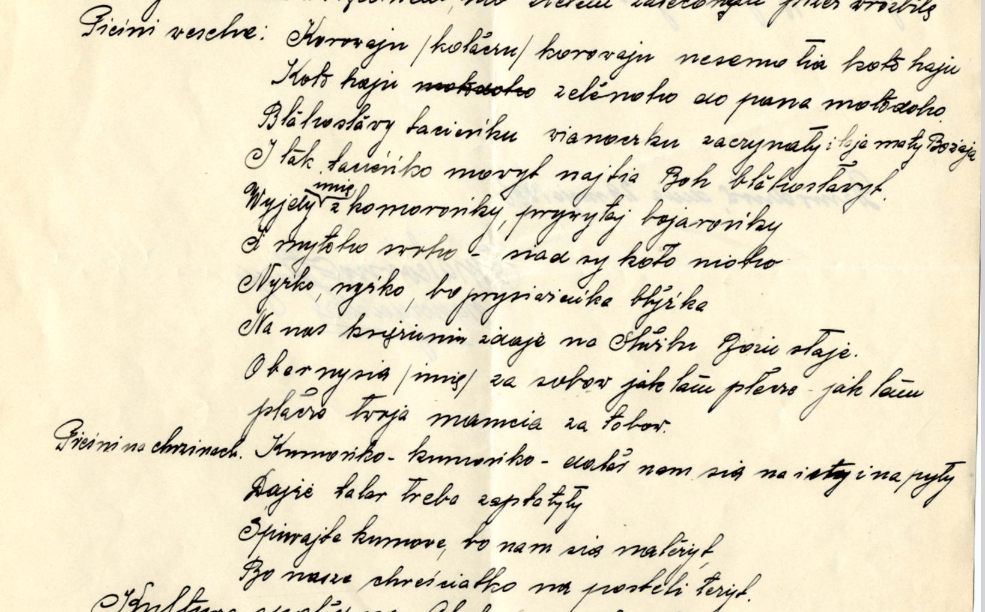
Transcript: Google-Powered
Warning: this transcription may be terrible. It was done electronically by someone who can speak neither Polish nor Ukrainian/Lemko. Do you wish to see it improve? You can help! Contact us.
Uwaga: ta transkrypcja może być fatalna. Została wykonana automatycznie przez osobę, która nie zna ani języka polskiego, ani ukraińskiego/łemkowskiego. Chcesz, żeby była lepsza? Możesz pomóc! Skontaktuj się z nami.
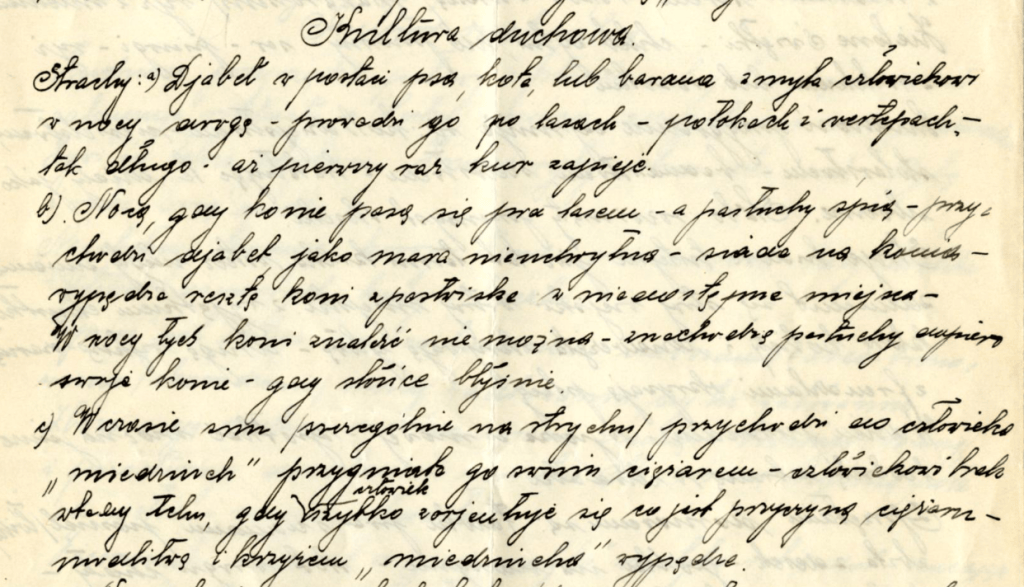
6Kultura duchowa.
Strachy:
a) Djabeł w postaci psa, kota, lub barana zmyka człowiekowi w nocy drogę – prowadzi go po lasach – potokach i wertepach. – tak długo aż pierwszy raz kur zapieje.
b) Nocą, gdy konie pasą się pod lasem – a pastuchy śpią – przychodzi djabeł jako mara nieuchwytna – siada na konia – wypędza resztę koni z pastwiska w niedostępne miejsca – W nocy tych koni znaleźć nie można – dopiero pastuchy znajdą swoje konie – gdy słońce błyśnie.
c) W czasie snu (szczególnie na strychu) przychodzi do człowieka „miednich” przygniata go swoim ciężarem – człowiekowi braknie wtedy tchu, gdy człowiek zorientuje się co jest przyczyną ciężaru – modlitwą i krzyżem „miednicha” wypędzi.
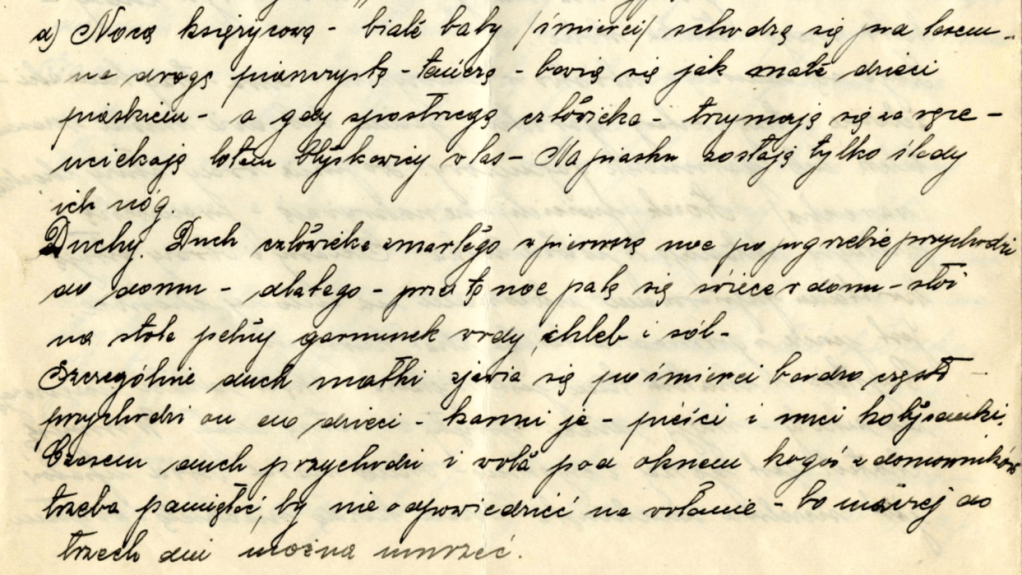
d) Noc księżycowa – “białe baby” /śmierci/ schodzą się za lasem –na drogę piaszczystą – tańczą – bawią się jak małe dziecipiaskiem – a gdy spostrzegą człowieka – trzymają się za ręce –uciekają lotem błyskawicy w las – Na piasku zostają tylko śladyich nóg.
Duchy.
Duch człowieka zmarłego wpierw ma po pogrzebie przychodzido domu – dlatego – przez tę noc palą się świece w domu – stoina stole pełny garnek wody, chleb i sól.Szczególnie duch matki zjawia się po śmierci bardzo częstoprzychodzi on do dzieci – karmi je – pieści i muci kołysanki.Czasem duch przychodzi i woła pod oknem kogoś z domownikówtrzeba pamiętać, by nie odpowiedzieć na wołanie – bo inaczej potrzech dniach można umrzeć.
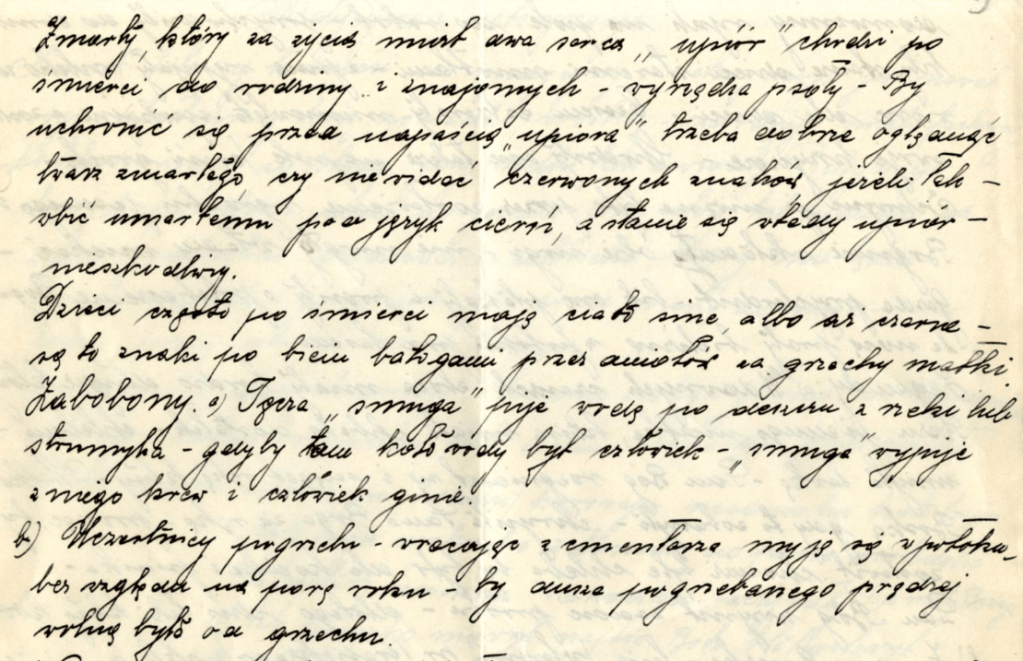
Zmarły, który za życia miał dwa serca, „upiór” chodzi po śmierci do rodziny i znajomych – wynędznia prosi – by uchronić się przed napaścią „upiora” trzeba osobno oglądnąć twarz zmarłego, czy nie widać czerwonych znaków, jeżeli tak – wbić umarłemu poza język cierń, a stanie się wtedy upiór – nieszkodliwy.
Dzieci częstokroć po śmierci mają ciało sine albo aż czarne – są to znaki po biciu batogami przez aniołów za grzechy matki.
Zabobony.
a) Jędza „zmora” pije wodę po ciemku z rzeki lub strumyka – gdyby tam koło wody był człowiek – „zmora” wypije z niego krew i człowiek ginie!
b) Uczestnicy pogrzebu wracając z cmentarza myją się w potoku bez względu na porę roku – by dusza pogrzebanego prędzej wolną była od grzechu.
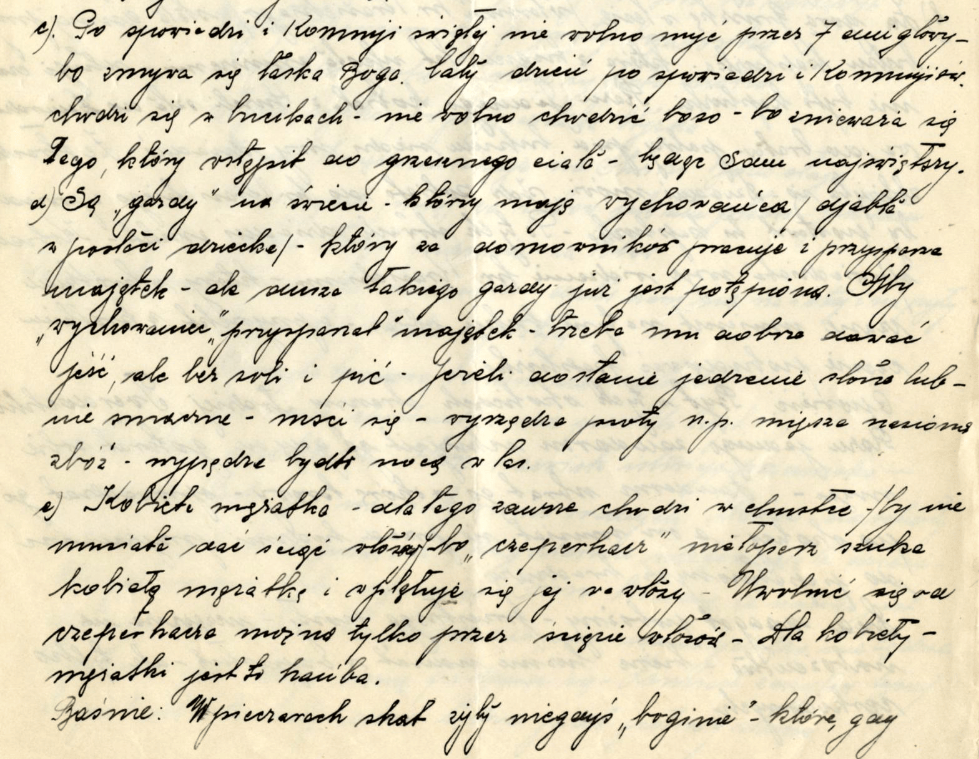
c) Po spowiedzi i Komunji świętej nie wolno myć przez 7 dni głowy –bo zmywa się łaska Boga. Cały dzień po spowiedzi i Komunji ś.chodzi się w bucikach – nie wolno chodzić boso – bo znieważa sięTego, który wstąpił do grzesznego ciała – będąc Sam najświętszy.
d) Są „gazdy” na świecie – którzy mają wychowańca /djabław postaci dziecka/ – który za domownika pracuje i przysparza majątek – ale dusza takiego gazdy już jest potępiona. Gdy„wychowaniec” przysporzył majątek – trzeba mu dobrze dawaćjeść, ale bez soli i pić. Jeżeli dostanie jedzenie słone lub –nie smaczne – mści się – wyrządza psoty n.p. mysze niszczązboże – wypędzi bydło nocą w las.
e) Kobieta mężatka – dlatego zawsze chodzi w chustce by niewidać ani śladu włosów – bo „creperhaer” /nietoperz/ szukakobietę mężatkę i wplątuje się jej we włosy. – Wyplątać się zcreperhaera można tylko przez ścięcie włosów. – Dla kobiety –mężatki jest to hańba.
Baśnie:
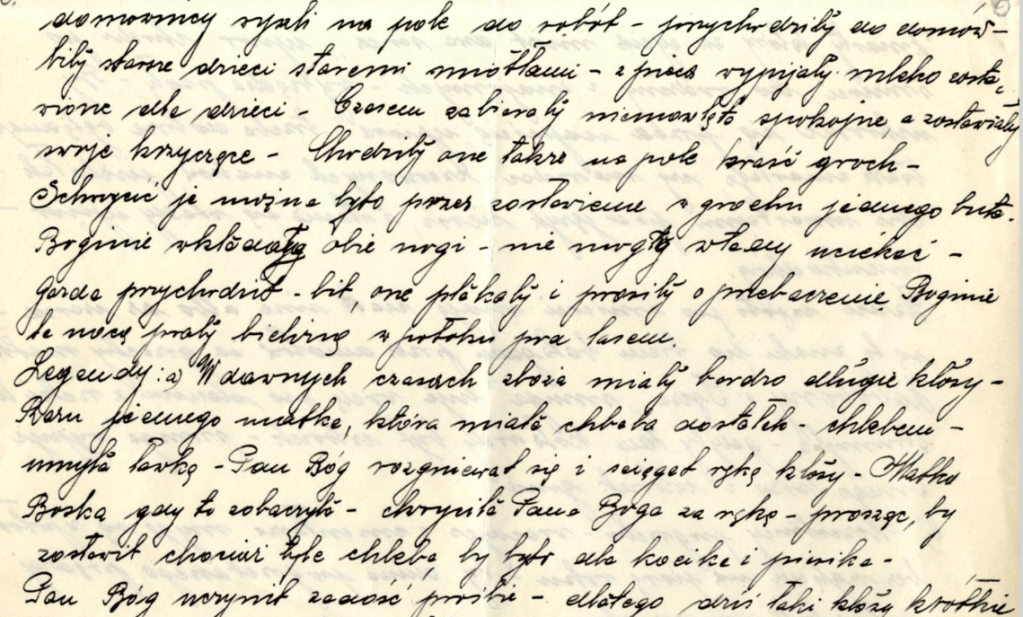
W pieczarach skał żyły niegdyś „boginie” – które, gdy dawniej szli na pole do robót – przychodziły do domów – biły stare dzieci staremi miotłami – z garnków wypijały mleko zostawione dla dzieci – Czasem zabierały niemowlęta spokojne, a zostawiały swoje krzyczące – Chodziły one także na pole kraść groch – Schwycić je można było przez zostawienie w grochu jednego buta. Boginie wkładały obie nogi – nie mogły wtedy uciekać – Gazda przychodził – bił, one płakały i prosiły o przebaczenie. Boginie te nocą prały bieliznę w potoku pod lasem.
Legendy:
a) W dawnych czasach zboża miały bardzo długie kłosy – Razu pewnego matka, która miała chleba dostatek – chlebem umyła ławkę – Pan Bóg rozgniewał się i ściągał ręką kłosy – Matka Boska gdy to zobaczyła – chwyciła Pana Boga za rękę – prosząc, by zostawił chociaż tyle chleba by było dla kociołka i pieska – Pan Bóg uczynił zadość prośbie – dlatego dziś takie kłosy krótkie.
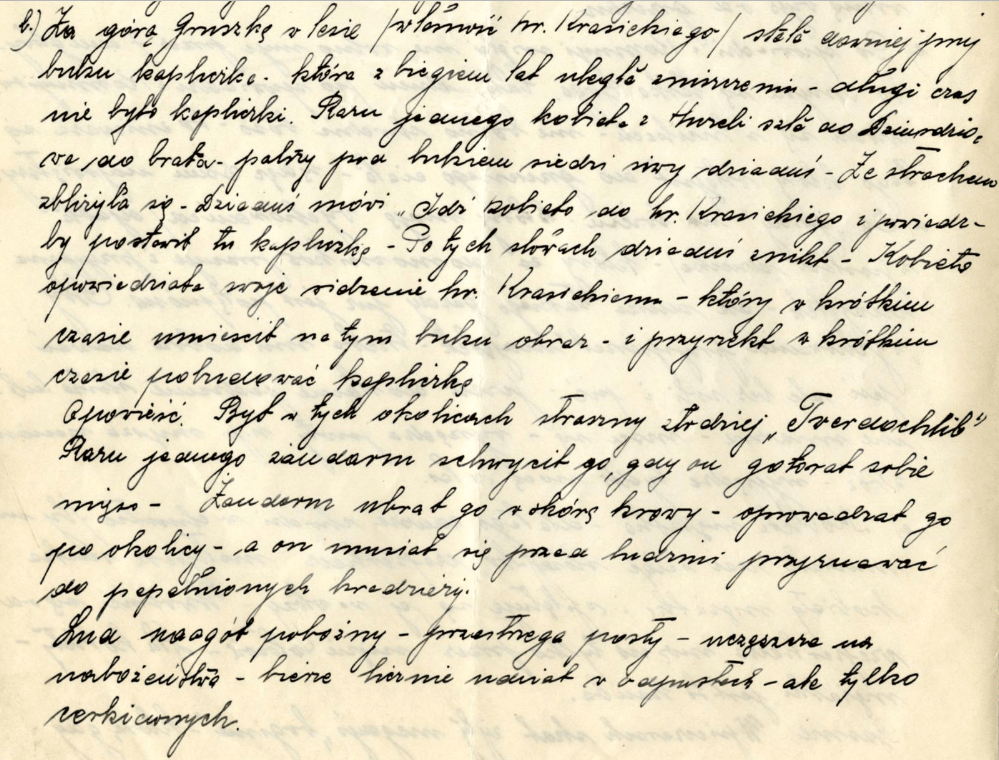
b.) Na górze Gruszce w lesie potomków hr. Krasickiego, stała dawniej przy buku kapliczka, która z biegiem lat uległa zniszczeniu – długi czas nie było kapliczki. Razu pewnego kocioł z Tureli szło do Dziurdziowa do brata – patrzy pod bukiem siedzi siwy dziaduś – Ze strachem zbliżyła się – Dziaduś mówi „Idź kobieto do hr. Krasickiego i powiedz by postawił tu kapliczkę – Po tych słowach dziaduś znikł – Kobieta opowiedziała swoje widzenie hr. Krasickiemu – który w krótkim czasie umieścił na tym buku obraz – i przyrzekł w krótkim czasie wskrzesić kapliczkę.
Opowieść.
Był w tych okolicach straszny złodziej „Twerdochlib” Razu pewnego żandarm schwycił go, gdy on gotował sobie mięso – Żandarm ubrał go w skórę krowy – oprowadzał go po okolicy – a on musiał się przed ludźmi przyznawać do popełnionych kradzieży.
Lud na ogół pobożny – przestrzega posty – uczęszcza na nabożeństwa – bierze licznie udział w odpustach – ale tylko cerkiewnych.
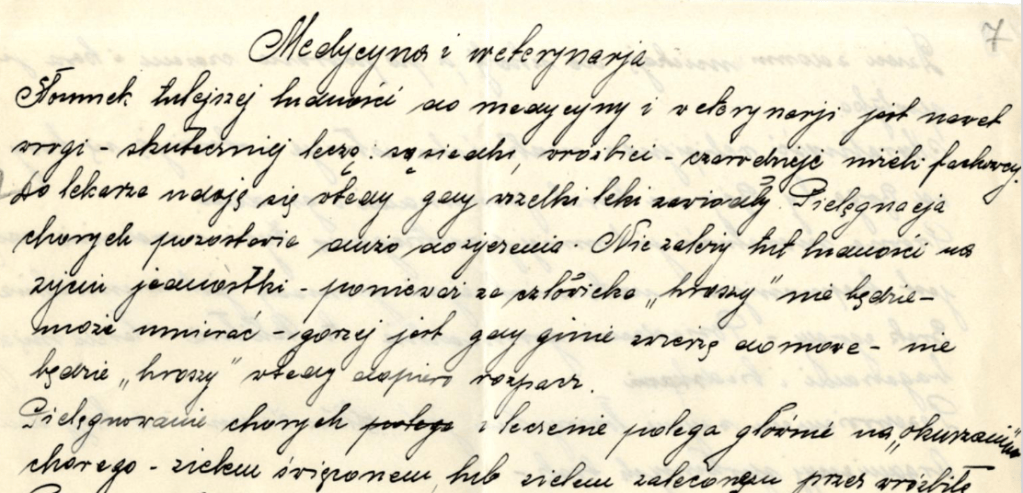
Medycyna i weterynarja
Stosunek tutejszej ludności do medycyny i weterynarji jest nawet wrogi – skuteczniej leczą sąsiedzi, wróżbici – czarodzieje niźli fachowcy. Do lekarza udają się wtedy gdy wszelkie leki zawiodły. Pielęgnacja chorych pozostawia dużo do życzenia. Nie zależy tu ludności na życiu jednostki – ponieważ za człowieka „groszy” nie będzie – może umierać – gorzej jest gdy ginie zwierzę domowe – nie będzie „groszy” wtedy dopiero rozpacz.
Pielęgnowanie chorych polega i leczenie polega głównie na „okuraniu” chorego – zielem święconem lub zielem zaleconym przez wróżbitę.
Pieśni wesilne:
Korowajn /kolairn/ korowajn niesiemy ha koło haju
koło haju mokoło zielonego do pana młodego
Błahosławy taniuśku wianoczku zacznaty i ty maty Boża
I tak taniuśku moływ najtia Boh błahosłavyv.
Wyjeźdy mnie z komoronky, prywytaj bojarouniky
I mnytcho moko… nad ny koło misto
Nyrko, nyrko bo prysiatnika błyźko
Na nas kryiunyj zdaje na Smilnu Goru staje.
Obernysia i mje za sobow jak tam płacze jak tam
płacze twoja mamcia za tobow.
Pieśni na chrzcinach:
Kumoszko, kumoszko – daliś nam sia na jisty i na pyty
Dajie haler trzeba zapłatyty
Śpiwajte kumowie, bo nam sia małozyt
Bo nasze chrzciniatko na proroki torzyt.
English Translation: Google-Powered
Warning: this translation may be terrible. It was done electronically by someone who can speak neither Polish nor Ukrainian/Lemko. Do you wish to see it improve? You can help! Contact us.
Uwaga: to tłumaczenie może być fatalne. Zostało wykonane automatycznie przez osobę, która nie zna ani języka polskiego, ani ukraińskiego/łemkowskiego. Chcesz, żeby było lepsze? Możesz pomóc! Skontaktuj się z nami.
Spiritual Culture.
Fearsome Apparitions:
a) The devil, in the form of a dog, a cat, or a ram, crosses a person’s path at night, leading them through forests, streams, and rugged, uneven terrain—continuing until the first cock crows.
b) At night, while horses graze near the forest and the herders are asleep, the devil—appearing as an elusive phantom—mounts one of the horses and drives the rest of the herd away into inaccessible places. It is impossible to find the horses during the night; the herders can only recover them once the sun rises.
c) While a person is sleeping (especially in an attic), a “miednich” (a crushing spirit) may arrive and press down upon them with its weight, causing the person to lose their breath. Once the individual realizes the cause of this pressure, they can drive the “miednich” away through prayer and the sign of the cross.
d) On moonlit nights, “white women” (figures of death) gather beyond the forest on a sandy path. They dance and play in the sand like small children; however, the moment they spot a human, they join hands and vanish into the forest with the speed of lightning, leaving only their footprints behind in the sand.
Spirits. After the funeral, the spirit of the deceased is said to return home; for this reason, candles are kept burning throughout the night, and a full pot of water, bread, and salt are placed on the table. The spirit of a mother, in particular, is believed to appear frequently after death—visiting her children, feeding them, caressing them, and singing lullabies. Sometimes, a spirit may call out to one of the household members from beneath a window; one must be careful not to answer, lest they die within three days.
A deceased person who possessed two hearts while alive—known as an upiór (revenant)—may return to haunt their family and acquaintances. To protect oneself from such an upiór, one should examine the face of the deceased for any red marks; if any are found, a thorn should be driven into the corpse’s tongue, which will render the upiór harmless.
Children who have passed away sometimes exhibit blue or even black marks on their bodies; these are said to be the result of lashes inflicted by angels as punishment for the sins of the mother.
Superstitions:
a) A zmora (a malevolent spirit or nightmare-creature) is said to drink water from a river or stream in the dark; if a person happens to be nearby, the zmora will drain their blood, causing the person to perish.
b) Upon returning from a cemetery, funeral attendees wash themselves in a stream—regardless of the season—in the belief that this helps the soul of the deceased be cleansed of sin more quickly.
c) Following confession and Holy Communion, one must not wash their hair for seven days, as doing so would wash away the grace of God. For the entire day following confession and Holy Communion, one must wear shoes—going barefoot is forbidden—as doing so would insult Him who, being Most Holy, has entered a sinful body.
d) There are certain “masters” (gazdy) in the world who keep a “ward”—a devil in the guise of a child—who works as a member of the household and helps accumulate wealth; however, the soul of such a master is already damned. Once this “ward” has helped amass wealth, he must be well-fed—though his food and drink must contain no salt. If he is given food that is salted or otherwise unpalatable, he takes revenge by causing mischief—for instance, by having mice destroy the grain or driving the cattle into the forest at night.
e) A married woman always wears a headscarf so that not a single strand of hair is visible; this is because a creperhaer (a bat) seeks out married women and becomes entangled in their hair. The only way to free oneself from a creperhaer is to cut off one’s hair—a source of great shame for a married woman.
Folk Tales:
In the caverns of the rocks, there once dwelt “boginki.” Whenever the household members went out to work in the fields, these beings would enter the homes, strike the children with old brooms, and drink the milk left in pots for the little ones. Sometimes, they would take away quiet, well-behaved infants, leaving their own wailing offspring in their place. They would also venture into the fields to steal peas. One could capture them by leaving a single shoe among the pea plants; the “boginki” would then insert both feet into it, rendering them unable to flee. The master of the house would arrive and beat them, whereupon they would weep and beg for forgiveness. At night, these goddesses would wash their linen in a stream near the forest.
Legends:
a) In ancient times, grain stalks had very long ears. Once, a mother who had an abundance of bread used a loaf to scrub a bench. God, becoming angry, reached out and pulled the ears of grain down. The Virgin Mary, seeing this, caught God by the hand and begged Him to leave at least enough grain to feed a small cat and a dog. God granted her request—which is why, to this day, the ears of grain are so short.
b) On Gruszka Hill, located in the forest belonging to the descendants of Count Krasicki, there once stood a small shrine by a beech tree; over the years, it fell into ruin, and for a long time, no shrine remained. One day, a woman from Turela was on her way to visit her brother in Dziurdziów when she noticed an old man with gray hair sitting beneath the beech tree. Approaching with trepidation, she heard the old man say, “Go, woman, to Count Krasicki and tell him to build a shrine here.” With those words, the old man vanished. The woman recounted her vision to Count Krasicki, who soon placed an image upon the beech tree and vowed to restore the shrine.
A Tale.
There was once a notorious thief in these parts named “Twerdochlib.” One day, a gendarme caught him in the act of cooking some meat. The gendarme draped a cowhide over the thief and paraded him throughout the area, forcing him to confess his various thefts to the local people. The people are generally devout—they observe fasts, attend church services, and participate in large numbers in religious festivals—but only those of the cerkiew.
The attitude of the local population towards medicine and veterinary medicine is even hostile – neighbors, fortune-tellers and wizards treat people more effectively than professionals. They go to the doctor when all medications have failed. The care of patients leaves much to be desired. The population here does not care about the life of an individual – because there will be no pennies for a person – he can die – it is worse when a pet dies – there will be no pennies, then only despair.
Nursing the sick and treating them mainly involves “curing” the sick person – with a holy herb or a herb recommended by a fortune teller.
Wedding Songs (Pieśni weselne)
We carry the korovai [ceremonial wedding bread] to the grove,
To the green grove, to the groom.
Bless, O Lord, the wreath begun, and you, Mother of God,
And so, O Lord, prayed the Mother of God, bless [them].
Come out to me from the chamber, greet the boyars [groomsmen],
And to me… over the town,
Dive, dive, for the prysiatnik [matchmaker/attendant] is near,
He stands over us, leaning on Smilna Mountain.
Turn around, and look behind you, how she cries there,
How your mommy cries for you.
Christening Songs
Godmother, godmother – you gave us [something] to eat and to drink,
Give a haler [coin], you have to pay!
Sing, godparents, because there are few of us,
Because our little christened child is heading toward the prophets [or: is being carried for blessing/destiny].
Sanok Genes seeks to create a database of transcripts and English translations from the “Kultura Duchowa” sections from the 1936 Sanok School Inspectorate Questionnaires. The original documents are held by the Sanok Museum of History and digitized by the Sanok Digital Library. To learn more, see the project description.
Sanok Genes stawia sobie za cel stworzenie bazy danych zawierającej transkrypcje oraz tłumaczenia na język angielski fragmentów dotyczących „kultury duchowej”, pochodzących z kwestionariuszy Inspektoratu Szkolnego w Sanoku z 1936 roku. Oryginalne dokumenty znajdują się w zbiorach Muzeum Historycznego w Sanoku i zostały zdigitalizowane przez Sanocką Bibliotekę Cyfrową. Więcej informacji można znaleźć w opisie projektu.

