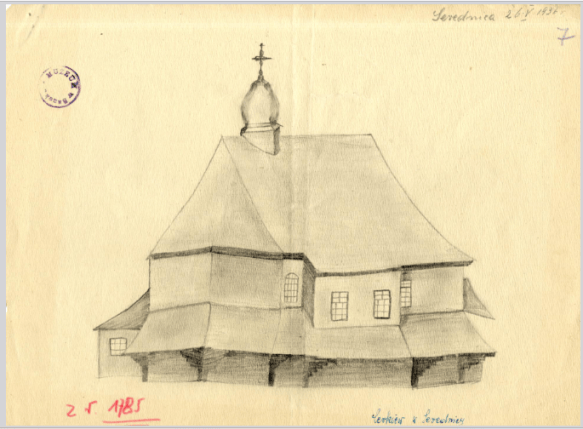
Serednica is a village in Uztrzyki Dolne Commune, Bieszczady County.
Serednica– wieś w gminie Uztrzyki Dolne, w powiecie bieszczadzkim.
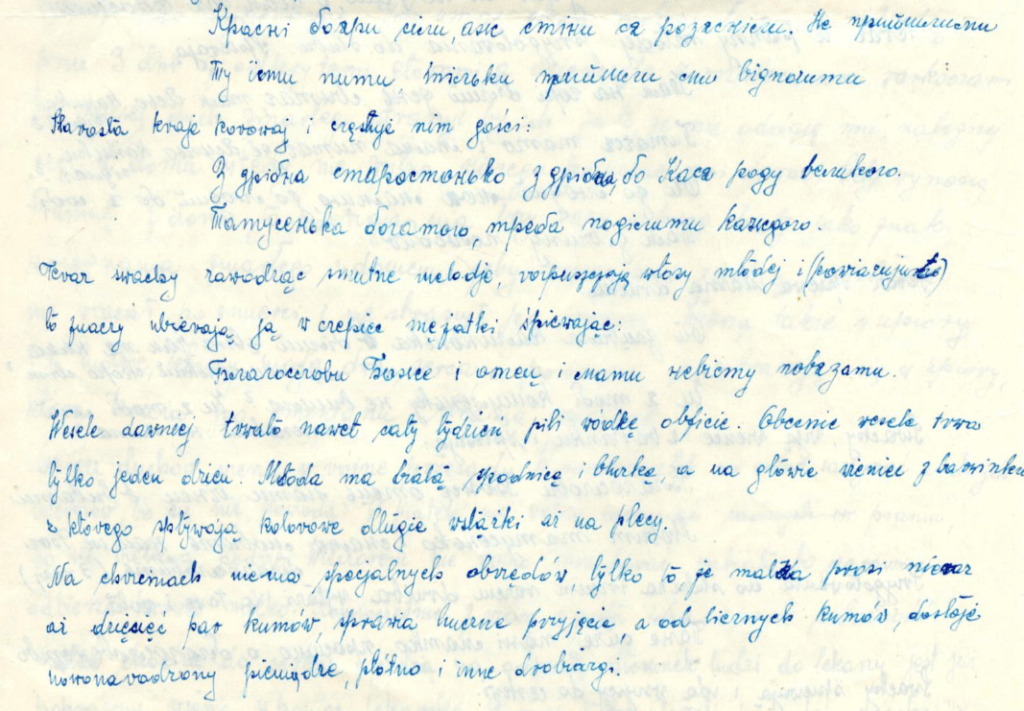
Transcript: Google-Powered
Warning: this transcription may be terrible. It was done electronically by someone who can speak neither Polish nor Ukrainian/Lemko. Do you wish to see it improve? You can help! Contact us.
Uwaga: ta transkrypcja może być fatalna. Została wykonana automatycznie przez osobę, która nie zna ani języka polskiego, ani ukraińskiego/łemkowskiego. Chcesz, żeby była lepsza? Możesz pomóc! Skontaktuj się z nami.
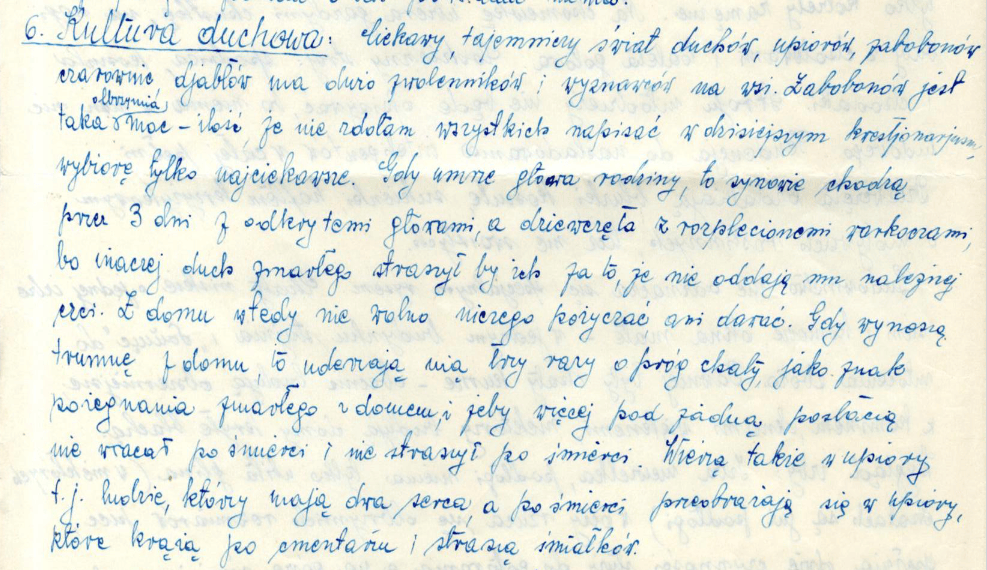
6. Kultura duchowa: Ciekawy, tajemniczy świat duchów, upiorów, zabobonów czarownic, djabłów ma dużo zwolenników i wyznawców na wsi. Zabobonów jest taka olbrzymia moc – ilość, że nie zdołam wszystkich napisać w dzisiejszym kwestjonarjuszu, wybiorę tylko najciekawsze. Gdy umrze głowa rodziny, to synowie chodzą przez 3 dni z odkrytemi głowami, a dziewczęta z rozplecionemi warkoczami, bo inaczej duch zmarłego straszył by ich za to, że nie oddają mu należnej czci. Z domu wtedy nie wolno niczego pożyczać ani darować. Gdy wynoszą trumnę z domu, to uderzają nią trzy razy o próg chałupy jako znak pożegnania zmarłego z domem i żeby więcej pod żadną postacią nie wracał po śmierci i nie straszył po śmierci. Wierzą także w upiory t.j. ludzie, którzy mają dwa serca, a po śmierci przeobrażają się w upiory, które krążą po cmentarzu i straszą śmiałków.
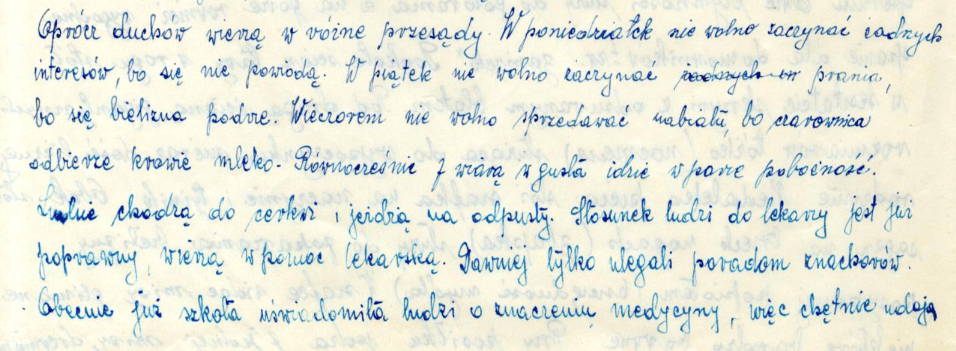
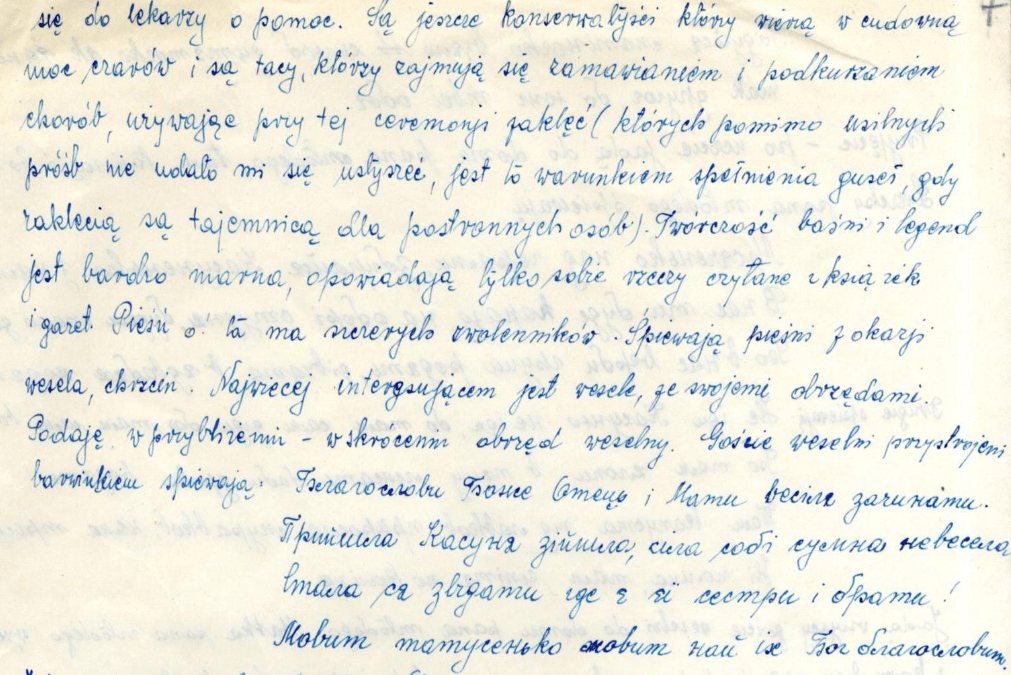
Oprócz duchów wierzą w różne przesądy. W poniedziałek nie wolno zaczynać żadnych interesów, bo się nie powiodą. W piątek nie wolno zaczynać żadnych prac prania, bo się bielizna podrze. Wieczorem nie wolno sprzedawać nabiału, bo czarownica odbierze krowie mleko. Równocześnie z wiarą w gusła idzie spore pobożność. Ludzie chodzą do cerkwi i jeżdżą na odpusty. Stosunek ludzi do lekarzy jest już poprawny, wierzą w pomoc lekarską. Dawniej tylko ulegali poradom znachorów. Obecnie już szkoła uświadomiła ludzi o znaczeniu medycyny, więc chętnie udają się do lekarzy o pomoc. Są jeszcze konserwatyści, którzy wierzą w cudowną moc czarów i są tacy, którzy zajmują się zamawianiem i podkurzaniem chorób, używając przy tej ceremonii zaklęć (których pomimo usilnych próśb nie udało mi się usłyszeć, jest to warunkiem spełnienia guseł, gdy zaklęcia są tajemnicą dla postronnych osób). Twórczość baśni i legend jest bardzo marna, opowiadają tylko sobie rzeczy czytane z książek i gazet. Pieśń o ta ma szczerych zwolenników. Śpiewają pieśni z okazji wesela, chrzcin. Najwięcej interesującem jest wesele, ze swojemi obrzędami. Podaję w przybliżeniu – w skróceniu obrzęd weselny. Goście weselni przystojeni barwinkiem śpiewają:
Благослови Боже Отець і Мати весілля починати.
Прийшла Касуня зійшла, сіла собі сумна невесела
Стала ся звідати где є її сестри і брати!
Мовить татусенько мовить най їх Бог благослови
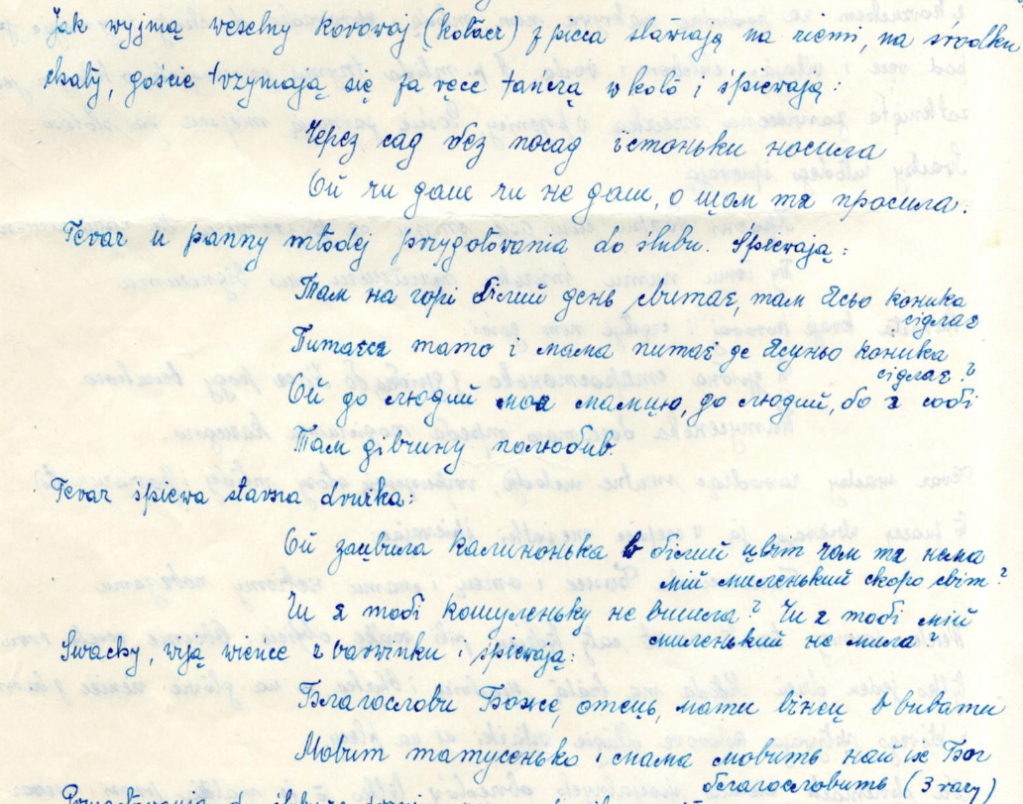
Jak wyjmą weselny korowaj (kołacz) z pieca stawiają na ziemi, na środku chaty, goście trzymają się za ręce tańczą w koło i śpiewają:
Через сад без посад істоньки носила
Ой чи даш чи не даш, о щом тя просила.
Teraz u panny młodej przygotowania do ślubu. Śpiewają:
Там на горі білий день свитає, там ясно коника сідлає
Туматься мамо і тата питає де ясно коника сідлає?
Ой до людий моя мамусю, до людий, бо я тобі
Там дівчину полюбив
Teraz śpiewa starsza drużka:
Ой зацвіла калинонька в білий цвіт чом тя на мамі
миленький скоро світ?
Чи я тобі кошуленьку не вишила? Чи я тобі мій
миленький не мила?
Swacky, wiją wieńce z barwinku i śpiewają:
Благослови Боже, отець, мати вінець взивати
Мовит татусенько і мама мовить най їх Бог благословити (3 рази)
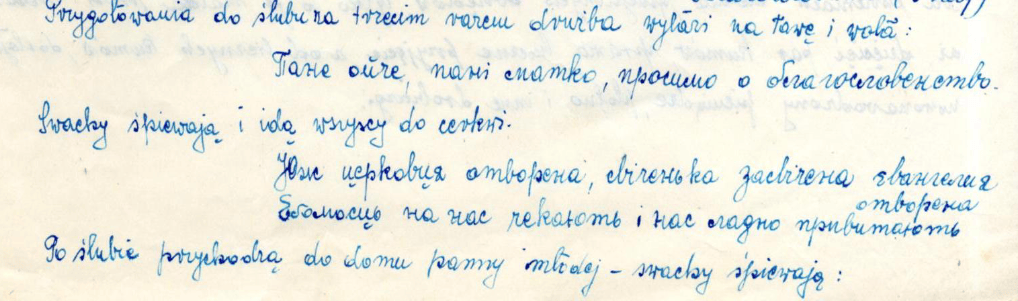
Przygotowania do ślubu na trzecim razem drużba wyłazi na ławę i woła:
Пане ойче, пані матко, прошимо о благословенство.
Swacky śpiewają i idą wszyscy do cerkwi.
Уже церьковця отворена, свічецька засвічена, євангелия
отворена,
Божосьць на нас чекають і нас ладно привитають.
Po ślubie przychodzą do domu panny młodej – swacky śpiewają:
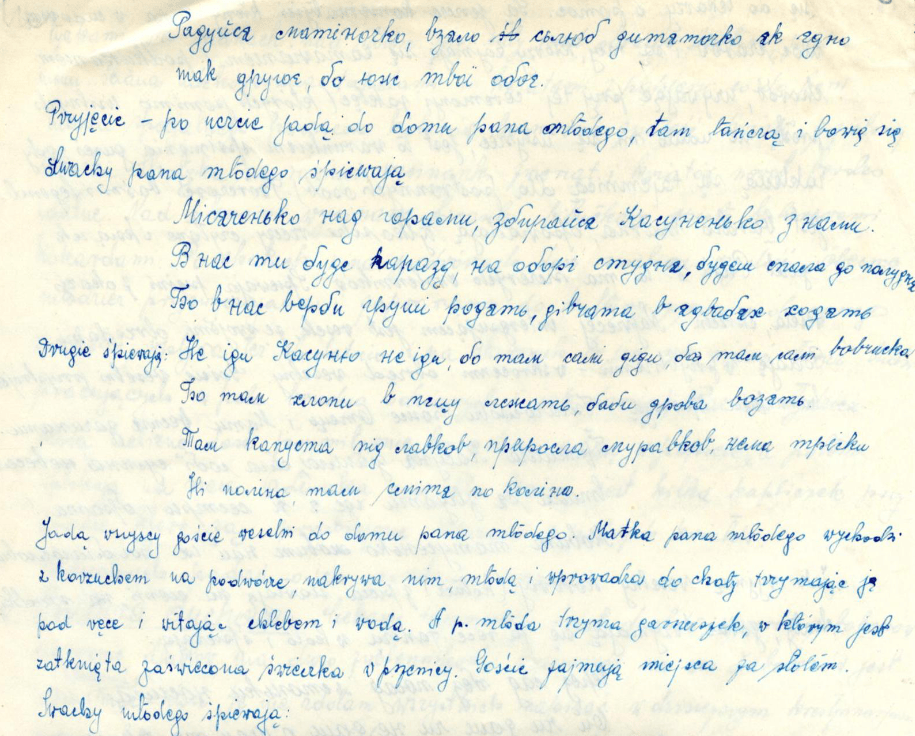
Радуйся свашиночко, взяло ти сіход дитаточко як едно так другоє, бо тоє твоі обоє.
Przyjęcie – po uczcie jadą do domu pana młodego, tam tańczą i bawią się. Swacky pana młodego śpiewają.
Місяченько над горами, збирайся Касуненко з нами.
В нас ти буде гаразд, на оборі студня, будем спати до полудня.
Бо в нас верби груші родять, дівчата в ахтандах ходять.
Drugie śpiewają:
Не йди Касуню не йди, бо там самі біди, бо там самі вовківця.
Бо там хлопи в мху очекать, баби дрова возять.
Там капуста під лавкою, переросла шпираков, нема трішки
Ні поліна, там свиню по коліно.
Jadą wszyscy goście weselni do domu pana młodego. Matka pana młodego wychodzi z kożuchem na podwórze, nakrywa nim młodą i sprowadza do chaty trzymając ją pod ręce i witają chlebem i wodą. A p. młoda trzyma garneczek, w którym jest zatknięta zaświecona świeczka w pszenicy. Goście zajmują miejsca za stołem.
Swacky młodego śpiewają:
Красні бояри сіли, але стіни ся розсілися. Не прийшлисми
Ту їсти пити імісчки прийшлисми відпочити
Starosta kraje korowaj i częstuje nim gości:
З дрібна старостонько з дрібна, бо каса роду великого.
Татусенька багатого, треба поділити кожного.
Teraz swacky zawodząc smutne melodje, rozpuszczają włosy młodej i (powiązujunto) Co znaczy ubierają ją w czepiec mężatki śpiewając:
Прилагосегови Боже і отец і мати невісту поbazamu.
Wesele dawniej trwało nawet cały tydzień pili wódkę obficie. Obecnie wesele trwa tylko jeden dzień. Młoda ma białą spódnicę i bluzkę, a na głowie wieniec z barwinku z którego spływają kolorowe długie wstążki aż na plecy.
Na chrzcinach nie ma specjalnych obrzędów, tylko to że matka prosi nieraz aż dziesięć par kumów, sprawia huczne przyjęcie, a od wiernych kumów dostaje nowonarodzony pieniądze, płótno i inne drobiazgi.
English Translation: Google-Powered
Warning: this translation may be terrible. It was done electronically by someone who can speak neither Polish nor Ukrainian/Lemko. Do you wish to see it improve? You can help! Contact us.
Uwaga: to tłumaczenie może być fatalne. Zostało wykonane automatycznie przez osobę, która nie zna ani języka polskiego, ani ukraińskiego/łemkowskiego. Chcesz, żeby było lepsze? Możesz pomóc! Skontaktuj się z nami.
Spiritual Culture: The intriguing and mysterious realm of spirits, specters, superstitions, witches, and devils finds many adherents and believers in the countryside. There is such an immense number of superstitions that I cannot list them all in today’s questionnaire; I shall select only the most interesting ones. When the head of a family dies, his sons go about bareheaded for three days, and the girls wear their hair unbraided—lest the spirit of the deceased haunt them for failing to show the proper respect. During this time, nothing may be lent or given away from the household. When the coffin is carried out, it is struck three times against the threshold of the cottage; this serves as a farewell between the deceased and their home, and is intended to ensure that the departed does not return in any form to haunt the living. There is also a belief in upiory (specters)—individuals born with two hearts who, upon death, transform into restless spirits that roam the cemetery and terrify the unwary.
Beyond these beliefs in spirits, there are various other superstitions. One must not begin any new venture on a Monday, for it will surely fail. Laundry should not be done on a Friday, as the linens will tear. Dairy products must not be sold in the evening, lest a witch cause the cow’s milk to dry up. Yet, this belief in folk magic and charms coexists with a deep sense of piety; people attend the Orthodox church and travel to religious festivals (odpusty). People’s attitude toward medical doctors has become more sensible, and they now trust in professional medical care—whereas in the past, they relied solely on the advice of folk healers. Nowadays, schooling has made people aware of the importance of medicine, so they readily turn to doctors for help. There are still some traditionalists who believe in the miraculous power of sorcery—individuals who practice “conjuring away” or “smoking out” illnesses through rituals involving incantations (which, despite my persistent requests, I could not manage to hear; keeping the incantations secret from outsiders is a prerequisite for the efficacy of these superstitious practices). The creation of new folktales and legends is quite meager; people mostly recount stories they have read in books or newspapers. Traditional singing, however, remains very popular. Songs are performed on occasions such as weddings and christenings. Weddings, with their various customs, are the most interesting; I provide here a brief, abridged account of the wedding ritual.
Bless us, God, Father and Mother, to begin the wedding.
Kasunya came up, sat down, sad and not cheerful.
She started to ask where her sisters and brothers were!
Father says, may God bless them.
When the wedding bread (korowaj / kolacz) is taken out of the oven, they place it on the ground, in the center of the house, guests hold hands, dance in a circle, and sing:
Through the garden without planting, she carried the basket.
Oh, will you give or not give what I asked of you?
Now at the bride’s, preparations for the wedding. They sing:
There on the hill, the white day is dawning, there clearly the horse is being saddled.
The young girl asks her mother and father where the horse is clearly being saddled?
Oh my dear mother, to the people, because I have
There fallen in love with a girl.
Now the older bridesmaid sings:
Oh, the viburnum bloomed white, why do you shine on mother, dear, so soon?
Didn’t I sew you a shirt? Didn’t I, my dear, love you?
Swacky (female wedding helpers) weave wreaths from periwinkle and sing:
Bless us, God, Father and Mother, to put on the wreath.
Father says, and mother says, may God bless them (3 times).
During preparations for the wedding, for the third time the best man climbs on the bench and calls:
Sir father, madam mother, we ask for your blessing.
Swacky sing and everyone goes to the church:
The church door is already open, candle is lit, the gospel is open,
The Lord is waiting for us and will warmly welcome us.
After the wedding, they come to the bride’s house—swacky sing:
Rejoice, dear sister-in-law, you have taken a child, one and then another, because both are yours.
The feast—after the banquet they go to the groom’s house, dance and have fun. Swacky of the groom sing:
Moon over the mountains, Kasunenko gather with us.
You will be fine with us, by the well in the yard, we will sleep till noon.
Because we have willow trees and pear trees bearing fruit, girls walk in moccasins.
Another song:
Don’t go Kasunya, don’t go, because there is only sorrow, because there are only wolves.
Because there the boys hide in the moss, women carry firewood.
Under the bench grows cabbage overtaken by weeds, there isn’t even a little firewood, and there a pig knee-high.
All wedding guests go to the groom’s house. The groom’s mother comes out in a coat to the yard, covers the bride with it, leads her into the house holding her by the arm, and they greet her with bread and water. The bride holds a small pot with a lit candle stuck in wheat. Guests take their seats at the table.
Swacky of the groom sing:
Handsome boyars sat down, but the walls crumbled. We didn’t come here to eat or drink, we came to rest.
The elder cuts the korowaj bread and serves the guests:
From a small elder, from a small one, because the family chest is big.
Father is wealthy, everyone must share.
Now swacky, wailing sad melodies, let down the bride’s hair and (powiązujunto) which means they dress her in a married woman’s cap while singing:
Bless us, God, Father and Mother, the bride after the wedding.
Weddings used to last even a whole week with plenty of vodka. Presently, the wedding lasts only one day. The bride wears a white skirt and blouse, and on her head a wreath of periwinkle from which colorful long ribbons flow down the back.
At christenings, there are no special rituals except sometimes the mother invites up to ten pairs of godparents, throws a big party, and receives money, linen, and other small gifts from the faithful godparents.
Sanok Genes seeks to create a database of transcripts and English translations from the “Kultura Duchowa” sections from the 1936 Sanok School Inspectorate Questionnaires. The original documents are held by the Sanok Museum of History and digitized by the Sanok Digital Library. To learn more, see the project description.
Sanok Genes stawia sobie za cel stworzenie bazy danych zawierającej transkrypcje oraz tłumaczenia na język angielski fragmentów dotyczących „kultury duchowej”, pochodzących z kwestionariuszy Inspektoratu Szkolnego w Sanoku z 1936 roku. Oryginalne dokumenty znajdują się w zbiorach Muzeum Historycznego w Sanoku i zostały zdigitalizowane przez Sanocką Bibliotekę Cyfrową. Więcej informacji można znaleźć w opisie projektu.

