Smerek is a village in Cisna Commune, Lesko County.
Smerek– wieś w gminie Cisna, w powiecie leskim.
Transcript: Google-Powered
Warning: this transcription may be terrible. It was done electronically by someone who can speak neither Polish nor Ukrainian/Lemko. Do you wish to see it improve? You can help! Contact us.
Uwaga: ta transkrypcja może być fatalna. Została wykonana automatycznie przez osobę, która nie zna ani języka polskiego, ani ukraińskiego/łemkowskiego. Chcesz, żeby była lepsza? Możesz pomóc! Skontaktuj się z nami.
- Kultura duchowa
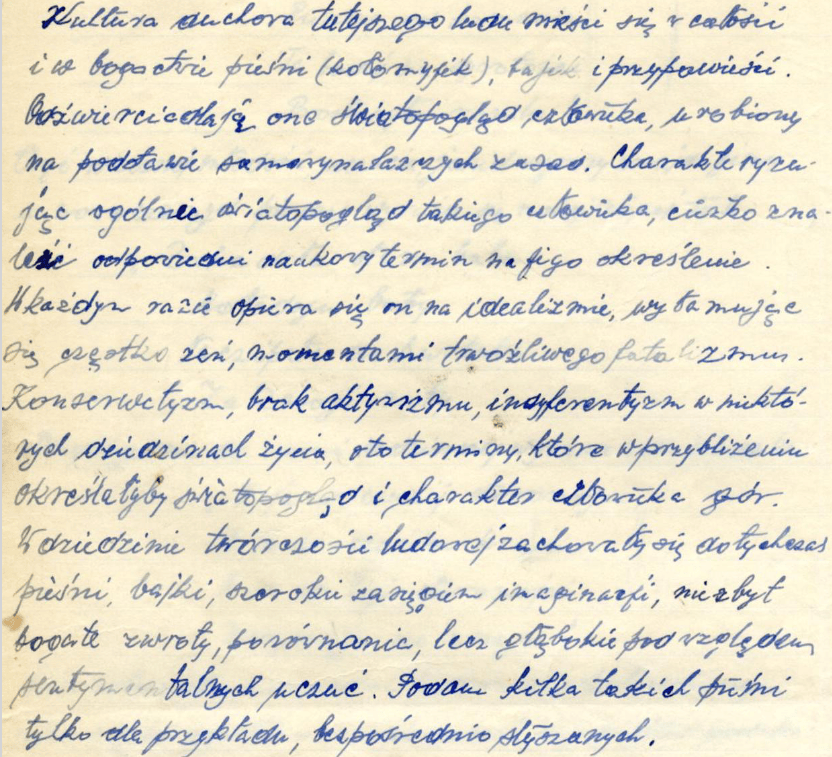
Kultura duchowa tutejszego ludu mieści się w całości i w bogactwie pieśni (kołomyjek), bajek i przypowieści. Odzwierciedlają one światopogląd człowieka, urobiony na podstawie samorzutnych zasad. Charakteryzując ogólnie światopogląd takiego człowieka, ciężko znaleźć odpowiedni naukowy termin na jego określenie. W każdym razie opiera się on na idealizmie, wyłamując się często zeń, momentami trwożliwego fatalizmu. Konserwatyzm, brak aktywizmu, indyferentyzm w niektórych dziedzinach życia, oto terminy, które w przybliżeniu określiłyby światopogląd i charakter człowieka gór. W dziedzinie twórczości ludowej zachowały się dotychczas pieśni, bajki, korobin, zarojów imaginacji, niezbyt bogate zwroty, porównania, lecz głębokie pod względem sentymentalnych uczuć. Podam kilka takich pieśni tylko dla przykładu, bezpośrednio słyszanych.
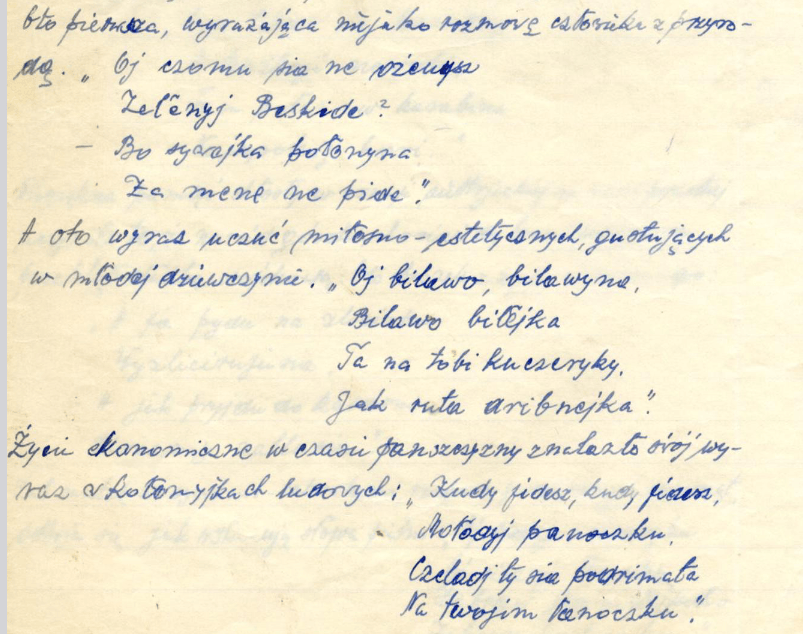
Oto pierwsza, wyrażająca niejako rozmowę człowieka z przyrodą.
„Oj czemu sia ne zielenysz
Zelenyj Beskide?
– Bo syarcjka połonyna
Za mene ne pide.”
A oto wyraz uczuć miłosno-estetycznych, gustujących w młodej dziewczynie.
„Oj bilawo, bilawyno,
Bilawo bilejka
Ja na tobi kuczeryky,
Jak ruta dribnejka.”
Życie ekonomiczne w czasie pańszczyzny znalazło swój wyraz w kołomyjkach ludowych;
„Kudy jidesz, kudy jidesz,
Mołodyj panoczku,
Czeladź ty sia podrymata
Na twojim łanoczku.”
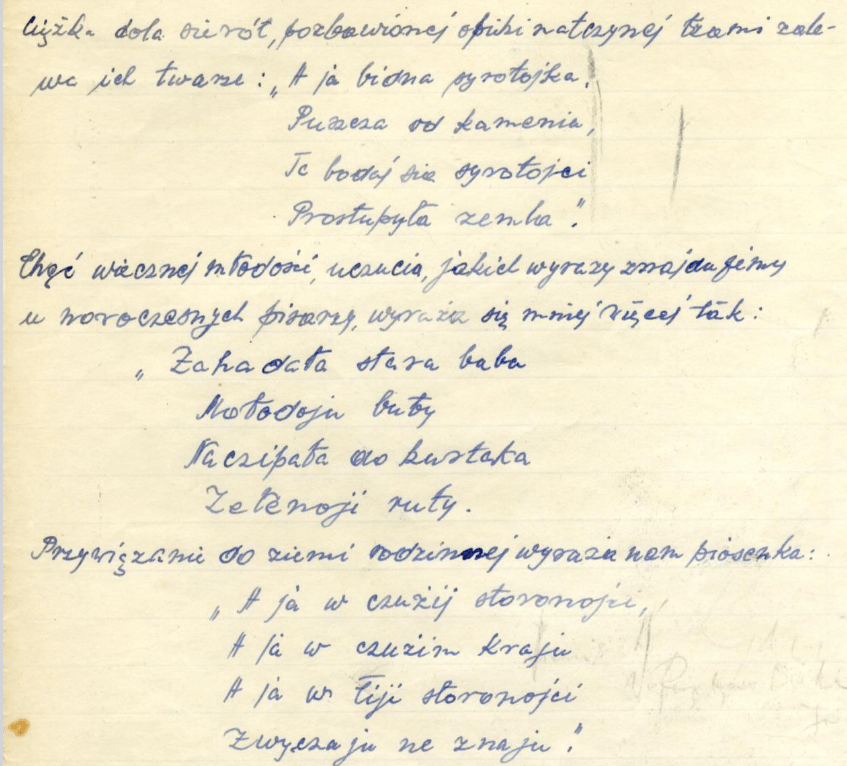
Ciężka dola sierót, pozbawionej opieki matczynej łzami zalewa ich twarze:
„A ja bidna syrotojka,
Puscza od kamenia,
Je bodaj sie syrotoici
Prostupiła zemla!”
Chęć wczesnej młodości, uczucia, jakie wyrazy znajdujemy u nowoczesnych pisarzy, wyraża się mniej więcej tak:
„Zahadała stara baba
Mołodoju byty
Naczipała do kurtaka
Zełenoji ruty.
Przywiązanie do ziemi rodzinnej wyraża nam piosenka:
„A ja w czużij storonojci,
A ja w czużim kraju
A ja w tiji storonojci
Zwyczaju ne znaju!”
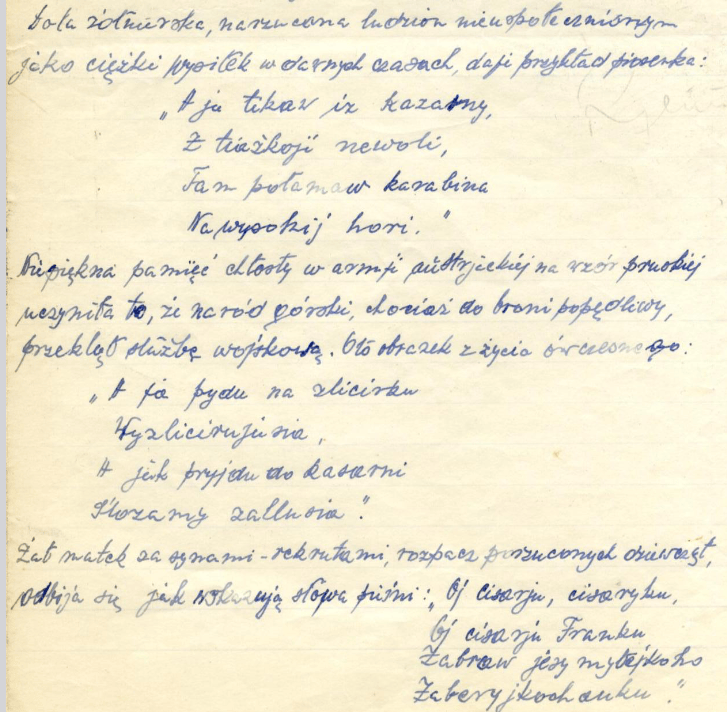
Dola żołnierska, narzucona ludziom nieuspołecznionym jako ciężki wysiłek w dawnych czasach, daje przykład piosenka:
„A ja tikar iz kazarny,
z tiażkoji newoli,
Tam połomaw karabina
Na wysokij hori.”
Dzięki pamięć chłosty w armji austryjackiej na wzór pruskiej uczyniła to, że naród górski, chociaż do broni popędliwy, przeklął służbę wojskową. Oto obrazek z życia ówczesnego:
„A ja pydu na slicitku
Wyzlicytuju sia,
A jak pryjdu do kasarni
Płoczuty zakłusia !”
Żal matek za synami-rekrutami, rozpacz porzuconych dziewcząt, odbija się jak wskazują słowa pieśni:
„Oj cisarju, cisaryku,
Oj cisarju Franku
Zabraw jesy mylejkoho
Zabery j kochanku.”
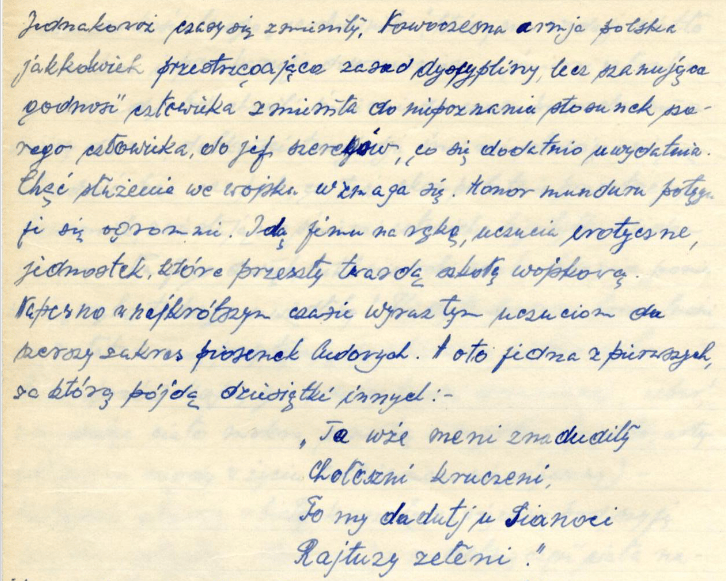
Jednakowoż czasy się zmieniły. Nowoczesna armia polska jakkolwiek przestrzegająca zasad dyscypliny, lecz szanująca godność człowieka zmieniła do niepoznania stosunek szarego człowieka do jej szeregów, co się dodatnio uwydatnia. Chęć służenia we wojsku wzmaga się. Honor munduru potęży się ogromnie. Idą jemu na rękę, uczenie erotyczne, jednostek, które przeszły twardą szkołę wojskową. Napewno w najkrótszym czasie wzrośnie poczet dla rzeszy sukces piosenek ludowych. A oto jedna z pierwszych, z którą pójdą dziesiątki innych:—
“Ta wże meni znudyły
Chołozni kruczeni,
To my dadutj u Sianoci
Rajtuzy zeleni!”
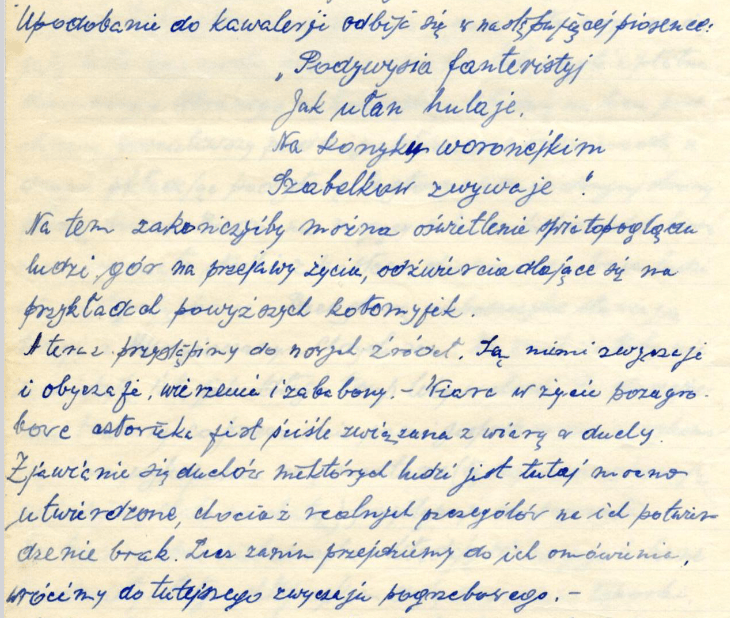
Upodobanie do kawalerji odbija się w następującej piosence:
„Podrywają fanteristyj
Jak ułan hulaje,
Na koniku woroneckim
Szabelką zwywaje!”
Na tem zakończyć by można oświetlenie przy topoglądzie ludzi, gór na przejawy życia, odzwierciadlające się na przykładach powyższych kołomyjek.
A teraz przystąpmy do nowych źródeł. Są niemi zwyczaje i obyczaje, wierzenia i zabobony. – Wiara w życie pozagrobowe człowiecze jest ściśle związana z wiarą w duchy. Zjawianie się duchów niektórych ludzi jest tutaj mocno utwierdzone, chociaż realnych szczegółów na ich potwierdzenie brak. Lecz zanim przystąpmy do ich omówienia, wrócimy do tutejszego zwyczaju pogrzebowego. –
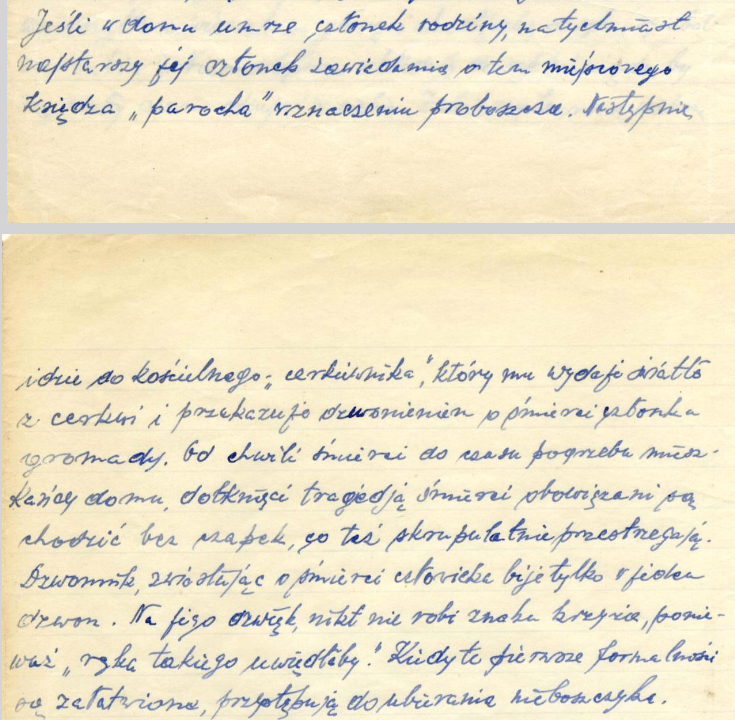
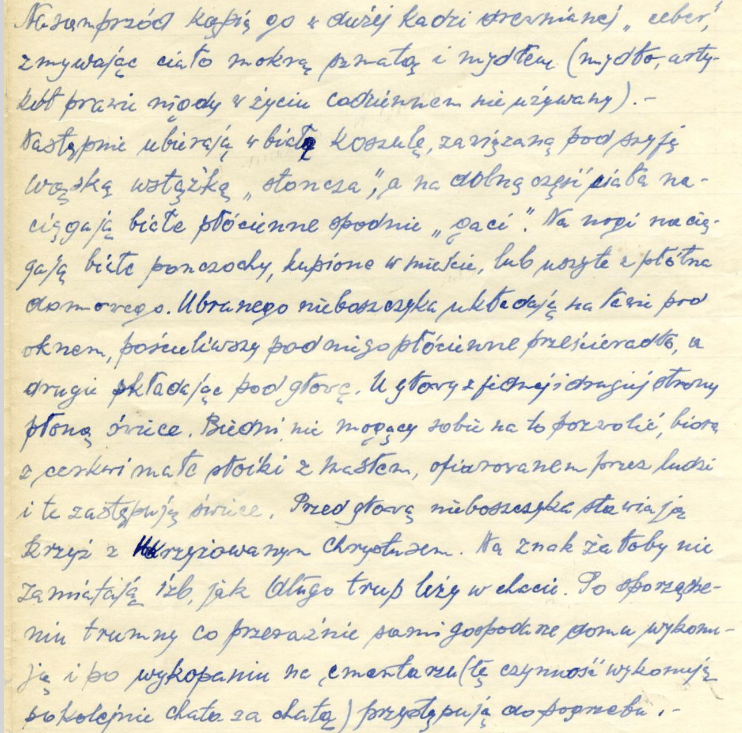
Jeśli w domu umrze członek rodziny, natychmiast najstarszy jej członek zawiadamia o tem miejscowego księdza, „parocha” w znaczeniu proboszcza. Następnie, idzie do kościelnego, cerkiewnika, któremu wydaje światło z cerkwi i przekazuje dzwonieniem o śmierci członka gromady. Od chwili śmierci do czasu pogrzebu mieszkańcy domu, dotknięci tragedją śmierci obowiązani są chodzić bez czapek, co też skrupulatnie przestrzegają. Dzwonnik, zwiastując o śmierci człowieka bije tylko w jeden dzwon. Na jego dźwięk nikt nie robi znaku krzyża, ponieważ „ręka takiego uwiędłaby.” Kiedy te pierwsze formalności są załatwione, przystępują do ubierania nieboszczyka.
Najpierw kąpią go w dużej kadzi drewnianej, cebrze, zmywając ciało mokrą szmatą i mydłem (mydło, artykuł prawie młody, w życiu codziennem nieużywany). – Następnie ubierają w białą koszulę, zawiązaną pod szyją wąską wstążką „słoneca”, a na dolną część ciała naciągają białe płócienne spodnie „gaci”. Na nogi naciągają białe pończochy, kupione w mieście, lub uszyte z płótna domowego. Ubranego nieboszczyka układają na ławie pod oknem, położywszy pod niego płócienne prześcieradło, a drugie składając pod głowę. U głowy z jednej i drugiej strony płoną świece. Biedni, nie mogący sobie na to pozwolić, biorą z cerkwi małe słoiki z masłem, ofiarowanem przez ludzi i te zastępują świece. Przed głowę nieboszczyka stawiają krzyż z ukrzyżowanym Chrystusem. Na znak, że toby nie zamiatają izb, jak długo trup leży w chacie. Po sporządzeniu trumny, co przeważnie sami gospodarze domu wykonują i po wykopaniu na cmentarzu (tę czynności wykonują pokolejnie chata za chatą) przystępują do pogrzebu. –
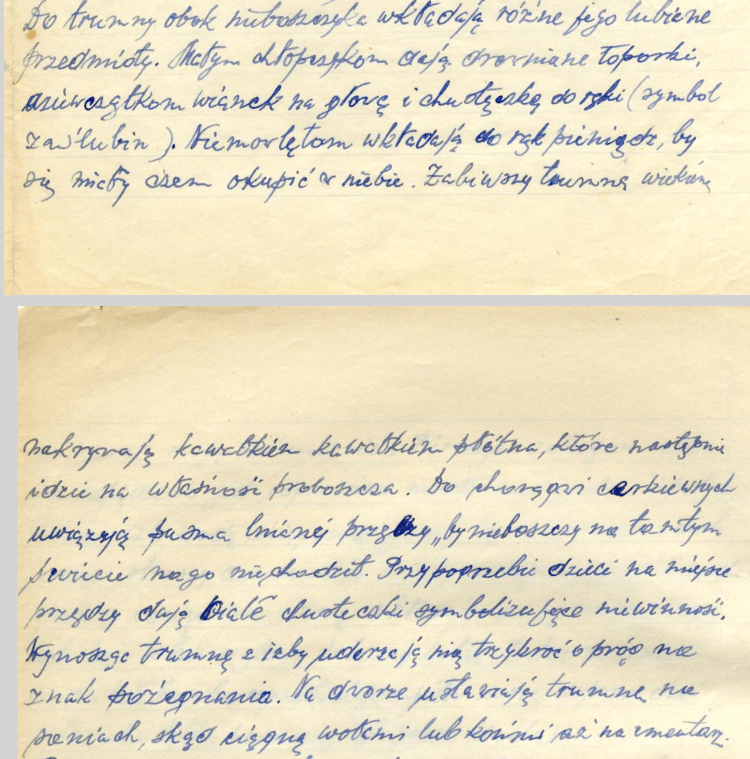
Do trumny obok nieboszczyka wkładają różne jego lubiane przedmioty. Małym chłopcom dają drewniane toporki, dziewczątkom wianek na głowę i chusteczkę do ręki (symbol zaślubin). Niemowlętom wkładają do rąk pieniądz, by się miały czem okupić w niebie. Zabiwszy trumnę wiekiem nakrywają kawałkiem kawałkiem płótna, które następnie idzie na własność proboszcza. Do chorągwi cerkiewnych uwiązują pasma lnianej przędzy, by nieboszczyk na tamtym świecie nago nie chodził. Przy pogrzebie dzieci na miejsce przędzy dają białe chusteczki symbolizujące niewinność. Wynosząc trumnę z izby uderzają nią trzy kroć o próg na znak pożegnania. Na dworze ustawiają trumnę na saniach, skąd ciągną wołami lub końmi aż na cmentarz.
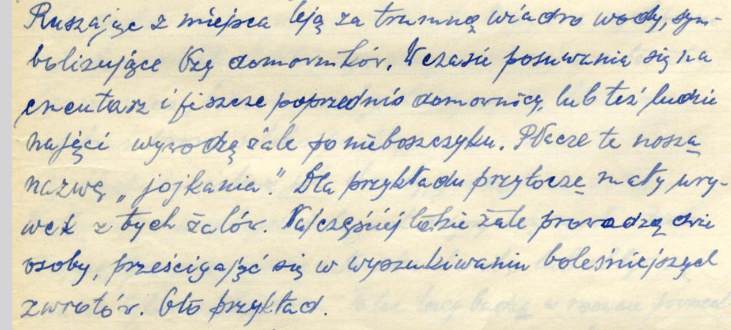
Ruszające z miejsca lecą za trumną wiadro wody, symbolizujące łzy domowników, teraz posuwanie się na cmentarz i jeszcze poprzednio domownicy, lub też ludzie najczęściej wyroki całe po nieboszczyku. Przez te noszą nazwę „jojkania”. Dla przykładu przytoczę urywek z tych żalów. Najczęściej takie żale prowadzą dwie osoby, prześcigając się w wyszukiwaniu boleśniejszych zwrotów. Oto przykład.
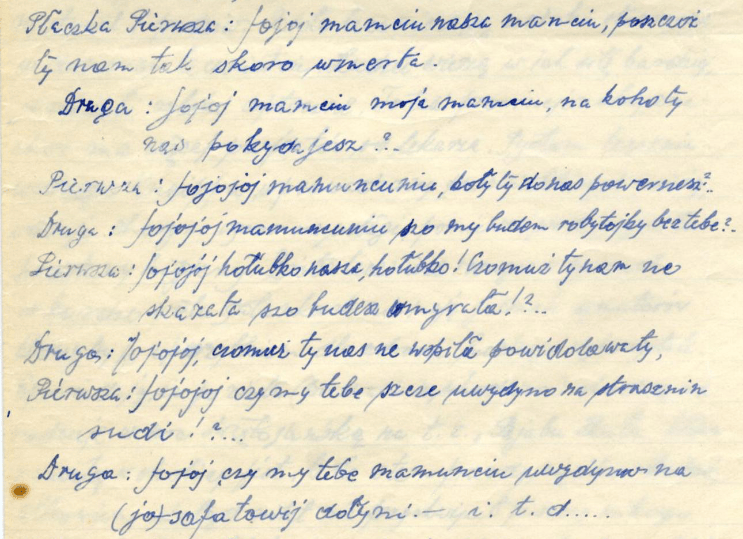
Pleczka Pierwsza: Jojoj mamciu nasza mamciu, pocomu ty nam tak skoro umerła.
Druga: Jojoj mamciu moje mamciu, na koho ty nas pokydajesz?..
Pierwsza: Jojojoj mamunciu niu, bo ty do nas pouerness.
Druga: Jojojoj mamunciuniu szo my budem robitysky bez tebe?..
Pierwsza: Jojojoj hołubko nasza hołubko! Czomuż ty nam ne skazała szo budesz umyraty!?..
Druga: Jojojoj czomuż ty nas ne wspiła powidoławety,
Pierwsza: Jojojoj czy my tebe sczere uwydymo na strasznim sudi!?…
Druga: Jojoj czy my tebe mamunciu prysły mo na (jo)szafatowij dołyni… i. t. d…..
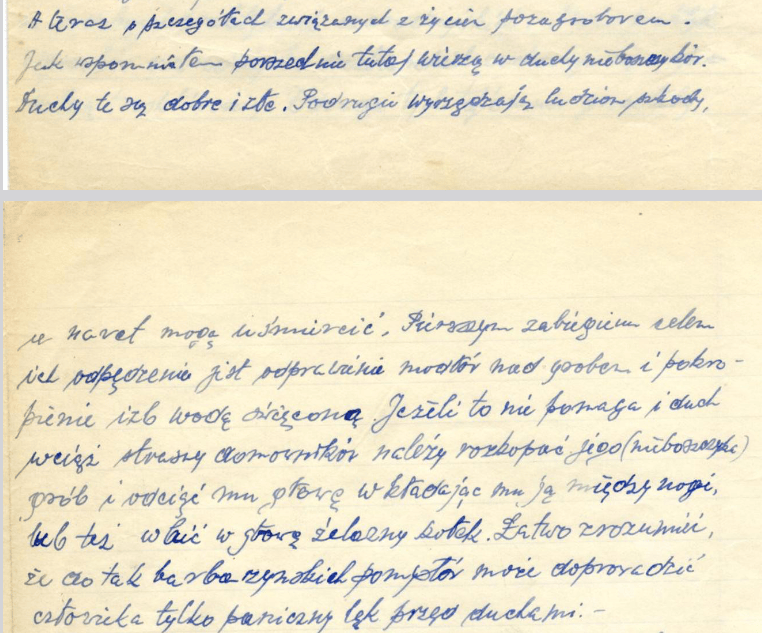
A teraz o szczegółach związanych z życiem pozagrobowem. Jak wspomniałem poprzednio tutaj wierzą w duchy nieboszczyków.Duchy te są dobre i złe. Drudzy wyrządzają ludziom szkody,że nawet mogą uśmiercić. Pierwszym zabiegiem celem ich odpędzenia jest odprawienie modłów nad grobem i pokropienie izb wodą święconą. Jeżeli to nie pomaga i duch wciąż straszy domowników należy rozkopać jego (nieboszczyka) grób i odciąć mu głowę wkładając mu ją między nogi,lub też wbić w głowę żelazny kołek. Łatwo zrozumieć,że do tak barbarzyńskich pomysłów może doprowadzić człowieka tylko paniczny lęk przed duchami. —
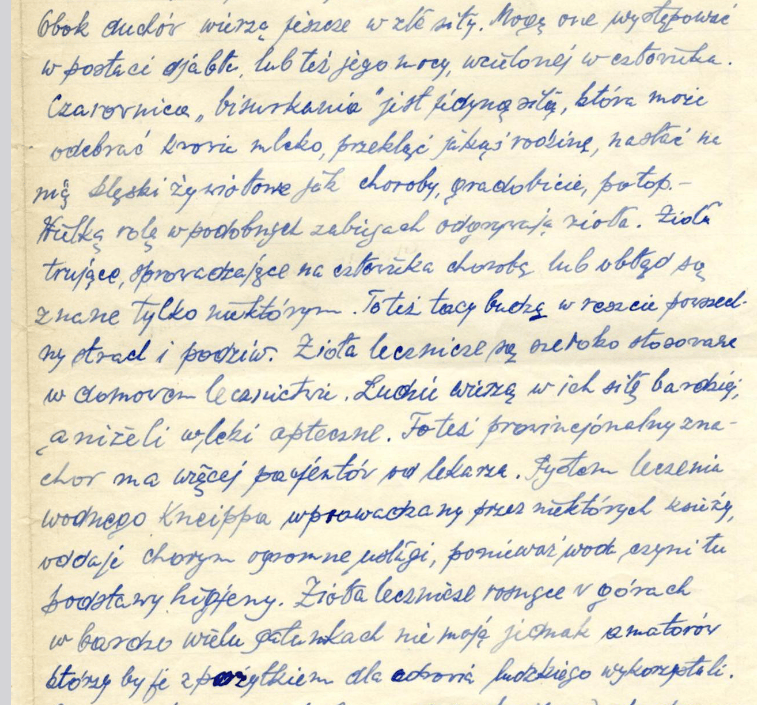
Obok duchów wierzę jeszcze w złe siły. Mogą one występować w postaci djabła, lub też jego mocy, wcielonej w człowieka. Czarownica, bisurkania “jest jedyną siłą”, która może odebrać krowie mleko, przekląć piękną roślinę, nasłać na nią klęski żywiołowe jak choroby, gradobicie, potop.–
Wielką rolę w podobnych zabiegach odgrywają zioła. Zioła trujące, sprowadzające na człowieka chorobę lub obłęd są znane tylko niektórym. Toteż tacy budzą wreszcie powszechny strach i podziw. Zioła lecznicze są nie tylko stosowane w domowem lecznictwie. Ludzie wierzą w ich siłę bardziej, aniżeli w leki apteczne. Toteż prowincjonalny znachor ma więcej pacjentów od lekarza. System leczenia wodnego Kneippa wprowadzony przez niektórych księży, oddaje chorym ogromne usługi, ponieważ woda czyni tu podstawy higieny. Zioła lecznicze rosnące w górach w bardzo wielu gatunkach nie mają jednak amatorów którzy by je z pożytkiem dla zdrowia ludzkiego wykorzystali.
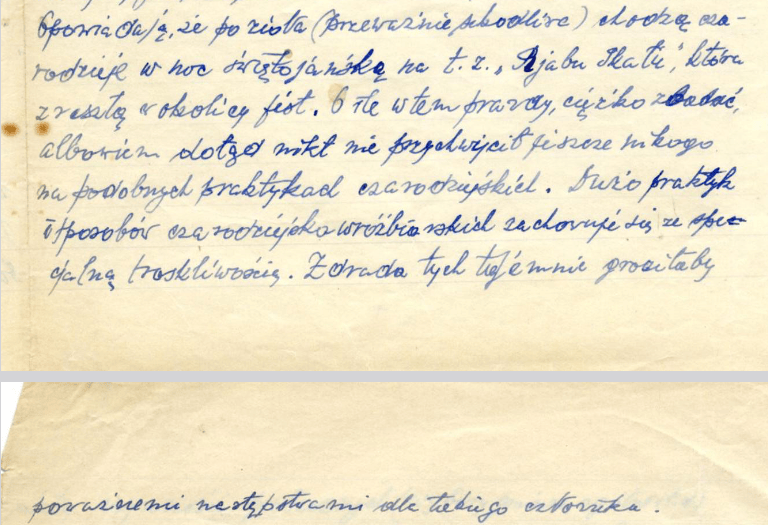
Opowiadają, że po zioła (przeważnie szkodliwe) chodzą czarodzieje w noc świętojańską na t.z. „Djable Skały”, które zresztą w okolicy jest. Ile w tem prawdy, ciężko zbadać, albowiem dotąd nikt nie przyłapał jeszcze nikogo na podobnych praktykach czarodziejskich. Dużo praktyk i sposobów czarodziejsko-wróżbiarskich zachowuje się ze specjalną troskliwością. Zdrada tych tajemnic groziłaby poważnemi następstwami dla takiego człowieka.
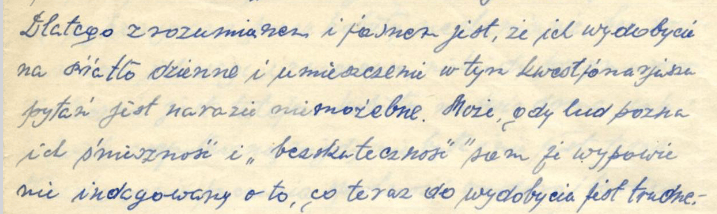
Dlatego zrozumiałem i jasnem jest, że ich wydobycie na światło dzienne i umieszczenie w tym kwestjonarjuka pytań jest na razie niemożebne. Może, gdy lud pozna ich śmieszność i „bezskuteczność” sam je wypowie nie indagowany o to, co teraz do wydobycia jest trudne.
English Translation: Google-Powered
Warning: this translation may be terrible. It was done electronically by someone who can speak neither Polish nor Ukrainian/Lemko. Do you wish to see it improve? You can help! Contact us.
Uwaga: to tłumaczenie może być fatalne. Zostało wykonane automatycznie przez osobę, która nie zna ani języka polskiego, ani ukraińskiego/łemkowskiego. Chcesz, żeby było lepsze? Możesz pomóc! Skontaktuj się z nami.
6. Spiritual Culture
The spiritual culture of the local people is contained in its entirety within the richness of their songs (kolomyikas), fairy tales, and parables. They reflect a human worldview shaped on the basis of spontaneous principles. Characterizing the worldview of such a person in general, it is difficult to find an appropriate scientific term to define it. In any case, it is based on idealism, often breaking away from it into moments of fearful fatalism. Conservatism, a lack of activism, and indifference in certain spheres of life—these are the terms that would approximately define the worldview and character of the mountain person. In the field of folk creativity, there have survived to this day songs, fairy tales, carols, and founts of imagination—not overly rich in turns of phrase or comparisons, yet deep in terms of sentimental feelings. I will provide a few such songs merely as examples, heard firsthand.
Here is the first, expressing, as it were, a conversation between man and nature:
“Oh, why do you not turn green,
Green Beskid?
— Because the orphaned mountain pasture
Will not marry me.”
And here is an expression of amorous-aesthetic feelings, delighting in a young maiden:
“Oh fair-haired one, fair-skinned beauty,
Fair, so very fair,
On you are little curls
Like fine-leafed rue.”
Economic life during the time of serfdom found its expression in folk kolomyikas:
“Where are you riding, where are you riding,
Young master?
Your serf-laborers have fallen asleep
On your little field.”
The hard lot of orphans, deprived of maternal care, floods their faces with tears:
“And I am a poor little orphan,
Forsaken even by a stone;
Would that for a little orphan
The earth might part and swallow her!”
The desire for early youth—feelings whose expressions we find in modern writers—is expressed roughly like this:
“An old woman took it into her head
To be young again;
She pinned onto her short coat
Some green rue.”
Attachment to one’s native land is expressed to us by the song:
“And I am in a foreign land,
And I am in a strange country,
And in that foreign land
I do not know the custom!”
The soldier’s lot, imposed upon unsocialized people as a heavy burden in olden times, is exemplified by the song:
“And I fled from the barracks,
From heavy bondage;
There I broke my rifle
On the high mountain.”
The bitter memory of flogging in the Austrian army, modeled on the Prussian style, meant that the mountain people, although quick to take up arms, cursed military service. Here is a picture from life in those days:
“And I will go to the conscription auction,
I will be drafted;
And when I come to the barracks,
I will be choked with weeping!”
The grief of mothers for their conscripted sons, and the despair of abandoned maidens, is reflected as the words of the song show:
“Oh Emperor, little Emperor,
Oh Emperor Franz,
You have taken away my beloved—
Take his sweetheart too.”
However, times have changed. The modern Polish army, while upholding the principles of discipline, yet respecting human dignity, has changed beyond recognition the attitude of the ordinary man toward its ranks, which stands out positively. The desire to serve in the army is growing. The honor of the uniform is strengthening immensely. Working in its favor are the romantic feelings of individuals who have gone through the tough military school. Surely, in the shortest possible time, the body of successful folk songs will grow. And here is one of the first, which dozens of others will follow:
“Well, I’ve already grown tired
Of twisted woolen trousers;
So they’ll give me in Sanok
Green riding breeches!”
A fondness for the cavalry is reflected in the following song:
“The infantrymen leap up
When an uhlan rides out to revel,
On a raven-black little horse
Brandishing his little saber!”
This concludes the overview of how the local mountain folk perceive life, as reflected in the examples of kolomyiky (folk songs/dances) mentioned above.
Let us now turn to other sources: local customs, traditions, beliefs, and superstitions. The belief in an afterlife is closely linked to a belief in spirits. The idea that the spirits of certain individuals manifest themselves is deeply rooted here, even if there is a lack of concrete evidence to support it. Before discussing this further, however, let us examine the local funeral customs.
When a family member dies, the eldest member of the household immediately notifies the local priest—referred to as a parokh (parish priest). Next, they go to the tserkivnyk (sexton/church attendant), who prepares the candles from the church and begins tolling the bell to announce the death to the community. From the moment of death until the funeral, the members of the household—grieving the loss—are required to go bareheaded, a rule they observe scrupulously. When announcing a death, the bell-ringer tolls only a single bell. Upon hearing it, no one makes the sign of the cross, for it is believed that “one’s hand would wither” if they were to do so. Once these initial formalities are complete, the process of dressing the deceased begins.
First, the body is bathed in a large wooden tub, using a wet cloth and soap (soap being a relatively recent introduction, not typically used in everyday life). – Next, they dress the deceased in a white shirt, tied at the neck with a narrow ribbon called a słoneca, and pull on white linen trousers known as gacie. On their feet, they place white stockings—either purchased in town or sewn from homespun linen. The dressed body is laid out on a bench beneath the window, with a linen sheet placed underneath and another folded to serve as a pillow. Candles burn on either side of the head. Those who are too poor to afford candles use small jars of butter—donated by others—which they obtain from the church. A cross bearing the figure of the crucified Christ is placed near the head of the deceased. As a sign of mourning, the rooms are not swept for as long as the body remains in the house. Once the coffin has been constructed—usually by the members of the household themselves—and a grave has been dug at the cemetery (a task performed by the villagers in turn, household by household), the funeral rites begin. –
Various items favored by the deceased are placed into the coffin alongside them. Young boys are given small wooden axes, while young girls receive a floral wreath for their heads and a handkerchief to hold (a symbol of marriage). Infants are given a coin to hold, so that they may have the means to “pay their way” in heaven. After the coffin lid is nailed shut, it is covered with a piece of linen, which subsequently becomes the property of the parish priest. Strands of flax yarn are tied to the church processional banners, ensuring that the deceased will not have to walk naked in the afterlife. At the funerals of children, white handkerchiefs—symbolizing innocence—are used in place of yarn. As the coffin is carried out of the room, it is tapped three times against the threshold as a gesture of farewell. Outside, the coffin is placed onto a sledge, which is then pulled by oxen or horses all the way to the cemetery.
As the procession sets off, a bucket of water is thrown after the coffin—symbolizing the tears of the household. Throughout the journey to the cemetery, the family members—or sometimes others—engage in what are known as “laments” (jojkania). I will provide an excerpt from these expressions of grief. Typically, two people lead these laments, vying with one another to come up with the most heart-wrenching phrases. Here is an example:
First Mourner: Oh, our dear mother, why did you have to die so soon?
Second Mourner: Oh, my dear mother, to whom are you leaving us behind?..
First Mourner: Oh, dear mother, why have you left us?..
Second Mourner: Oh, dear mother, what are we to do without you?..
First Mourner: Oh, our dear dove, why didn’t you tell us you were going to die!?..
Second Mourner: Oh, why didn’t you manage to tell us in time?
First Mourner: Oh, will we ever see you again at the Last Judgment!?…
Second Mourner: Oh, mother, will we ever meet you again in the valley of the afterlife… etc.
And now, regarding the details concerning the afterlife: as I mentioned previously, the people here believe in the spirits of the deceased. These spirits can be either benevolent or malevolent. The latter cause harm to the living—sometimes even bringing about death. The first step taken to ward them off involves offering prayers at the grave and sprinkling one’s living quarters with holy water. If this proves ineffective and the spirit continues to haunt the household, the grave must be exhumed; the deceased’s head should be severed and placed between their legs, or an iron stake must be driven into the skull. It is easy to see how a state of panic-stricken terror—a profound fear of spirits—can drive a person to such barbaric measures. —
Beyond spirits, there is also a belief in malevolent forces. These may manifest as the devil himself, or as his power embodied within a human being. A witch—known locally as a bisurkania—is considered a potent force capable of drying up a cow’s milk, cursing a flourishing plant, or bringing down natural disasters, such as blights, hailstorms, or floods. —
Herbs play a significant role in these practices. Certain poisonous herbs, capable of inducing illness or madness, are known only to a select few; consequently, those who possess this knowledge inspire both widespread fear and awe. Medicinal herbs are not merely used in domestic folk remedies—people place greater faith in their power than in pharmaceutical medicines. For this reason, a local folk healer often attracts more patients than a trained physician. The Kneipp water-cure system, introduced by certain priests, provides a great service to the sick, as water serves as the foundation for hygiene here. Yet, the medicinal herbs that grow in the mountains—found in a great variety of species—lack anyone to gather and utilize them for the benefit of human health.
It is said that on St. John’s Eve, sorcerers go to collect herbs (mostly harmful ones) at the so-called “Devil’s Rocks”—a site that, incidentally, exists in the area. It is difficult to determine how much truth lies in this, as no one has ever actually caught anyone engaging in such sorcery. Many magical and divinatory practices are guarded with great care; revealing these secrets could lead to serious consequences for the person who does so.
Therefore, it is clear and understandable that bringing these practices to light—or including questions about them in this questionnaire—is currently impossible. Perhaps, once the local people come to realize how ridiculous and “ineffective” these practices are, they may speak of them of their own accord, without being prompted—something that is currently very difficult to elicit.
Sanok Genes seeks to create a database of transcripts and English translations from the “Kultura Duchowa” sections from the 1936 Sanok School Inspectorate Questionnaires. The original documents are held by the Sanok Museum of History and digitized by the Sanok Digital Library. To learn more, see the project description.
Sanok Genes stawia sobie za cel stworzenie bazy danych zawierającej transkrypcje oraz tłumaczenia na język angielski fragmentów dotyczących „kultury duchowej”, pochodzących z kwestionariuszy Inspektoratu Szkolnego w Sanoku z 1936 roku. Oryginalne dokumenty znajdują się w zbiorach Muzeum Historycznego w Sanoku i zostały zdigitalizowane przez Sanocką Bibliotekę Cyfrową. Więcej informacji można znaleźć w opisie projektu.

