Rajskie is a village in Solina Commune, Lesko County.
Rajskie– wieś w gminie Solina, w powiecie leskim.
Transcript: Google-Powered
Warning: this transcription may be terrible. It was done electronically by someone who can speak neither Polish nor Ukrainian/Lemko. Do you wish to see it improve? You can help! Contact us.
Uwaga: ta transkrypcja może być fatalna. Została wykonana automatycznie przez osobę, która nie zna ani języka polskiego, ani ukraińskiego/łemkowskiego. Chcesz, żeby była lepsza? Możesz pomóc! Skontaktuj się z nami.
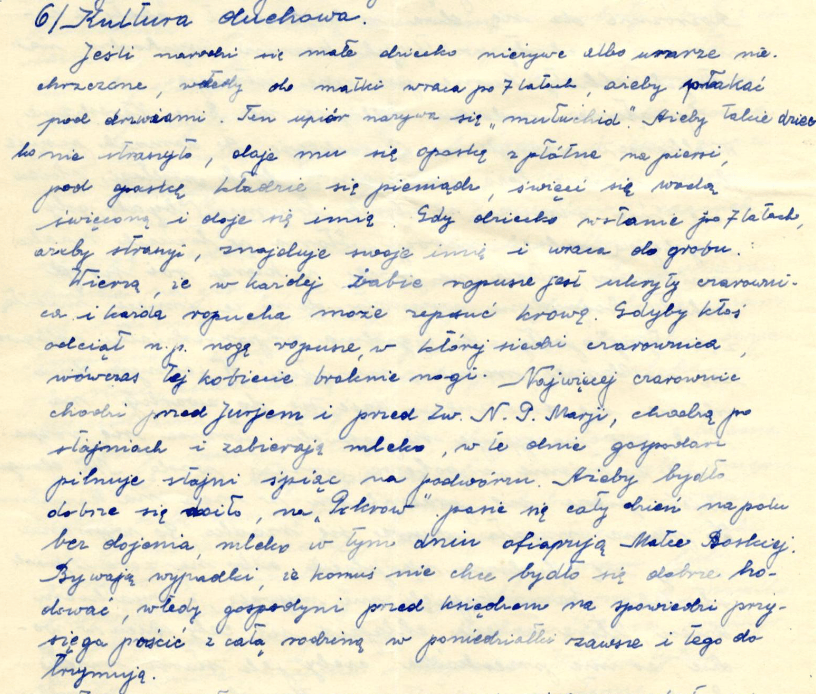
6/ Kultura duchowa.
Jeśli narodzi się małe dziecko nieżywe albo umrze niechrzczone, wtedy dla matki wraca po 7 latach, ażeby popłakać pod drzwiami. Ten upiór nazywa się „mułuchid”. Kiedy takie dziecko się straszyło, daje mu się opaskę z płótna na piersi, pod opaskę kładzie się pieniądz, święci się wodą święconą i daje się imię. Gdy dziecko wstanie po 7 latach, ażeby straszyć, znajduje swoje imię i wraca do grobu.
Wierzą, że w każdej żabie ropusze siedzi ukryty czarownica i każda ropucha może zepsuć krowę. Gdyby ktoś odciął n.p. nogę ropusze, w której siedzi czarownica, wówczas tej kobiecie braknie nogi. Najwięcej czarownic chodzi przed Jurjem i przed Zw. N. P. Marji, chodzą po stajniach i zabierają mleko, w te dnie gospodarz pilnuje stajni śpiąc na podwórzu. Ażeby bydło dobrze się doiło, na „Pokrow” pasie się cały dzień na polu bez dojenia, mleko w tym dniu ofiarują Matce Boskiej.
Bywają wypadki, że komuś nie chce bydło się dobrze hodować, wtedy gospodyni przed księdzem na spowiedzi przysięga pościć z całą rodziną w poniedziałki zawsze i tego dotrzymują.
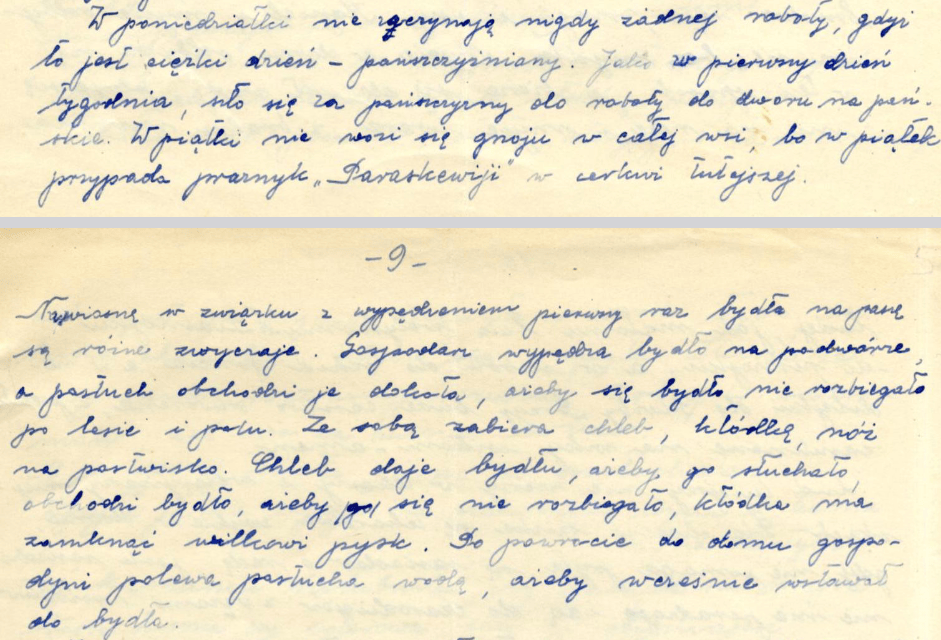
W poniedziałki nie zaczynają nigdy żadnej roboty, gdyż to jest ciężki dzień – pańszczyźniany. Jako w pierwszy dzień tygodnia, szło się za pańszczyznę do roboty do dworu na pańskie. W piątki nie wozi się gnoju w całej wsi, bo w piątek przypada jarmark. Paraskewiji w cerkwi tutejszej.
Napisane w związku z wypędzeniem pierwszy raz bydła na paszę są różne zwyczaje. Gospodarz wypędza bydło na podwórze, a pastuch obchodzi je dokoła, ażeby się bydło nie rozbiegało po lesie i polu. Ze sobą zabiera chleb, kłódkę, nóż na pastwisko. Chleb daje bydłu, ażeby go słuchało, obchodzi bydło, ażeby go się nie rozbiegało, kłódka ma zamknąć wilkowi pysk. Po powrocie do obory gospodyni polewa pastucha wodą, ażeby wcześnie wstawał do bydła.
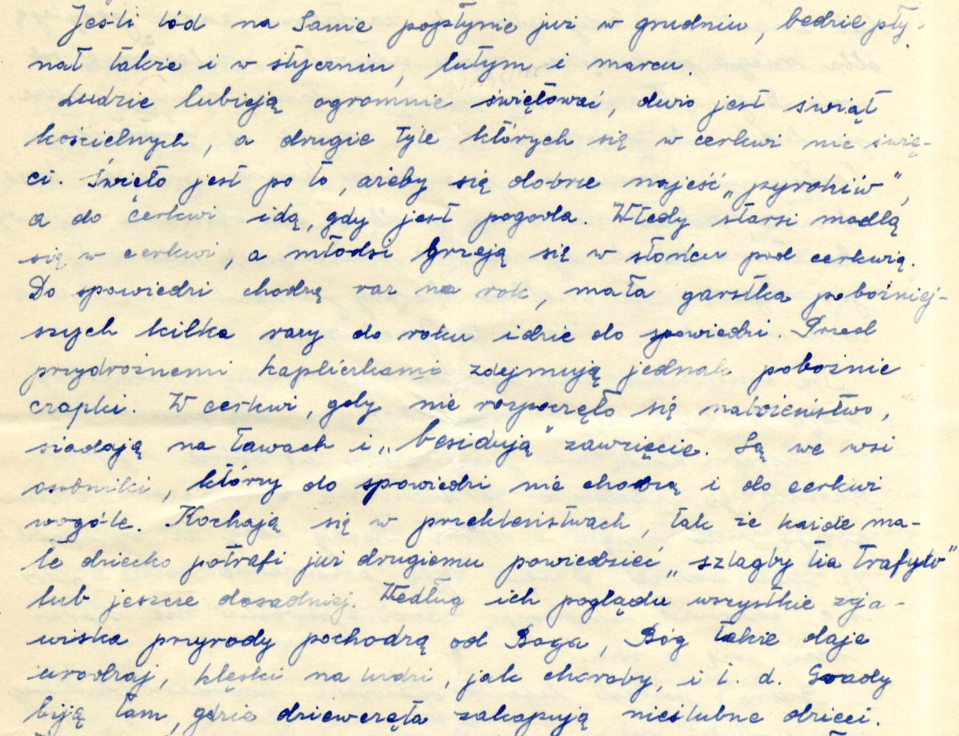
Jeśli lód na Sanie popłynie już w grudniu, będzie płynął także i w styczniu, lutym i marcu.
Ludzie lubią ogromnie świętować, dużo jest świąt kościelnych, a drugie tyle których się w cerkwi nie święci. Święto jest po to, ażeby się dobrze najeść „pyrohów”, a do cerkwi idą, gdy jest pogoda. Wtedy starsi modlą się w cerkwi, a młodsi grzeją się w słońcu pod cerkwią. Do spowiedzi chodzą raz na rok, mała garstka pobożniejszych kilka razy do roku idzie do spowiedzi. Przed przydrożnymi kapliczkami zdejmują jednak pobożnie czapki. W cerkwi, gdy nie rozpoczęło się nabożeństwo, siadają na ławach i „besidują” zawzięcie. Są we wsi osobnicy, którzy do spowiedzi nie chodzą i do cerkwi w ogóle. Kochają się w przekleństwach, tak że każde małe dziecko potrafi już drugiemu powiedzieć „szlagby cię trafił” lub jeszcze dosadniej. Według ich poglądu wszystkie zjawiska przyrody pochodzą od Boga, Bóg także daje urodzaj, klęski na ludzi, jak choroby, i t. d. Owady biją tam, gdzie dziewczęta zakopują nieślubne dzieci.
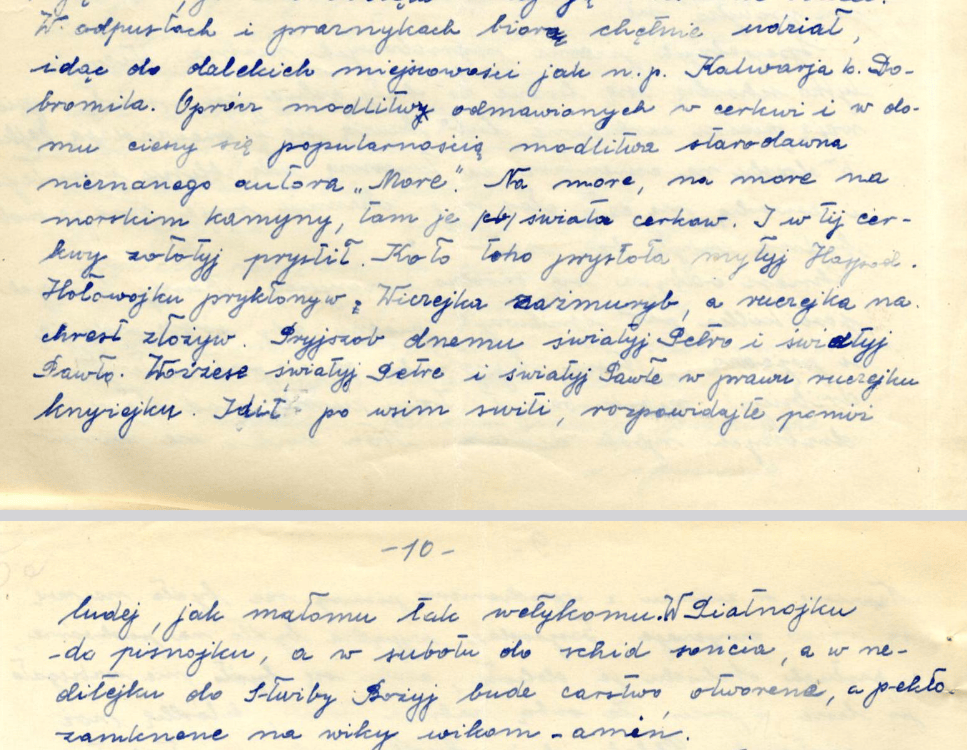
W odpustach i praznykach biorą chętnie udział, idąc do dalekich miejscowości jak n.p. Kalwarja k. Dobromila. Oprócz modlitwy odmawianych w cerkwi i w domu cieszy się popularnością modlitwa starodawna nieznanego autora „More”. Na more, na more na morskim kamyny, tam je sby swiata cerkow. I w tyj cerkuy zołotoj prysł. Koło toho prystoła my tyj Hospod. Hołowojku prykłonyw, Wserejka zarmunyb, a ruczejka na chrest złożyw. Pryszow dnemu swiatyj Petro i swiatyj Pawło. Wozmese swiatyj Petro i swiatyj Pawłe w prawu ruczyjku knyjizku. Idit po wsim switi, rozpowidajte pomiń ludej, jak małomu tak wełykomu. W piatnojku – do pismojku, a w subotu do schid soncia, a w nediłejku do Służby Bożyj bude carstwo otworene, a pekło zamknene na wiky wikom – amiń.
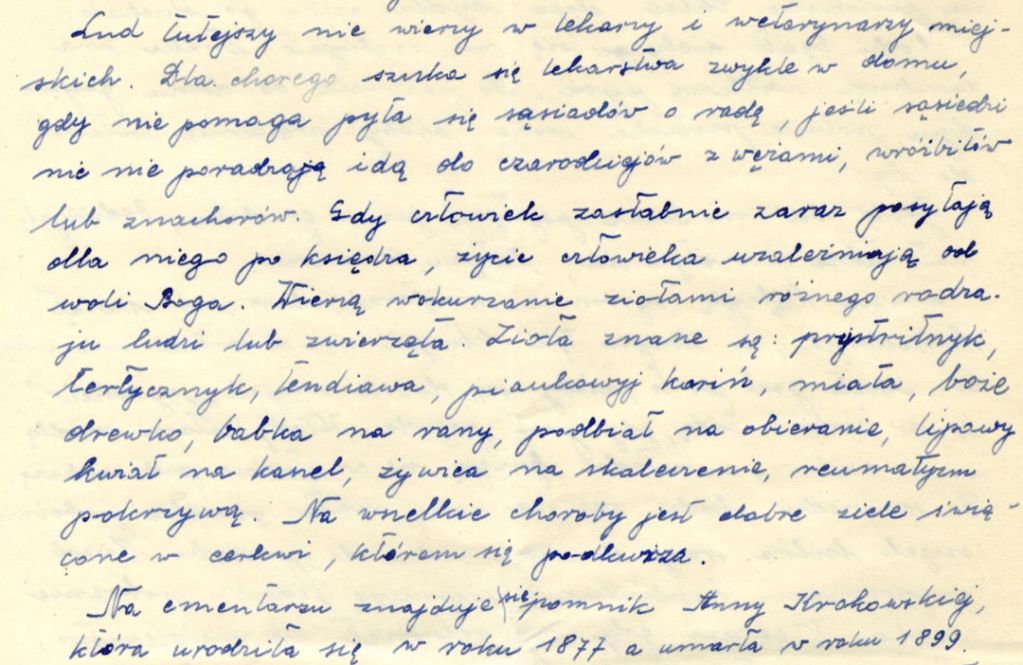
Lud tutejszy nie wierzy w lekarzy i weterynarzy miejskich. Dla chorego szuka się lekarstwa zwykle w domu, gdy nie pomaga pyta się sąsiadów o radę, jeśli sąsiedzi nie nie poradzą idą do czarodziejów z wężami, wróżbitów lub znachorów. Gdy człowiek zasłabnie zaraz posyłają dla niego po księdza, życie człowieka uzależniają od woli Boga. Wierzą wokurzanie ziołami różnego rodzaju ludzi lub zwierzęta. Zioła znane są: przymiotnyk, certycznyk, tendiawa, piankowyj koriń, miata, boże drewko, babka na rany, podbiał na obieranie, lipowy kwiat na kaszel, żywica na skaleczenie, reumatyzm pokrzywą. Na wielkie choroby jest dobre ziele święcone w cerkwi, którem się podkurza.
Na cmentarzu znajduje się pomnik Anny Krokowskiej, która urodziła się w roku 1877 a umarła w roku 1899.
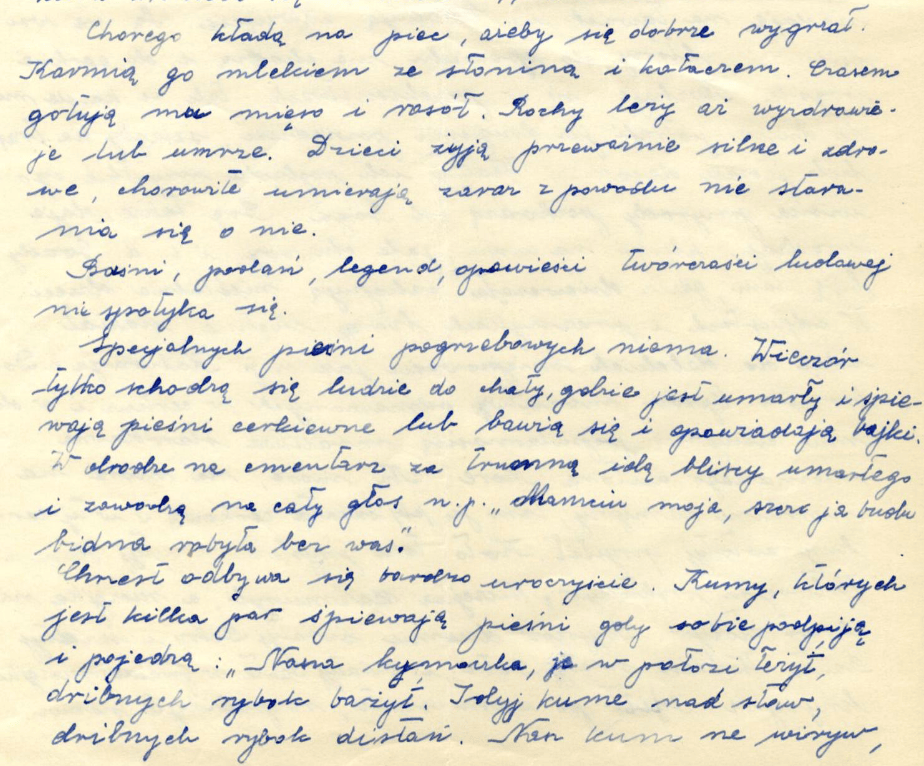
Chorego kładą na piec, ażeby się dobrze wygrzał. Karmią go mlekiem ze słoniną i kołaczem. Czasem gotują mu mięso i rosół. Chory leży aż wyzdrowieje lub umrze. Dzieci żyją przeważnie silne i zdrowe, chorowite umierają zaraz z powodu nie starama się o nie.
Baśni, podań, legend, opowieści twórczości ludowej nie spotyka się.
Specjalnych pieśni pogrzebowych niema. Wieczór tylko schodzą się ludzie do chaty, gdzie jest umarły i śpiewają pieśni cerkiewne lub bawią się i opowiadają bajki.
W drodze na cmentarz za trumną idą bliscy umarłego i zawodzą na cały głos n.p. „Mamusiu moja, coże ja budu bidna robiła bez was.”
Chrzest odbywa się bardzo uroczyście. Kumy, których jest kilka par śpiewają pieśni gdy sobie podpiją i pojedzą:
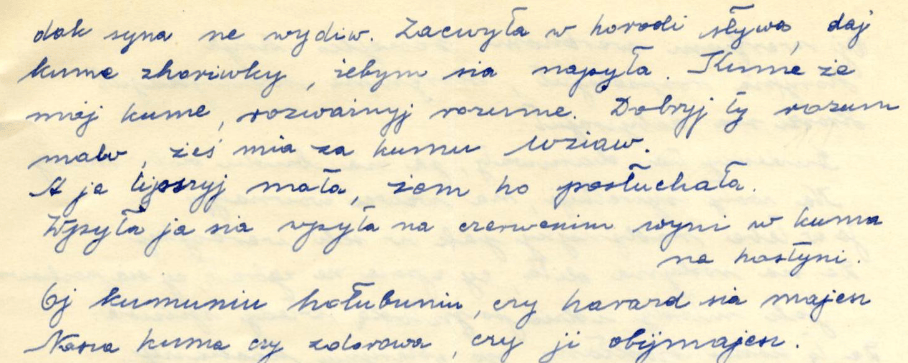
„Nasza kymuszka, jo w połozi łezył, dribnych rybok bazyl. Idyj kume nad staw, drobnych rybok distań. Nan kum ne wiszyw, dak syna ne wydiw. Zaczyła w horodi sływa, dajkume zhoriwky, żebym sia napyła. Thume że mij kume, rozwajnyj rozume. Dobryj ty rozum mału, żeś mia za kumu wziaw.
A ja lijoszyj mała, żem ho posłuchała.
Wjzyła ja na wypyła na czerwonim wyni w kumana na hostyni.
Oj kumuniu hołubuniu, czy harard na majesz. Nasza kuma czy zolorowa, czy ji obymajesz.
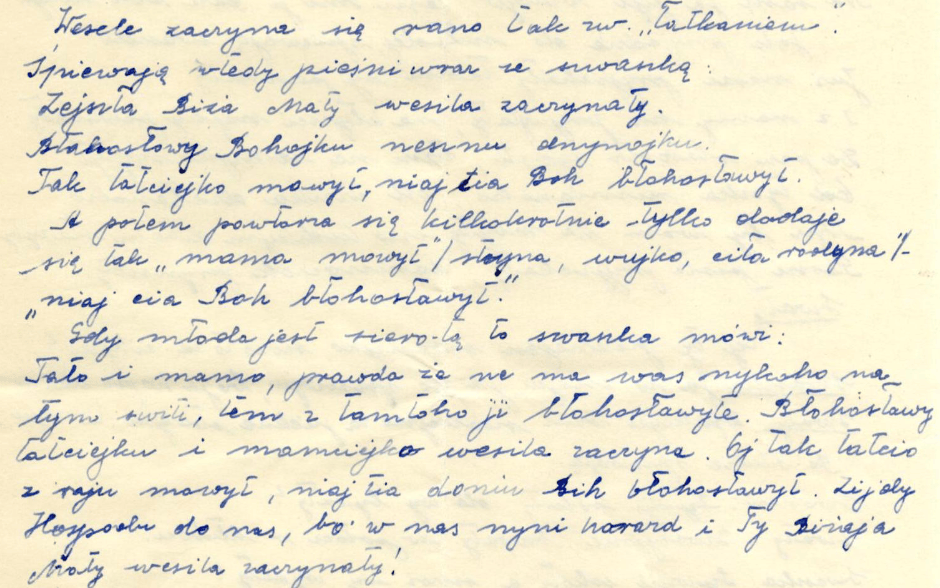
Wesele zaczyna się rano tak zw. „łatkaniem”.
Śpiewają wtedy pieśni wraz ze swanką:
Zejszła zora mały wesila zaczynały.
Błahosławy Bohojku nesnu dnymojku.
Tak tatejko mowyw, niaj tia Boh błohosławyw.
A potem powtarza się kilkakrotnie tylko dodaje
się tak „mama mowyw / stasza, wujko, ciła rodyna /
„niaj cia Boh błohosławył.”
Gdy młoda jest sierotą to swanka mówi:
Tato i mamo, prawda że ne ma was nyktoho na
tym świti, tóm z tamtoho ji błohosławte. Błohosławy
tatejku i mamujko wesila zaczyna. By tak tateio
z raju mowyw, niaj tia doniu Boh błohosławył. Zijdzy
Hospodu do nas, bo w nas nyni narard i ty Siziaja
mały wesila zaczynały!
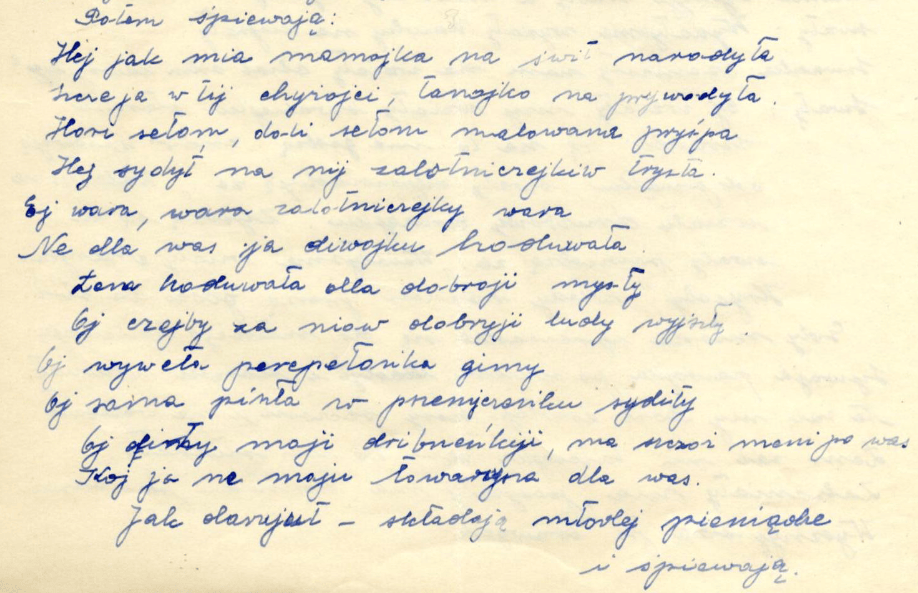
Potem śpiewają:
Hej jak mia mamojka na świt narodyła
hereja w tyj chyżyci, tanajko na prywodyła.
Hori sełom, doły sełom malowana jwyźpa
Hej sydyt na nij załotnierejkiw trysta.
Oj wara, wara załotnierejky wara
Ne dla was ja diwojku hodowała.
Żena hodowała dla dobroji myśli
Oj czejby za niow dobroji ludy wyjśły.
Oj wywełi perepełonku giny
Oj sama piwła w prenjeronku sydyty.
Oj ofirky moji dribneńkyji, ma mnoi menije was
Hoj ja ne maju towarysza dla was.
Jak darują – składają młodej pieniądze i śpiewają.
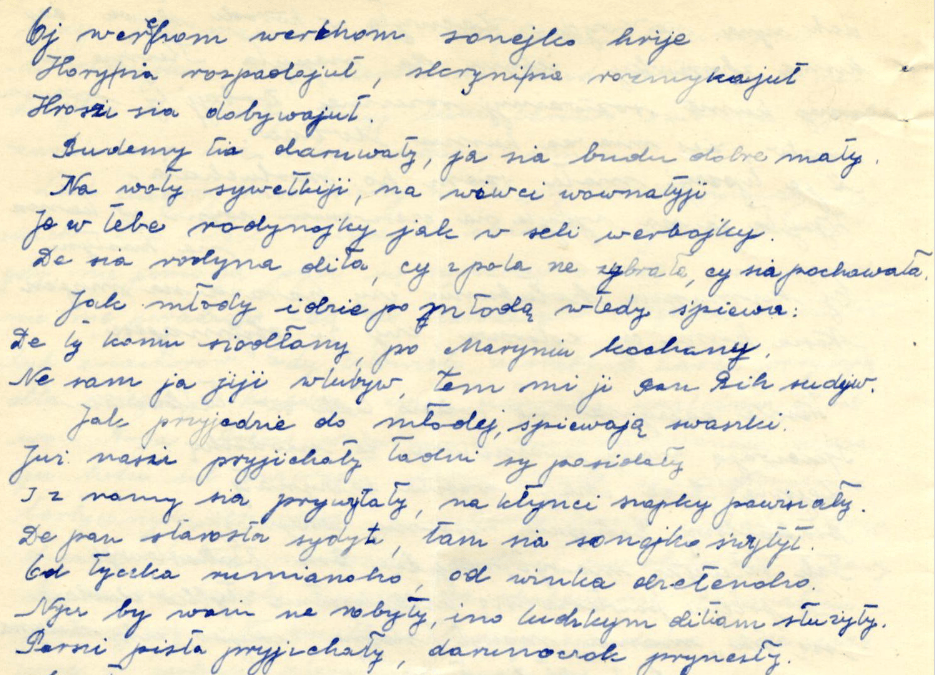
Oj wejdzom wejdzom soneczko hrije
Hlorypka rozpasajut, skrzypie rozmykajuť
Hroszi sia dobywajuť.
Budemy cia daruwaty, ja na budu dobre mały.
Na woły sywethiji, na wowci wownatyji
Jo w tebe rodynojky jak w seli werbojky.
De na rodyna dita, cy z pola ne zybrała, cy na pochowała.
Jak młody idzie po młodą wtedy śpiewa:
Że ty koniu siodłany, po Maryniu kochany.
Ne sam ja jiji ślubyw, tem mi ji sam Bih sudjw.
Jak pryjedzie do młodej, śpiewają swatki.
Już nassi pryjechały ławki sy pośadały
I z namy sa prywitały, na kłynci czapky pawynały.
Że pan starosta sydyt, tam na soneczko swytyt.
Od tyczka rumianoko, od winka wereteńsko.
Nye by wam ne robyły, ino ludskym ditiam służyły.
Pani sosta pryjechały, darunoczk prynesły.
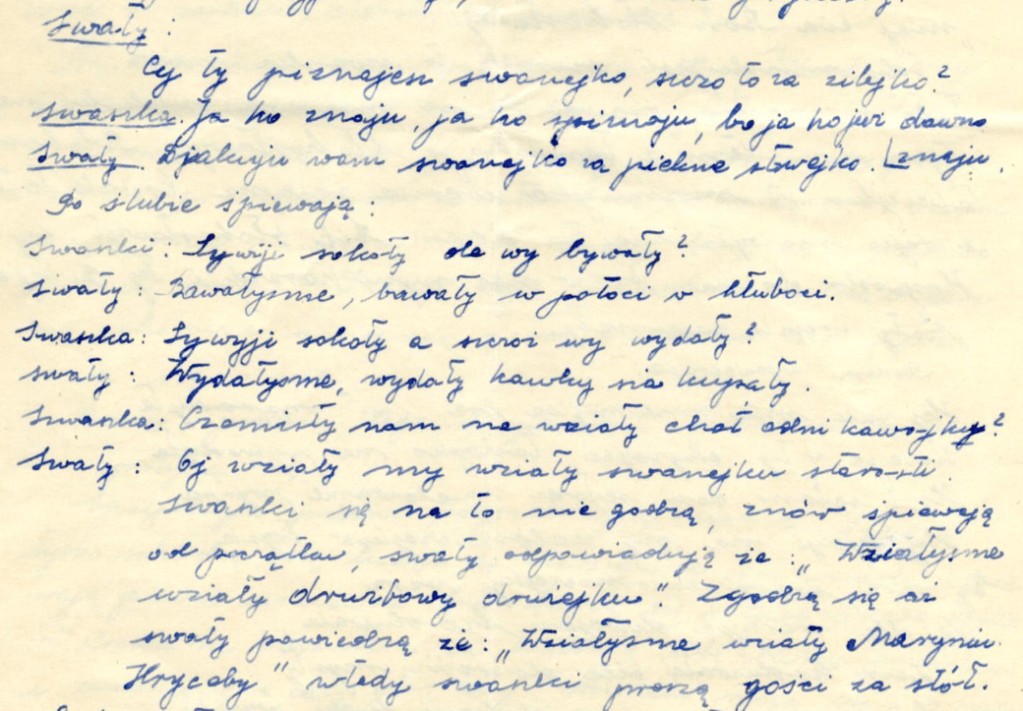
Swaty: cy ty piznajen swanejko, szto to za zilyjko?
swanka: ja ho znaju, ja ho pzirnaju, bo ja ho juz dawno
Swaty: Djakuju wam swanejko za piekne słowejko. [znaju.
Po ślubie śpiewają:
Swanka: Lywyji sokoły de wy bywały?
Swaty: Bawałysme, bawały w połoci v hłuboci.
Swanka: Lywyji sokoły a sztoz wy wydały?
swaty: Wydałysme, wydały kawły na kupały.
Swanka: Czomisty nam ne wzięły choć odni kawojky?
Swaty: Oj wzięły my wzięły swanejku starosti.
swanki się na to nie godzą, znów śpiewają
od początku, swaty odpowiedują że: „Wzięłysme
wzięły drużbowy drużejku!” Zgodzą się aż
swaty powiedzą że: „Wzięłysme wzięły Maryniu
Hrycoby” wtedy swanki proszą gości za stół.
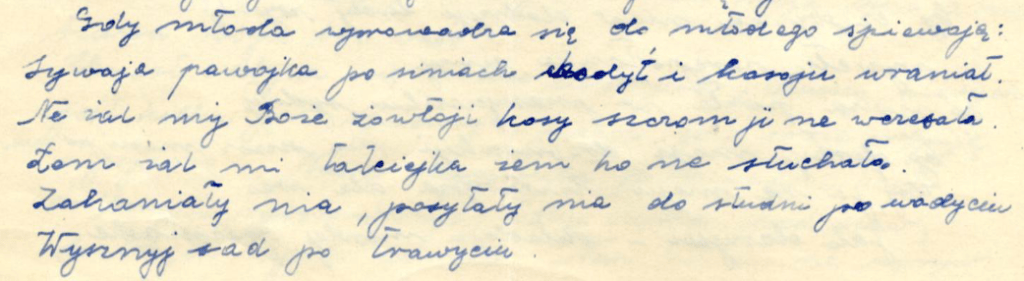
Gdy młoda wyprowadza się do młodego śpiewają: Tywaja pawojka po siniach skodyć i koroju wraniał.Ne żal mij Boże żow toji kosy szorom ji ne weresata. Lem żal mi Talejka żem ho ne słuchała.
Zahaniały nia, posyłały nia do studni po wodyciu
Wyrnyj sad po trawyciu
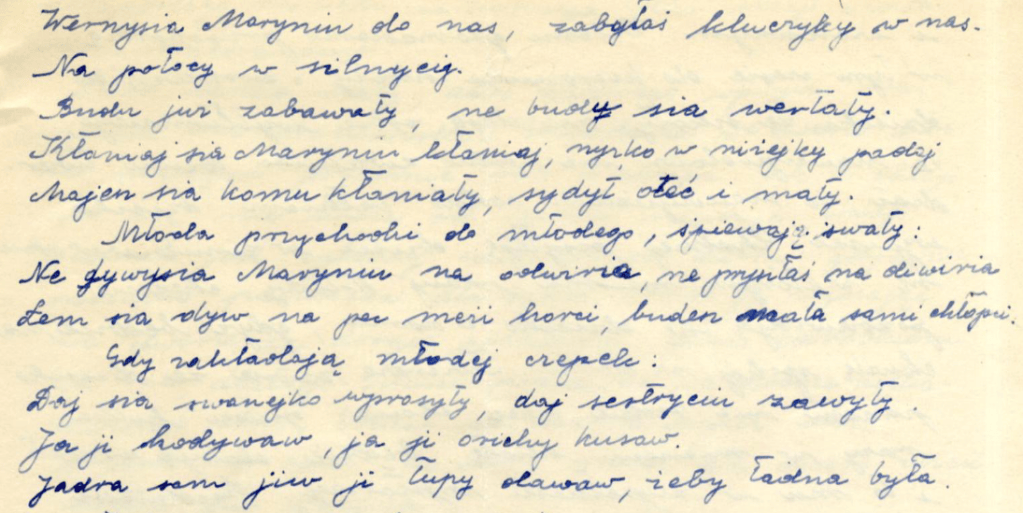
Wernysia Maryniu do nas, zabojlas kluczyky w nas. Na połosy w silnycyg.Budu już zabawały, ne budy sia wertaly. Ukłaniaj sia Maryniu kłaniaj, nyrko w nijskyj jasłyj Majen sia komu kłaniały, sydyt oteć i maty.
Młoda prychodzi do młodego, śpiewają swaty:
Ne dywysia Maryniu na odiwia, ne smytai na diwizia
Lem sia dyw na psy meń horei, buden miała sami chłopii.
Gdy zakładają młodej czepek:
Daj sia swanejko wyprosyty, daj sestryciu zawyty.
Ja ji hodywaw, ja ji orichy kusaw.
Jadra sam jiw ji łupy dawaw, żeby ładna była.
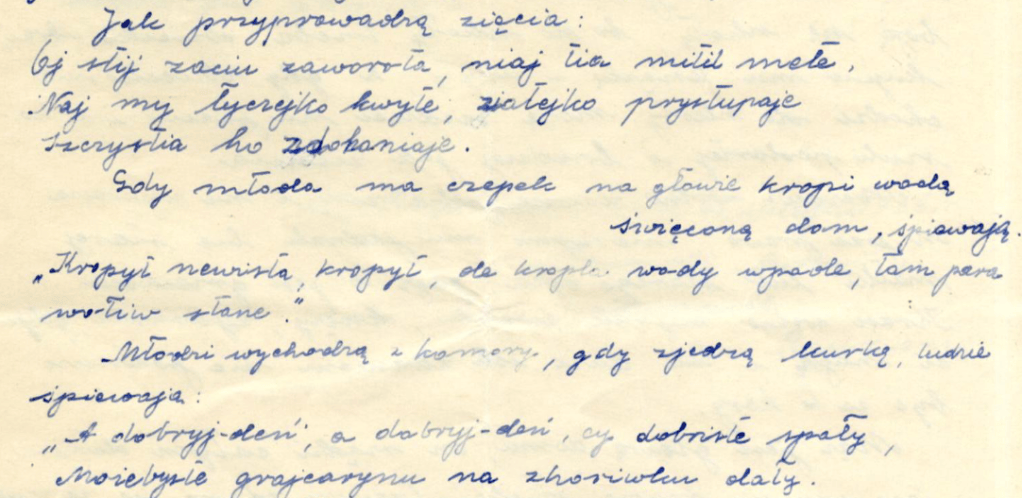
Jak przyprowadzą zięcia:
Oj stój zacim zaworota, miaj tia mili mete,
Naj my tycejko kwyte, ziałejko prystupaje
Szczystia ho zdobaniaje.
Gdy młoda ma czepek na głowie kropi wodą święconą dom, śpiewają:
„Kropyi newista kropyi, de kropla wody upadła, tam para wotiw stanie.”
Młodzi wychodzą z komory, gdy zjedzą kurkę, ludzie śpiewają:
„A dobryj-deń, a dobryj-deń, cy dobrizte spały,
możebyste grajcarynu na zhoriwku dały.”
English Translation: Google-Powered
Warning: this translation may be terrible. It was done electronically by someone who can speak neither Polish nor Ukrainian/Lemko. Do you wish to see it improve? You can help! Contact us.
Uwaga: to tłumaczenie może być fatalne. Zostało wykonane automatycznie przez osobę, która nie zna ani języka polskiego, ani ukraińskiego/łemkowskiego. Chcesz, żeby było lepsze? Możesz pomóc! Skontaktuj się z nami.
6/ Spiritual Culture.
If a child is born dead or dies unbaptized, it is believed that after seven years it returns to its mother to weep outside her door. This apparition is called a “muluchid.” To prevent such a child from becoming a malevolent spirit, a linen band is placed across its chest with a coin tucked underneath; the child is then blessed with holy water and given a name. When the child rises after seven years, it finds its name and returns to its grave.
It is believed that a witch may hide inside a toad, and that any such toad can cause harm to a cow. If, for instance, one were to sever the leg of a toad inhabited by a witch, the woman herself would lose a leg. Witches are said to be most active before St. George’s Day and the Feast of the Assumption of the Blessed Virgin Mary; they roam through stables to steal milk. On these days, the head of the household guards the stable by sleeping in the farmyard. To ensure the cattle continue to yield milk well, they are left to graze in the fields all day on the Feast of the Intercession (Pokrov) without being milked—the milk for that day is offered to the Mother of God.
In cases where livestock fails to thrive, the mistress of the house may swear before a priest during confession that she and her entire family will fast every Monday—a vow they then strictly observe.
No work is ever begun on Mondays, as it is considered a “heavy” day—a relic of the era of pańszczyzna (corvée labor). As the first day of the week, it was traditionally the day one had to report to the manor to perform forced labor for the landlord. On Fridays, no one in the entire village hauls manure, because Friday is market day—coinciding with the feast of Saint Paraskeva at the local Greek church. There are various customs associated with the first time the cattle are driven out to pasture. The owner brings the livestock into the yard, and the herdsman walks around them to ensure they do not scatter into the woods or fields. He takes bread, a padlock, and a knife with him to the pasture: he gives the bread to the cattle so they will obey him, circles them to keep them from straying, and uses the padlock to “lock” the wolf’s jaws. Upon returning to the barn, the mistress of the house splashes the herdsman with water—a gesture meant to ensure he wakes up early to tend to the livestock.
If the ice on the San River begins to drift as early as December, it will continue to do so throughout January, February, and March.
The local people are very fond of celebrating; there are many church holidays, as well as just as many others that are not observed within the church itself. For them, a holiday is an occasion to feast on pyrohy (dumplings), and they only attend church when the weather is fine. On such days, the older folk pray inside, while the younger ones warm themselves in the sun just outside. Most people go to confession only once a year, though a small, more devout group may go several times. Nevertheless, they reverently remove their hats whenever they pass by roadside shrines. Inside the church, before the service begins, people sit on the benches and engage in animated conversation. There are also some individuals in the village who never go to confession and never set foot in the church at all. They are fond of using profanity, to the extent that even a small child might say to another, “Damn you,” or something even more blunt. In their worldview, all natural phenomena originate from God; it is God who grants bountiful harvests, but also inflicts calamities upon people, such as diseases. Swarms of insects are said to appear in places where girls have buried their illegitimate children.
They readily participate in religious festivals and patronal feast days, often traveling to distant locations—for instance, to Kalwaria near Dobromil. In addition to prayers recited in the church or at home, there is a popular, ancient prayer of unknown authorship known as “More.” It begins: “Upon the sea, upon the sea, on a stone in the sea, there stands the church of the whole world. And in that church, there is a golden altar. Beside that altar sits the Lord Himself; He bows His head, His heart is filled with sorrow, and He rests His hands upon the cross. Then come Saint Peter and Saint Paul. Saint Peter and Saint Paul take a book into their right hands. ‘Go throughout the whole world,’ they say, ‘and tell all people—both young and old—that on Friday, through the reading of the Scriptures; on Saturday, by sunrise; and on Sunday, during the Divine Liturgy, the Kingdom shall be opened, and Hell shall be locked forever and ever—amen.'”
The local people do not place their trust in doctors or urban veterinarians. When someone falls ill, the first step is usually to look for a remedy at home; if that fails, neighbors are asked for advice. If the neighbors cannot help, people turn to snake charmers, fortune-tellers, or folk healers. When a person becomes gravely ill, a priest is immediately summoned, as they believe a person’s life depends entirely on the will of God. They also practice “fumigation”—using various herbs to cleanse or treat both people and animals. Known herbs include: przymiotnyk, certycznyk, tendiawa, marshmallow root, mint, southernwood, plantain for wounds, coltsfoot for skin abrasions, linden blossoms for coughs, and resin for cuts; nettles are used to treat rheumatism. For serious illnesses, they use herbs that have been blessed in the Greek church, which are then burned to create smoke.
In the cemetery, there is a monument to Anna Krokowska, who was born in 1877 and died in 1899.
A sick person is placed on top of the stove to get thoroughly warmed. They are fed milk mixed with lard, as well as kołacz (a type of festive bread). Sometimes, they are given meat and broth. The sick person remains there until they either recover or pass away. Children generally grow up strong and healthy; those who are sickly often die quickly, as little effort is made to care for them.
Folktales, myths, legends, and other forms of traditional folklore are not encountered here.
There are no specific funeral songs. In the evening, people gather at the house where the deceased lies; they may sing Greek Catholic hymns, or, conversely, amuse themselves by telling stories.
On the way to the cemetery, the loved ones of the deceased follow the coffin, wailing at the top of their voices—for example: “Oh, my dear mother, what will poor me do without you?”
A christening takes place very ceremoniously. The godparents (kumy), of whom there are several pairs, sing songs once they have had a little to drink and eat:
“Our godmother lies in childbirth (w połogu), craving little fish.
Go, godfather, to the pond, catch some little fish.
Our godfather did not come out until he saw his son.
A plum tree bloomed in the garden; give me, godfather, some horilka (moonshine/vodka) so I can have a drink.
Oh godfather, my godfather, thoughtful mind.
You had good sense to take me as a godmother,
And I had even better sense to listen to you.
I drank and drank red wine at the godfather’s gathering.
Oh godfather, little dove, how are you faring?
Is our godmother well, and do you embrace her?”
Wedding (Wesele)
The wedding begins in the morning with what is called łatkanie. They sing songs then together with the swanka (matchmaker/wedding woman):
“The dawn has risen so we could begin the wedding.
Bless, little God, this bright little day.
Thus father spoke: may God bless you.”
And then it is repeated several times, only adding things like:”mother spoke / elder [sister/brother], uncle, the whole family / may God bless you.”
When the bride is an orphan, the swanka says:
“Father and mother, it is true that you are no longer with us in this world, so bless her from the other world. Bless, little father and little mother, the beginning of the wedding. As if father were speaking from heaven: may God bless you, daughter. Come down, Lord, to us, for today there is joy/abundance with us, and you, Holy Mother, [we] begin the wedding!”
Then they sing:
“Hey, how my little mother brought me into the world
Here in this little cottage, and father led [me] in.
Hills are a village, valleys are a village, a painted island,
Hey, three hundred golden [suitors/lads] sit upon it.
Oh beware, beware, golden ones, beware—
I did not raise the maiden for you.
A woman raised [her] for a good thought,
Oh, in case good people should come for her.
Oh, they led out the quail…
Oh, she herself will sit…
Oh, my little [offerings/gifts]…”
As they give gifts—laying down money for the bride—they sing:
“Oh come out, come out, the sun warms,
They unfasten pockets, unlock chests,
Bring out money.
We will gift you so that you will have good things:
Grey oxen, woolly sheep.
You have as many relatives as there are little willows in the village—
Where is the family, child, whether they didn’t gather [them] from the field or buried [them]?”
When the groom goes for the bride, then he sings:
“Oh you saddled horse, beloved [ride] for Marynia.
I did not marry her on my own, rather God Himself judged/destined her for me.”
When he arrives at the bride’s house, the swatki (matchmakers/wedding women) sing:
“Our people have already arrived, taken seats on the benches,
And greeted us, hung their caps on the peg.
That the starosta (wedding master of ceremonies) sits, there in the sun he shines,
From a rosy little stick, from a spindle…
May they not work for you, only serve human children.
The pani starościna arrived, brought a little gift.”
Matchmakers (Swaty): “Do you recognize, little swanka, what kind of little herb this is?”
Swanka: “I know it, I recognize it, because I have known it for a long time.”
Matchmakers (Swaty): “Thank you, little swanka, for the kind little word.”
After the wedding, they sing:
Swanka: “Grey falcons, where have you been?”
Matchmakers (Swaty): “We were, we were in the deep swamp.”
Swanka: “Grey falcons, and what did you see?”
Matchmakers (Swaty): “We saw, we saw… by the water.”
Swanka: “Why didn’t you bring us even a single little [part/piece]?”
Matchmakers (Swaty): “Oh, we took, we took, little swanka of the starosta!”
The swanki do not agree with that and sing again from the beginning; the swaty answer: “We took, we took…” They agree only when the swaty say: “We took, we took Marynia for Hryć [Hryc]!” Then the swanki invite the guests to the table.
When the bride is led away to the groom’s house, they sing:
“…
It is not a pity before God for that braid…
Only I regret… that I did not listen to him.
They drove her, sent her to the well for water,
[To] the orchard for grass.
Come back, Marynia, to us, you left your little keys with us.
…
Bow, Marynia, bow low at the low threshold,
You have someone to bow to: father and mother are sitting there.”
When the bride arrives at the groom’s house, the swaty sing:
“Do not look, Marynia, at the girls, do not… at the maidens;
Only look up toward the stove/ceiling, you will have all boys.”
When they put the czepek on the bride:
“Let yourself be asked, little swanka, let your little sister be wrapped/covered.
I raised her, I cracked nuts for her:
I ate the kernels myself and gave her the shells, so she would be pretty.”
When they bring in the son-in-law:
“Oh stand behind this gate…
May it bloom for you, little… approaches,
Wishes him happiness.”
When the bride has the czepek on her head and sprinkles the house with holy water, they sing:
“Sprinkle, young wife, sprinkle: where a drop of water falls, there a pair of oxen will stand.”
The newlyweds come out of the komora (storage room/bridal chamber); after they eat a chicken, people sing:
“A good day, a good day, did you sleep well?
Perhaps you would give a grajcar (small coin) for horilka (moonshine/vodka)?”
Sanok Genes seeks to create a database of transcripts and English translations from the “Kultura Duchowa” sections from the 1936 Sanok School Inspectorate Questionnaires. The original documents are held by the Sanok Museum of History and digitized by the Sanok Digital Library. To learn more, see the project description.
Sanok Genes stawia sobie za cel stworzenie bazy danych zawierającej transkrypcje oraz tłumaczenia na język angielski fragmentów dotyczących „kultury duchowej”, pochodzących z kwestionariuszy Inspektoratu Szkolnego w Sanoku z 1936 roku. Oryginalne dokumenty znajdują się w zbiorach Muzeum Historycznego w Sanoku i zostały zdigitalizowane przez Sanocką Bibliotekę Cyfrową. Więcej informacji można znaleźć w opisie projektu.

