Wańkowa is a village in Olszanica Commune, Lesko County.
Wańkowa – wieś w gminie Olszanica, w powiecie leskim.
Transcript: Google-Powered
Warning: this transcription may be terrible. It was done electronically by someone who can speak neither Polish nor Ukrainian/Lemko. Do you wish to see it improve? You can help! Contact us.
Uwaga: ta transkrypcja może być fatalna. Została wykonana automatycznie przez osobę, która nie zna ani języka polskiego, ani ukraińskiego/łemkowskiego. Chcesz, żeby była lepsza? Możesz pomóc! Skontaktuj się z nami.
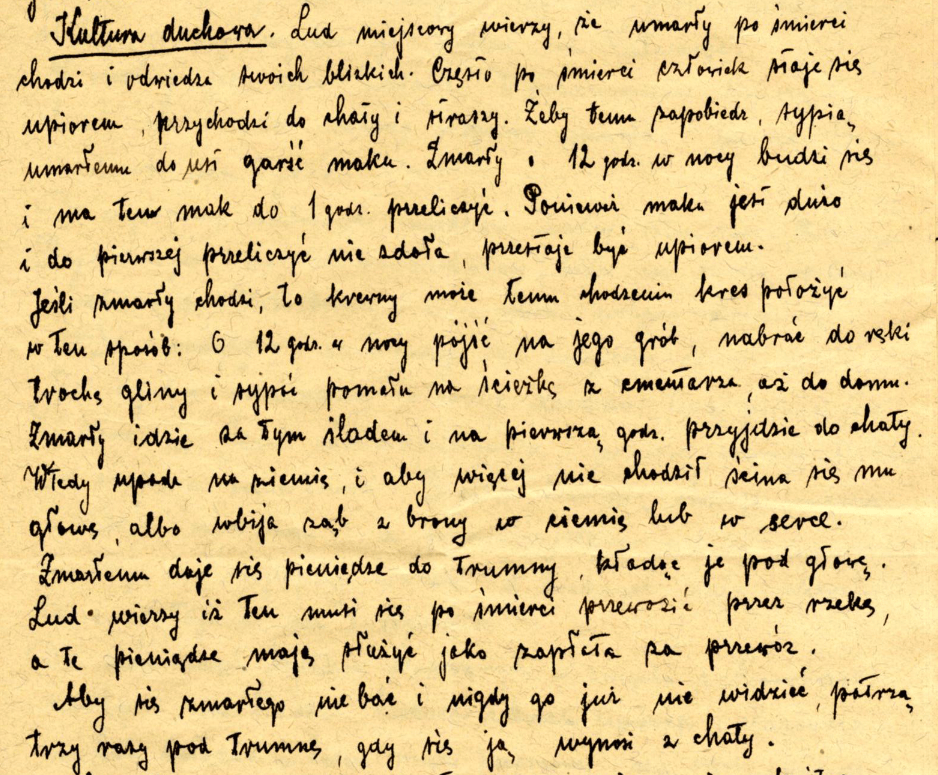
Kultura duchowa. Lud miejscowy wierzy, że umarły po śmierci chodzi i odwiedza swoich bliskich. Często po śmierci człowiek staje się upiorem, przychodzi do chaty i straszy. Żeby temu zapobiec, sypią umarłemu do ust garść maku. Zmarły o 12 godz. w nocy budzi się i ma ten mak do 1 godz. przeliczyć. Ponieważ maku jest dużo i do pierwszej przeliczyć nie zdoła, przestaje być upiorem.
Jeśli umarły chodzi, to krewny może temu chodzeniu kres położyć w ten sposób: o 12 godz. w nocy pójść na jego grób, nabrać do ręki trochę gliny i sypać pomału na ścieżkę z cmentarza aż do domu. Zmarły idzie za tym śladem i na pierwszą godz. przyjdzie do chaty. Wtedy upadnie na ziemię, i aby więcej nie chodził sieka mu się głowę, albo wbija sakh z bronny w ziemię lub w serce.
Zmarłemu daje się pieniądze do trumny, kładąc je pod głowę. Lud wierzy, iż ten musi się po śmierci przewozić przez rzekę, a te pieniądze mają służyć jako zapłata za przewóz.
Aby się zmarłego nie bać i nigdy go już nie widzieć, patrzą trzy razy pod trumnę, gdy się ją wynosi z chaty.
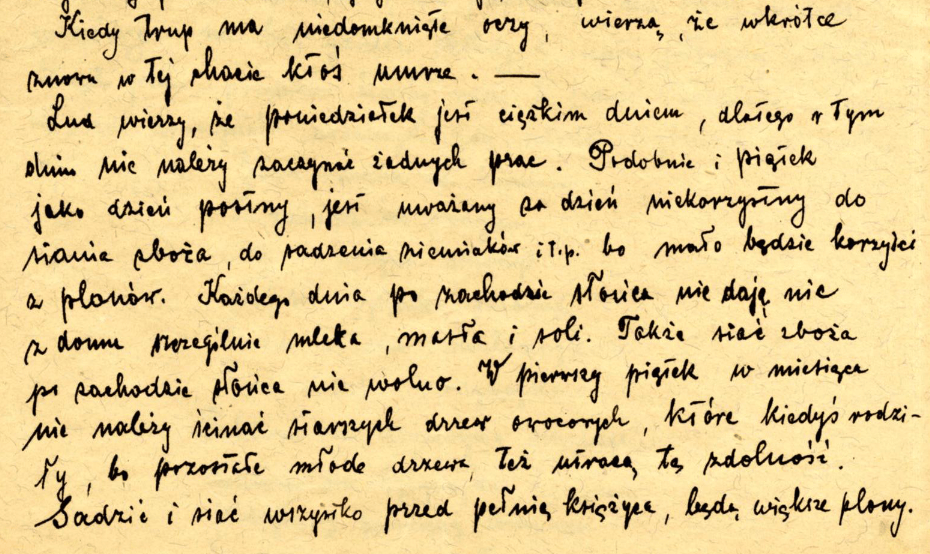
Kiedy trup ma niedomknięte oczy, wierzą, że wkrótce znowu w tej chacie ktoś umrze. —
Lud wierzy, że poniedziałek jest ciężkim dniem, dlatego w tym dniu nie należy zaczynać żadnych prac. Podobnie i piątek jako dzień postny, jest uważany za dzień niekorzystny do siania zboża, do sadzenia ziemniaków itp., bo mało będzie korzyści a plonów. Każdego dnia po zachodzie słońca nie daje nic z domu, szczególne mleka, masła i soli. Także siać zboża po zachodzie słońca nie wolno. W pierwszy piątek w miesiącu nie należy rzynać starszych drzew owocowych, które kiedyś rodziły, bo pozostałe młode drzewa, też utracą tę zdolność.
Sadzić i siać wszystko przed pełnią księżyca, będą większe plony.
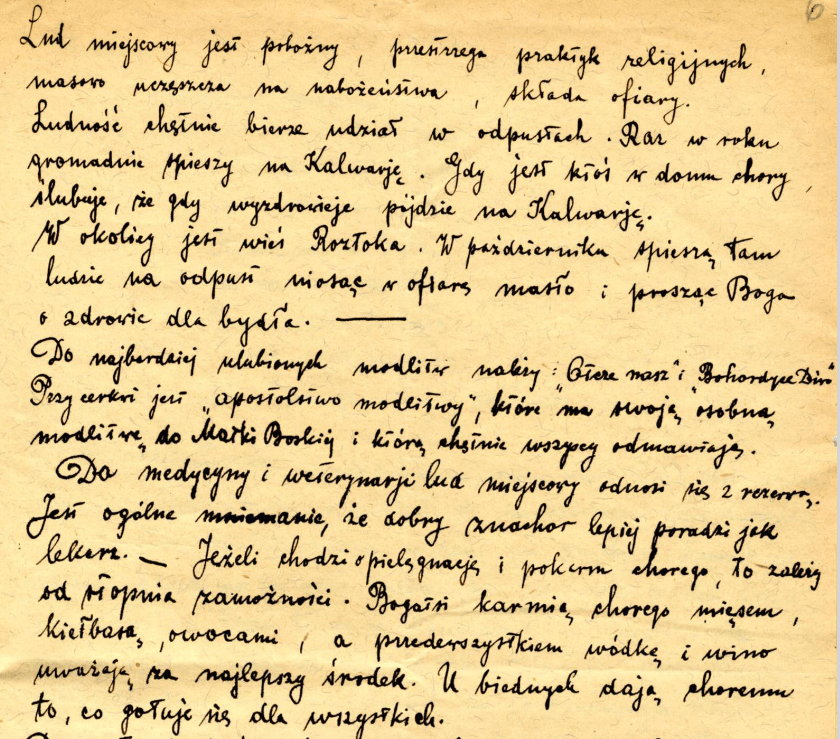
Lud miejscowy jest pobożny, przestrzega praktyk religijnych, masowo uczęszcza na nabożeństwa, składa ofiary. Ludność chętnie bierze udział w odpustach. Raz w roku gromadnie pieszy na Kalwarię. Gdy jest ktoś w domu chory, ślubuje, że gdy wyzdrowieje pjdzie na Kalwarię.
W okolicy jest wieś Roztoka. W październiku spieszą tam ludzie na odpust niosąc w ofierze masło i prosząc Boga o zdrowie dla bydła. —
Do najbardziej ulubionych modlitw należy: “Ojcze nasz” i “Bohorodyce Diwo”. Przy cerkwi jest “apostolstwo modlitwy”, które ma swoją osobną modlitwę do Matki Boskiej i którą chętnie wszyscy odmawiają.
Do medycyny i weterynarii lud miejscowy odnosi się z rezerwą. Jest ogólne mniemanie, że dobry znachor lepiej poradzi jak lekarz. — Jeżeli chodzi o pielęgnację i pokarm chorego, to zależy od stopnia zamożności. Bogaci karmią chorego mięsem, kiełbasą, owocami, a przede wszystkim wódkę i wino uważają na najlepszy środek. U biednych dają choremu to, co gotuje się dla wszystkich.
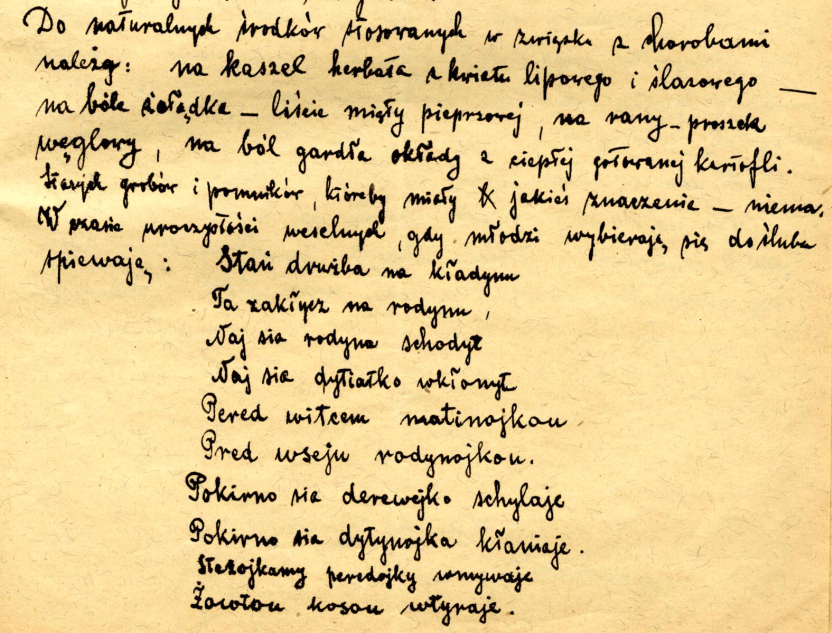
Do naturalnych środków stosowanych w związku z chorobami należą: na kaszel herbata z kwiatu lipowego i ślazowego – na bóle żołądka – liście mięty pieprzowej, na rany – proszek węglowy, na ból gardła okłady z ciepłej gotowanej kartofli. Starych grobów i pomników, któreby miały jakieś znaczenie – niema.
W czasie uroczystości weselnych, gdy młodzi wybierają się do ślubu śpiewają:
Stań drużba na kładynu
Ta zakłycz na rodynu,
Naj sia rodyna schodyt
Naj sia dytiatko wkłanyt
Pered witcem matinojkow
Pred wseju rodynojkow.
Pokirno sia derewejko schylaje
Pokirno sia dytynojka kłaniaje.
Steżejkamy peredojky zmywaje
Zołotoju kosou wtyraje.
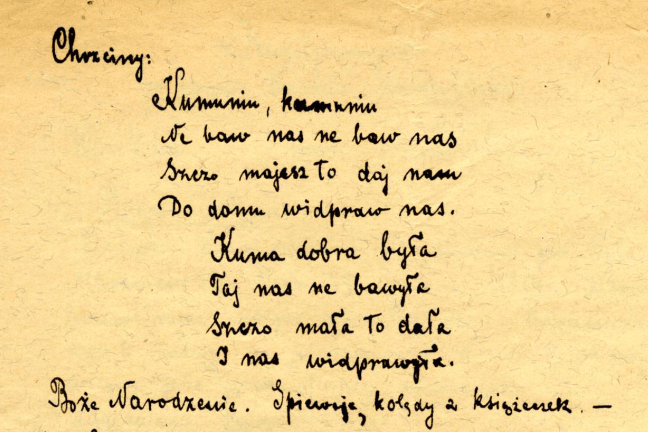
Chrzciny:
Kumuniu, kumuniu
Ne baw nas ne baw nas
Szczo majesz to daj nam
Do domu widpraw nas.
Kuma dobra była
Taj nas ne bawyła
Szczo mała to dała
I nas widprawiła.
Boże Narodzenie. Śpiewają kolędy z książeczek. —
English Translation: Google-Powered
Warning: this translation may be terrible. It was done electronically by someone who can speak neither Polish nor Ukrainian/Lemko. Do you wish to see it improve? You can help! Contact us.
Uwaga: to tłumaczenie może być fatalne. Zostało wykonane automatycznie przez osobę, która nie zna ani języka polskiego, ani ukraińskiego/łemkowskiego. Chcesz, żeby było lepsze? Możesz pomóc! Skontaktuj się z nami.
Spiritual culture. The local people believe that the dead continue to roam after passing, visiting their loved ones. Often, a deceased person may become a restless spirit—a upiór—who returns to their home to haunt the living. To prevent this, a handful of poppy seeds is placed into the mouth of the deceased. It is believed that the dead awaken at midnight and must count every single seed before one o’clock. Since there are so many seeds, they cannot possibly finish counting them by the deadline, and thus they cease to be a restless spirit.
If a deceased person begins to roam, a relative can put an end to it: at midnight, they go to the grave, take a handful of earth, and slowly scatter it along the path leading from the cemetery all the way to the house. The deceased follows this trail, arriving at the home by one o’clock. Upon arrival, the spirit collapses to the ground; to ensure they never roam again, one might sever their head, or drive a harrow tooth—or a similar iron spike—into the ground or directly into the spirit’s heart.
Money is placed in the coffin, tucked beneath the head of the deceased. It is believed that the dead must cross a river in the afterlife, and this money serves as payment for the ferryman.
To avoid fearing the dead or ever seeing them again, one should look beneath the coffin three times as it is being carried out of the house.
If a corpse’s eyes remain partially open, it is believed that someone else in that household will soon die.
The local people consider Monday an “ill-fated” or “heavy” day; therefore, no new work or tasks should be started on that day. Similarly, Friday—being a day of fasting—is considered an inauspicious time for sowing grain, planting potatoes, and the like, as it is believed that such efforts will yield little benefit or harvest. After sunset, nothing should be given away from the household—especially milk, butter, or salt. Furthermore, sowing grain after sunset is strictly forbidden. On the first Friday of the month, one should not cut down older fruit trees that once bore fruit, for if this is done, the remaining young trees will also lose their ability to bear fruit.
Planting and sowing should be completed before the full moon to ensure a more abundant harvest.
The local people are devout; they observe religious practices, attend church services in large numbers, and offer sacrifices. They participate eagerly in religious festivals (odpusty) and, once a year, travel in a large group on foot to the Kalwaria (Calvary) shrine. If someone in a household falls ill, a vow is often made: should the person recover, a pilgrimage to Kalwaria will be undertaken.
In the vicinity lies the village of Roztoka. In October, people flock there for a religious festival, bringing offerings of butter and praying to God for the health of their livestock.
Among the most cherished prayers are the “Our Father” and the “Rejoice, O Virgin Theotokos” (Bohorodyce Diwo). Attached to the local church is an “Apostleship of Prayer” group, which has its own specific prayer to the Mother of God—a prayer that is recited willingly by all.
The local population approaches formal medicine and veterinary care with a degree of skepticism; there is a widespread belief that a skilled folk healer (znachor) is more effective than a trained physician. As for the care and nourishment provided to the sick, these depend largely on the family’s level of wealth. The wealthy feed the sick with meat, sausage, and fruit; above all, they consider vodka and wine to be the best remedies. Among the poor, the sick are given whatever is being cooked for the whole household.
Natural remedies used for various ailments include: linden and mallow blossom tea for a cough; peppermint leaves for stomach aches; powdered charcoal for wounds; and warm, boiled potatoes applied as a compress for a sore throat. There are no old graves or monuments of any significance.
During wedding celebrations, as the bride and groom set off for the ceremony, they sing:
Stand, groomsman, upon the footbridge,
And call out to the kin,
Let the kin gather round,
Let the child bow down—
Before the father and the mother,
Before all the gathered kin.
Humbly the little tree bows low,
Humbly the child bows down.
She washes the path ahead,
And wipes it dry with her golden braid.
Christening:
Godparent, dear godparent,
Do not keep us waiting, do not keep us waiting—
Give us what you have,
And send us on our way home.
The godmother was kind,
She did not keep us waiting;
She gave what she had,
And sent us on our way.
Christmas. They sing carols from small booklets. —
Sanok Genes seeks to create a database of transcripts and English translations from the “Kultura Duchowa” sections from the 1936 Sanok School Inspectorate Questionnaires. The original documents are held by the Sanok Museum of History and digitized by the Sanok Digital Library. To learn more, see the project description.
Sanok Genes stawia sobie za cel stworzenie bazy danych zawierającej transkrypcje oraz tłumaczenia na język angielski fragmentów dotyczących „kultury duchowej”, pochodzących z kwestionariuszy Inspektoratu Szkolnego w Sanoku z 1936 roku. Oryginalne dokumenty znajdują się w zbiorach Muzeum Historycznego w Sanoku i zostały zdigitalizowane przez Sanocką Bibliotekę Cyfrową. Więcej informacji można znaleźć w opisie projektu.

