Bukowiec is a village in Solina Commune, Lesko County.
Bukowiec– wieś w gminie Solina, w powiecie leskim.

Transcript: Google-Powered
Warning: this transcription may be terrible. It was done electronically by someone who can speak neither Polish nor Ukrainian/Lemko. Do you wish to see it improve? You can help! Contact us.
Uwaga: ta transkrypcja może być fatalna. Została wykonana automatycznie przez osobę, która nie zna ani języka polskiego, ani ukraińskiego/łemkowskiego. Chcesz, żeby była lepsza? Możesz pomóc! Skontaktuj się z nami.
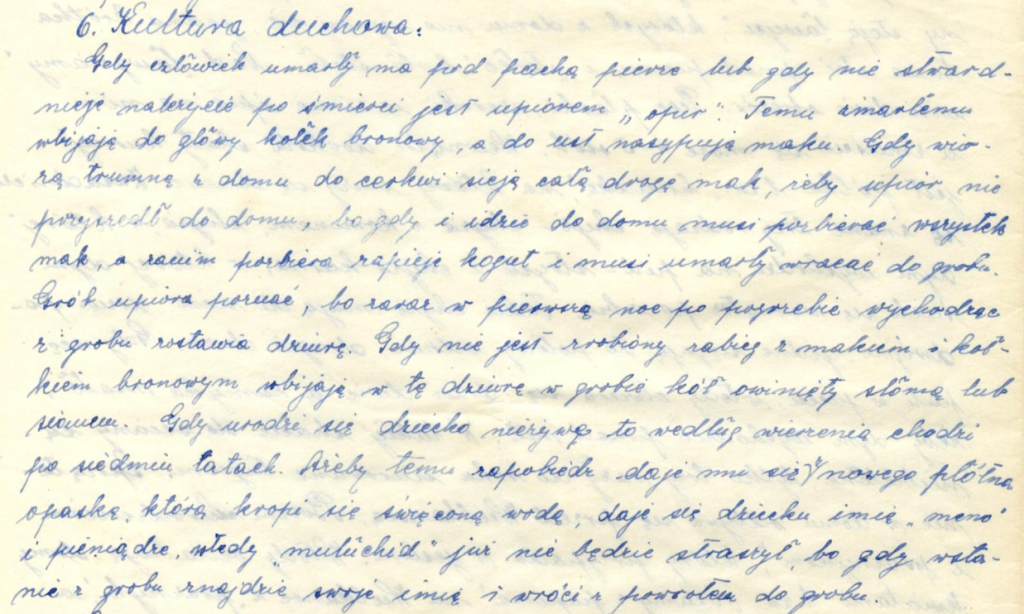
- Kultura duchowa:
Gdy człowiek umarły ma pod pachą pierze lub gdy nie stwardnieje materyjele po śmierci jest upiorem „opir”. Temu zmarłemu wbijają do głowy kołek bronowy, a do ust nasypują maku. Gdy wożą trumnę z domu do cerkwi sieją całą drogę mak, żeby upiór nie przyszedł do domu, bo gdy i idzie do domu musi pozbierać wszytek mak, a zanim pozbiera zapieje kogut i musi umarły wracać do grobu. Grób upiora poznać, bo zaraz w pierwszą noc po pogrzebie wychodząc z grobu zostawia dziurę. Gdy nie jest zrobiony zabieg z makiem i kołkiem bronowym wbijają w tę dziurę w grobie kół owinięty słomą lub sianem. Gdy urodzi się dziecko nieżywe to według wierzenia chodzi po siedmiu latach. Ażeby temu zapobiedz daje mu się nowego płótna opaskę, którą kropi się święconą wodą, daje się dziecku imię „meno” i pieniądze, wtedy „mulichid” już nie będzie straszył, bo gdy wstanie z grobu znajdzie swoje imię i wróci z powrotem do grobu.
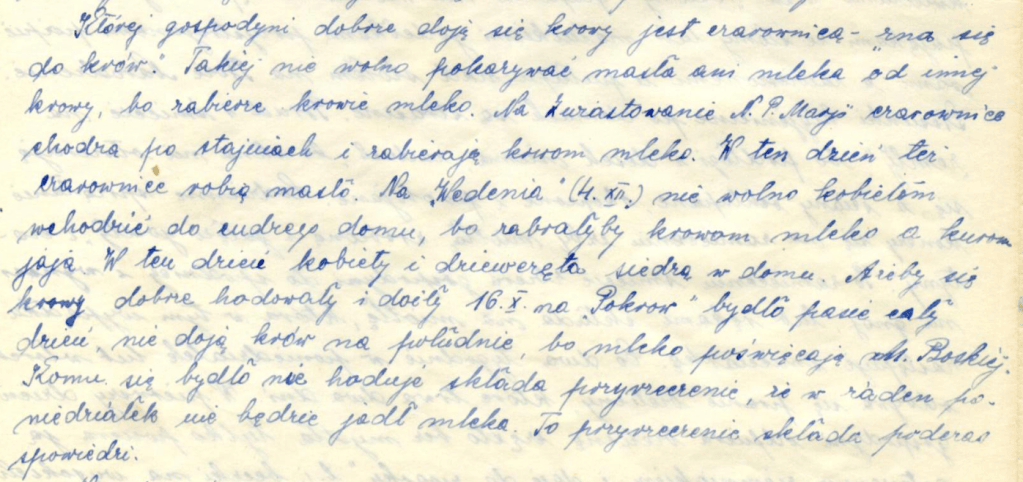
Której gospodyni dobrze doją się krowy jest czarownica – “zna się do krów”. Takiej nie wolno pokazywać masła ani mleka od innej krowy, bo zabierze krowie mleko. Na Zwiastowanie N. P. Marji czarownice chodzą po stajniach i zabierają krowom mleko. W ten dzień też czarownice robią masło. Na Wprowadzenia (4. XII.) nie wolno kobietom wchodzić do cudzego domu, bo zabrałyby krowom mleko a kurom jaja. W ten dzień kobiety i dziewczęta siedzą w domu. Ażeby się krowy dobrze hodowały i doiły 16. X. na “Pokrow” bydło pasą cały dzień, nie doją krów na południe, bo mleko poświęcają M. Boskiej. Komu się bydło nie hoduje składa przyrzeczenie, że w żaden poniedziałek nie będzie jadł mleka. To przyrzeczenie składa podczas spowiedzi.
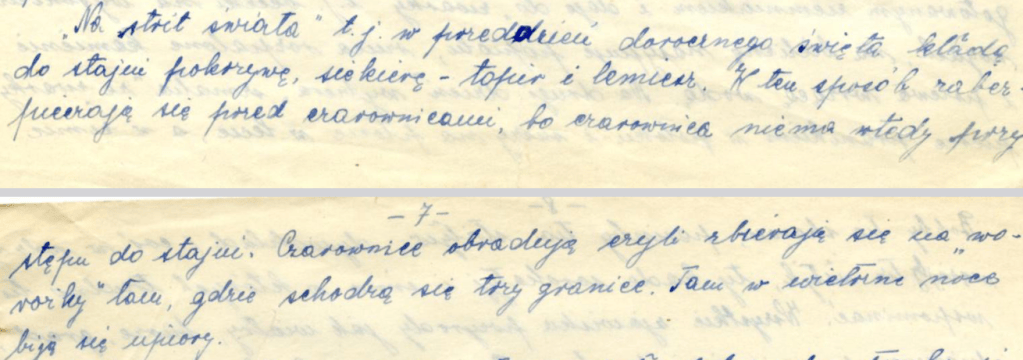
“Na strót świata” t.j. w przeddzień dorocznego święta kładą do stajni pokrzywę, siekierę – topór i lemiesz. W ten sposób zabezpieczają się przed czarownicami, bo czarownica nie ma wtedy przystępu do stajni. Czarownice obradują czyli zbierają się na “woworky” tam, gdzie schodzą się trzy granice. Tam w wietrzne noce biją się upiory.
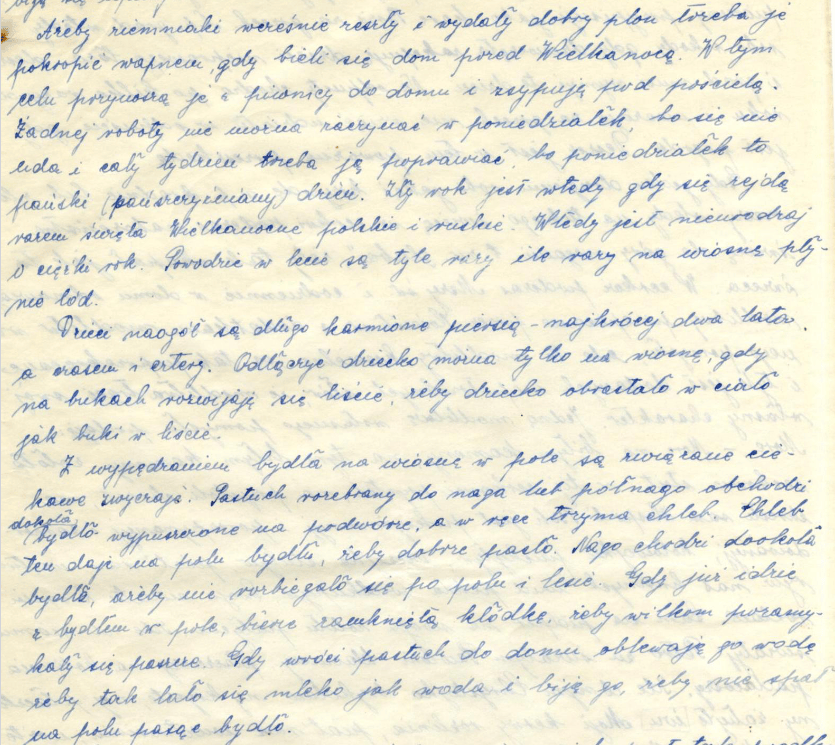
Ażeby ziemniaki wcześnie zeszły i wydały dobry plon trzeba je pokropić wapnem gdy bieli się dom przed Wielkanocą. W tym celu przynosi je z piwnicy do domu i zsypuje pod pościele. Żadnej roboty nie można zaczynać w poniedziałek, bo się nie uda i cały tydzień trzeba ją poprawiać, bo poniedziałek to pański (poświęcany) dzień. Zły rok jest wtedy gdy się zejdą razem święta Wielkanocne polskie i ruskie. Wtedy jest nieurodzaj i ciężki rok. Powodzie w lecie są tyle razy, ile razy na wiosnę płynie lód.
Dzieci naogół są długo karmione piersią – najkrócej dwa lata, a czasem i cztery. Odłączyć dziecko można tylko na wiosnę, gdy na bukach rozwijają się liście, żeby dziecko obrastało w ciało jak buki w liście.
Z wypędzaniem bydła na wiosnę w pole są związane ciekawe zwyczaje. Pastuch rozebrany do naga lub półnago obchodzi wokoło bydło wypuszczone na podwórze, a w ręce trzyma chleb. Chleb ten daje na polu bydłu, żeby dobrze pasło. Nago chodzi dookoła bydła, ażeby nie rozbiegało się po polu i lesie. Gdy już idzie z bydłem w pole, bierze zamkniętą kłódkę, żeby wilkom pomykały się paszcze. Gdy wróci pastuch do domu oblewają go wodą żeby tak lało się mleko jak woda i biją go, żeby nie spał na polu pasąc bydło.
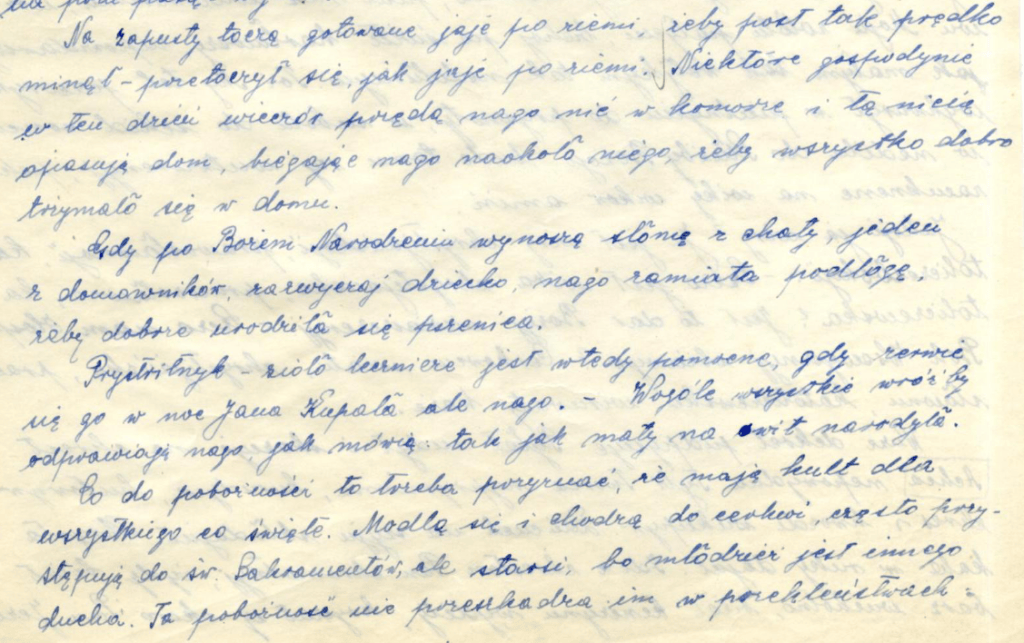
Na zapusty toczą gotowane jaje po ziemi, żeby post tak prędko minął – potoczył się, jak jaje po ziemi. Niektóre gospodynie w ten dzień wieczór przędą nago nić w komorze i tą nicią opasują dom, biegając nago naokoło niego, żeby wszystko dobro trzymało się w domu.
Gdy po Bożym Narodzeniu wynoszą słomę z chaty, jeden z domowników, zazwyczaj dziecko, nago zamiata podłogę, żeby dobrze urodziła się pszenica.
Przystritnik – zioło lecznicze jest wtedy pomocne, gdy zerwie się go w noc Jana Kupała ale nago. – W ogóle wszystkie wróżby odprawiają nago, jak mówią, tak jak matka na świt narodziła.
Co do pobożności to trzeba przyznać, że mają kult dla wszystkiego co święte. Modlą się i chodzą do cerkwi, często przystępują do św. Sakramentów, ale starzy, bo młodzież jest innego ducha. Ta pobożność nie przeszkadza im w przekleństwach.
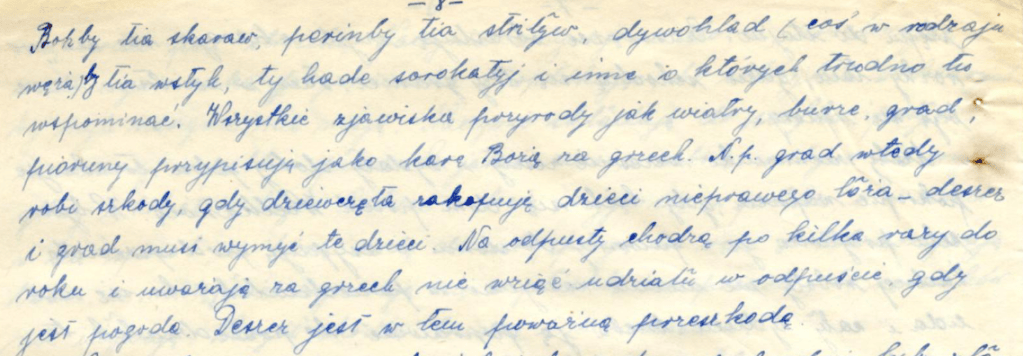
Boh by tia skarał, perinby tia strilyw, dywohlad (coś w rodzaju węża) by tia sharaw, ty hadie sorokatyj i inne o których trudno tu wspominać. Wszystkie zjawiska przyrody jak wiatry, burze, grad, pioruny przypisują jako karę Bożą za grzech. N.p. grad wtedy robi szkody, gdy dziewczęta zakopują dzieci nieprawego łoża — deszcz i grad musi wymyć te dzieci. Na odpusty chodzą po kilka razy do roku i uważają za grzech nie wziąć udziału w odpuście, gdy jest pogoda. Deszcz jest w tem poważną przeszkodą.
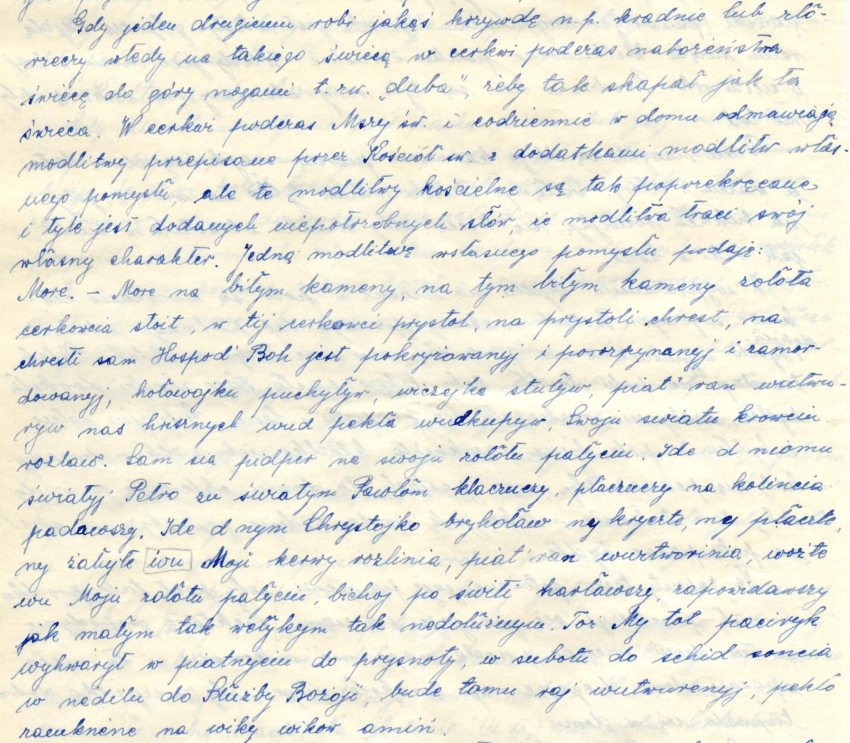
Gdy jeden drugiemu robi jakąś krzywdę n.p. kradnie lub złorzeczy wtedy na takiego świecą w cerkwi podczas nabożeństwa świecę do góry nogami t.zw. „duba”, żeby tak skapał jak ta świeca. W cerkar podczas Mszy św. i codziennie w domu odmawiają modlitwy przepisane przez Kościół sw z dodatkami modlitw własnego pomysłu, ale te modlitwy kościelne są tak poprzekręcane i tyle jest dodanych niepotrzebnych słów że modlitwa traci swój własny charakter. Jedną modlitwę własnego pomysłu podaję:
More. – More na bitym kameny, na tym bitym kameny zołota cerkowcia stoił, w tej cerkowci prystoł, na prystoli chrest, na chresti sam Hospod Boh jest pokryowanyj i posypanyj i zamordowanyj, hołowojku pachyływ, wszyjko stuljiw piať ran widorzyw nas hrisznych wred pekła widkupyw. Swoju swiatu krowciu rozlaio. Sam na pidpor na swoju zołotu pałyciu. Ide d niomu swiatyj Petro zu swiatym Pawłom klaczuchy płaczuchy na kolincia padaiuchy. Ide d nym Chrystejko szohoław ny kojerte, ny płaczte, ny żaliyte iuż Moij krowy rozlinia, piať ran wowtworinia, wse to wu moju rołotu pałyciu, bihoj po switi nastaiochy, zapowidaiuchy jak małym tak wełykym tak nadołużyie. Toj kty toł pacyryk wykwaryt w piatnyciu do prysnoty, w subotu do schid soncia w nedilu do Służby Bożoj, bude tomu raj wowtworenyj, pekło zaczynene na wiky wikow amin.
Jakoji ja wiry? Ja jest wiry chrystijanskoji, prawosławnoji, katoliczesbkoji. – Prero jest wira chrystijanska, prawosławna, katoliczewska? Jest to dar Borij onrawierenyj. Prero nam Hospod Boh Wsewysznyj obiawyr? Cerkoweju swiatu, chrystijanska, prawosławnu, katoliczesku winuway karie.
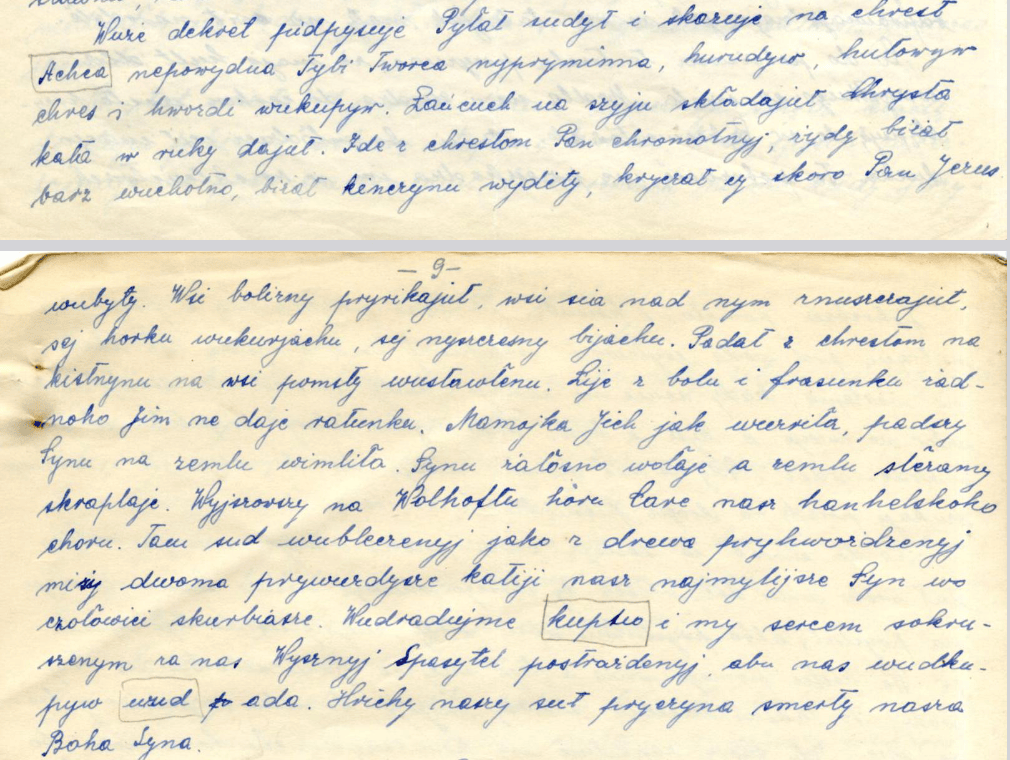
Wure dekret pidpysuje Pÿłat sudÿt i skazuje na chrest. Achia nepowÿdna Bÿli Tworca nÿpryymima, hurudÿw, hutovÿw chrest i hwordi wykupÿw. Łańcuch na szyju składajut chrysta kata w rukÿ dajut. Ide z chrestom Pan chromotnyj, rÿdzÿ brat barz wielmożno, brat kenerynu wydity, kryczat ez skoro Pan Jezus wubyty. Wsi bolizny pryrikajut, wsi sia nad nym znuscajut, sej horku wekurjaschu, sej nyczesny bijachu. Padat z chrestom na histrynu na wsi strony wustawlenu. Lije s bolu i frasunku radnoho jim ne daje ratunku. Mamajka jeh jak wezryła, padaj hynu na zemlu wimlita. Synu ratowno wołaje a zemlu slezamy skraplaje. Wyjszoszy na Wolhostu hore care nasz hanhelskoho choru. Tam sud wubleczenyj jako z drewa prychwozdzenyj mizyj dwoma prywerdzyre katyji nasz najmylijse Syn wo crołowici skurbiasze. Wudradujme kuptio i my sercem sokrunenym za nas Wyzny j Spasytel postradanyj abu nas wudkupyw eczed to ada. Hrichy naszy sut pryczyna smerty naszoho Boha Syna.
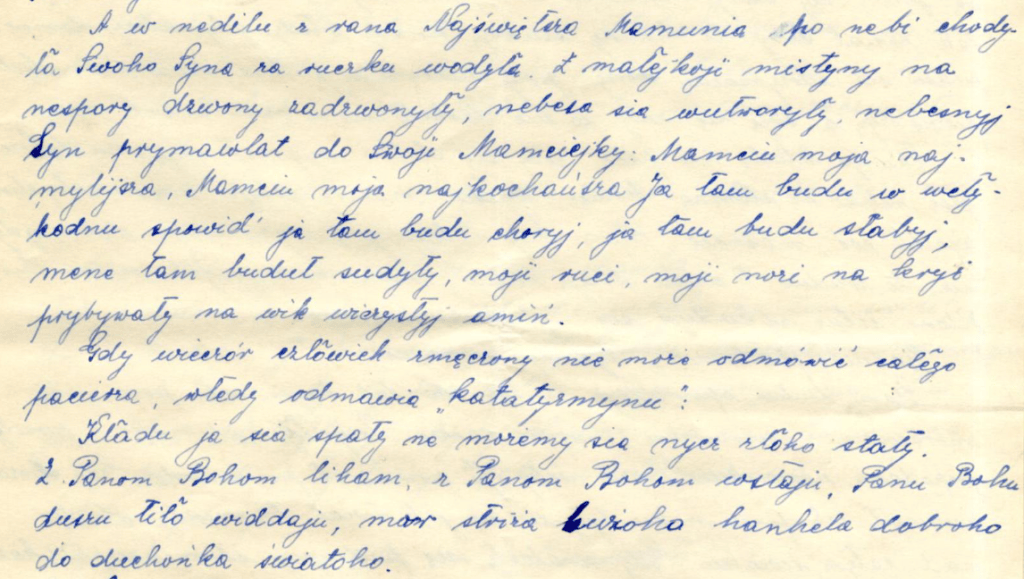
A w nedilu z rana Najświętsza Mamunia po nebi chodyła Swoho Syna za ruczki wodyła. Z małej koji mistyny na nespory dzwony zadzwonyły, nebesa sia wytworyły, nebesnyj Syn prymawlat do Swoji Mamejky: Mameju moja najmylijsza, Mameju moja najkochańsza ja tam budu w wełykodnu spowid’ ja tam budu choryj, ja tam budu słabyj,mene tam budut sudyty, moji ruki, moji nohi na krzyżprybywały na wik wierzystyj amin’.
Gdy wieczór człowiek zmęczony nie może odmówić całego pacierza, wtedy odmawia „kataterymnu”:
Kładu ja sia spaty ne możemy się nycz złoho stały. Z Panom Bohom liham, z Panom Bohom zostaju, Panu Bohuduszu tiło widdaju, moho stworca swiatoho hanheła dobrohodo duchonika swiatoho.
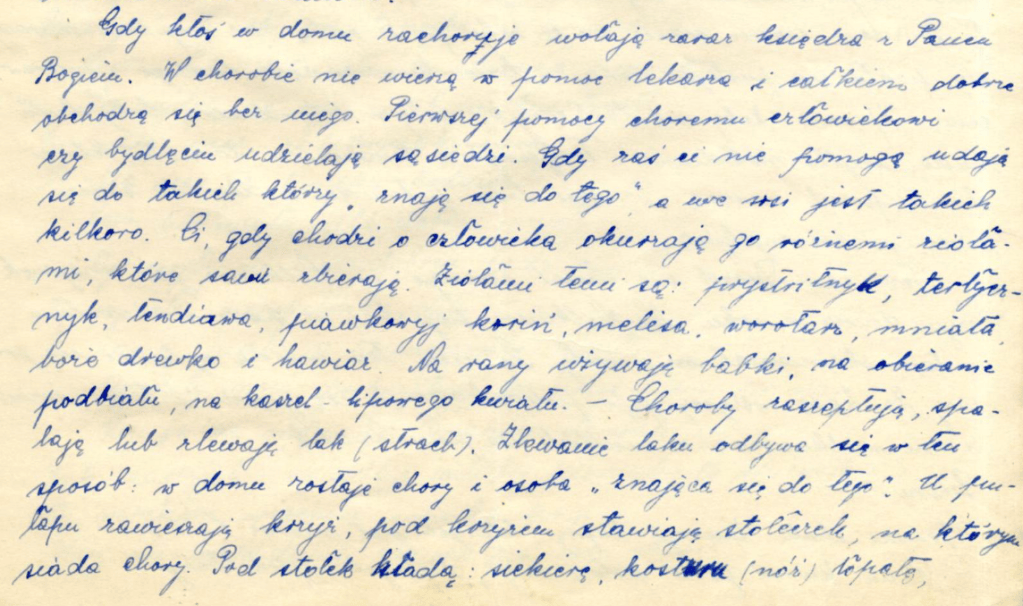
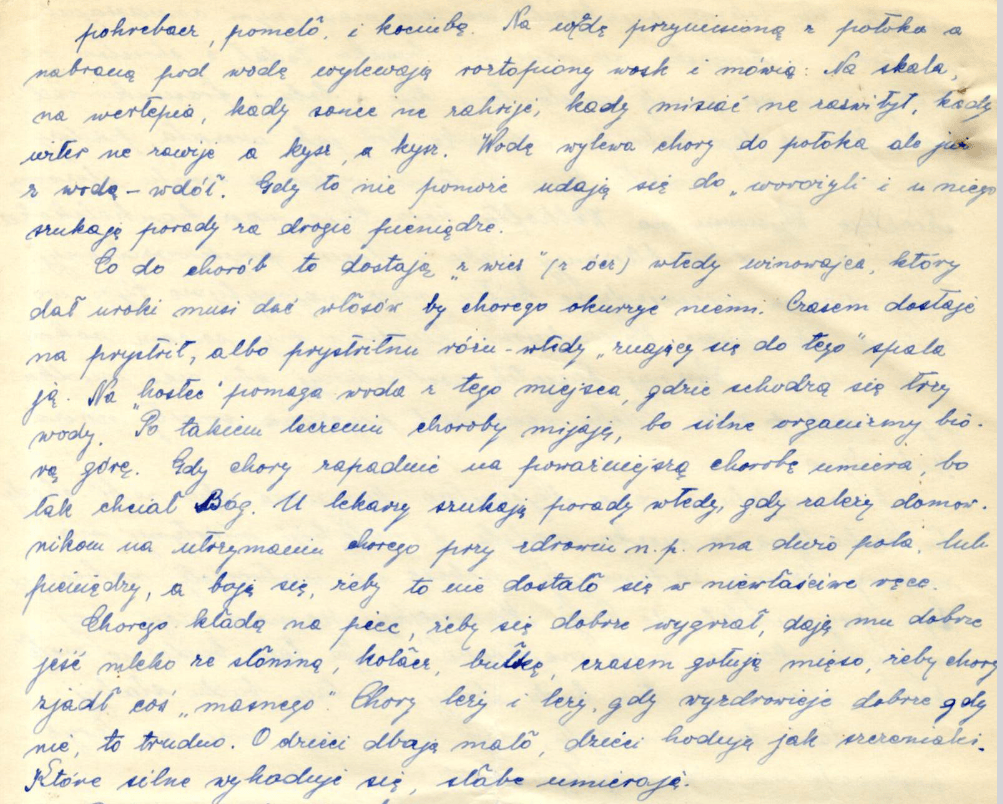
Gdy ktoś w domu zachoruje wołają zaraz księdza z Panem Bogiem. W chorobie nie wierzą w pomoc lekarza i całkiem dobrze obchodzą się bez niego. Pierwszej pomocy choremu człowiekowi czy bydlęciu udzielają sąsiedzi. Gdy zaś ci nie pomogą udają się do takich którzy „znają się do tego”, a we wsi jest takich kilkoro. Ci, gdy chodzi o człowieka okadzają go różnemi ziołami, które sami zbierają. Ziołami temi są: przywrotnik, tertyrnyk, lędźwiana, pijawkowy korzeń, melisa, worotan, mniata, boże drewko i hawiar. Na rany wzywają babki, na obieranie podbiału, na kaszel – lipowego kwiatu. – Choroby receptują, spalają lub zlewają lek (strach). Zlewanie lęku odbywa się w ten sposób: w domu zostaje chory i osoba „znająca się do tego”. U pułapu zawieszają krzyż, pod krzyżem stawiają stołeczek, na którym siada chory. Pod stołek kładą: siekierę, kostur (nóż) łopatę, pohrebacz, pomiotło i kociubę. Na wodę przyniesioną z potoka a nabraną pod wodę wylewają roztopiony wosk i mówią: Na skała,na wertepy, kędy słońce nie jaśnieje, kędy miesiąc nie oświecił, kędy wiatr nie rawije a kysz, a kysz. Wodę wylewa chory do potoka ale już z wodą – w dół. Gdy to nie pomoże udają się do worożyli i u niego szukają porady za drogie pieniądze.
Co do chorób to dostają „z wieś” („z ócz”) wtedy winowajca, który dał uroki musi dać włosów by chorego okadzić niemi. Czasem dostaje na przytryt, albo prystritnu różu – wtedy, rugają się do tego i spalą ją. Na „hostec” pomaga woda z tego miejsca, gdzie schodzą się trzy wody. Po takiem leczeniu choroby mijają, bo silne organizmy biorą górę. Gdy chory zapadnie na poważniejszą chorobę umiera, bo tak chciał Bóg. U lekarza szukają porady wtedy, gdy zależy domownikom na utrzymaniu chorego przy zdrowiu n.p. ma dużo pola lub pieniędzy, a boją się, żeby to nie dostało się w niewłaściwe ręce.
Chorego kładą na piec, żeby się dobrze wygrzał, dają mu dobrze jeść mleko ze słoniną, kołacz, bułkę, czasem gotują mięso, żeby chory zjadł coś „masnego”. Chory leży i leży, gdy wyzdrowieje dobrze gdynię, to trudno. O dzieci dbają mało, dzieci hodują jak sęreńszki. Które silne wyhodują się, słabe umierają.
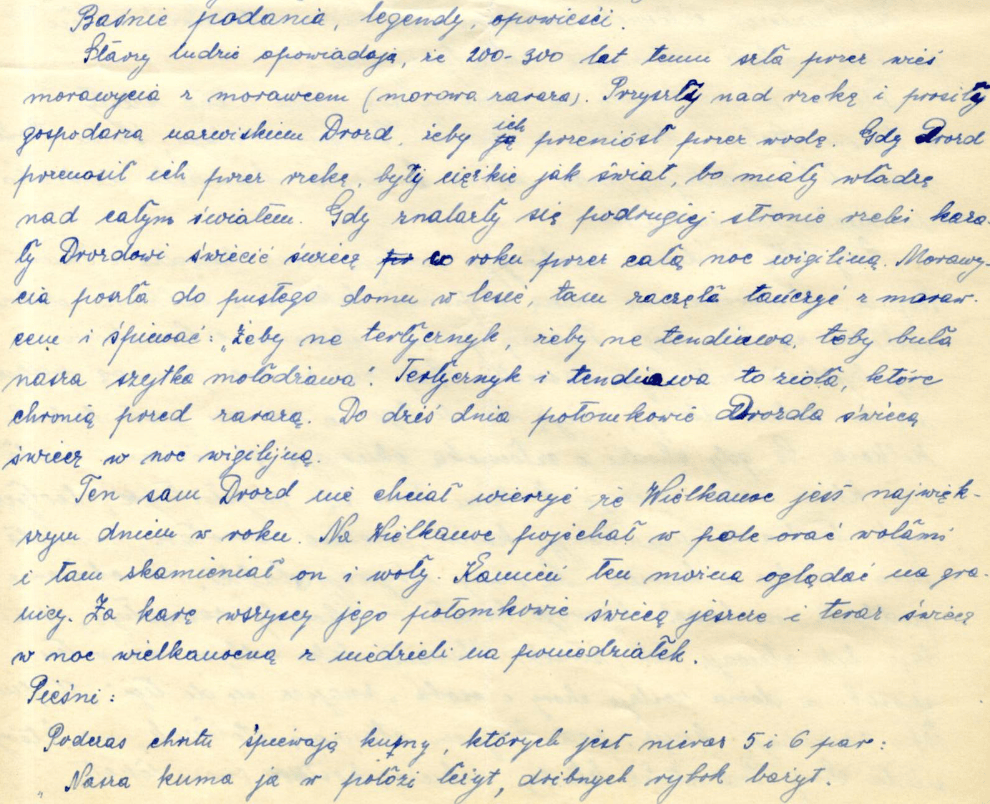
Baśnie podania, legendy, opowieści.
Starsi ludzie opowiadają, że 200–300 lat temu szła przez wieś morawycia z morawcem (morowa zaraza). Przyszli nad rzekę i prosili gospodarza nazwiskiem Drozd, żeby ich przeniósł przez wodę. Gdy Drozd przenosił ich przez rzekę, byli ciężkie jak świat, bo miały władzę nad całym światem. Gdy znalazły się po drugiej stronie rzeki kazały Drozdowi świecić świecę co roku przez całą noc wigilijną. Morawycia poszła do pustego domu w lesie, tam zaczęła tańczyć z morawcem i śpiewać: żeby nie tercjernyk, żeby nie tendiawa, toby była nasza wszytka mołodława. Tercjernyk i tendiawa to zioła, które chronią przed zarazą. Do dziś dnia potomkowie Drozda świecą świece w noc wigilijną.
Ten sam Drozd nie chciał wierzyć, że Wielkanoc jest największym dniem w roku. Na Wielkanoc pojechał w pole orać wołami i tam skamieniał on i woły. Kamień ten można oglądać na granicy. Za karę wszyscy jego potomkowie świecą jeszcze i teraz świecę w noc wielkanocną z niedzieli na poniedziałek.
Pieśni:
Podczas chrztu śpiewają kumy, których jest nieraz 5 i 6 par:
Nasza kuma ja w potoku leżyt, drobnych rybek bożyt.
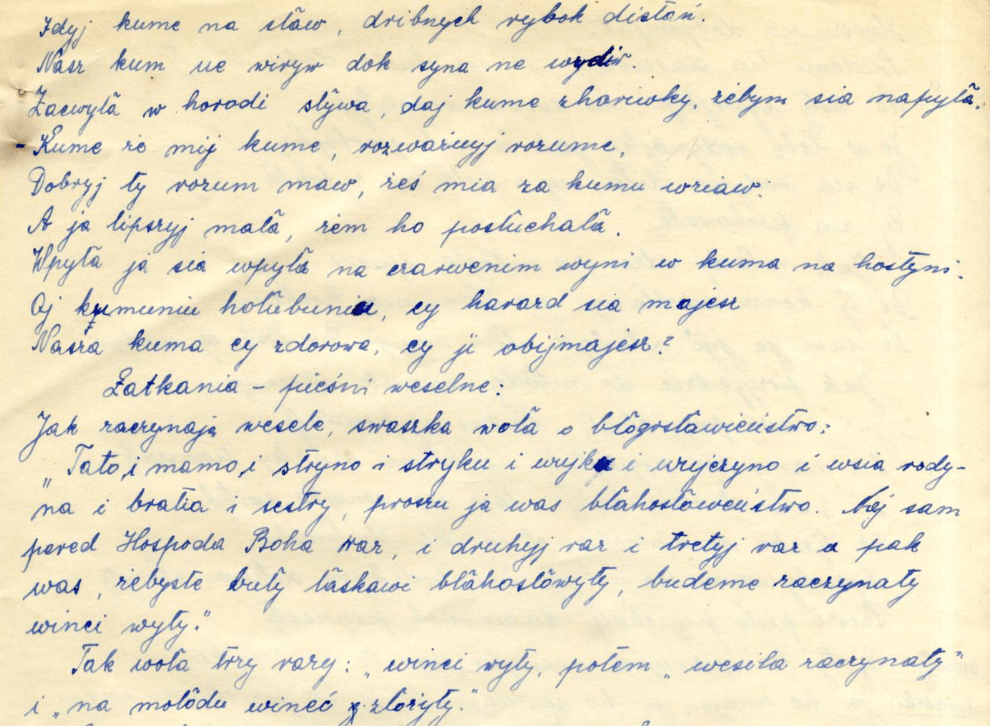
Idy, kume, na staw, dribnych rybok dostaw.
Nasz kum ne wirym, dok syna ne wydiw.
Zacwiła w horodi sływa, daj, kume, rhorisky, rebym sia napyła.
Kume, to mij kume, rozwaruyj rorume,
Dobryj ty rozum masz, res’ mia za kumu wziaw.
A ja lipszyj mała, rem ho posłuchała.
Wpyła ja sia wpyła na czarwenim wyni, co kuma na hostyni.
Oj, kumuniu hołubnice, czy harard sia maje sz?
Nasza kuma czy zdorowa, czy ji obijmajesz?
Łatkania – pieśni weselne:
Jak zaczynają wesele, swaszka woła o błogosławieństwo:
“Tato i mamo, i stryno, i stryku, i wujku, i wujczyno, i wsia rodyna, i bratia, i sestry, proszu ja was błahosłoweństwo. Hej, sam pered Hospoda Boha raz, i druhyj raz, i tretyj raz, a pak was, reby ste były łaskawi błahosłowyty, budemo zaczynaty wineć wyty.”
Tak woła try razy: “wineć wyty”, potem “wesile zaczynaty” i “na mołodu wineć złoriyty.”
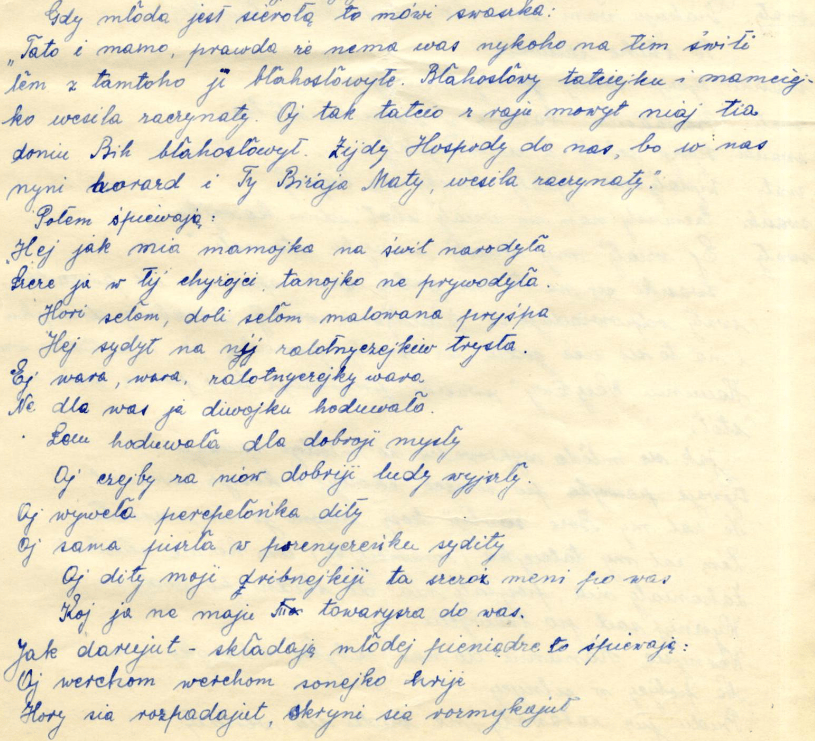
Gdy młoda jest sierotą to mówi swaszka:
„Tato i mamo, prawda że nema was nykoho na tym świti
lem z tamtoho ji blahosłowyte. Blahosłowy tatejku i mamciej
ko wesila zaczynaty. Oj tak tateio z raju mowyt niaj tia
domu Bih blahosłowyt. Zyjdzy Hospody do nas, bo w nas
nyni howard i Ty Biłaja Maty, wesila zaczynaty.”
Potem śpiewają:
Hej jak mia mamojka na świt narodyła
Zere ja w tyj chyżyci tanojko ne prywodyła.
Hori sełom, doli sełom malowana pryspa
Hej sydyt na nyj rałotnyrejkiw trysta.
Ej wara, wara, rałotnyrejky wara.
Ne dla was ja diwojku hoduwała.
Lem hoduwała dla dobroji mysły
Oj cejby na niu dobriji ludy wyszły.
Oj wyweła perepełonka dity
Oj sama justa w poreniereszku sydyty
Oj dity moji dribnejszyji ta szerok meni po was
Koj ja ne maju tia towarysza do was.
Jak darujut – składają młodej pieniądze to śpiewają:
Oj werchom werchom sonejko hrije
Hory sia rozpadajut, skryni sia sormykajut
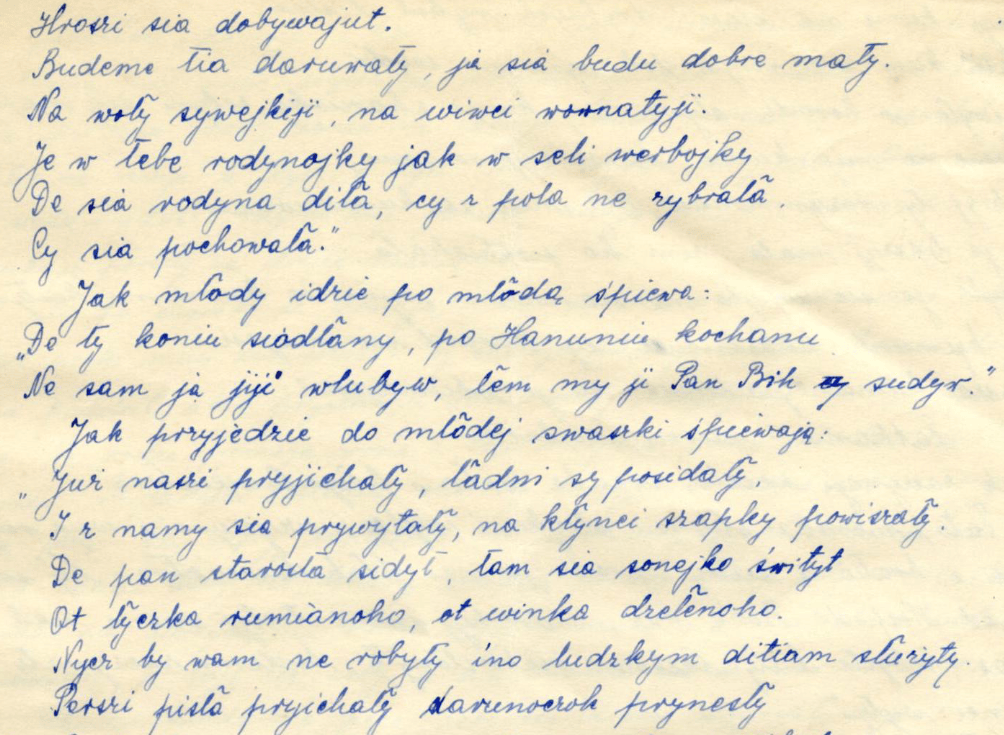
Hroszi sia dobiwajut.
Budeme tia daruwaty, ja sia budu dobre maty.
Na woly sywejkyji, na wiwei mownatyji.
Je w tebe rodynojky jak w seli werbojky.
De sia rodyna dila, cy z pola ne wybrała.
Cy sia pochowała.
Jak młody idzie po młodu spiewa:
“Do ty koniu siodłany, po Hanuniu kochanu
Ne sam ja jiji wlubyw, lem my ji Pan Bih sudyw.”
Jak pryjedzie do młodej swaski spiewaju:
“Juz naszi pryjichaly, ładni sy posidały,
I z namy sia prywitały, na klynei czapky powiszały.
De pan starosta sidyt, tam sia sonejko śwityt
Ot tyerka rumiancho, ot winko drełenho.
Bych by wam ne robyły ino ludzkym ditiam służyły.
Perszi pisla pryjichaly darenczok prynesły.”
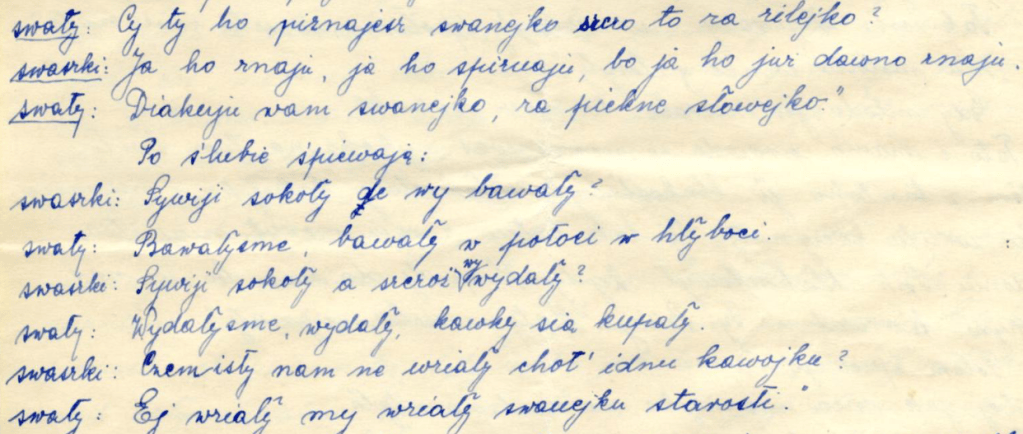
swaty: Cy ty ho piznajesz swanejko siero to za rilejko?
swaszki: Ja ho znaju, ja ho spivaju, bo ja ho już dawno znaju.
swaty: Diakuju wam swanejko, za piekne słowejko.
Po ślubie śpiewają:
swaszki: Sywiji sokoły de wy bawały?
swaty: Bawałysme, bawały w potoci w hłyboci.
swaszki: Sywiji sokoły a szczości wydały?
swaty: Wydałysme, wydały, kawky sia kupały.
swaszki: Czemisty nam ne wziały chot’ idnu kawojku?
swaty: Ej wziały my wziały swanejku starosti.
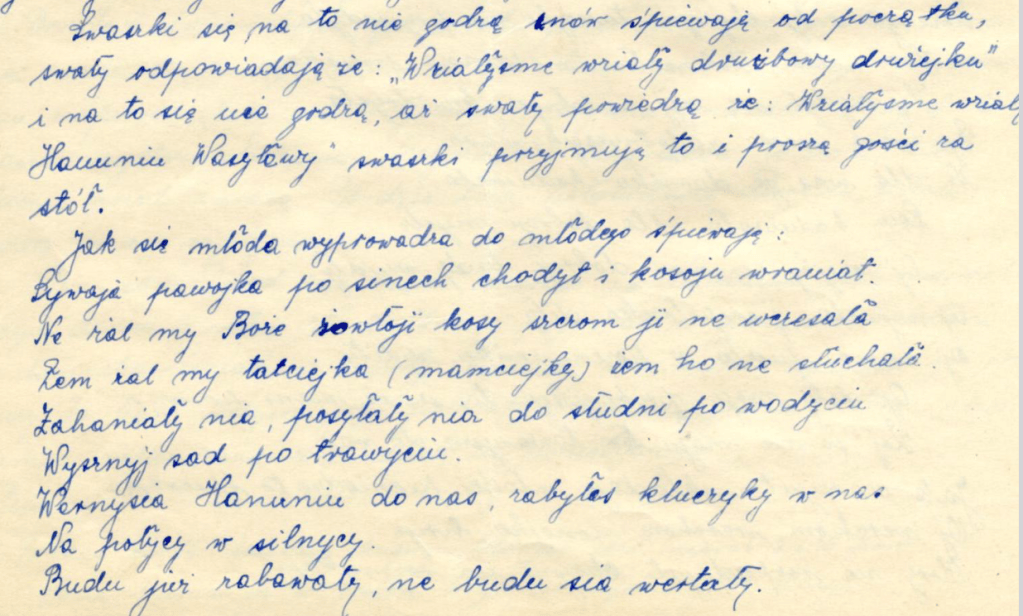
Swaszki się na to nie godzą znów śpiewają od początku,swaty odpowiadają że: „Wzięliśmy wzięli drużbowy drużejkę”i na to się nie godzą, aż swaty powiedzą że: Wzięliśmy wzięliHanuniu Wasytową swarki przyjmują to i proszą gości za stół.
Jak się młoda wyprowadza do młodego śpiewają:
Bywają pawojka po sinech chodyt i kosoju wraciat.
Ne rał my Boże rowłaji kosy srerom ji ne weresałâ
Żem żał my tatejka (mamciejkę) żem ho ne słuchała.
Zahaniały mia, posyłały nia do studni po wodyciu
Wysypyj sad po trawyciu.
Wernysia Hanuniu do nas, zabyłas kluczyky u nas
Na policiy w silnycy.
Budu już rabowały, ne budu sia werhtały.
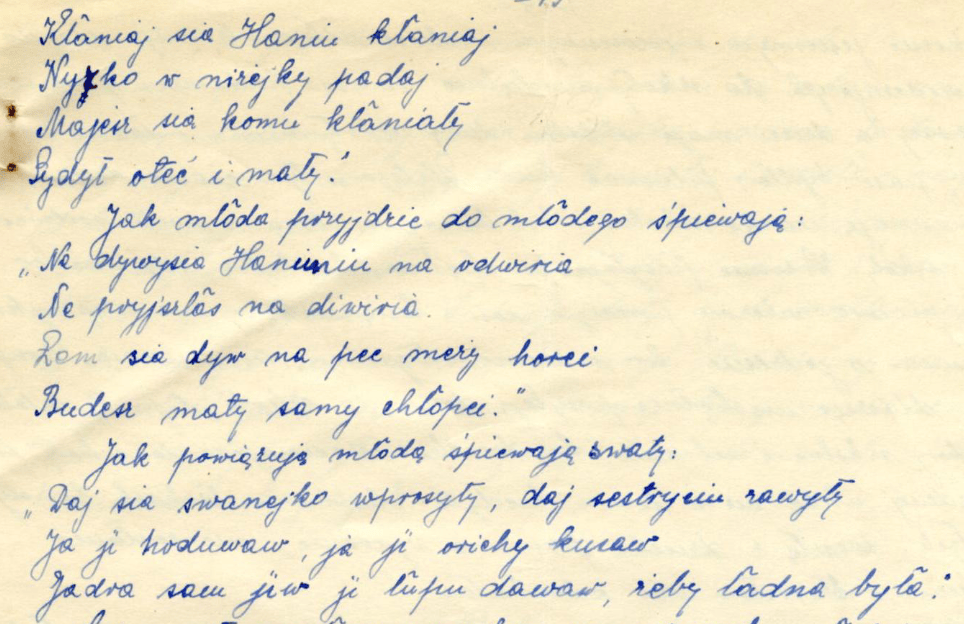
Kłaniaj sia Haniu kłaniaj
Nyzko w nirejky padaj
Majesz sia komu kłaniały
Hydył otec i maty.
Jak młoda przyjdzie do młodego śpiewają:
„Ne dywisia Haniniu na odwiria
Ne pryszłaś na diwiria.
Łom sia dyw na pec mery horei
Budesz maty samy chłopci.”
Jak powierzają młodą śpiewają swaty:
„Daj sia swanyjko uprosyty, daj sestryciu zawyty
ja ji hoduwaw, ja ji oriechy kupew
jadra sam jiw ji łupu dawaw, żeby ładna była.”
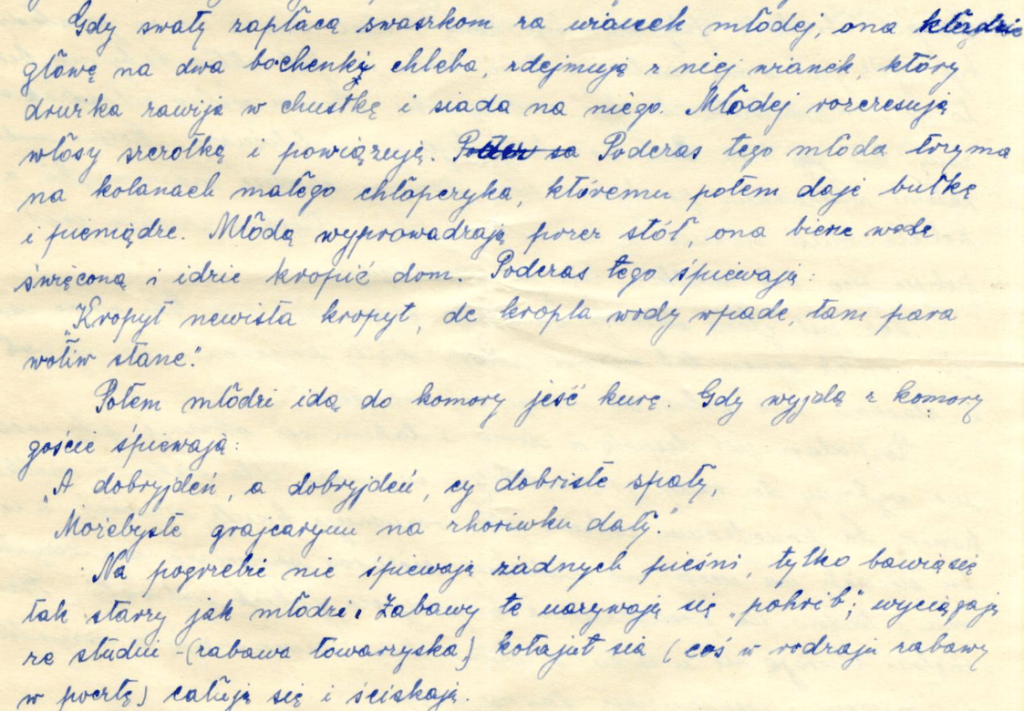
Gdy swaty zapłacą swaszkom za wianek młodej; ona kładzie głowę na dwa bochenki chleba, zdejmuje z niej wianek, który drużba zawija w chustkę i siada na niego. Młodej rozczesują włosy szczotką i powiązują. Podczas tego młoda trzyma na kolanach małego chłopczyka, któremu potem daje bułkę i pieniądze. Młodą wyprowadzają przez stół, ona bierze wodę święconą i idzie kropić dom. Podczas tego śpiewają:
„Kropił niewista kropił, de kropla wody wpadnie, tam para wołów stanie.”
Potem młodzi idą do komory jeść kurę. Gdy wyjdą z komory goście śpiewają:
„A dobrydzień, a dobrydzień, cy dobriste spały,
Mogłyście grajcarzyka na rhoriwku daly.”
Na pogrzebie nie śpiewają żadnych pieśni, tylko bawią się tak starzy jak młodzi. Zabawy te nazywają się pohrib; wyciągają ze studni (zabawa towarzyska) kołyszą się (coś w rodzaju zabawy w pocztę) całują się i ściskają.
English Translation: Google-Powered
Warning: this translation may be terrible. It was done electronically by someone who can speak neither Polish nor Ukrainian/Lemko. Do you wish to see it improve? You can help! Contact us.
Uwaga: to tłumaczenie może być fatalne. Zostało wykonane automatycznie przez osobę, która nie zna ani języka polskiego, ani ukraińskiego/łemkowskiego. Chcesz, żeby było lepsze? Możesz pomóc! Skontaktuj się z nami.
- Spiritual Culture:
If a deceased person has feathers under their armpit, or if their body does not stiffen after death, they are considered an opir (a type of revenant or vampire). In such cases, a harrow-tooth—a wooden peg—is driven into the deceased’s head, and poppy seeds are poured into their mouth. When the coffin is transported from the home to the church, poppy seeds are scattered along the entire path to prevent the opir from returning home; should it attempt to return, it would be compelled to gather every single seed. Before it could finish, a rooster would crow, forcing the dead being to return to its grave. An opir’s grave can be identified because, on the very first night after the burial, the creature leaves a hole when emerging from the earth. If the aforementioned measures—using poppy seeds and a harrow-tooth—were not taken, a wooden stake wrapped in straw or hay is driven into this hole. According to folk belief, a child born dead will begin to roam after seven years. To prevent this, the child is provided with a strip of new linen cloth sprinkled with holy water, along with a name and some money; this ensures the mulichid (the restless spirit of the child) will not haunt the living, for upon rising from the grave, it will find its name and return to its resting place.
A woman whose cows yield an abundance of milk is suspected of being a witch—she is said to “know the secret of cows.” One must never show such a woman butter or milk obtained from another person’s cow, lest she “take away” the animal’s milk. On the Feast of the Annunciation of the Blessed Virgin Mary, witches are said to roam through stables to steal milk from cows; on this same day, they also busy themselves with the churning of butter. On the Feast of the Presentation (December 4th), women are forbidden from entering anyone else’s home, lest they take away the cows’ milk or the hens’ eggs. On this day, women and girls remain indoors. To ensure that cows thrive and yield plenty of milk, on October 16th—the Feast of the Pokrov (the Veil of the Mother of God)—the cattle are left out to graze all day, and the cows are not milked at midday, as the milk is dedicated to the Mother of God. Those whose livestock do not thrive may make a vow to abstain from consuming milk on any Monday; this pledge is typically made during confession.
On the eve of a major annual feast, people place nettles, an axe, and a ploughshare inside the stable. This serves as protection against witches, who are then unable to enter. Witches are said to gather for their assemblies—known as woworky—at the precise point where three boundaries meet. It is also in such places that, on windy nights, upiory (revenants or spirits) engage in combat.
To ensure that potatoes sprout early and yield a good harvest, they should be sprinkled with lime at the time the house is whitewashed before Easter. For this purpose, the potatoes are brought from the cellar into the house and piled beneath the bedding. No work should be begun on a Monday, as it will not go well and will require constant correction throughout the week; Monday is considered a “sacred” (consecrated) day. A year is considered inauspicious if the Polish and Ruthenian Easters fall on the same date; such a year is marked by poor harvests and great hardship. The number of times ice flows down the rivers in the spring indicates how many floods will occur during the summer. Children are generally breastfed for a long time—at least two years, and sometimes as long as four. Weaning should only take place in the spring, when the leaves are unfurling on the beech trees, so that the child might “grow flesh” just as the beech trees grow their leaves.
There are interesting customs associated with driving cattle out to the fields in the spring. The herdsman, either completely or partially naked, walks around the cattle once they have been let out into the yard, holding a loaf of bread in his hands. He gives this bread to the cattle once they reach the fields, to ensure they graze well. He walks around them in the nude so that they do not wander off into the fields or the forest. When he sets off with the herd, he carries a locked padlock—a symbolic gesture intended to “lock” the jaws of the wolves. Upon his return home, he is doused with water—to ensure that milk will flow as freely as the water—and struck, to keep him from falling asleep while tending the cattle in the fields.
During Shrovetide (Zapusty), people roll a boiled egg along the ground, hoping that the season of Lent will pass just as quickly—rolling by, much like the egg across the earth. On the evening of this day, some housewives spin thread while completely naked in a chamber; they then wrap this thread around the house—running around the exterior in the nude—to ensure that all prosperity remains within the home.
When the straw is cleared from the cottage after Christmas, one of the household members—usually a child—sweeps the floor while naked, a ritual believed to ensure a good wheat harvest.
The medicinal herb known as przystritnik is said to be effective only if gathered on the night of St. John (Kupala Night) by someone who is completely naked. In fact, all such divinations and rituals are performed in the nude—or, as the saying goes, “just as one’s mother brought one into the world.” As for their piety, it must be admitted that they hold a deep reverence for all things sacred. They pray, attend the Greek church, and frequently receive the Holy Sacraments—though this is mostly true of the older generation, as the youth are of a different spirit. Yet, this piety does not prevent them from using profanities.
“May God punish you,” “May you be struck down,” “May a dywohlad [a serpent-like creature] seize you,” “You mottled viper”—these are just a few examples, among others too crude to mention here. They attribute all natural phenomena—such as winds, storms, hail, and lightning—to divine punishment for sin. For instance, they believe that hail causes damage when young women bury children born out of wedlock; the rain and hail, they say, must wash these children away. They also make pilgrimages to religious festivals several times a year, considering it a sin to miss one when the weather is fair. Rain, however, serves as a significant obstacle to these observances.
When one person harms another, e.g. steals or curses someone, then a candle is lit upside down in the church during the service, the so-called “duba” so that it drips like this candle. In Cerkar during Holy Mass. and every day at home they recite prayers prescribed by the Holy Church with additions of prayers of their own ideas, but these church prayers are so twisted and so many unnecessary words are added that the prayer loses its own character. I offer one prayer of my own idea:
The sea. – A sea upon a beaten stone, on that beaten stone stands a golden little church, in that little church is an altar, on the altar is a cross, on the cross the Lord God Himself is bloodied and strewn [with wounds] and murdered; He bowed His dear head, closed everything [His eyes], opened five wounds, [and] redeemed us sinners from hell.
He poured out His holy blood. He Himself leaned for support upon His golden staff.
Saint Peter and Saint Paul come to Him, kneeling, weeping, falling upon their knees.
Dear Christ comes to them [and says]: “Why do you grieve, do not weep, do not sorrow; already My blood is poured out, five wounds are opened; take this, My golden staff, run throughout the world, preaching and proclaiming to both small and great, as is fitting.
Whoever recites this little prayer on Friday before mealtime [fasting], on Saturday before sunrise, [and] on Sunday before the Divine Liturgy, for that person paradise will be opened [and] hell closed forever and ever, amen.”
Of what faith am I? I am of the Christian, Orthodox, Catholic faith. – What is the Christian, Orthodox, Catholic faith? It is a revealed gift of God.
What has the Lord God Almighty revealed to us? He commands us to confess the Holy, Christian, Orthodox, Catholic Church.
Pilate already signs the decree, judges [Him], and sentences [Him] to the cross.
Oh, the innocent Creator was not accepted; He [Pilate/the crowd] prepared the cross and bought the nails.
They place a chain around His neck [and] give Christ into the hands of the executioner.
The crippled/limping Lord walks with the cross; the dear brother [sees] very haughtily, to see the brother [from] Cyrene; they shout that Lord Jesus is soon to be beaten/killed.
All pains afflict Him, everyone torments Him; this one gives Him bitter [gall] to drink, this wicked one beats Him.
He falls with the cross onto the sharp gravel/stones exposed on all sides.
He pours from pain and sorrow; no one gives Him any rescue.
When His dear Mother looked upon Him, she fell straight to the ground, fainting. “Son, save [yourself]!” she cries out, and sprinkles the earth with tears.
Having ascended Mount Golgotha, our King of the angelic choir.
There, stripped of His garments, as He is nailed to the wood between two criminals/executioners, our dearest Son grieves for humanity.
Let us rejoice together with a contrite heart, [for] the Supreme Savior suffered for us in order to redeem us from hell.
Our sins are the cause of the death of our God, the Son.
And on Sunday morning, the Most Holy Dear Mother walked through heaven, leading her Son by His little hands.
From a small place/town the bells rang for vespers, the heavens opened, [and] the Heavenly Son spoke to His Dear Mother:
“My dearest Mother, my most beloved Mother, I will be there for Easter confession; I will be ill there, I will be weak there, they will judge Me there, [and] they will nail My hands, My feet to the cross, forever and ever, amen.”
When in the evening a tired person cannot recite the whole prayer, then they recite the “kataterymna”:
I lay myself down to sleep; may nothing evil happen to me. With the Lord God I lie down, with the Lord God I remain; to the Lord God I surrender my soul and body, to my Creator, to the holy good angel, [and] to the Holy Spirit.
When someone in a household falls ill, they immediately summon a priest to bring the Lord God [the Eucharist]. They place no faith in the help of a doctor during illness and manage quite well without one. First aid for a sick person—or even for livestock—is provided by neighbors. If that proves insufficient, they turn to those who “know how to handle such things,” of whom there are several in the village. When dealing with a human, these individuals perform a ritual of fumigation using various herbs they have gathered themselves—herbs such as lady’s mantle, tertyrnyk, lędźwiana, pijawkowy korzeń (leech root), lemon balm, tansy, mint, southernwood, and hawiar. For wounds, they call upon “wise women” (babki); for inflammation, they use coltsfoot; and for a cough, they employ linden blossoms. They prescribe remedies for ailments, or perform rituals such as “burning” or “pouring out” the illness (often referred to as “pouring out the fright”). The ritual of “pouring out the fright” is conducted as follows: the sick person and the “knowledgeable” individual remain in the house. A cross is hung from the ceiling, and a small stool is placed beneath it, upon which the patient sits. Underneath the stool, they arrange an axe, a knife, a shovel, a poker, a hearth broom, and a fire rake. Molten wax is then poured into water—water that has been fetched from a stream, specifically taken from against the current—while the following words are spoken: “To the crags, to the rugged ravines, where the sun does not shine, where the moon has never cast its light, where the wind does not blow—begone, begone!” The patient then carries the water back to the stream and pours it out—this time, with the current, downstream. If this fails to help, they seek out a vorozhyla (a diviner or folk healer) and pay a high price for their counsel. As for illnesses, people sometimes fall victim to the “evil eye” (cast by someone’s gaze); in such cases, the person responsible for the affliction must provide some of their own hair, which is then burned to create smoke used to “fumigate” (purify) the sick person. Sometimes, an ailment known as rystrytna (a form of skin eruption or rash) occurs; for this, the afflicted person is subjected to a ritual of verbal rebuking (scolding the illness) followed by a burning ceremony. For the condition known as hostec (often associated with rheumatic pain or general malaise), water taken from a spot where three streams meet is considered a remedy. Following such treatments, illnesses often subside, as the body’s own strength prevails. If a person falls victim to a more serious illness and dies, it is simply because that was God’s will. A doctor is consulted only when the family has a vested interest in keeping the person alive—for instance, if the individual owns a great deal of land or money, and the family fears that these assets might fall into the wrong hands.
The sick person is placed atop the stove to get thoroughly warmed, and they are fed hearty, rich foods—milk mixed with lard, kołacz (festive bread), or rolls; sometimes, meat is cooked so that the patient might consume something “fatty” (nourishing). The patient remains lying there for a long time; if they recover, well and good—if not, that is simply how it is. Little attention is paid to children; they are raised much like wild creatures—the strong ones survive, while the weak ones die.
Fables, lore, legends, and tales.
The elders tell of a time, 200–300 years ago, when Morawycia and Morawiec—personifications of a deadly plague—traveled through the village. Upon reaching the river, they asked a farmer named Drozd to carry them across the water. As Drozd ferried them over, they felt as heavy as the entire world, for they held dominion over the whole earth. Once they reached the other side, they commanded Drozd to keep a candle lit throughout the entirety of every Christmas Eve. Morawycia went to an empty house in the forest, where she began to dance with a morawiec (a plague-bringer) and sing: “Were it not for tercjernyk and tendiawa, all our young folk would be ours.” Tercjernyk and tendiawa are herbs that protect against the plague. To this day, the descendants of Drozd light candles on Christmas Eve.
This same Drozd refused to believe that Easter was the greatest day of the year. On Easter, he went out to his field to plow with his oxen, and there, both he and the oxen turned to stone. This stone can still be seen on the boundary line. As a penance, all his descendants continue to light a candle on Easter night—from Sunday into Monday—to this very day.
Songs
During a christening, the godparents sing, of whom there are often 5 or 6 pairs:
Our godmother lies in the stream, swearing by [or craving] tiny little fish.
Go, godfather, to the pond, fetch some tiny little fish.
Our godfather did not believe [it] until he saw his son.
A plum tree bloomed in the garden; give me, godfather, some vodka (horivka), so I may have a drink.
Godfather, O my godfather, consider [use your] reason,
You have good sense, that you took me as godmother.
And I had even better [sense], that I listened to him.
I got tipsy, I got tipsy on red wine, at the godmother’s feast.
Oh, dear godmother, little dove, are you doing well?
Is our godmother healthy, do you embrace her?
Łatkania – Wedding Songs
When they begin the wedding, the matchmaker/bridesmaid calls out for a blessing:
“Father and mother, and paternal aunt, and paternal uncle, and maternal uncle, and maternal aunt, and all the family, and brothers, and sisters, I ask you for a blessing. Hey, first before the Lord God once, and a second time, and a third time, and then you, that you be so kind as to bless [us], we will begin to weave the wreath.”
Thus she calls out three times: “to weave the wreath,” then “to begin the wedding,” and “to place the wreath upon the bride.”
When the bride is an orphan, the matchmaker says:
“Father and mother, it is true that neither of you is in this world, so bless her from the other [world]. Bless, dear father and dear mother, the beginning of the wedding. Oh, thus dear father speaks from paradise: ‘May God bless your home.’ Come down to us, O Lord, for today we have a feast [celebration], and You, White [Pure] Mother, to begin the wedding.”
Afterward, they sing:
Hey, when my dear mother brought me into the world,
That I did not lead a dance in this little cottage.
Up the village, down the village, a painted earthen bench [porch],
Hey, three hundred suitors sit upon it.
Hey, beware, beware, suitors, stay back!
Not for you did I raise my girl.
I raised her only for good fortune [good intention],
Oh, so that good people might come for her.
Oh, the little quail led out her children,
Oh, she herself remained sitting in the little furrow.
Oh, my tiniest children, how wide/lonely the world is for me without you,
Since I have no companion for you.
When they give gifts—presenting money to the bride—they sing:
Oh, over the mountain peak the little sun warms,
The mountains split apart, the chests unlock,
Money is brought forth.
We will gift you, [and] I will fare well.
For gray oxen, for woolly sheep.
You have as many relatives as there are little willows in the village.
Where has the family gone, have they not returned from the field,
Or have they hidden away?
When the groom goes to fetch the bride, he sings:
“Saddled horse, [let’s go] for my beloved Hanunia [Annie],
Not by myself did I fall in love with her, rather the Lord God destined her for me.”
When he arrives at the bride’s house, the bridesmaids/matchmakers sing:
“Our people have already arrived, they sat down nicely,
And greeted us, hung their caps on the pegs.
Where the master of ceremonies sits, there the little sun shines,
From the rosy cheeks, from the green wreath.
May we not work for you, only serve other people’s children.
The first envoys arrived [and] brought a little gift.”
Groom’s party: Do you recognize him, dear matchmaker, what kind of herb/flower this is?
Bride’s party: I know him, I sing to him, because I have known him for a long time.
Groom’s party: Thank you, dear matchmaker, for the lovely little word.
After the wedding ceremony, they sing:
Bride’s party: Gray falcons, where have you been lingering?
Groom’s party: We lingered, we lingered in the deep stream.
Bride’s party: Gray falcons, and what did you see?
Groom’s party: We saw, we saw jackdaws bathing.
Bride’s party: Why didn’t you bring us at least one little jackdaw?
Groom’s party: Hey, we brought, we brought [one] for the matchmaker and the master of ceremonies.
The bridesmaids do not agree to this and sing again from the beginning; the groom’s party answers: “We brought, we brought a bridesmaid for the groomsman,” and they do not agree to that either, until the groom’s party says: “We brought, we brought Hanunia for Wasyl [Basil].” The bridesmaids accept this and invite the guests to the table.
When the bride moves out to the groom’s house, they sing:
Farewell, little peahen, she walks through the hallways and sweeps with her braid.
God did not grant me to undo the braid, nor did I weave it in the evening,
That I pity my dear father (dear mother), that I did not listen to him.
They chased me, sent me to the well for water,
Through the blooming orchard across the grass.
Come back to us, Hanunia, you forgot your little keys with us,
On the shelf in the salt-box.
I will already be working [serving], I will not turn back.
Bow down, Hania, bow down,
Fall low at their feet,
You have someone to bow to:
Here are your father and mother.
When the bride arrives at the groom’s house, they sing:
“Do not look, Hanunia, at the doorposts,
You have not come to a grand estate.
Only look at the stove [and] among the pots,
You will have nothing but boys.”
When they entrust the bride, the groom’s party sings:
“Let yourself be entreated, dear matchmaker, let us wrap [veil] our little sister;
I raised her, I bought her walnuts,
I ate the kernels myself and gave her the shells, so that she would be pretty.”
Capping Ritual & Funeral Customs
When the groom’s party pays the bridesmaids for the bride’s wreath, she lays her head on two loaves of bread, [and the matchmaker] removes the wreath from her, which the groomsman wraps in a kerchief and sits upon. They comb the bride’s hair with a brush and tie it up. During this, the bride holds a little boy on her lap, to whom she afterward gives a sweet roll and money. They lead the bride out over the table; she takes holy water and goes to sprinkle the house. During this, they sing:
“Sprinkle, bride, sprinkle; wherever a drop of water falls, there a pair of oxen will stand.”
Afterward, the newlyweds go into the pantry/chamber to eat a hen. When they come out of the chamber, the guests sing:
“A good day, a good day, did you sleep well?
You could have given a kreuzer [small coin] for vodka.”
At a funeral, they do not sing any songs; instead, both the old and the young play games. These games are called “pohrib” [wake/funeral games]; they “pull out of the well” (a parlor game), swing/rock (something like the game of “post office”), kiss, and embrace.
Sanok Genes seeks to create a database of transcripts and English translations from the “Kultura Duchowa” sections from the 1936 Sanok School Inspectorate Questionnaires. The original documents are held by the Sanok Museum of History and digitized by the Sanok Digital Library. To learn more, see the project description.
Sanok Genes stawia sobie za cel stworzenie bazy danych zawierającej transkrypcje oraz tłumaczenia na język angielski fragmentów dotyczących „kultury duchowej”, pochodzących z kwestionariuszy Inspektoratu Szkolnego w Sanoku z 1936 roku. Oryginalne dokumenty znajdują się w zbiorach Muzeum Historycznego w Sanoku i zostały zdigitalizowane przez Sanocką Bibliotekę Cyfrową. Więcej informacji można znaleźć w opisie projektu.

