Procisne is a village in Lutowiska Commune, Biesczady County.
Procisne to wieś w gminie Lutowiska, w powiecie bieszczadzkim.
Transcript: Google-Powered
Warning: this transcription may be terrible. It was done electronically by someone who can speak neither Polish nor Ukrainian/Lemko. Do you wish to see it improve? You can help! Contact us.
Uwaga: ta transkrypcja może być fatalna. Została wykonana automatycznie przez osobę, która nie zna ani języka polskiego, ani ukraińskiego/łemkowskiego. Chcesz, żeby była lepsza? Możesz pomóc! Skontaktuj się z nami.
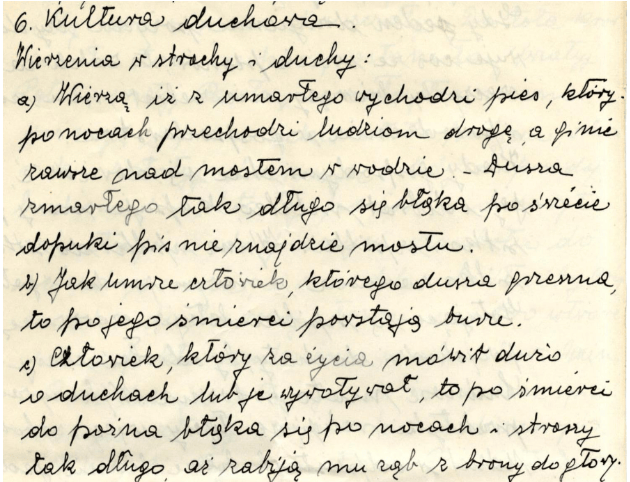
6. Kultura duchowa.
Wierzenia w strachy i duchy:
a) Wierzą, iż z umarłego wychodzi pies, który po nocach przechodzi ludziom drogę, a ginie zawsze nad mostem w wodzie. – Dusza zmarłego tak długo się błąka po świecie dopóki pies nie znajdzie mostu.
b) Jak umrze człowiek, którego dusza grzeszna, to po jego śmierci powstają burze.
c) Człowiek, który za życia mówił dużo o duchach lub je wywoływał, to po śmierci do późna błąka się po nocach i straszy tak długo, aż zabiją mu ząb z brony do głowy.
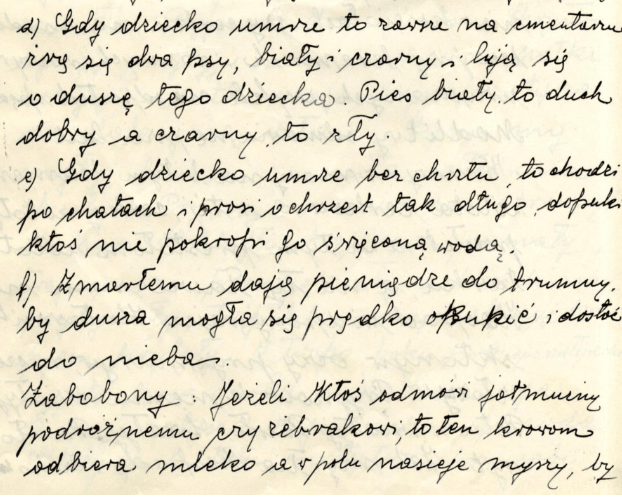
d) Gdy dziecko umrze to zawsze na cmentarzu rzą się dwa psy, biały i czarny, biją się o duszę tego dziecka. Pies biały to duch dobry a czarny to zły.
e) Gdy dziecko umrze bez chrztu, to chodzi po chatach i prosi o chrzest tak długo dopóki ktoś nie pokropi go święconą wodą.
f) Zmarłemu dają pieniądze do trumny, by dusza mogła się prędko okupić i dostać do nieba.
Zabobony: Jeżeli ktoś odmówi jałmużny podróżnemu czy żebrakowi, to ten krowom odbiera mleko a w polu nasieje myszy, by wyszwykły rosiery.
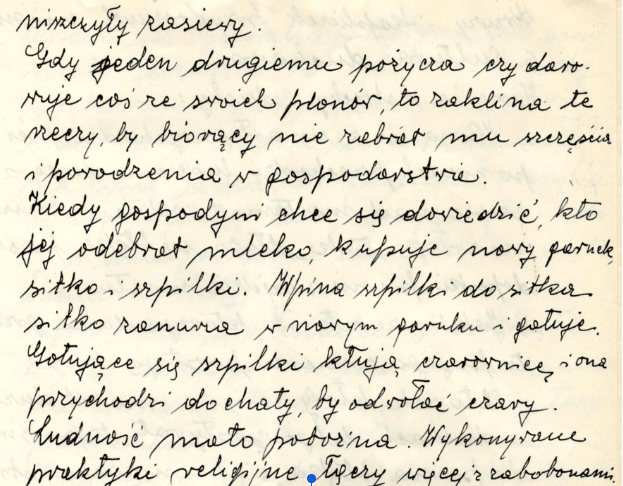
Gdy jeden drugiemu pożycza czy daruje coś ze swoich plonów, to zaklina te rzeczy, by biorący nie nabrał mu szczęścia i powodzenia w gospodarstwie.
Kiedy gospodyni chce się dowiedzieć, kto jej odebrał mleko, kupuje nowy garnek, sitko, szpilki. Wpina szpilki do sitka, sitko rzuca w nowym garnku i gotuje.
Gotujące się szpilki kłują czarownicę, i ona przychodzi do chaty, by odwołać czary.
Ludność mało pobożna. Wykonywane praktyki religijne tchną więcej zabobonami.
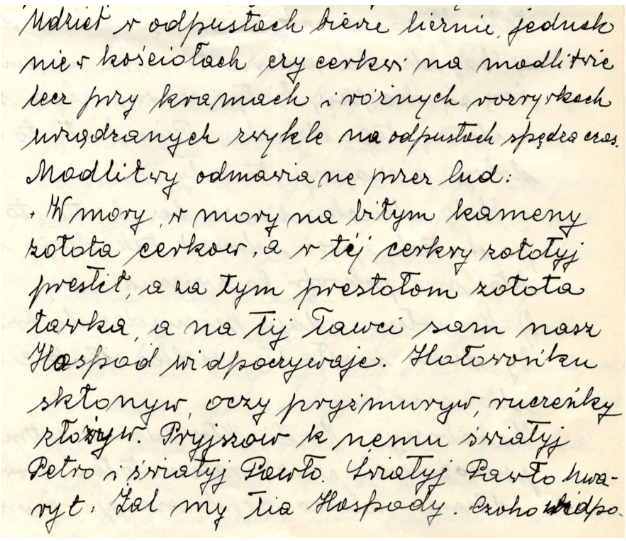
Udział w odpustach bierze biernie, jednak nie w kościołach czy cerkwi: na modlitwie, lecz przy kramach i różnych rozrystkach urządzeniach, zwykle na odpustach spędza czas. Modlitwy odmawiane przez lud:
W mory, w mory na bitym kameny rotota cerkow, a w tej cerkry rototyj prestit, a na tym prestotom rotota tawka, a na tij tawci sam nasz Gospod widpoczywaje. Hołowoniku skłonyw, oczy przymuryw, ruczeńky złożyn. Pryjśwow k nemu światyj Petro i światyj Pawło. Światyj Pawło hwaryt: Żal my Tia Hospody. Czoho widpoczywojesz?
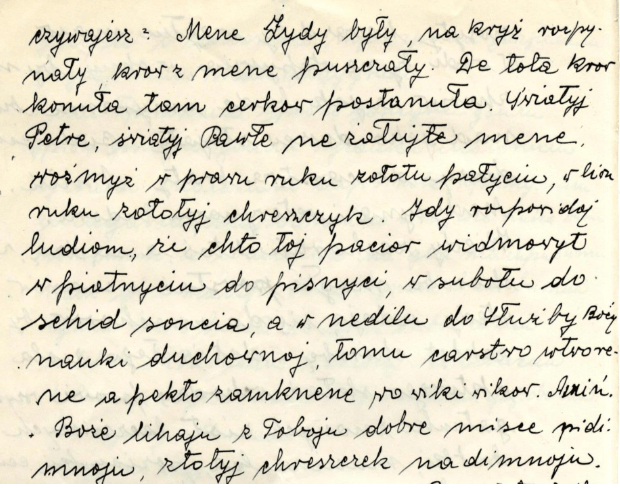
Mene Żydy były, na kryż rozpniaty krow z mene puszczaty. De tota krowkonuła tam cerkow postanuta. Swiatyj Petre, swiatyj Pawle ne ratiujte mene. Woźmyż w prawu ruku zołotu pałyciu, o liow ruku zołotyj chresrezyk. Ydy rozpowiedajludiom, że chto toj pacior widmowy w piatnyciu do pisnyci, w subotu doschod soncia, a w nedilu do służby Bocynanki duchownoj, tomu carstwo wtworene a pekło zamknene pro wiki wikow. Amiń. Boze lihaju z Toboju dobre misce pidi. mnoju, ztotyj chresrezek nadimnoju.
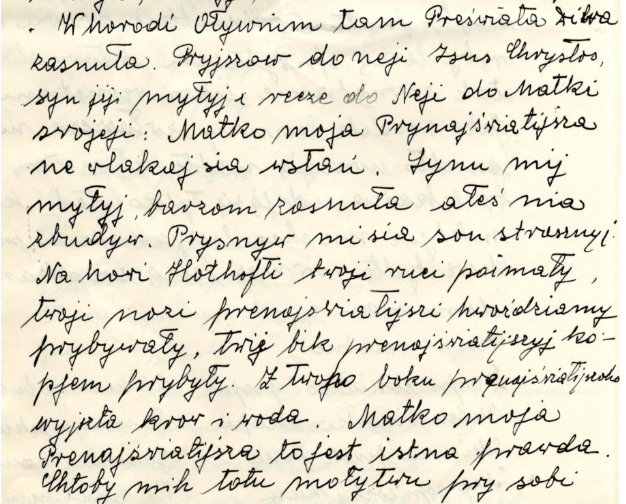
W horodi Oływnim tam Preswiata Diwa zasnuła. Pryjszow do neji Isus Chrystos, syn jiji myłyj i recze do Neji do matki swojeji: Matko moja Prynajswietiejszane ne chakiej się wstań. Synu mijmyłyj barzo mnye zasnuła ales’ miazbudyw. Prysnyw mi sie sen strasznyj. Na hori Hłothofte twoji ruci poimały, twoji nohi prenajswiatiejszi hwoździamy prybywały, twij bik prenajswiatiejszyj kopjem prybyły. Z twojo boku prenajswiatiejszoho wyjęta krow i woda. Matko moja Prenajswiatiejsza to jest istna prawda.
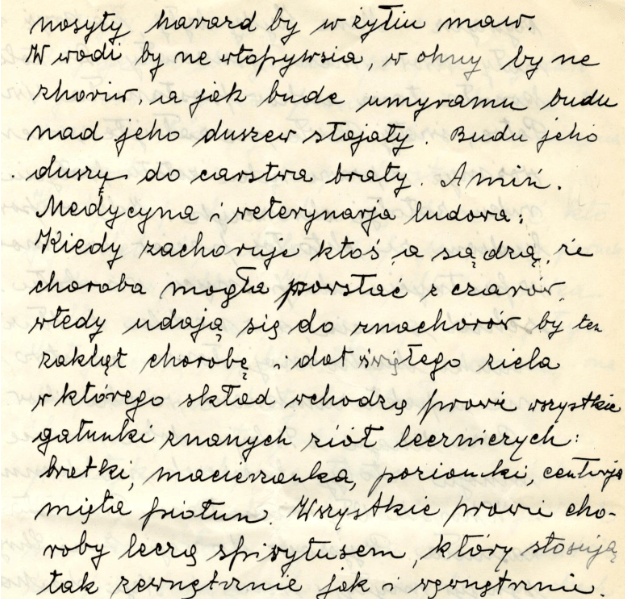
Chtoby mih totu motytru pry sobi nosyty havard by w zytiu maw. W wodi by ne utopywsia, w ohny by ne zhoriw, a jak bude umyramu budu nad jeho duszew stojaty. Budu jeho duszy do carstwa braty. Amin.
Medycyna i weterynarja ludowa:
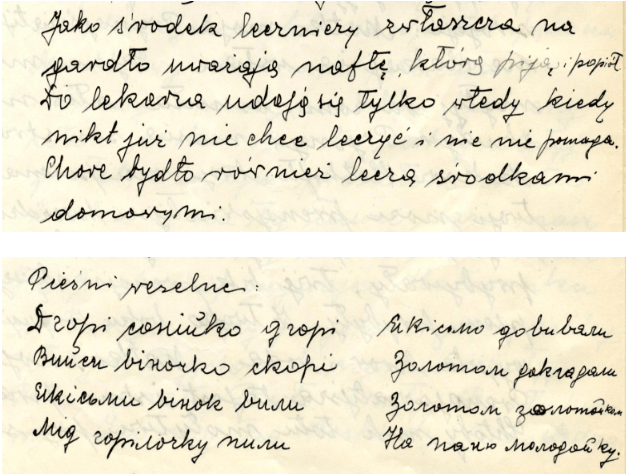
Kiedy zachoruje ktoś a sądzą, że choroba mogła powstać z czarów, wtedy udają się do znachorów by ten zaklął chorobę, i dał świętego ziela w którego skład wchodzą prawie wszystkie gatunki znanych ziół leczniczych: bratki, macierzanka, poziomki, centurja mięta i piotun. Wszystkie prawie choroby leczą spirytusem, który stosują tak zewnętrznie jak i wewnętrznie.
Piesni weselne:
Дгорі сонічко дгорі
Вийся віночко скорі
Як ісьми вінок вили
Мід горілочку пили
Вікісно довивали
Золотом докладали
Золотом золотіли
На паню молодойку.
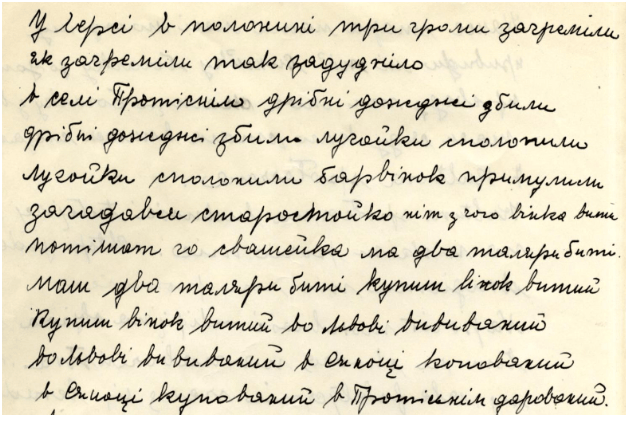
У Черсі в полонині три громи загреміли
як загреміли так загудніло
в селі Протіснім дрібні дожднеі збили
дрібні дожднеі збили лугойки сполонили
лугойки сполонили барвінок примулили
загадав си старостойко ніт з чого вінка вити
потішає го свашейка ма два таляри биті
маш два таляри биті купиш вінок витий
купиш вінок витий во Львові вививаний
во Львові вививаний в скляниці купований
в скляниці купований в Протіснім дарований.
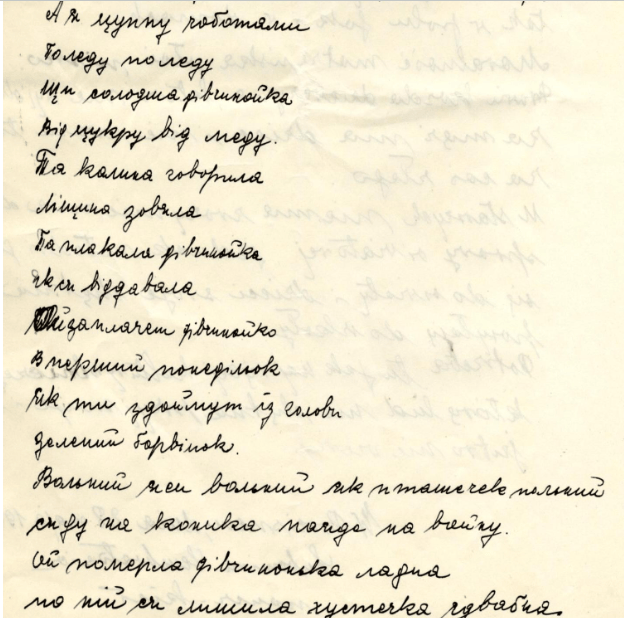
А я цупру роботами
Толеду поледу
Щи солодша дівчинойка
Від цукру, від меду.
Та калина говорила,
Ліщина зовила,
Плакала дівчинойка,
Як си віддавала.
П’ізанларет дівчинойко
В перший понеділок
Як ти здоймут із голови
Зелений барвінок.
Вільний ям вільний, як пташечел політний
Сиду на коникс поїде на війну.
Ой померла дівчинойка ладна
По ній си лишила хутечка рудабя.
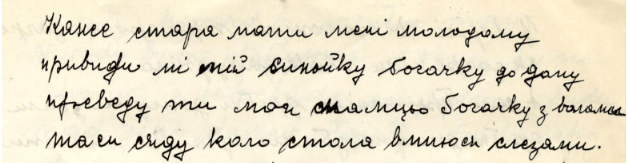
Каже стара мати мені молодому
приведи мій синойку богачку додому
приведеш ти моя мамцю богачку з вола
мита сяду коло стола вмиюсь сльозами.
English Translation: Google-Powered
Warning: this translation may be terrible. It was done electronically by someone who can speak neither Polish nor Ukrainian/Lemko. Do you wish to see it improve? You can help! Contact us.
Uwaga: to tłumaczenie może być fatalne. Zostało wykonane automatycznie przez osobę, która nie zna ani języka polskiego, ani ukraińskiego/łemkowskiego. Chcesz, żeby było lepsze? Możesz pomóc! Skontaktuj się z nami.
- Spiritual Culture.
Beliefs regarding specters and spirits:
a) It is believed that a dog emerges from a deceased person; it crosses people’s paths at night and always vanishes into the water beneath a bridge. The soul of the deceased wanders the world until the dog finds such a bridge.
b) If a person with a sinful soul dies, storms arise following their death.
c) A person who, during their lifetime, spoke frequently about spirits or attempted to summon them will, after death, wander the nights for a long time, haunting the living—until a tooth from a harrow is driven into their head.
d) When a child dies, two dogs—one white and one black—appear at the cemetery and fight over the child’s soul; the white dog represents a benevolent spirit, the black one a malevolent spirit.
e) If a child dies unbaptized, it wanders from house to house, pleading for baptism, until someone sprinkles it with holy water.
f) Money is placed in the coffin of the deceased so that their soul may quickly pay its ransom and gain entry into heaven.
Superstitions: If someone refuses to give alms to a traveler or a beggar, that person may take the milk from the cows or infest the fields with mice to destroy the crops.
When someone lends or gives a portion of their harvest to another, they cast a spell over the items to ensure that the recipient does not carry away the owner’s good fortune or prosperity.
When a housewife wishes to discover who has taken the milk from her cows, she procures a new pot, a strainer, and some pins. He plugs the pins into the strainer, throws the strainer into a new pot and cooks.
The boiling pins prick the witch, and she comes to the cottage to undo the spells.
The population is not very pious. The religious practices performed are more full of superstitions.
He takes part in indulgences passively, but not in churches or orthodox churches: he prays, but at stalls and various facilities, and usually spends his time at indulgences. Prayers recited by the people:
In the sea, in the sea, on the beaten stone, there is a rotot of tserkovs, and in this cerkry there is a rototy prestit, and on this prestotom a rotota tawka, and on this towci our Inn himself can be seen resting. Hołowonik slopes, eyes of walls, movements of deposits. Please shine light on him, Petro, and shine on him, Paweł. Światyj Pavlo hwaryt: We feel sorry for Tia Hospoda. Why are you resting?
There were some Jews, and a cow was let loose on a crutch. De tota krowkonula there cerkov postanuta. Saint Petra, Saint Paul, I don’t save me. Let’s take a zołoty stick in the right hand, and a zołoty chresrezyk in the right hand. The Jews told the people that this was the ghostly bead on Friday to Pisnytsia, that soncia would come to work on Friday, and that the priest Bocynanka would serve in Nedil, that the empire would be created and the hell would be closed in the wiki of the Ages. Amin. God bless you from Toboju, good bowls of pidi. mnoju, ztotyj chresrezek nadimnoju.
In Olywni horodi there the Prescient Diva fell asleep. Prijszow to Nija Jesus Christ, son of jija washes and says to Nija to his mother: My Holy Mother, please do not get up. My son, my son, I was very worried about you. I had a terrible dream. On the horizon, Hlothoft, your horses have been captured, your pre-holy horses have flown, your pre-holy bike has shot out with a bang. From your side there is a cow and water taken out of the world. My Pre-holy Mother, this is the real truth.
I’d like to have a good laugh at the end of my life. There was no drowning in the water, there was no death in the water, and when the house died, there was a building above his soul. I will build his soul to the tsarism, brothers. Amin.
Folk medicine and veterinary medicine:
When someone falls ill and they think that the disease could have been caused by witchcraft, they go to a medicine man to curse the disease and give him a holy herb which includes almost all species of known medicinal herbs: pansies, thyme, wild strawberries, centurion, mint and python. They treat almost all diseases with spirit, which they use both externally and internally.
Wedding Songs
Twist it up, wreath, twist it up quickly!
As we wove the wreath,
We drank mead and horilka.
We wove it with great care,
Adorning it with gold,
Making it gleam with gold,
For the young bride.
In the Chersa mountain pasture, three peals of thunder rolled;
When they rolled, the earth began to rumble.
In the village of Protisne, a fine rain came down,
A fine rain that flooded the meadows,
Flooding the meadows and burying the periwinkle.
The starosta wondered: “From what shall we weave the wreath?”
The svashka comforted him: “I have two minted thalers.”
“With these two minted thalers, you can buy a woven wreath—”
“A wreath woven in Lviv,”
“Purchased in a glass-fronted shop,”
“And gifted here in Protisne.”
And I am sweeter than sugar—
Sweeter, far sweeter—
The young maiden is sweeter still,
Sweeter than sugar, sweeter than honey.
The kalyna spoke,
The hazel tree called out,
And the young maiden wept
As she was given away in marriage.
You will weep, young maiden,
On that first Monday,
When they take the green periwinkle
From off your head.
I am free, free as a bird in flight;
I shall mount my horse and ride off to war.
Oh, a beautiful young maiden has died,
Leaving behind a small, reddish kerchief.
The old mother says to me, her young son:
“Bring a wealthy bride home, my son.”
“If I bring a wealthy bride home, Mother,”
“I shall sit at the table and wash my face with tears.”
Sanok Genes seeks to create a database of transcripts and English translations from the “Kultura Duchowa” sections from the 1936 Sanok School Inspectorate Questionnaires. The original documents are held by the Sanok Museum of History and digitized by the Sanok Digital Library. To learn more, see the project description.
Sanok Genes stawia sobie za cel stworzenie bazy danych zawierającej transkrypcje oraz tłumaczenia na język angielski fragmentów dotyczących „kultury duchowej”, pochodzących z kwestionariuszy Inspektoratu Szkolnego w Sanoku z 1936 roku. Oryginalne dokumenty znajdują się w zbiorach Muzeum Historycznego w Sanoku i zostały zdigitalizowane przez Sanocką Bibliotekę Cyfrową. Więcej informacji można znaleźć w opisie projektu.

