The Mystery of the Treasure from Bukowsko

The following is a translated excerpt from an article in the upcoming edition of Ziemia Sanocka, the annual publication of the Historical Museum in Sanok. In 2022, 156 silver coins were discovered buried in Bukowsko. In the longer Polish text, Piotr’s co-authors will describe the discovery and the coins. This excerpt concerns the history of the property and the people who lived there.

By Piotr Zelny, Historical Museum in Sanok

Copyright 2026, Piotr Zelny

The property at Henryka Sienkiewicza Street no. 2 (building plot no. 2204) in Bukowsko — on which the Volunteer Fire Department station now stands — was occupied by several buildings, including outbuildings, before World War II. A residential and commercial building stood at the site where the treasure of coins was hidden. The property was owned, at least from the mid-19th century until January 1943, by the Jewish, merchant family of Pinter, who may have been related to the Bukowsko family of famous rabbis bearing the same surname.

Due to military operations and fighting against the UPA (Ukrainian Insurgent Army) during World War II and immediately afterward, a significant portion of the records — including historical ones — from the offices operating in Bukowsko were destroyed. Consequently, the history of the treasure’s hiding place and the people who lived there, as reconstructed in this article, is incomplete. Basic information was provided by land registers (unfortunately, the supporting documents are missing) and the records of the municipal court in Bukowsko; maps and cadastral surveys were equally helpful. The notarial records of notaries operating in Bukowsko were used only to a limited extent. Although the house belonged to a Jewish family, valuable information was provided by the church registers and the vital books of the Bukowsko parish. Unfortunately, the records of the Jewish registry office in Bukowsko — which were very important for this research — have been virtually completely destroyed. For the entire district, we are aware of only 239 surviving copies of birth, marriage, and banns records.1 This fact makes it impossible to fully reconstruct the family connections of the property owners, and many important events in the family’s life have also been lost.   

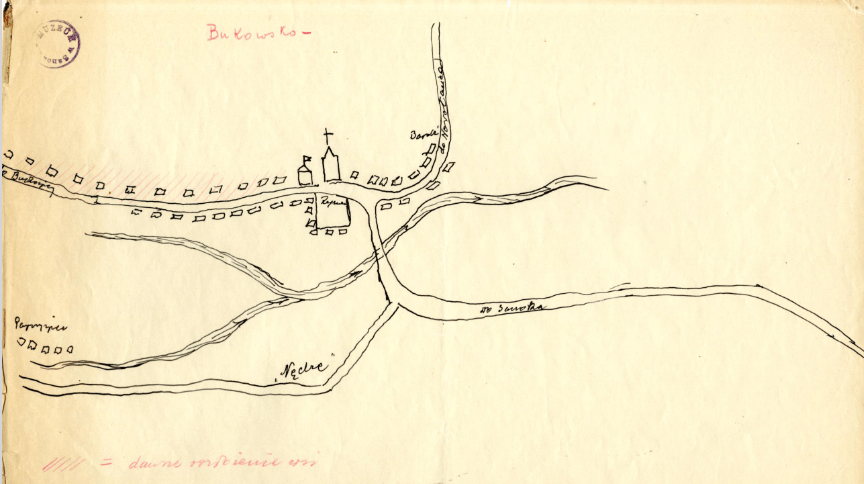
The first documented owner of the property where the treasure was found was Fejwel Pinter, who was likely born between the first and third decades of the 19th century. At that time, the property consisted of a wooden house, no. 72 (building plot no. 152) and a small garden located directly behind it and adjacent to the Sanoczek stream, then known as Stawki (ground plot no. 2943). It was one of many houses densely surrounding the main market square in Bukowsko, situated on its southeastern frontage. The house was occupied by a Christian couple, Jan Antoniewicz (b. 1813) with his wife Wiktoria (b. 1813) and their son Józef (b. 1840).2 Fejwel, on the other hand, lived in his second wooden house, no. 110, with a garden located almost exactly on the opposite side of the market square (building plot no. 178). He owned one more small plot of land, but it was encumbered by an easement and served as an access road. He did not own any farmland, meadows, or pastures, so he certainly did not make his living from farming. Perhaps he was a merchant, like his grandson later on. At least three other Pinter families (the families of Abraham Pinter, Mortka Pinter, and Peretz Pinter) also lived in the town, residing in houses near the market square.3 

Between 1853 and 1878, Fejwel converted the garden behind his house from a ground plot  into a building plot (no. 347) and sold a slightly larger portion of it (93.5 m², 12.1 m long × 7.75 m wide), which bordered the stream. The new, rather poor owners built a small house on it, literally squeezed between the stream, the street, and the small backyard of the Pinters’ house. In this unaltered form, the Pinters’ property — consisting of a spacious house with an area of 114.5 m² (length 15.9 m × width 7.2 m)  and a tiny backyard measuring 60.5 m² (7.8 m long × 7.75 m wide), survived until World War II.4
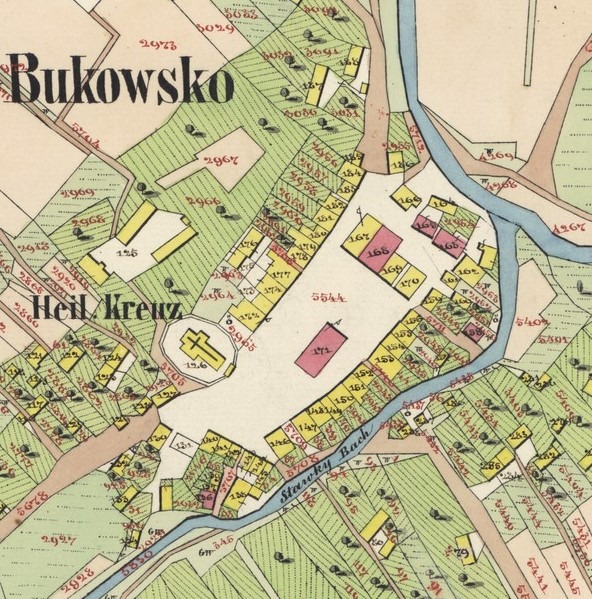
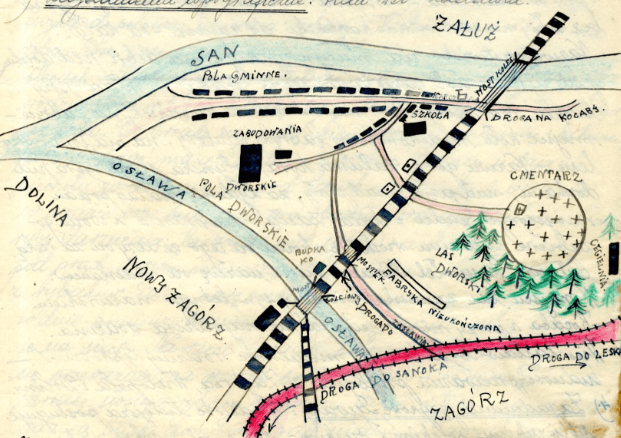
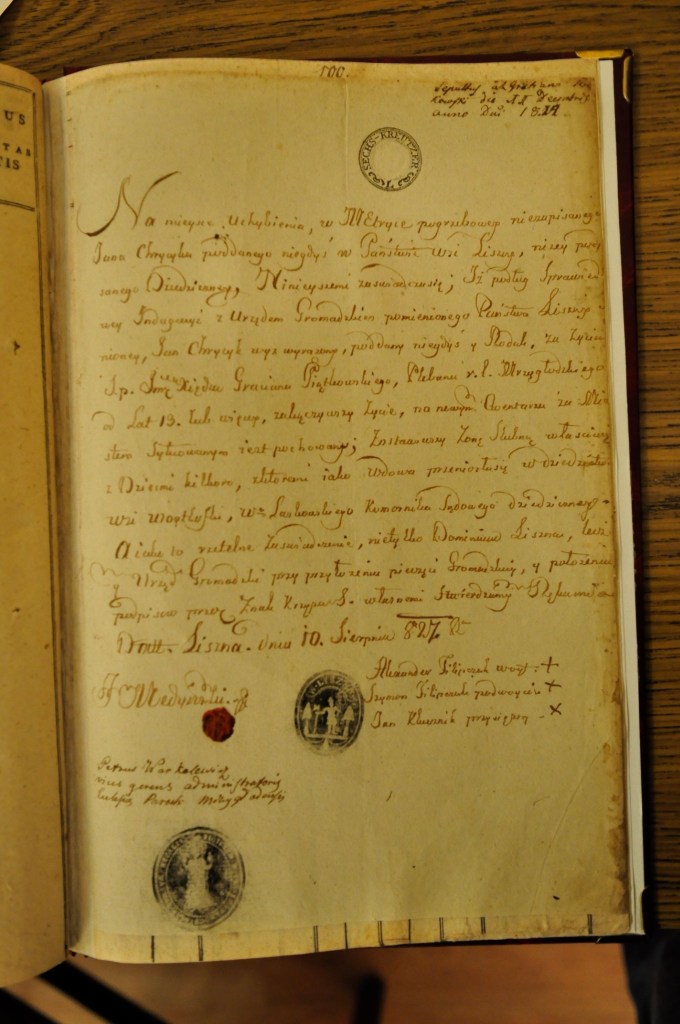
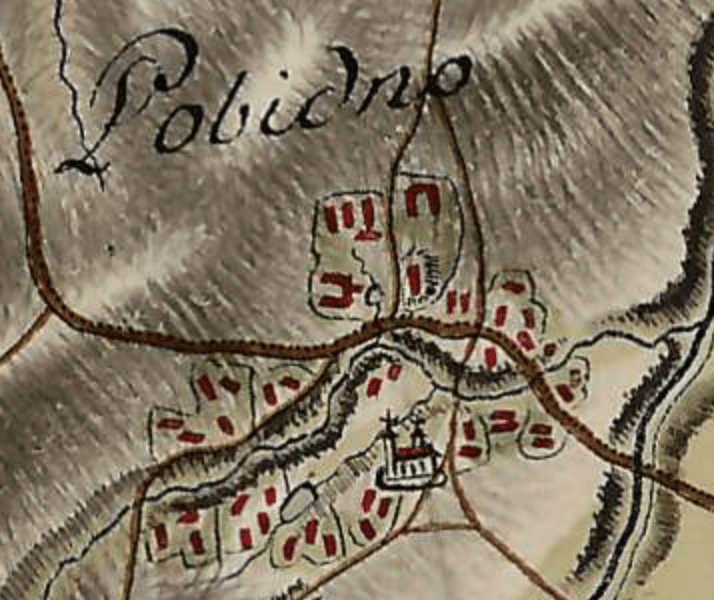
Cadastral Map of Bukowska, 1852, State Archives in Przemyśl.

After Fejwel, the house was inherited by Dawid (before 1894), presumably his son, who died in 1909. He and his wife Sara had at least four children: a daughter, Mariem, married to a man named Leiblank (first name unknown); Pesla, married to Beck; Chaya; and a son, Awigdor, also known as Wigdor (in some documents occurs the Polonized form Wiktor). Tenants also lived in the house: the Jewish Mendel family and, from around 1904 to around 1943, the Catholic Pieszczoch family, about whom we write below. We do not know exactly what Dawid did for a living; perhaps he was a merchant, as his son would later be. In January 1894, Dawid borrowed 157 zlotys and 32 cents from Lazar Regenbogen of Sanok, using the house as collateral. He did not redeem the promissory notes until December 1904. A year before his death, in July 1908, he again borrowed money from Lazar against a mortgage. This time, it was a very substantial sum of 986 crowns and 88 halers (equivalent to the former 1,973 Rhine zlotys and 76 cents). The debt passed to the children along with the benefit of inventory and then on to the grandchildren, and it was never fully repaid. Dawid left no will, so on December 30, 1909, the court, based on a decree of inheritance, awarded each sibling one-fourth of the estate and granted the widow a life interest in one-seventh. Over the next four years, a series of purchase and sale agreements were concluded, resulting in changes to the ownership structure among the siblings. In September 1910, the siblings bought out their mother’s life estate, and Benjamin Pinter (relationship unknown) purchased half of the shares due to Chaja and Mariem, respectively. Mariem then sold the remainder of her share to Simon Leiblank. In September 1913, Awigdor Pinter and Pesla Beck of the Pinter family purchased Simon Leiblank’s share and divided it equally between themselves. As a result, the property had four co-owners: Awigdor and Pesla each owned 1/3, and Chaja and Benjamin each owned 1/6 of the property. This arrangement remained in place until the death of one of them, Awigdor, in 1938, when further divisions of the estate took place.5

The head of the household remained Avigdor Pinter, born in 1881. His wife, Chaya Presser — five years his junior — whom he married in 1909. Together, they raised six children: David (born out of wedlock in Gorlice in 1909), Dima (born Sept. 12, 1912), Pinkas Meilech (born October 22, 1914), Mojżesz (born June 26, 1917), Abraham Hersch (born January 6, 1922), and Cypra (born October 9, 1925). Avigdor was a merchant and ran a fabric store on the ground floor of the house.6 He also dealt in money; particularly from the early 1930s onward, he was both a borrower and, less frequently, a lender. These included both ordinary cash loans and mortgages, denominated in both zlotys and dollars, at interest rates ranging from 6% to 10%. His son, Pinkas Meilech, helped him run the business; Pinkas later moved to Kraków.7 Avigdor died on April 29, 1938, at the age of 57. His widow and children (except for Dawid) became his heirs. According to an inventory drawn up in July 1938, his estate was in debt to the tune of 3,160 zł (assets totaling 603 zł), of which nearly half — 1,500 zł — was a mortgage debt inherited from his father, Dawid. The total value of the house, described as old and measuring 114.5 m², was appraised at 900 zł, while the land on which it stood in the town center, measuring 175 m², was valued at 600 zł. The widow Chaja Pinter, née Presser, became the lady of the house; the youngest children, Abraham Hersch and Cypra, remained under her care and financial guardianship. Mojżesz was already of legal age and lived in Bukowsko, though we do not know if he lived in the family home; Dima had left for an unknown destination and could not be contacted; and Pinkas Meilech settled in Kraków. Their aunt Pesla Beck, née Pinter, and Benjamin Pinter (relationship unknown) remained co-owners of the house, but we do not know whether they lived there.8 
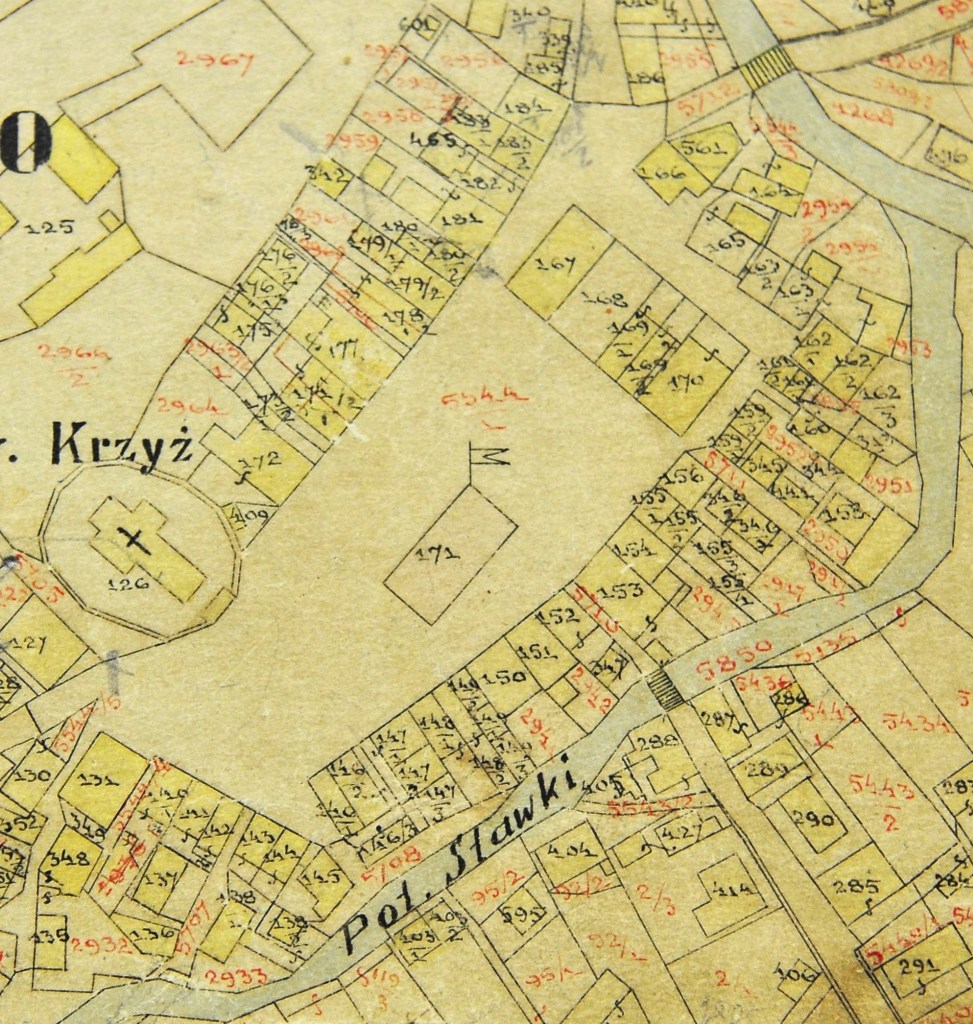
Cadastral Map of Bukowska, 1896, State Archives in Rzeszów, the branch in Sanok.

We do not know what became of the family during the Nazi occupation. The last mention of them dates from April 14, 1942; it is a resolution by the municipal court in Bukowsko regarding the registration of property rights in the land registry. They were likely killed or deported along with other Jews that same year or the next, perhaps to the Nazi German forced-labor and extermination camp in Zasław, to Bełżec, or to other camps.9 Between December 14, 1942 (the Sanok County Administrator’s resolution to seize ownerless property) and January 20, 1943 (registration in the land register), their house, as ownerless property, was seized by the German administration. The house was likely destroyed or demolished along with the remaining wooden structures on Market Square as a result of subsequent fighting with UPA units. By a decree of the Sanok District Court dated February 10, 1958, the vacant plot was transferred to the State Treasury, and as a result of land consolidation carried out in June 1995, it was merged with two other parcels.10 

Although the Pinters were the sole owners of the property, for most of the time they rented out part of the house to outside tenants — or, as they were called at the time, “chamber-dwellers” (Polish komornik). As we have already mentioned, in the second half of the 19th century, these were the Antoniewicz family, who were Christian. At the turn of the 19th and 20th centuries, the tenants were the Jewish Fisch Mendel family. Unfortunately, we cannot say anything more about them. We also do not know how long they lived as lodgers with the Pinters. They were listed in the Bukowsko parish census only by the first and last name of the head of the family as residents of the house. Around 1904, another family, this time Catholic, became the tenants. The Pieszczochs were “Americans” — that’s how economic emigrants returning from the United States to Poland were referred to. Jan Pieszczoch was born in Bukowsko in 1867; his wife, Maria née Pleśniarska, born in 1870, was also from Bukowsko. It is not known exactly when they left for the United States; they do not appear on the arrival lists of the main immigration offices at Castle Garden (Clinton) and Ellis Island in New York.11 The vast majority of emigrants from Galicia went through immigration clearance at this very port, but that does not rule out the possibility that they may have arrived at a different port. They were married in the United States in 1897, so they certainly emigrated before that date. They settled in “Ferfield,” which may refer to Fairfield, Connecticut, in New England. There, their four children were born: Edward in 1898, Helena in 1900, Henryk in 1901, and Julia, the last to be born in the United States, on June 16, 1903. Julia died shortly thereafter on March 8, 1905, but this time in Bukowsko. These two dates thus mark the time of the Pieszczochs’ return to Poland and the beginning of their stay with the Pinters. In the following years, more children were born: Emilia Wiktoria in 1908, Franciszka Katarzyna in 1909, Jadwiga in 1914, and finally Janina Maria in 1917. Jan Pieszczoch’s wife, Maria, died in February 1934, and as early as September of that same year, the newly widowed Jan married the widow Wiktoria Pietrzycka. Jan died on July 27, 1938, and on April 11, 1941, his two-month-old granddaughter — the daughter of his eldest son, Edward — also died. The Pieszczoch family likely remained with the Pinters until the very end, that is, until the house was seized by the Third Reich in January 1943.12

The history of the family and the house alone, of course, will not provide us with a direct and definitive answer to the questions of who, when, and why the treasure was hidden. However, if we place it in the proper historical and archaeological context and incorporate technical aspects — such as the composition of the coins, their purchasing power in specific years, and the metal content — we will be able to obtain fairly reliable answers to the questions that puzzle us.

The youngest Austro-Hungarian crowns and Russian rubles in the hoard date from 1915 – 1916, so we assume that the hoard’s owners had been saving money in the cup up until that time. The later American 5 and 10-cent coins from 1919 were used as jewelry. However, they are very important to the find itself because, as the most recent artifacts, they determine the age of the hoard. This means that whoever hid the hoard must have done so no earlier than 1919. At that time — shortly after the end of World War I — ethnic and religious conflicts that had been simmering for years erupted, fueled by the catastrophic economic situation. In November 1918, fighting broke out between Poles and Ukrainians. That same month, some Jewish homes in Bukowsko were attacked and looted. Another looting incident occurred in 1922 following a major fire that destroyed 17 Jewish homes and one Christian home.13 Thus, there was no shortage of threats, and everyone likely tried to protect their belongings in one way or another. 

Our treasure was likely also secured by its owners at the time. However, that was not when it was buried and eventually forgotten. If that had been the case, some very tragic events would have had to occur that would have prevented the owner from returning to claim his property — such as death, expulsion, or flight. However, nothing of the sort happened to either the Pinters or the Pieszczochs at that time; no one died, no one fled, no one was expelled — the owners were alive and running their business, the tenants continued to live there, and the house was neither burned down nor demolished (in the 1938 probate case following Awigdor’s death, the house is described as old). After the end of World War I, one of the main problems facing both Poland and all the former partitioning powers was rampant hyperinflation. In 1919, the annual inflation rate in Poland was 1,123.6% (by comparison, inflation in March 2026 was 3%), and the dollar exchange rate rose nearly 14-fold between November 1918 and December 1919. However, hyperinflation was only just gaining momentum, reaching 35,714.6% in 1923.14 In a situation of such extreme hyperinflation (by comparison, the memorable hyperinflation of February 1990 stood at 1,183%), hoarding cash made absolutely no sense. All the cash that the owners of the hoard had at their disposal in early 1919 — and which they had not managed to use to purchase any goods in the following months — became worthless in terms of purchasing power. Fortunately, the coins of that time were based on the silver standard, so the owners of the treasure kept the coins for the value of the silver itself, which had a total weight of ………… and a value of ………….. That silver was their treasure, a safety net for a rainy day in the event of another bout of hyperinflation, a crisis, a war, or other difficult situations. The cup containing the silver coins remained in the house throughout the entire interwar period and was hidden only when such a situation arose once again — namely, World War II.  

There is no way to determine unequivocally and with absolute certainty which of the house’s residents hid the treasure; in this regard, we have only circumstantial evidence and speculation. However, it is highly probable that the treasure belonged to the Pinter family. They were the owners of the house and its primary residents; they ran a store, handled and managed cash, and everything indicates that they could simply afford to keep such a large amount of silver for so long — for example, as a safeguard for their business.15 The Pieszczoch family, on the other hand, spent quite a long time in the United States (before 1897 — until around 1904). It seems, however, that upon their return, they would not have kept the old Rhine zloty coins (a dozen or so), which by then had long since been out of circulation, even though they had the value of silver bullion. From them, we would rather expect dollars or crowns themselves, which, upon their return to their homeland, had already been the new and sole means of payment for 12 years. As chamber-dwellers (tenants), they were certainly much poorer than the Pinters, the owners of the house; that was usually the case under the circumstances of the time. 

As for the person who hid the treasure, most evidence points to Chaya Pinter of the Presser family, who became the lady of the house and head of the family after the death of her husband, Avigdor. Perhaps one day between April 14, 1942 (the last mention) and January 20, 1943 (when the Third Reich seized the abandoned house), she hid the treasure behind the back wall of the house, finally tossing in her old bracelet strung with American cent coins from 1919, which she had previously worn on her wrist. We do not know what became of her afterward; perhaps she perished along with many others in the Holocaust, and the treasure remained buried for the next eighty years until a fortunate water main break in April 2022. 

  1. State Archives in Przemyśl, Jewish Religious Communities — a collection of fragments of collections, courtesy of Deborah Greenlee. ↩︎
  2.  Parish Office in Bukowsko, “Status animarum”, vol. I, house no. 72, courtesy of Deborah Greenlee. ↩︎
  3. State Archives in Przemyśl, Geodetic Archives, Series 127, ref. no. 1, 2, 3, 5, 9, and 0190M; State Archives in Rzeszów, the branch in Sanok, Cadastral Office in Sanok, ref. no. 397; The building plot number 152 remained unchanged until 1995, while the house number changed several times. In 1852, it was number 72, then 61 until around 1932, and finally 364, presumably until 1943–1946. ↩︎
  4.  The mortgage book of the Pinter’s estate (lwh 413) contains no mention of these transactions, as the mortgage book was established between 1874 and 1894 — that is, after they had already taken place. For this reason, the findings were based on cadastral maps from 1852 and 1896, land registers (see note 3), and the inventory of Awigdor Pinter’s estate, see State Archives in Rzeszów, the branch in Sanok, Municipal Court in Bukowsko, ref. no. 391. This information is essential for a reliable and certain determination of land ownership at the site where the treasure was hidden. 
    ↩︎
  5. State Archives in Rzeszów, the branch in Sanok, Land and Oil Registers of the Courts in Bukowsko, ref. no. 2, pp. 169–176; Parish Office in Bukowsko, “Status animarum”, vol. II, p. 113, courtesy of Deborah Greenlee.  ↩︎
  6. The 1929 Polish Business Directory Project, Księga Adresowa Polski, 1929, pp. 634 – 635, www.jri-poland.org, [access: April 17, 2026].  ↩︎
  7. State Archives in Rzeszów, the branch in Sanok, The records of Notary Leon Jaworski in Bukowsko, ref. no. 3, file no. 210/37. ↩︎
  8. State Archives in Rzeszów, the branch in Sanok, Land and Oil Registers…, ref. no. 2, pp. 169 – 176; Ibid., ref. no. 1, pp. 317 – 323; State Archives in Rzeszów, the branch in Sanok, Municipal Court in Bukowsko, ref. no. 391.   ↩︎
  9. An unidentified Abraham Pinter died in the Bukowsko ghetto. Another Pinter, whose first name is unknown, was captured and shot by the bridge over the Sanoczek stream or at the Jewish cemetery located in a nearby grove called “Parszywiec” or “ Tarniaczek,” along with about a hundred other Jewish people — mainly escapees from the Bukowsko ghetto — by military police and Gestapo officers from Sanok in June 1943, IPN (Institute of National Remembrance), Casualty Database, www.straty.pl [accessed: April 20, 2026].  ↩︎
  10. State Archives in Rzeszów, the branch in Sanok, Land and Oil Registers…, ref. no. 2, pp. 169 – 171. ↩︎
  11. Statue of Liberty Ellis Island Foundation, Arrival Records Collection, www.statueofliberty.org, [accessed: April 18, 2026]; Passenger lists of vessels arriving at New York: New York City, www.familysearch.org [accessed: April 20, 2026]. ↩︎
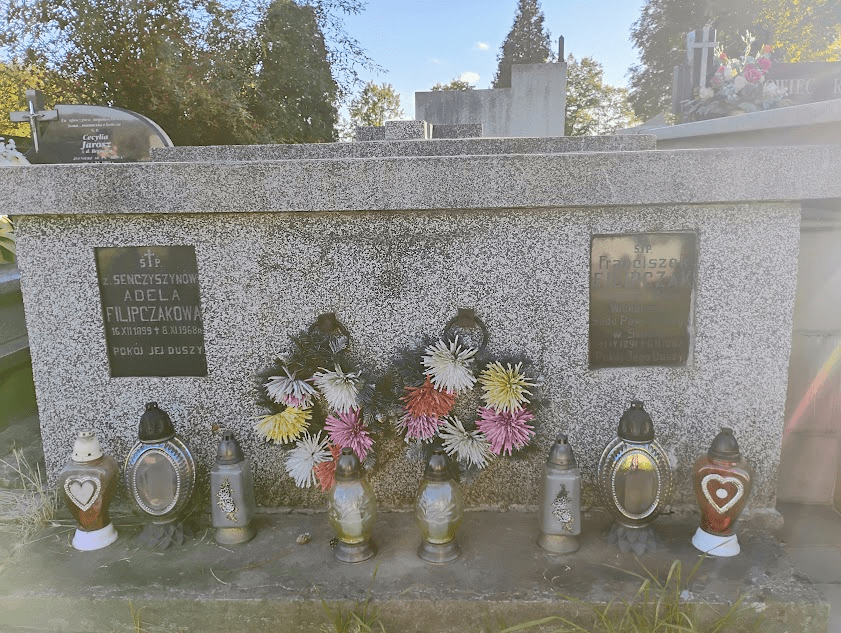
  12. Parish Office in Bukowsko, *Status animarum*, vol. II, p. 113, courtesy of Deborah Greenlee; State Archives in Rzeszów, the branch in Sanok, Civil Registry Records of the Roman Catholic Parish in Bukowsko, ref. no. 2, pp. 343, 376, 408, 498; Bukowsko Baptisms, Volume X, 1893–1940, www.semanchuk.com [accessed April 19, 2026]; Bukowsko Civil Death Records, Volume 7, 1889–1945, www.semanchuk.com [accessed: April 19, 2026]; The Pieszczoch family grave, where Jan, Maria (née Pleśniarska), Helena, and Emilia Wiktoria are buried, is located at the Bukowsko Cemetery, Bukowsko Cemetery Transcription (Sanok County, Poland), www.semanchuk.com [accessed: April 21, 2026].  ↩︎
  13. Encyclopaedia of Jewish Communities, Poland, Western Galicia, Silesia, Vol. III, Yad Vashem, Jerusalem 1984,  s. 69 – 70. ↩︎
  14. T. Skrzyński, Walka z inflacją w Polsce w latach 1918 – 1927. Rola Władysława Grabskiego, Zeszyty Naukowe nr. 733, Akademia Ekonomiczna w Krakowie 2007, s. 217 – 228. ↩︎
  15. A visual inspection of the vessel in which the treasure was found did not reveal that it was a ritual Netilat Yadim cup (Hebrew for “hand washing”), which is used in Jewish culture for ritual hand washing. ↩︎
(Part 5) Bieszczady County: Vampires, Witches, and other Terrifying Creatures in the School Inspectorate Questionnaires 

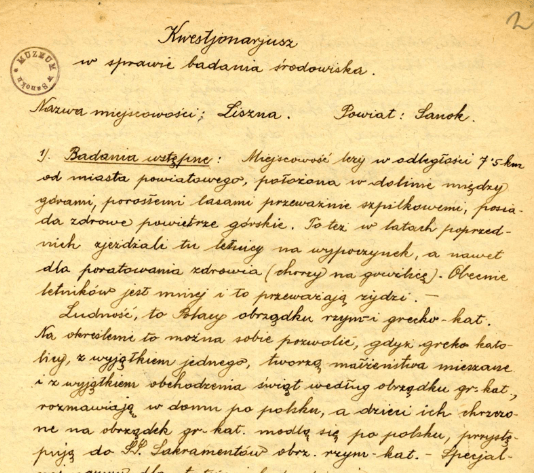
This is the fifth and final part of our project translating information on pre-WWII beliefs in vampires, witches, monsters, demons, death rituals and superstitions in specific villages. This post focuses on modern-day Bieszczady County. The information was provided by local school officials to the Sanok School Inspectorate in the late 1930s. The original documents and metadata are available online from the Sanok Historical Museum through the Sanok Digital Library.

To learn more about the scope and purpose of this project, see Introduction: Vampires, Witches, and other Terrifying Creatures in the Sanok School Inspectorate Questionnaires 

Part 1: Krosno County

Part 2: Sanok County (minus Komańcza)

Part 3: Komańcza Gmina

Part 4: Lesko County

Part: 5 Bieszczady County


Lutowiska

Procisne

Belief in ghosts and spirits

a) They believe a dog emerges from a deceased person, which crosses people’s paths at night and always disappears over a bridge in the water. The soul of the deceased wanders the world for as long as the dog cannot find the bridge.

b) When a person whose soul is sinful dies, storms arise after their death.

c) A person who talked a lot about ghosts, or summoned them during their lifetime, will wander late through the night after death and haunt until a harrow tooth is driven into their head.

d) When a child dies, two dogs—one white and one black—always fight at the cemetery, battling for the child’s soul. The white dog is a good spirit, and the black one is an evil one. 

e) When a child dies without baptism, it wanders from house to house and asks for baptism until someone sprinkles it with holy water.

f) They put money in the coffin for the deceased, so the soul can quickly pay its way and get to heaven.

Superstitions: If someone refuses alms to a traveler or a beggar, they take milk from the cows and sow mice in the field to destroy the crops. When someone lends or gifts some of their harvest to another, they cast a spell to protect those things so that the receiver does not take away their happiness and prosperity on the farm. When a housewife wants to find out who has stolen her milk, she buys a new pot, a sieve, and pins. She sticks the pins into the sieve, submerges the sieve in the new pot, and boils it. The boiling pins prick the witch, causing her to come to the cottage to undo the spell. 

Questionnaires without monsters

Dwernik, Krywe, Krywka, Skorodne, Stuposiany, Żurawin

Czarna Gora

Serednie Małe 

They believe in the afterlife; some dead people haunt. At a child’s baptism, if the godparents do not recite prayers out loud, after the priest, various faults will cling to this child; among other things, it may become a sleepwalker. They go to a fortune teller in secret, in the event of some accident: fire, theft. Every woman believes in a witch who takes milk from cows, and men do too, only they say it does not happen in their own village…

…Witches are most active on the eve of St. George, and on the feasts of the Mother of God. Cautious people then place an axe under the stable doors, lock the doors with padlocks, and hang linen above the doors. The present generation does not know any legends or fairy tales, but they used to exist.

Rosochate

The following beliefs are connected to a deceased person:

1) When they carry the dead person out of the house, they place bread under the cart so that the wheel rolls over the bread, ensuring that the deceased does not mourn or regret leaving their household.

2) On the first night after the funeral, they place a plate with clean water and a small piece of purchased white linen on the table—believing that the deceased will come back to wash their hands. In the morning, they look for traces of water droplets on the linen—if there are any, the deceased has visited; if not, they will still come. On Monday, they will not lend or give anything to anyone, because then they would be forced to give things away for the entire week…

…If one walks around the house three times on Christmas Eve and looks through the window, they will see the coffin of whoever is going to die that year…

They believe in the evil eye and cast these charms with a word. They believe in witchcraft, (e.g., a woman can bewitch milk), so another woman boils 300 pins in the bewitched milk, and this witch will feel a pricking sensation–later they find out who did it. There are incidents of beatings of women suspected of witchcraft. When a cow calves, and someone comes at that time to borrow something, they will not give it, because the milk would keep spoiling after that. Before an annual feast, they will not give anything from the house, so as not to permit witchcraft. When there is a drought, and they want rain, then at the boundary of the fields, one must bury a crayfish and a frog. They say that a crayfish and a frog do not like each other, so they will therefore pray for so long until rain falls and washes them away. They must therefore be buried lightly, because otherwise the foul weather would last a long time. They believe in various local sorcerers who have the power to disperse lightning and hail clouds.

School in Rosochate; 24 May 1936

Żołobek

Regarding fears and ghosts, many beliefs and superstitions exist among the population, such as upiory, witches, and evil spirits; others believe in snake charming. The population—mostly women—is pious, while the men, especially returnee emigrants from foreign countries and World War participants, do not recognize religion.

Questionnaires without monsters

Chrewt, Czarna, Paniszczów, Polana, Sokołów Wola

Uztrzyki Dolne 

Bandrów Narodowy

The local people believe very strongly in ghosts and terrors. The population believes that after death, the soul of a good person returns to Earth. On the third night after death, it comes to say goodbye to the family and household, and then leaves forever into the afterlife. The soul of an evil person stays constantly on Earth and does penance where it sinned. Almost every old villager has seen a ghost, and almost every villager has been led astray by an evil spirit called “błąd”. By the road leading to Bandrow Narodowy, on the so-called border, stands an old willow tree, where passing residents are continuously frightened at night. Under this willow tree, a woman once buried (the exact date cannot be established) her strangled illegitimate child. On the pasture called “Łazy”, a villager driving pigs home from the fair in the evening was possessed by the “błąd”, and as a result, he was only found in the morning sitting by the stream in a daze. The population believes that scares walk from house to house.  A frightening incident recently occurred at the farm of a man named Gełyczak. During the evening, something started throwing stones at the servants. The frightened residents of the house all ran out onto the road screaming. They spent the night at a neighbor’s house, and the next day they brought a priest. The residents of this local village believe that an evil spirit resides in every cat. Therefore, there are very few domestic cats. There was even such an incident where a peasant called “Jekawy”, being convinced that an evil spirit was in his cat, caught the cat, gouged out its eyes, skinned it alive, and threw the cat into the fire. Since then, this farmer received the nickname “Kołołab” in addition to “Jekawy”. The population believes that some women are witches. When a calf is born and a woman comes to borrow something, she is definitely a witch who came to steal the milk. Monday is considered a difficult day by the inhabitants, therefore one should not travel anywhere; it is best to stay at home and chat. If a housewife sells milk and that milk has to cross water—meaning that the buyer must walk or cross over a river—then the housewife must [perform a protective ritual over] the milk after herself. Local women know how to charm away illnesses and remove the evil eye by taking burnt coal into a bowl of water, reciting incantations, and sprinkling the sick person’s face. On ‘Good Friday’, no housewife would lend anything for all the world…

…The local people strongly believe that witches possess special small stones, with which they go out into the dew. There, a stone moistened in the dew only needs to be rubbed against a cow’s udder to steal its milk. Last year, a similar incident occurred, where women chased an imagined witch with sticks, because she was walking with something through the dew.

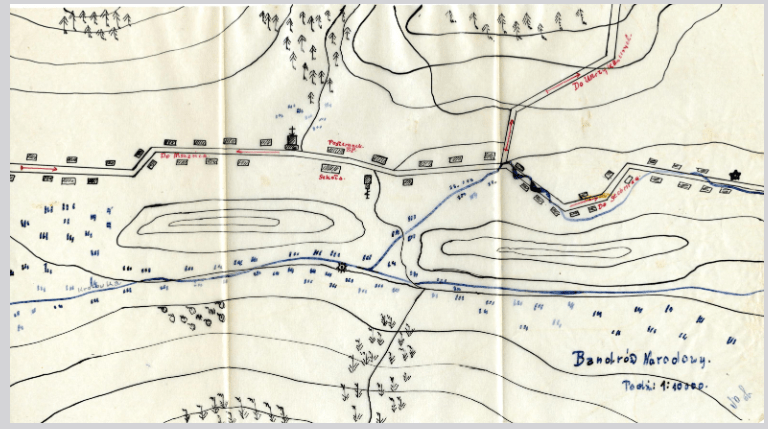
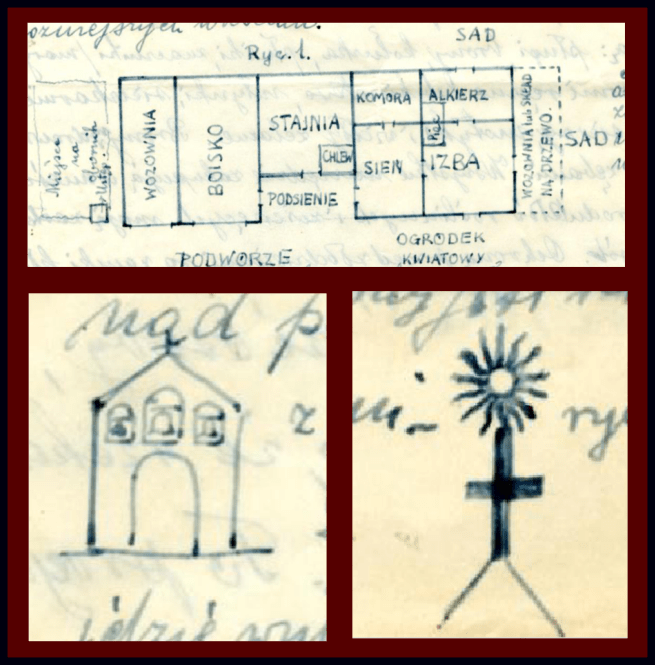
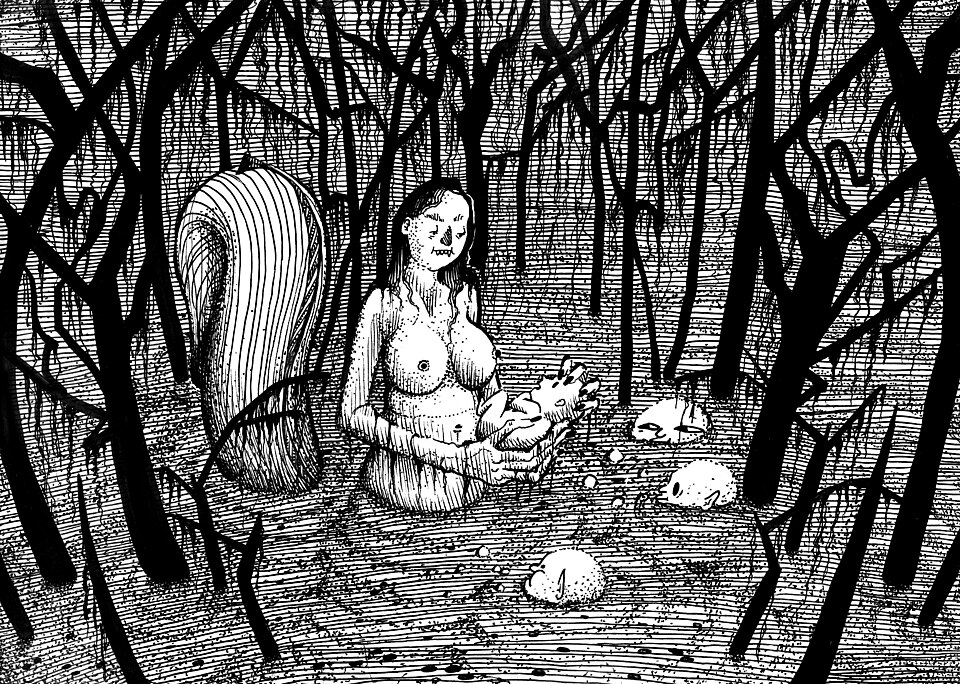
Imagery from Bandrów Narodowy questionnaire

Hoszowczyk

When it comes to the beliefs of the local people, along with various rituals, one cannot complain about a lack of them. For example, regarding a deceased person and a funeral, according to their beliefs, while the person is still alive but sick, milk should not be given from another house to the sick person’s house. This is because in the event of their death, the cow from which the milk came will lose its milk. If, however, milk was given and death occurred, then the housewife (the owner of the cow) runs to the water and blesses/crosses it with her hands, so that the cow does not lose its milk. The same applies to a house where a sick person dies: no milk must be taken out, otherwise the cows will lose it. Immediately after the death of the sick person, the members of the household stir/mix everything equally found in the house, so that the deceased does not take away the harvest. 

If there were two priests at the funeral, work after the funeral proceeds as normal; however, if there was only one priest, then for two weeks following the funeral, it is forbidden to wash clothes, grind grain, thresh, etc. on the ground, because the soul of the deceased is bound to wander around the farmstead buildings for another two weeks and its peace must not be disturbed (because one priest leads out the body, and the second, the soul).

When the deceased is being carried out of the house, they strike the coffin three times against the threshold, which is meant to signify that the deceased is bowing to the household members.

Once the coffin is placed on the cart, one of the household members places a loaf of bread on it. Then, as the coffin passes the border of the estate where the deceased lived, one of the household members quickly removes the bread so that the deceased does not take the harvest’s fertility with them. Upon returning from the funeral, the household members consume this bread…

Serednica

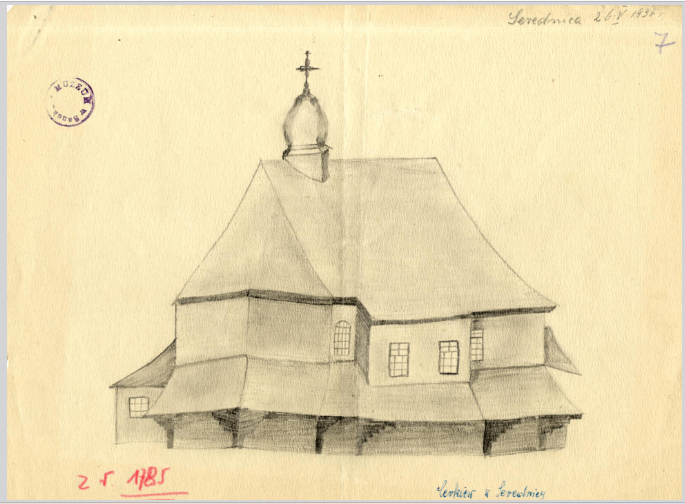
The interesting, mysterious world of spirits, upiórs, superstitions, witches, and devils has many followers and believers in the countryside. There is such an immense power–a vast number of superstitions–that I will not manage to write them all down in today’s questionnaire; I will choose only the most interesting ones. When the head of the family dies, the sons walk for three days with their heads uncovered, and the girls with their braids unbraided, because otherwise the spirit of the deceased would haunt them for not paying him proper respect. From the house at that time, it is forbidden to lend or give anything away. When they carry the coffin out of the house, they strike it three times against the threshold of the cottage as a sign of the deceased’s farewell to the home, and so that he would never return under any guise after death and would not haunt after death. They also believe in upiórs, i.e., people who have two hearts, and after death, they transform into upiórs that roam around the cemetery and terrify residents.

In addition to spirits, they believe in various superstitions. On Mondays, no business should be started, because it will not succeed. On Fridays, one must not start doing laundry, because the linen will tear. In the evening, it is forbidden to sell dairy products, because a witch will take away the cow’s milk…

Questionnaires without monsters

Berehy Dolne and Górne, Brelików, Dźwiniacz Dolny, Jałowe, Jasień, Leszowate, Łobozew, Łodyna, Moczary, Równia, Stankowa, Teleśnica Sanna, Ustianowa


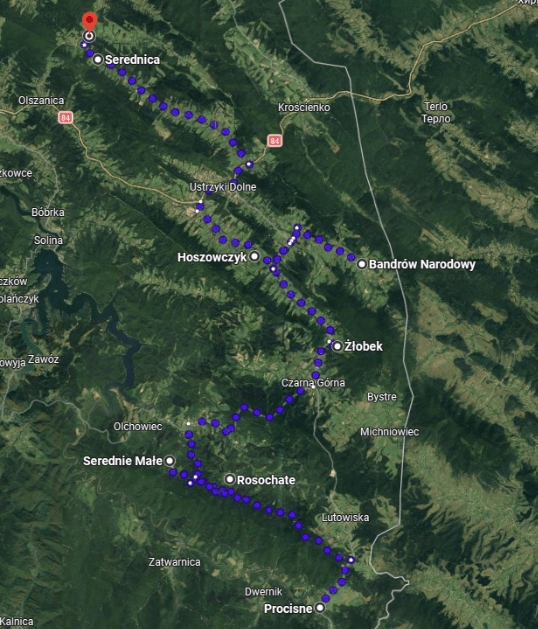
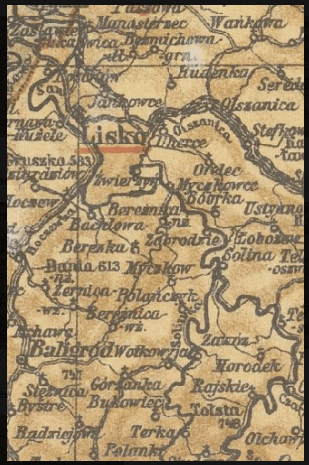
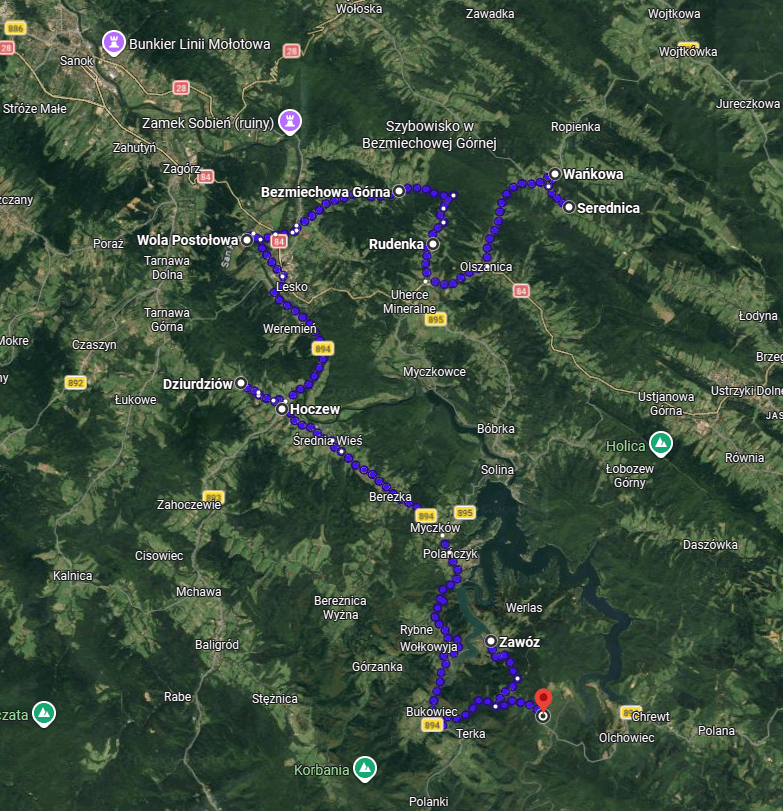
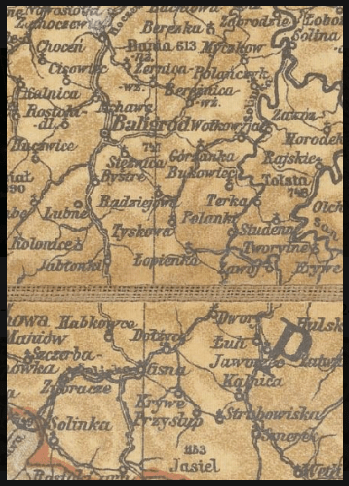
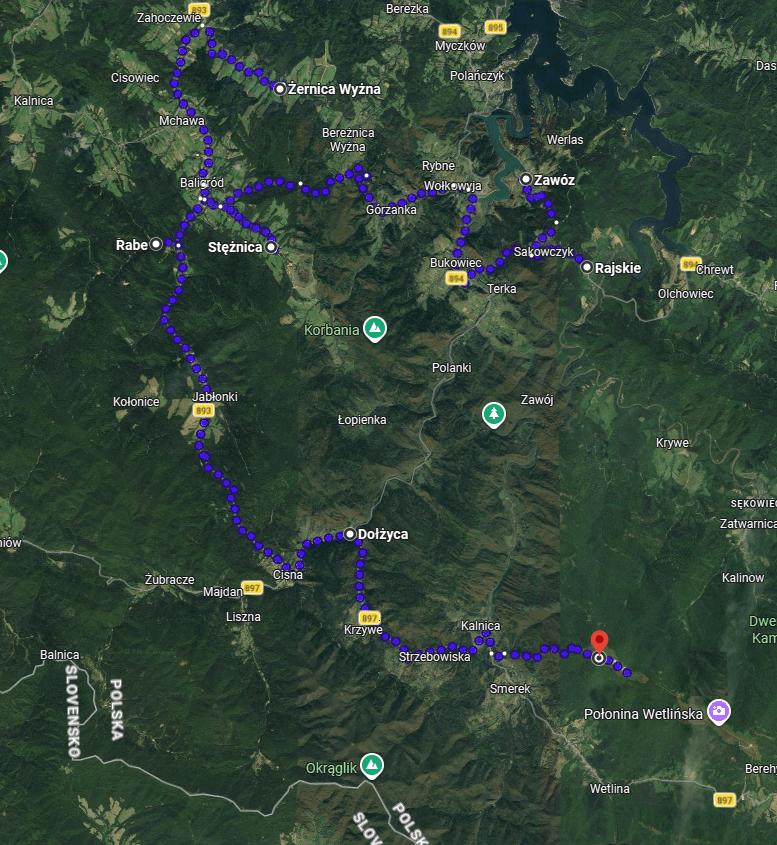
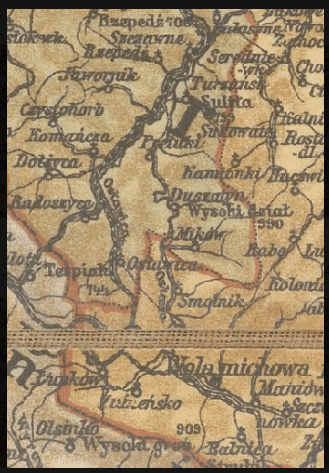
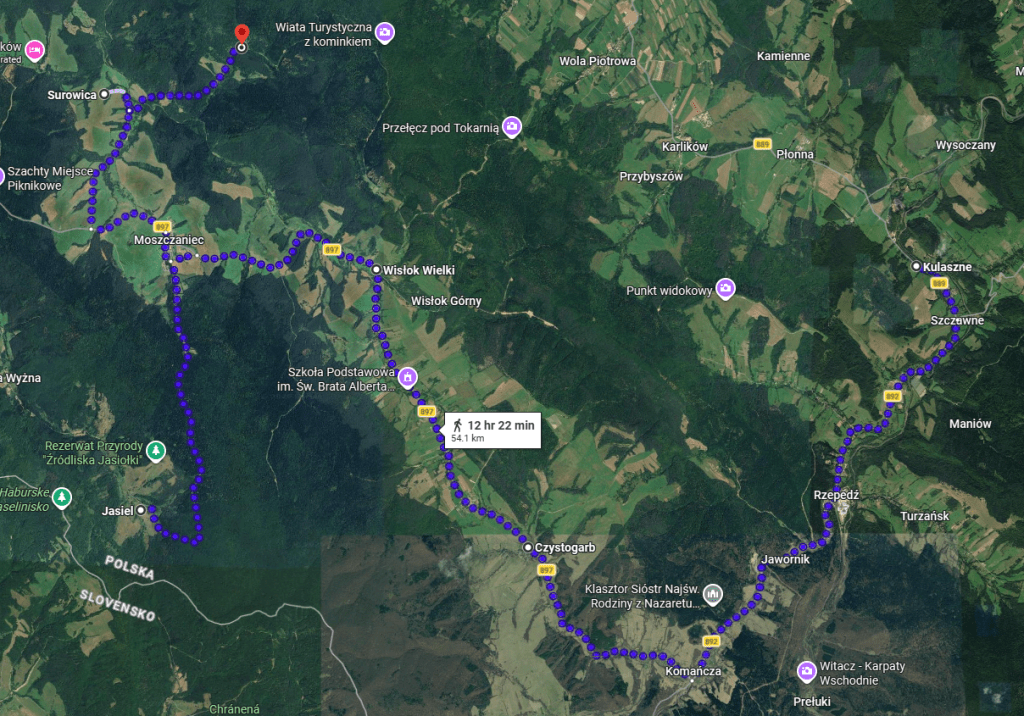
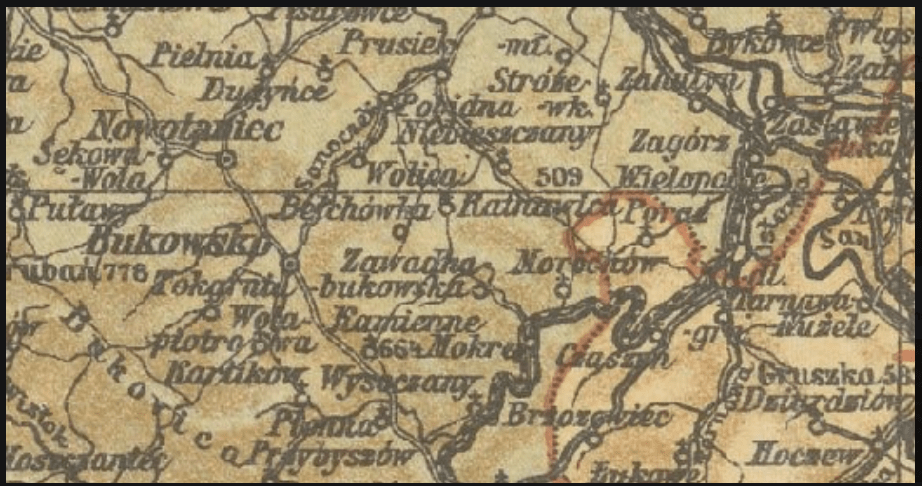
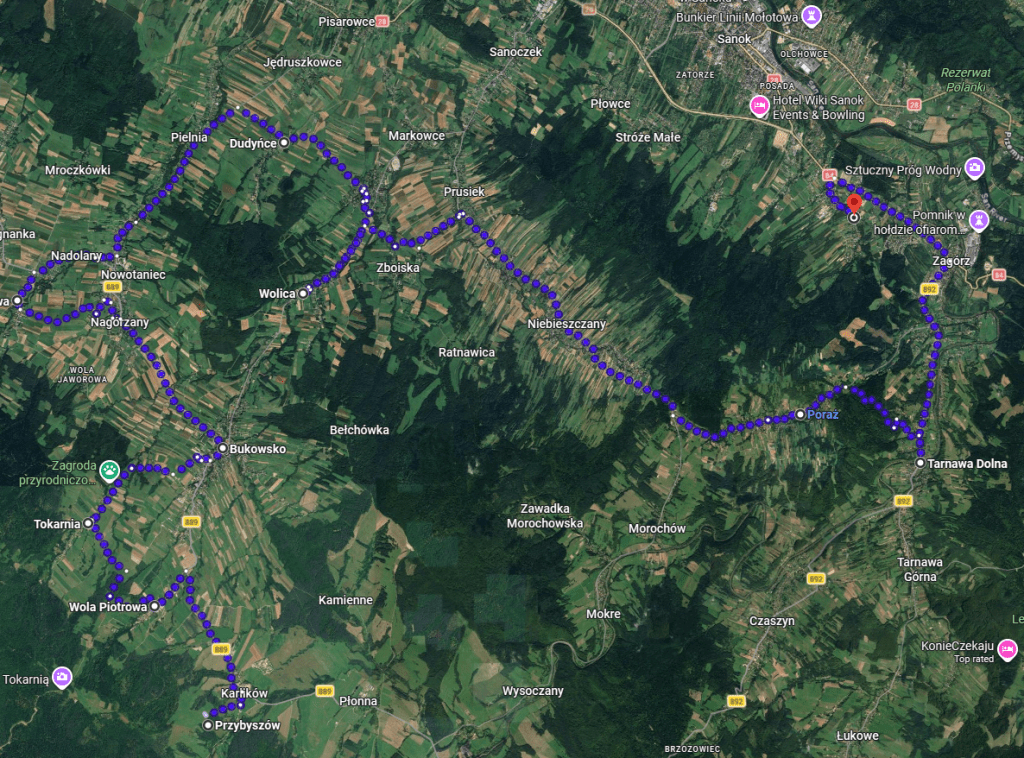
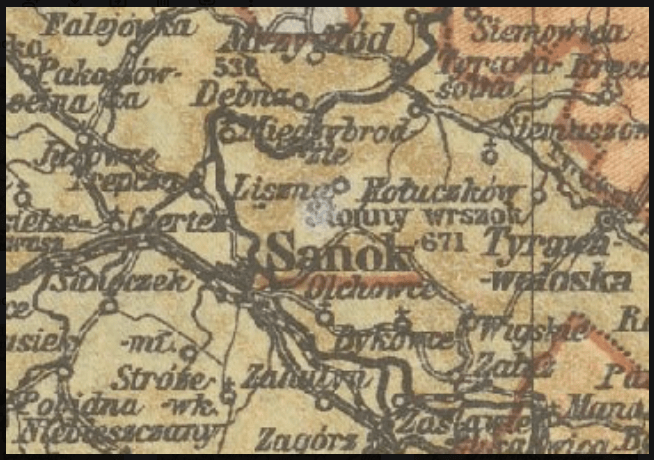
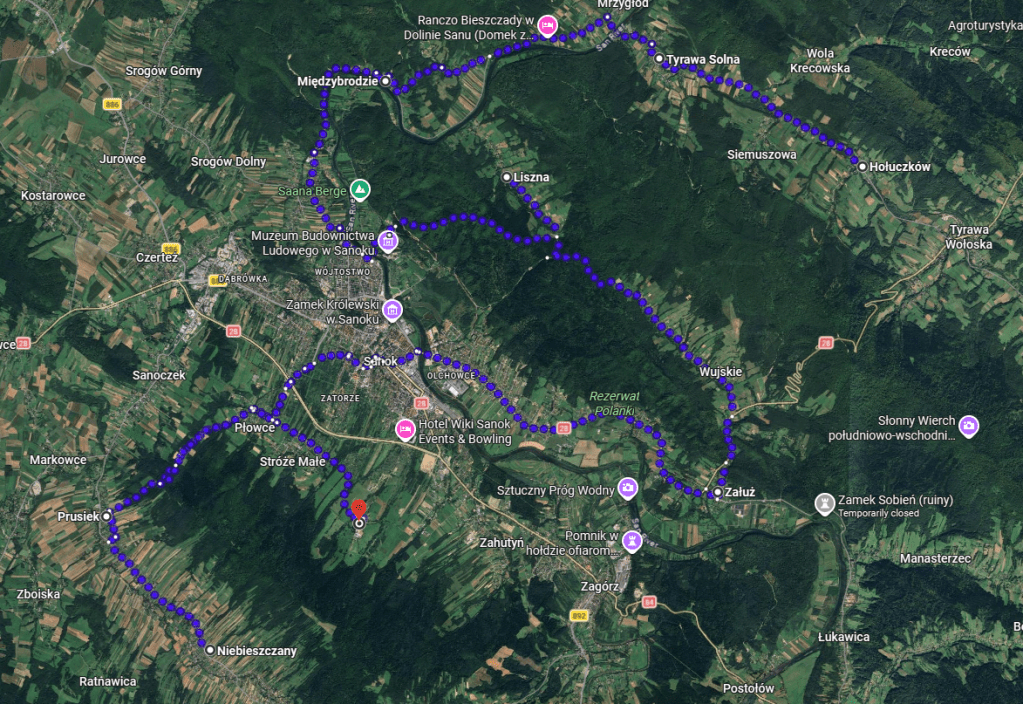
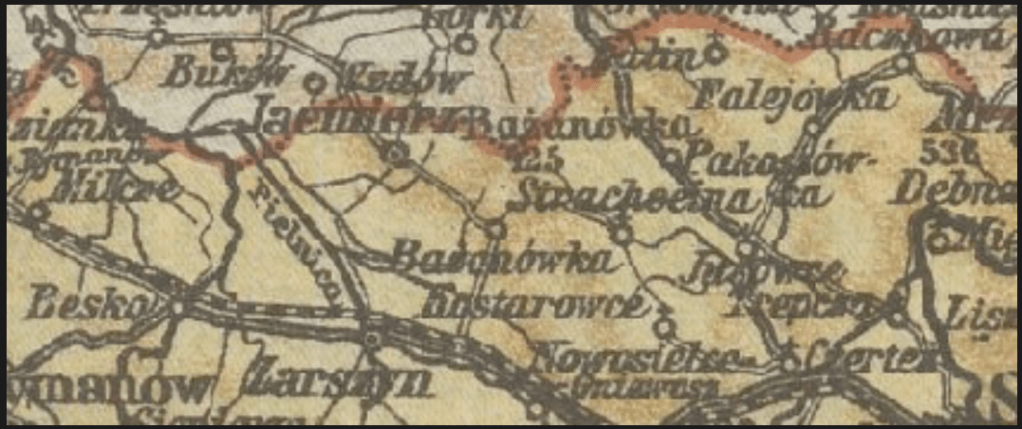
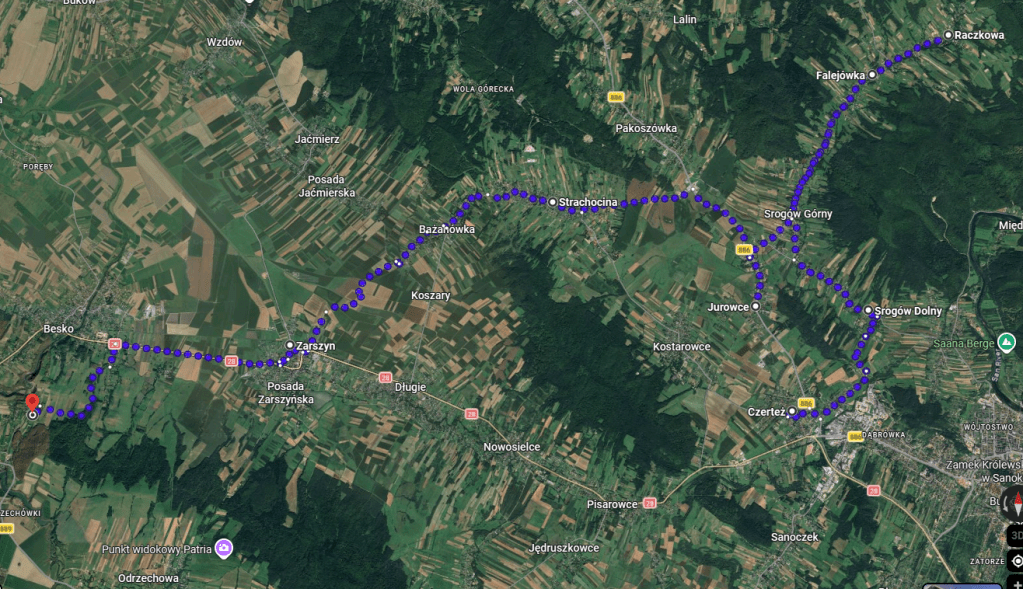
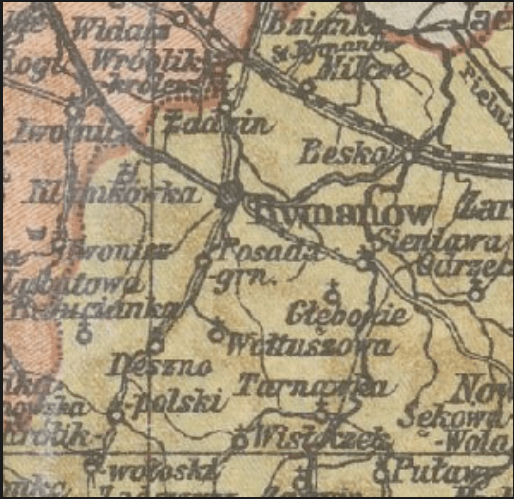
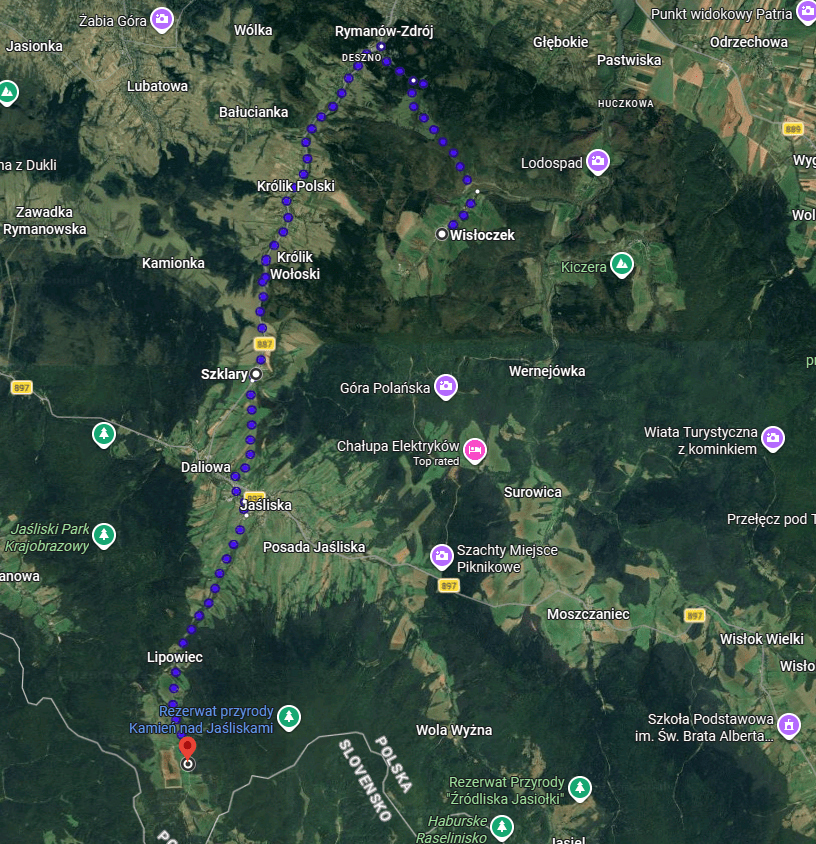
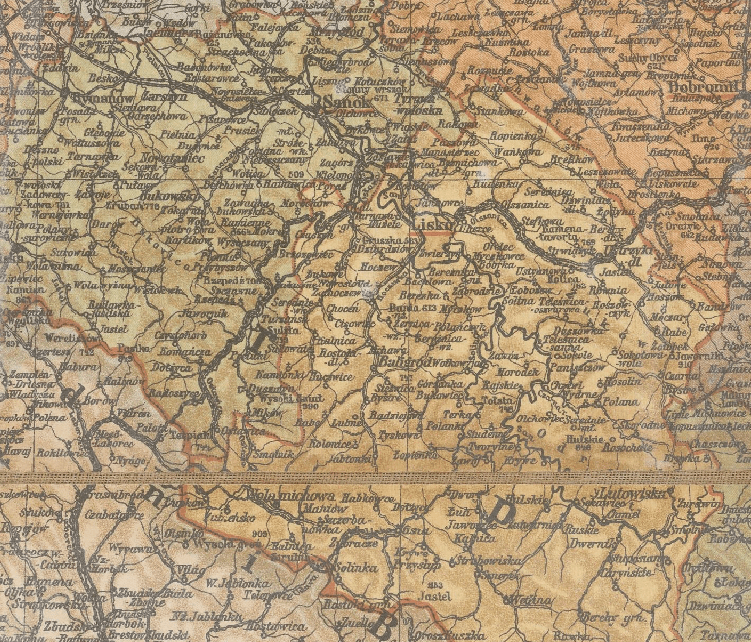
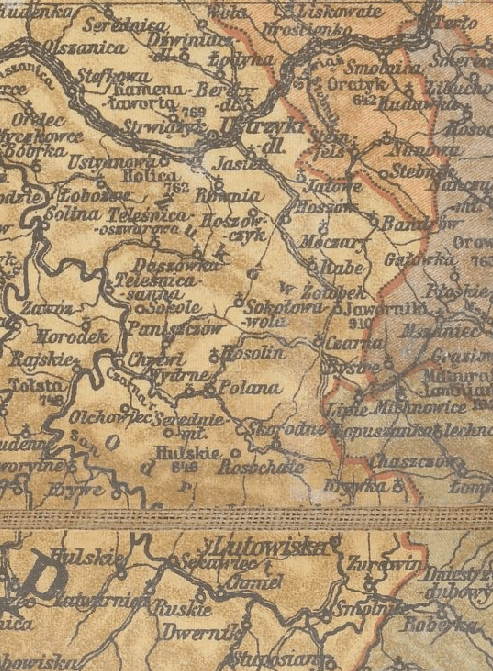
Images are found within the questionnaires, themselves, and are in the public domain. Please credit the Sanok Digital Library, not this site. Route maps from Google, vintage Galicia map from polona.pl, translations by Google.

<– Previous: Lesko County

(Part 4) Lesko County: Vampires, Witches, and other Terrifying Creatures in the School Inspectorate Questionnaires 

This is the fourth of five parts in our project translating information on pre-WWII beliefs in vampires, witches, monsters, demons, death rituals and superstitions in specific villages. This post focuses on modern-day Lesko County. The information was provided by local school officials to the Sanok School Inspectorate in the late 1930s. The original documents and metadata are available online from the Sanok Historical Museum through the Sanok Digital Library.

To learn more about the scope and purpose of this project, see Introduction: Vampires, Witches, and other Terrifying Creatures in the Sanok School Inspectorate Questionnaires 

Part 1: Krosno County

Part 2: Sanok County (minus Komańcza)

Part 3: Komańcza Gmina

Part 4: Lesko County

Part: 5 Bieszczady County


Olszanica

Wańkowa

The local people believe that after death, the deceased walks and visits their loved ones. Often after death, a person becomes an upiór, comes back to the cottage, and haunts it. To prevent this, they pour a handful of poppy seeds into the mouth of the deceased. The deceased wakes up at 12 o’clock at night and has until 1 o’clock to count those poppy seeds. Because there are many poppy seeds and they cannot manage to count them by one o’clock, they cease to be a upiór. 

If the deceased is believed to return, traditional accounts suggest a relative might attempt to end the haunting through specific ritual movements. This involved tracing a path with clay from the grave to the home at midnight. Upon the figure’s return to the cottage at one o’clock, folklore describes the application of various physical measures or ritual interventions to ensure the spirit remains at rest. Money is often placed under the head of the deceased in the coffin. This tradition reflects the belief that the soul must be ferried across a river in the afterlife, with the coins serving as payment for the passage.

Rudenka

When someone is afraid of a dead person, they take the hands of the dead person and command them to squeeze their own fingers and hands, then they will no longer be afraid, just as the dead person is not afraid.

When they carry out the coffin, no one should leave the house ahead of the deceased, so that the dead person does not return to that house again.

New cottages are blessed with holy water.  Before it is blessed, it is vulnerable to evil spirits.  They protect an unblessed cottage against the entry of an evil spirit in this way: an old woman carries blessed items from the old house and places them in the coals…

…When a bride enters her husband’s house for the first time and does not want his parents to live, then as she crosses the threshold and sees his parents, she says to herself with great comfort: “Neither this one, nor that one, neither dad, nor mom.” Within a year, they die. Some of us are afraid that the bride might cast a spell on them, so when the husband brings the bride to their house, they quickly hide somewhere in the house, because they believe that if the bride crosses the threshold and does not see them, her wish will not come true.

To avoid fearing the deceased and to never see them again, people spit three times beneath the coffin as it is carried out of the house. If the corpse’s eyes are left open, it is believed that someone else in the household will soon die.

Questionnaires without monsters

Orelec, Paszowa, Uherce Mineralne


Lesko Gmina

Bezmiechowa Górna and Dolna

Old people believe in ghosts and haunted places, they are superstitious, the young do not believe in these things. They do not believe in spells and witchcraft, they do not go to fortune-tellers, they are religious, they like to go to indulgences.

Wola Postołowa

The common people believe in witchcraft and superstitions, such as: that someone can cast an evil eye on another; it is not good if someone sets out on a journey, to the field, or to the market, and is crossed by someone with empty water-pitchers, or by a priest, a hare, or a cat, for they will surely meet with some misfortune. They believe that in certain places something haunts at night or that a wandering spirit attaches itself to you. They believe that certain deceased individuals walk the earth…

…They believe in the inspirations of an evil spirit and the blowing of the wind…

Dziurdziów

a)  A devil in the form of a dog, cat, or ram misleads a person from their path at night—leading them through forests, creeks, and wilderness—until the rooster crows at dawn.

b) At night, when horses graze outside the forest and the shepherds are asleep—the devil comes as the elusive mara—sitting on a horse—and drives the rest of the horses out of the pasture to inaccessible places. At night, these horses cannot be found; the shepherds will only find their horses when the sun shines. 

c) While a person is asleep (especially in the attic), a “miedznich” comes and pins them down with its weight, leaving them unable to breathe; once the person realizes the cause of the pressure, they can drive the “miedznich” away using prayer and the sign of the cross.

d) Moonlit night – białe baby gather in the forest on a sandy road – they dance – they play with the sand like little children – and when they notice a human – they hold hands – they escape into the forest with the speed of lightning – Only the tracks of their feet remain on the sand.

Ghosts. The ghost of a deceased person comes home on the first night after the funeral – that is why candles are kept burning in the house throughout this night – a full small pot of water, bread, and salt stand on the table.The ghost of a mother especially appears very often after death – she comes to her children – feeds them – caresses them, and hums lullabies.Sometimes a ghost comes and calls beneath the window to one of the household members – one must remember not to answer the call – because otherwise, one can die within three days.

A deceased person who had two hearts during their lifetime, an “upiór,” walks after death among their family and acquaintances – causing mischief – To protect oneself from the upiór’s’ attack, one must carefully examine the face of the deceased to see if any red marks are visible, if so – drive a thorn under the deceased’s tongue, and then the upiór will become – harmless.” 

Deceased children after death have a blue-gray or even black body –these are marks from being beaten with whips by angels for the sins of the mother.

Superstitions. a) The rainbow called “smuga” (streak) drinks water after rain from a river or a stream – if a person were there near the water – the “smuga” will drink the blood from them and the person dies. 

b) Funeral participants, returning from the cemetery, wash themselves in a stream regardless of the time of year—so that the soul of the buried one may be free from sin sooner. 

c) After confession and Holy Communion, one is not allowed to wash their hair for 7 days, because God’s grace is washed away. The whole day after confession and Holy Communion, one walks on crutches – it is forbidden to walk barefoot – because one insults Him who entered a sinful body – being Himself most holy.

d) There are “gards” on earth who have a foster child, a little devil in the form of a child- who works for the household and acquires property – but the soul of such a gard is already condemned. The foster child brings prosperity – one must feed them well, but without salt, and plenty to drink. If any food is salty or not tasty, he takes revenge – he plays tricks, e.g., mice carry away the grain or at night he drives the cattle into the forest.

e) A married woman always wears a headscarf so she doesn’t have to have her hair cut; because the “czeperheir” (bat) seeks out a woman without one and entangles itself in her hair. One can only be freed from the “czeperheir” by cutting the hair. For such a woman, this is a disgrace.

Fairy tales: “Boginki” once lived in mountain caves; when the household members went out to the fields to work, these beings would enter the homes, beat the older children with old brooms, and drink the milk left on the stove for the little ones. Sometimes they would take a quiet infant and leave their own screaming child in its place. They also used to go to the fields to steal peas; one could catch them by leaving a single boot among the plants. The goddesses would slip both feet into it—rendering them unable to flee—and when the farmer arrived and beat them, they would weep and beg for forgiveness. At night, these goddesses would wash their laundry in the stream by the forest.

Legends: 

a) In ancient times, grains had very long ears –Once, a mother who had a surplus of bread used it to wash a bench–God became angry and began stripping the ears of grain with His hand – When the Mother of God saw this, she grabbed God’s hand – begging Him to leave at least enough for the birds and small creatures – God granted the request – which is why today the ears of grain are so short. 

b) The Legend of the Shrine: Beyond Mount Gniwka in the forest (owned by Count Krasicki), a small shrine used to stand next to a beech tree, which fell into ruin over the years; for a long time, there was no shrine there. One day, a woman from Twierdza was walking to Dziurdziów to visit her brother. She noticed a grey-haired old man sitting under the beech tree. Approaching with fear, the old man told her: “Go, woman, to Count Krasicki and tell him to build a shrine here.” After saying these words, the old man vanished. The woman shared her vision with Count Krasicki, who shortly after placed a holy icon on that beech tree and promised to build a proper shrine soon.

c) The Tale of the Thief: There was a notorious thief in these parts nicknamed “Twardochlib” (Hardbread). One day, a gendarme caught him while he was cooking meat. The gendarme forced him into a cow’s hide and paraded him around the neighborhood, where he had to publicly confess his thefts to the local people.

Hoczew

In this local area, there are many roadside crosses and shrines. Their origins vary; some crosses are connected to stories from the time of the abolition of serfdom. – These crosses are specially protected and decorated with flowers and wreaths. They must not be touched, and underneath some of them, documents decreeing the abolition of serfdom are said to be buried. Crosses were also erected at the site of tragic accidents, e.g., death by lightning strike, the appearance of a vision, a ghost, etc. 

Chapels, on the other hand, are built by order of a supernatural force: some father or grandfather dreamed that the Mother of God came to him and told him to build a chapel on that very spot. Immediately after such a dream, the chapel was built, and subsequent generations carefully protect and decorate them. In general, belief in ghosts, apparitions, and post-mortem spirits is very deeply rooted here. They believe that the deceased can appear or punish their loved ones. Immediately after death, they dress the deceased in garments specially kept for death in a chest. A man is dressed in trousers, a shirt, and shoes. They place a handkerchief with a coin (10 groszy) in his hand so that he has something to pay his way with in the next world.

They put the body into the coffin only just before it is carried out of the house; they also give the deceased a cap and a cane decorated with a ribbon. Girls are dressed in wedding attire for the coffin, and a small coin is also given. In the evening, neighbors gather at the cottage of the deceased man or woman and recite funeral prayers from prayer books. Boys and girls sing funeral songs. These evening services and prayers are called a “pogrzeb” (funeral)…

…They also believe that some women take away cows’ milk. A cow suddenly stops giving milk, and they rush with a roar toward the barn of that housewife who allegedly took her milk, and roar demands to return the milk, thereby exposing the woman who took this milk from her. Vigilante justice over such a witch is sometimes very severe.  They also believe in a kind of demon you can breed yourself: You take a chicken egg and the master of the house carries this egg under his arm for six weeks. A devil hatches, and if you give him food and drink, he brings happiness and wealth in the home…

… No fairy tales or legends have been noticed in this locality.They tell each other stories in the evenings, about upiory and ghosts. They willingly recount adventures they have experienced,either their own or those of their neighbors.

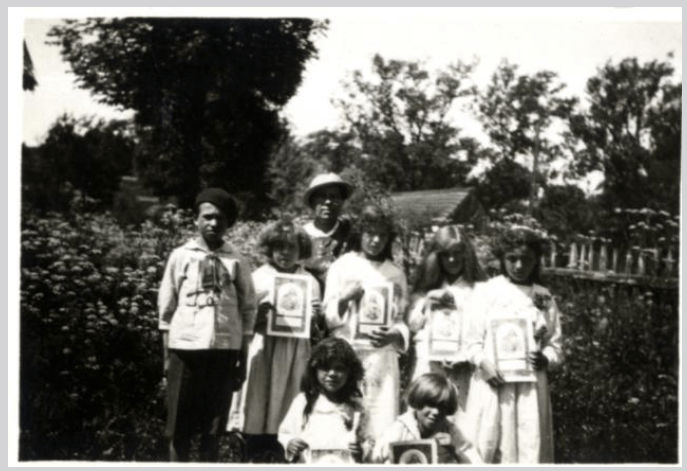
First Communion 1935, Hoczew

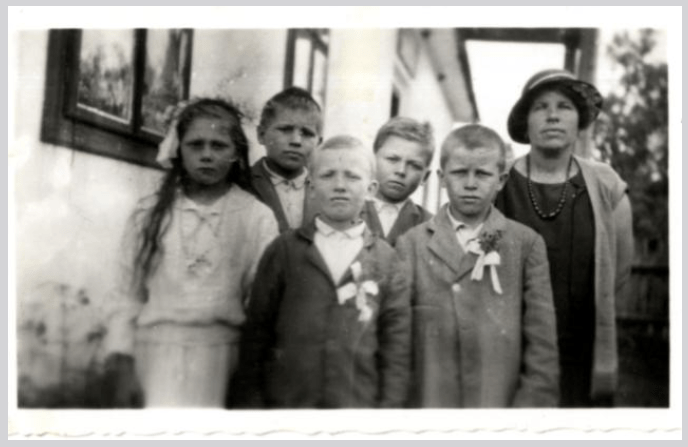
First communion 1933, Hoczew

Forest Festival 1934, Hoczew

Średnia Wieś

An interesting and funny tale circulates about one of the local homesteads. Years ago, an old man is said to have lived in this homestead. He raised a devil for himself by carrying a chicken egg under his armpit for a long time. This little devil was said to be a great friend to his guardian. He protected him from misfortunes, helped with work, and even entertained children in the old man’s family. Before his death, the old man gave this devil to his children. And so the horned one lived in the homestead until recently, taking care of the old man’s descendants. Lately, he has become a great prankster, tormenting all the neighbors around. Namely: he would take various pieces of their underwear and clothing, tear them into narrow strips, and store them in his master’s attic, where he would allegedly see the master. The householder finally grew tired of this, because his neighbors would suspect him of theft; so he spread the word that he wanted to get rid of the devil and would gladly sell him.

After some time, with the help of a middleman, a wealthy gazda from the mountains in the vicinity of Cisna, approached the devil’s owner, declaring that he wanted to buy the devil (true fact). After some bargaining, again through the middleman, the for the devil was agreed upon for 60 złoty–whereby the middleman made 20 złoty. It was packed tightly into an old pot, and the satisfied buyer drove away.

After some time, however, the devil enthusiast arrives back in Średnia Wieś and announces with regret that the devil has escaped him. Nobody could help him with this, however, because the devil could not be caught a second time, and he settled contentedly back in his old place.To this day, they say, the farmer lives with the devil and does quite well for himself. Only he and his family are pale, as if lifeless, of a gloomy disposition; and his sons are mentally dull (though they went to school). The father does not go to church, and everyone predicts a miserable end for him, because “once someone falls into the devil’s claws, they will never break free from them.”

People here also believe that upiórs (vampire in Rusyn) live among them. This upiór cannot be recognized during his lifetime because he is just like any other person; however, they maintain that he has two hearts and harms ordinary people. After death, however, upiórs must do penance within their homestead for as long as it takes for the family to make some offering to God, or order a Holy Mass for his soul.

There are still “płanetnicy” among the inhabitants here, who rule over weather changes, direct hail and great storms. When one of them dies, and God does not allow another to appear, then great hailstorms and tempests prevail.

The majority of the population believes that this year’s hail was so destructive only because a month ago an old farmer died, who, according to everyone’s belief, was a “płanetnik.”

Despite these superstitions, the local people are devout, claiming that one must not anger God, nor irritate the devil. 

Questionnaires without monsters

Łukawica, Postołów


Solina

Bereska

The local population believes that on the first night after the funeral, the soul of the deceased comes back to ask for help, which is why they place bread, salt, and water on the table. The items remain there until morning, after which they are given to the poor.

They put poppy seeds into the coffin. They believe that the deceased returns, so to prevent them from having time to come back, they give them poppy seeds. The deceased counts them from the evening, and before they can finish counting, midnight passes, causing them to stay in the grave.

They place water and a cloth on the windowsill, believing that the soul of the deceased comes to wash itself. It is a local custom during the first week to offer a Holy Mass for the soul of the deceased, so that the soul from the other world does not return.

They believe that a cat crossing the road portends misfortune and failure. If someone walking is crossed by a person carrying an empty bucket, they also predict misfortune and failure. Seeing a priest walking or driving past, when going on some business to an office etc., portends misfortune; to reverse this, they throw straw onto the bare ground. A passing Jew portends good luck. On Christmas, boys are the first to walk among the cottages, and as “pobażnicy” they bring good luck for the whole year, whereas the arrival of a girl is not welcomed, because it portends bad luck.

After Christmas Eve, they extinguish a candle; if the smoke from the flame turns toward the door, someone will die, but if it whirls around the candle, it portends a wedding.

Christmas celebration, Bereska, 1936

Easter in Bereska

Festive attire, Bereska

Nativity play “Szopka krakowska,” Bereska, 1936

Festive attire of the youth in Bereska

A girl in national dress, Bereska

Myczków

There are very many divinations and superstitions among the local people. On long winter evenings, it is not the threads of fairy tales or legends that gather everyone by the fireplace to listen, but rather fears of ghosts and spooks flow from the mouths of old people. If someone dies, a bowl of water and a handkerchief are left on the table in the room for the night, so that the little soul can wash itself; and it has happened–this one and that one has seen it–the bowl has moved and the handkerchief too, and they believe it. Everyone believes in this. They like to chat about it in the evenings.

A child was born stillborn. They buried it and forgot it. After six years someone spoke of a ghost appearing under the windows of the cottage. It was the soul of that child, demanding baptism, so one must throw it a piece of linen cloth and make the sign of the cross over this little soul, and it will stop returning because it will become a little angel in heaven.

Zawóz

In the “olden times”, when people drank vodka by the cupful, stories arose about ghosts and terrors created by the alcohol-clouded mind. Today, they no longer believe in this. Only beliefs in upiory persist. An “upiór” is a dead person who had two hearts. He walks after death and terrifies people, most of all his family. To prevent this, a harrow tooth is driven into his skull. Since the upiór only walks until midnight, poppy seeds are poured into his mouth. Before the upiór can sort through the poppy seeds, midnight passes, and he no longer has time to walk.

They believe more in superstition. For example, if someone dies in the village, nothing can be sown, because then that crop will also die. You also cannot sow during a new moon, because just as the moon is empty, the ear of grain will be empty too.The days of the week are divided into “men’s” and “women’s”. There are two women’s days: Wednesday and Saturday (they also include…). Women’s days are not lucky. For example, broad beans planted on a woman’s day will never grow!…

…Several dozen years ago, a great number of “reptiles” could be found here. They could be encountered everywhere: in the barn, in the stable, even in the hallway. Because of this, the fable “of the king of snakes” has survived to this day. Such a king has a diamond of immense value on his forehead. Sometimes the king goes to the river to bathe, and then he takes off the diamond. Many a brave soul has already tried to steal the diamond. However, the snake-king always noticed it in time. At his whistle, all the snakes would gather and kill the brave soul.

Bukowiec

If a deceased person has feathers under their armpit or if their body does not stiffen after death, they are considered an upiór. A harrow-tooth stake is driven into such a deceased person’s head, and poppy seeds are poured into their mouth. When the coffin is carried from the house to the church, poppy seeds are scattered along the entire path to prevent the upiór from returning home; for if it tries to come back, it must pick up every single seed, and by the time it finishes, the rooster crows, forcing the dead to return to the grave. An upiór’s grave can be recognized because on the very first night after the funeral, upon leaving the grave, he leaves a hole. When the procedure with the poppy seeds and the harrow peg has not been performed, they drive a peg wrapped in straw or hay into this hole in the grav.. According to belief, a stillborn child will wander the earth for seven years; to prevent this, a band made of new linen—sprinkled with holy water—is placed on the child, and they are given a name and some money. Then, the “mułuchid” will no longer haunt the living, for upon rising from the grave, it will find its name and return to its resting place.

A housewife whose cows milk well is a witch–she knows her way with cows. You must not show her butter or milk from another cow, or she will steal that cow’s milk. On the Feast of the Annunciation of the Blessed Virgin Mary, witches go around stables and steal milk from cows. On this day, witches also make butter. On Ash Wednesday, women are not allowed to enter someone else’s house, because they would steal milk from the cows and eggs from the hens. On this day, women and girls stay at home. In order for cows to breed well and milk well, on October 1st on “Pokrow”, cattle are grazed all day, and they do not milk cows because they dedicate the milk to the Mother of God. Anyone whose cattle do not breed well makes a promise that they will not consume milk on any Monday. This promise is made during confession.                 

On the eve of the holiday, i.e., on the eve of the annual holiday, they place nettles, an axe – a hatchet, and a plowshare into the stable. In this way, they protect themselves against witches. Then the witches then have no access to the stable. Witches deliberate, meaning they gather for “evening parties” where three borders meet. There, on windy nights, upiory fight each other.  

As for the piety of the local people, one must acknowledge their deep reverence for all things sacred. They pray and attend the cerkiew, frequently receiving the sacraments—though this applies mostly to the older generation, as the youth are of a different spirit. Yet, this piety is strangely intertwined with curses and imprecations—invoking God’s wrath or lightning strikes, or calling down monstrous curses upon others—using epithets like “you spotted viper” and other names too foul to mention. They attribute natural phenomena—such as winds, storms, hail, and lightning—to God’s punishment for sin; for instance, they believe hail causes damage when a young woman buries an illegitimate child, as the rain and hail must wash those children out of the earth…

… Old folk say that 200–300 years ago, a morowica and a morawiec—representing the black plague—passed through the village. They came to the river and asked a farmer named Drozd to carry them across the water. As Drozd was carrying them across the river, they felt as heavy as the world itself because they held dominion over the entire world. Once they were on the other side of the river, they ordered Drozd to light a candle every year through the entire Christmas Eve night. The morowica went into an empty house in the forest, where she began to dance with the morawiec and sing: “Let there be no terliczyk, let there be no tendiawa, so that all the children will be ours.” Terliczyk and tendiawa are herbs that protect against the plague. To this day, Drozd’s descendants light a candle on Christmas Eve.

This same Drozd did not want to believe that Easter is the greatest day of the year. On Easter Sunday, he went out into the field to plow with oxen, and there he, along with his oxen, turned to stone. This stone can still be seen on the border. As a punishment, all of his descendants still light a candle on Easter night, from Sunday into Monday. 

Terka

The local population of the village believes in upiórs and witches. An upiór is recognized by the fact that when he dies, he has feathers under his armpit, while an upiór’s grave can be recognized by the fact that the magical being, leaving the grave on the first night after the funeral, leaves a hole in the grave. Immediately after death, a harrow tooth must be driven into the vampire’s head, and poppy seeds must be scattered during the procession to the cemetery, because if he wants to return, he must gather all the poppy seeds. A witch is usually what they call an old woman who has highly productive milk cows. You must not show her milk or butter, or she will steal the magic. In this village, there is one such woman considered to be a witch, and they say she goes at night to crossroads, or where three borders meet, and there she fights with other witches. The next day, this woman is weak and has bruises on her body. 

No work should be started on a Monday, because it will not succeed, and it will have to be repeated throughout the entire week. Crop failures occur when Polish and Rusyn holidays coincide in the same year.

When cattle produce little milk, the farmer makes a vow that he will fast from milk every Monday. Children are generally breastfed for a long time, usually up to 2 or 3 years. A child should not be weaned at any other time except when the beeches are budding.

At Christmas, if someone from the household goes out into the yard, walks around the entire house three times while touching the corners, and looks through the window, they can see who will get married, die, etc. this year. The local people are pious in their own way. They attend the church and take part in feast days, sometimes in distant villages. Despite this, religious morality remains low. People consider all natural phenomena to come from God’s will. Everything is generally seen as a punishment for sins. For example, hail only destroys crops when girls bury illegitimate children. Rain must wash away the bodies of these children. People say prayers daily, but often distort them in their own way. 

There is a story about a “wątkopak” (kupaku). A woman was washing clothes “in the dead” at the stream and a wątkopak arrived, a huge beast that devoured people. It said that it would eat this woman when she finished washing.She was very scared and washed for a very long time. Out of fear, she turned into stone and remained there at the stream as a large stone, which people still show each other to this day.

Rajskie

If a mother has a small child that dies unbaptized, it returns to the mother after 7 years to weep under the doors. This phantom is called ‘maluchid’. So that such a child does not haunt, a linen band is placed on its chest, a coin is placed underneath, it is sprinkled with holy water, and it is given a name. When the child returns after 7 years to haunt, it finds its name and returns to the grave.

They believe that inside every toad a witch is hidden by spells, and every toad can spoil a cow’s milk. If someone were to cut off, for example, the leg of a toad in which a witch resides, then that woman will be missing a leg. Witches wander most before the feast of St. George and before the feast of]the Most Holy Virgin Mary; they wander through stables and steal milk, which is why farmers guard the stables by sleeping in the yard. So that the cattle will give milk well, on “Pokrow” cows stay out in the field the whole day without being milked; the milk from this day is offered to the Mother of God. There are cases when someone’s cattle do not thrive well, then the housewife swears to the priest during confession to always fast with the whole family on Mondays, and they keep to this. 

…According to their view, all natural phenomena come from God; God also sends a good harvest, misfortunes upon people, such as diseases, etc. Lightning strikes where girls bury illegitimate children.

Questionnaires without monsters

Bóbrka, Górzanka, Myczkowce, Polańczyk, Solina


Baligród

Żernica Wyżna

The soul of the deceased returns home for an entire week, and during this time, a bowl of water must be left out because the soul washes away its sins at night. If a father or a mother dies, it is forbidden to strike even a single corner in the cottage for a whole year.

Stężnica

Regarding the deceased, they believe here, for example, that if a hen were set on eggs in the year a household member died, it would be hard for the deceased to lie in the grave, as they would feel a heavy weight on their chest.They also do not plant garlic in the year of a household member’s death, because it would not grow for seven years. A small bowl of water is placed on the window sill so that the soul of the deceased can bathe.

Rabe

The population is very superstitious and suspicious. After a husband’s funeral, they wash their hands and faces in a stream, and in winter with snow. At home, they touch the stove with their hands. To prevent the deceased from coming back, they throw poppy seeds into the grave. If there is a flood, they say that a woman buried a child in the ground and the water must wash it out. If there is no rain, they throw poppy seeds into the stream, and this is supposed to bring rain. If someone’s breeding of cows or sheep does not go well, whoever they bought them from gave them with an “evil hand.” They will not bring butter to another village, or their own will run out. They put nettles into the hearth so there will be no mice in the house. When a child is born, they put an object into its hand so it will love working later on. They wash the bathwater depending on the gender—if it is a boy, they use peas so he will have curly hair, and if it is a girl, they use rye. Superstition is encountered here at every turn…

…There are few legends and fairy tales. Barely one legend is known. In the forest, there is a stone, and around it an anthill. The elders say that a very long time ago, on Easter Sunday, an orphan girl was pasturing sheep and spinning flax. God punished her in such a way that He turned the girl into a stone and the sheep into the anthill’s mounds.

Questionnaires without monsters

Kołonice, Mchawa, Nowosiółki, Roztoki Dolne, Zahoczewie, Żerdenka, Bystre and Łubne

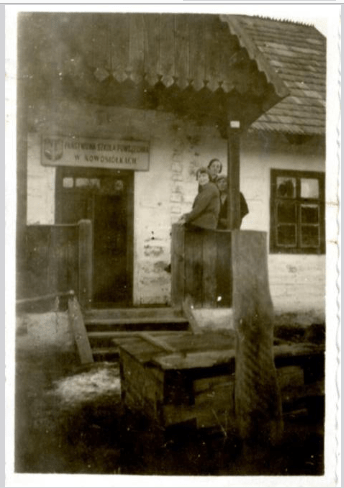
School in Nowosiółki


Cisna

Dołżyca

People believe that there are witches who take away butter and milk from cows, and on St. John’s Day, they weave wreaths of yellow flowers and put them on the cows’ heads. It is then that the witches enter among the cows and take away the milk—these witches are called ‘bosorkyni’. From the stable, she will take a piece of the threshold or a piece of coal. The witches dress in black skirts, a white blouse, and a white headscarf tied under the chin. They go into the stable and into the field—they say there are six ‘bosorkyni’ in this village. They know the appropriate herbs…

…They believe that the dead walk—that people have two souls—and that they haunt the living; even now, the soul walks and haunts. In one room in this village, there is said to be a presence that strangles women—it has already strangled four—and every year a corpse must appear in that room; someone is bound to die there, and the walls of the room must not be washed for a full year.  They mourn for a year and are not allowed to go to weddings, sing, or wear fine clothes.  

Smerek

The spiritual culture of the local people lies entirely within the richness of their songs (kołomyjki), fairy tales, and parables. These reflect a person’s worldview, formed on the basis of self-generated principles. When characterizing the general worldview of such a person, it is difficult to find an appropriate scientific term to define it. In any case, it is based on idealism, rarely breaking away from it, except for moments of fearful fatalism. Conservatism, lack of activism, and indifference in certain areas of life—these are the terms that would approximately define the worldview and character of the man of the mountains. In the field of folk creativity, there have been preserved until now songs, fairy tales, a wide stock of imagination, not very rich phrases or comparisons, but deep in terms of sentimental feelings. I will give a few such songs just as an example, heard directly…

… On this, one could conclude the illumination of the worldview of the mountain people regarding the manifestations of life, reflected in the examples of the above kolomyikas.

And now we shall proceed to new sources. These are customs and traditions, beliefs and superstitions. Belief in the afterlife is authentically closely linked with the belief in spirits. The appearance of the spirits of certain people is firmly established here, although real details to confirm them are lacking. But before we move on to discussing them, we shall return to the local funeral custom. 

If a family member dies at home, the oldest member immediately notifies the local priest “paroch” in the meaning of a parish priest. Next he goes to the church servant; the sexton, who gives him light from the cerkiew and announces the death of a community member by tolling the bells. From the moment of death until the time of the funeral, the residents of the house affected by the tragedy of death are required to walk without hats, which they strictly observe. The bell-ringer, announcing a person’s death, strikes only a single bell. Upon hearing its sound, no one makes the sign of the cross, because otherwise, their hand would wither. Once these first formalities are taken care of, they proceed to dress the deceased. The deceased is bathed in a large wooden vat or tub, washing the body with a wet cloth and soap (soap being an item almost never used in daily life). — Next, they dress him in a white shirt, tied at the neck with a narrow ribbon called “ołonecza”, and pull white linen trousers, “gacie”, over the lower part of the body. On the feet, they pull white stockings, purchased in town or sewn from homemade linen. The dressed deceased is laid on a bench under the window, after spreading a linen sheet beneath him and folding another under his head. Candles burn at the head on both sides. The poor, who cannot afford this, take small jars of butter from the cerkiew—donated by people—and these substitute for candles. In front of the deceased’s head, they place a cross with the Crucified Christ. As a sign of mourning, they do not sweep the rooms for as long as the corpse lies in the cottage. After making the coffin—which is mostly done by the masters of the house themselves—and after digging the grave at the cemetery (this task is performed sequentially, cottage by cottage), they proceed to the funeral. Into the coffin next to the deceased, they place various of their favorite objects. Little boys are given small wooden axes, little girls a wreath on their head and a handkerchief in their hand (a symbol of marriage). Infants are given money in their hands so that they have something to ransom themselves with in heaven. When nailing the coffin lid, they cover it with a piece of linen cloth, which then becomes the property of the parish priest. To the church banners, they tie strands of linen yarn so that the deceased does not walk naked in the afterlife. At children’s funerals, instead of yarn, they give white handkerchiefs symbolizing innocence. When carrying the coffin out of the room, it is struck three times against the threshold as a sign of farewell. On the road, they place the coffin on a sleigh, from where it is pulled by oxen or horses all the way to the cemetery. Upon moving from the spot, they pour a bucket of water behind the coffin, symbolizing the tears of the household members. While moving towards the cemetery, and even before that, the household members, or hired people, express their laments for the deceased. These wails are called “jojkania.” As an example, I will quote a short excerpt from these laments. Most often, such laments are led by two people, competing to find the most painful expressions. Here is an example.   

First Mourner: Oh, mother, our mother, why did you die to us so soon.

Second Mourner: Oh, mother, my mother, who are you leaving us to?..

First Mourner: Oh, dear mother, when will you return to us?..

Second Mourner: Oh, dear mother, what will we do without you?..

First Mourner: Oh, our little dove, our dove! Why didn’t you tell us that you were going to die!?..

Second Mourner: Oh, why didn’t you manage to let us know,

First Mourner: Oh, will we see you again at the Last Judgment!?…

Second Mourner: Oh, will we see you, dear mother, in the Valley of Josaphat… etc.

And now about the details related to life beyond the grave. As I mentioned previously, the spirits of the deceased wander here. These spirits are good and bad. The latter cause harm to people, and they can even kill. The first procedure aimed at driving them away is to say prayers over the grave and sprinkle the rooms with holy water. If this does not help and the spirit continues to terrorize the household members, one must dig up his grave and cut off his head, placing it between his legs, or drive an iron stake into the head. It is easy to understand that a person can be driven to such barbaric actions only by a panic fear of spirits.  Besides spirits, they also believe in evil forces. These can manifest in the form of the devil, or his power incarnated in a human being. A witch (bisurmanka) is the only power that can steal a cow’s milk, curse a family, or bring down natural disasters upon them, such as diseases, hailstorms, and floods.  Herbs play a major role in such practices. Poisonous herbs, which bring illness or madness upon a person, are known only to a few. Therefore, such people evoke general fear and admiration among the masses… Medicinal herbs, of which many grow in the mountains, do not, however, have enthusiasts who would utilize them for the benefit of human health. They say that sorcerers go to gather herbs (mostly harmful ones) on St. John’s Night to the so-called “Rjabu Skała”, which is located in the area. How much truth there is in this is difficult to investigate, because so far no one has caught anyone engaged in such magical practices. Many magical and fortune-telling practices and methods are preserved with special care. Betrayal of these secrets would threaten serious consequences for such a person.

Therefore, it is understandable and clear that bringing them to light and including them in this questionnaire is currently impossible. Perhaps, when the people realize their “ridiculousness” and “ineffectiveness,” they will speak about them on their own without being questioned about what is now difficult to extract. 

Questionnaires without monsters

Buk, Cisna, Łopienka, Solinka, Strubowiska, Żubracze


Images are found within the questionnaires, themselves, and are in the public domain. Please credit the Sanok Digital Library, not this site. Route maps from Google, vintage Galicia map from polona.pl, translations by Google.

<– Previous: Komancza Gmina

Bieszczady County: Next –>

(Part 3) Komańcza Gmina: Vampires, Witches, and other Terrifying Creatures in the School Inspectorate Questionnaires 

This is the third of five parts in our project translating information on pre-WWII beliefs in vampires, witches, monsters, demons, death rituals and superstitions in specific villages. This post focuses on modern-day Komańcza Gmina. This information was provided by local school officials to the Sanok School Inspectorate in the late 1930s. The original documents and metadata are available online from the Sanok Historical Museum through the Sanok Digital Library.

To learn more about the scope and purpose of this project, see Introduction: Vampires, Witches, and other Terrifying Creatures in the Sanok School Inspectorate Questionnaires 

Part 1: Krosno County

Part 2: Sanok County (minus Komańcza)

Part 3: Komańcza Gmina

Part 4: Lesko County

Part: 5 Bieszczady County


Komańcza

Balnica

They place a dying man on a bench and spread straw for him, so that it will be easier for him to die. When he dies and is already lying on the table, they take care that a cat or a dog does not pass under him –because then he will not become stiff. For they believe that a person who does not become stiff, if a cat or a dog passed under him, is an upiór. They perform protective rituals such as pouring poppy seeds into the mouth of such a person to prevent them from returning to their village or harming the household and cattle. They carry the coffin through the door in such a way that they strike the doorway three times, and its handle against the door latch. Along the way, they scatter poppy seeds behind him, and into the grave they throw money for every deceased person.

They believe in the evil eye. They throw a knot into the water. If the knot sinks and falls to the bottom, it means the sick person was afflicted by the evil eye…

…On Maundy Thursday, after the evening service, people leaving the church do not look back, because whoever looks back will die this year.

Zubeńsko

They believe that human souls, whose bodies do not rot after death, turn into upiory that torment the household members. To avoid this, immediately after the funeral, they scatter poppy seeds all around the grave, which the deceased must gather; this takes so much time that they will not manage to finish before dawn. On the other hand, so that a child does not walk after death, a piece of skin must be cut from the ear, or a nail must be driven into the forehead. They also believe in places haunted by the devil, who deceives man by taking the form of some animal, most often a goat or as will-o’-the-wisps. In connection with these places, the most diverse stories circulate, more or less sinister depending on the degree of fantasy or imagination of the storyteller. The day of terrors is Thursday.

They believe in witches who take milk away from cows and can cause an illness in a person, through the evil eye, manifested by severe shivering and nausea “nud pade ne szołowiska”. To get rid of it, one needs to throw a burning ember into water, preferably holy water, then drink it, and for good measure, wash the face and wipe oneself with the shirt one is wearing. To make the whole procedure more effective, fumigate oneself with burned herbs blessed on the Feast of Our Lady of the Herbs…

Łupków

Belief in upiórs – the still warm body of the deceased is considered the dwelling place of the upiór. They would drive a nail into a child’s head; for an adult they would bury and sprinkle the grave with poppy seeds, believing that before the spirit can gather all the poppy seeds, the rooster will crow.

Smolnik ad Baligród

Belief in upiory. We know that an upiór can reside in an unbaptized body. They drive a nail into a child’s head, bury others, and sprinkle poppy seeds over the grave, so that before the spirit can gather the poppy seeds, the rooster will crow. Belief in casting spells, taking milk away from cows.

Mików

There are kinds of fears and ghosts that the local people connect with a deceased person; what other beliefs and superstitions exist are in connection with the days of the week, month, and year…

…There is a custom known as “koły”—youth gatherings featuring drumming, kissing, and various forms of mischief and revelry. Despite the clergy’s efforts, this pagan custom cannot be eradicated. The people are very fond of attending religious festivals (odpusty), though often more to visit family than for religious reasons. During these festivals, people’s behavior in the churches is often inappropriate; they chat and walk out during the service. They are particularly fond of the blessing of water at these events. The population is superstitious, frequently seeking the advice of fortune-tellers—whether regarding the construction of a new home, a trip to America, marriage, or a theft. Such a fortune-teller can be found in almost every village. There are also “healers” whose consciences bear the burden of ruined health and lost lives. Poverty and low levels of culture foster this situation. Pagan customs such as Kupala (bonfire festivities) for St. John’s Day and Rusala (the Friday evening before Pentecost) have also survived.

Prełuki

Crosses and shrines were erected either for a specific intention or in places where, as people say, ghosts used to appear.When someone dies, in the evening relatives, older neighbors, youth, and children gather for a so-called “kola” [circle]. They pray, sing pious hymns, read psalms, and also arrange various games, such as “shoeing the girls”, hitting, or “roasting the rooster”. The deceased is laid on boards supported by two stools on straw covered with homemade linen. On the first night after the funeral, they place a lit candle, bread, salt, water with a bowl, and a towel on the table, because they believe that the soul needs all of this. On the first evening after the funeral, they walk with a veiled candle around the corners to see if death is anywhere. When they place the deceased into the coffin, they give him some blessed herbs, a piece of a bread roll, garlic, and money. On top, some people sprinkle him with poppy seeds, so that he twists and troubles himself for as long as it takes to gather that poppy seeds, so that he does not walk after death. Grain is scattered behind him, so that he does not take the harvest to the other world and so that crops will grow. From the linen fabric given to the deceased, they pull out threads, so that flax and hemp will grow. When they carry the deceased out of the cottage, they knock the coffin three times against the threshold as a sign of gratitude for everything, because they believe that until this time, the deceased still knows and feels everything. Things of the deceased are burned or given to the poor. The straw on which he lay is carried to the river bank and burned, watching the rising smoke, inferring where this soul will return whether to heaven or to hell. The population seems generally pious, likes to go to Sunday services, devotions, and indulgences, but they strongly believe in witchcraft, superstitions, quack doctors, etc…

…On Christmas Eve, besides hay, straw, and a large loaf of bread, they bring a piece of a plow—a coulter—and an axe into the cottage to place under the table, and they encircle all the table legs with a chain, upon which they keep their feet during dinner so that they might be strong and healthy like iron. On the first day of Christmas, a woman is not allowed to enter the cottage first because they believe in the so-called “połazyk” or “łazik,” and if a woman enters the house, it is a bad omen for the whole year, and if any misfortune occurs, it would be blamed on that person. The local people also believe in so-called “bisiurkinie,” who bewitch milk and take milk away from cows, and this happens mostly before St. George’s Day. To prevent such a witch from entering the cottage, they often place a harrow, a plow, and an axe before the door, and they also encircle the entire homestead with poppy seeds.

Jawornik

The local population is not pious. Inside the church, during the service, talking and sleeping are constantly seen. When the priest delivers a learned sermon that is not interspersed with interesting stories, they leave the church. On the other hand, they love weddings and music so much that they bring infants with them, and even if uninvited, the whole village turns out. They believe in fortune-tellers and folk healers and spend money on them. When a cow falls ill, they immediately fumigate it with a burnt swallow’s nest and smear its eyes with water colored with scrapings from someone else’s stable. On Good Friday and every day before St. George’s Day, women run around the stables naked (before sunrise) and scrape the thresholds of neighboring stables where the cows are. They also cut the tails of other people’s cows and fumigate their own stables and cows with the burnt hair. When someone is bitten by a viper, they take a brand-new small knife and give it to a folk healer, so that he may cast a spell over the bite

They do not have favorite songs. At weddings and music gatherings, the youth sing Polish and Ruthenian military songs. At a funeral, one of the deceased’s family members walks, crying out with a weeping voice, recalling the good deeds of the deceased. When the deceased lies on the bench, the living gather for the so-called ‘koły’ (circles/rounds). In these circles, one person portrays the deceased and performs a public confession, and then penance. Instead, there is laughter, shouting, and fighting. They do not act as if they came to pray. After the funeral, they stand around, eating and drinking just like at a wedding. 

Turzańsk

Some older people believe that the dead walk, so when someone in the village dies, they gather for the so-called “koły,” during which they tell each other various adventures and organize games. There used to be a customary game during which people hit each other, which is now disappearing.

Maniów

A dying person is placed on a bench, and straw is spread beneath them so that they may die more easily. After death, when they are laid out on the benches, they make sure that no dog or cat passes under him, because then the deceased will not stiffen. If, despite this, he does not stiffen, they consider such a person to be an upiór, who after death returns to strangle cattle. Unless someone prevents this using secret practices, the upiór causes death to people.

An Upiór-Man is buried differently. They cut off his head and place it between his legs, and they nail the coffin shut with three nails, driving them into the head, heart, and legs. Then he will never leave the coffin. They carry the coffin out in such a way that they lock the door with the handle, but take it off its hinges and leave through there. They scatter poppy seeds along the entire path, and they also put poppy seeds into the deceased’s mouth. They also scatter poppy seeds into the grave so that if he does get out, he will spend all his time gathering those seeds…

…When a child is born generally calm, but suddenly at some point starts screaming and crying, people do not understand what happened and say it caught “from church” (the name of an illness). Then, a woman goes to the cemetery with an old pot (at whatever time the child started screaming). She takes soil from the most recent grave into the pot and water from a stream. She mixes this mud and rubs it on the child moving away from herself, using the back of her hand. Afterward, she returns the soil and the pot to the cemetery.

Maniów–Lemko woman

Kulaszne

The population devoutly believes in all kinds of ghosts, and is superstitious. A dead child is placed with a wax ring on its finger, and two coins in its hands, so that it might ‘buy its way in’ at the gates of heaven. The old deceased often walk the earth, shrieking, and there are incidents where they cause great harm to their siblings or children. Here is what a farmer told me about his deceased father:

“We buried our father properly, and he had a nice funeral, and we dressed him well; it was apparent, however, that he was not entirely satisfied, for every third night after the funeral, he would come to the barn and bring bundles of grain and scatter it around, disturbing the cattle. There was no helping it, and this went on for quite a long time. During this time we suffered a lot. We went with our affliction to a peasant in [Usijaw], who, having arrived at our estate, confirmed the presence of an upiór. He ordered us to dig the “gates” from under the house. Finally, when all that did not help, we went to the cemetery, dug father up from the grave, and drove a nail into his head so he would not come back anymore. This measure proved to be truly effective, because since then we have been living in our former peace.”

Another farmer has a similar story.

Kulaszne–Forest Festival


Czystohorb

The local people believe in specters and spirits. When a family member dies, a Holy Mass is offered so that the deceased’s spirit does not haunt the living. There are many such superstitions; for instance, if someone in the village dies, no work may be started on that day.

On St. Andrew’s Eve, girls smear their hands with honey and flour, then offer their hand to a dog; the direction in which the dog licks it indicates the direction from which a future husband will come.

On the night of Maundy Thursday, farmers keep watch in the stable, fearing that witches might transform into various creatures or cast spells to steal the livestock’s milk.

Wisłok Dolny

When someone dies, people go to the so-called “świecenie.” The elders sing then, while the youth play pranks and mischief; no one is allowed to sleep in that house. After the funeral, they host a feast, mostly inviting the priest. When the deceased is remembered, one must give an offering. Once the sun sets, it is forbidden to take out the trash, otherwise someone will die. The house where the deceased lies is swept by someone from a different house. When trash is burned and the smoke blows toward a certain cottage, they claim someone will die there. They forbid crying, because if one cries, the deceased will be wet in the afterlife. They put holy water in the coffin so that the body does not decay. After the funeral, they place a bowl of water and a towel in the spot where the deceased lay, so that the soul can wash itself. Deceased husbands visit their wives and consort with them; if a wife wants to free herself from him, she must turn the deceased’s wedding clothes inside out.

Wisłok Górny

The local population believes in ghosts and spirits associated with the deceased person. They believe that the spirit of the deceased returns after death and takes revenge on those who troubled him during his lifetime. For example, the locals tell of such an event. A few years ago, a peasant died whose spirit returned and took revenge in a terrible way on people and animals—and this lasted for a year. Divine services and prayers did not help. So they brought in a Czech sorcerer, who allegedly drove that spirit back into the grave—then everyone went to the cemetery, dug up the grave, and cut off the deceased’s head, from which blood allegedly poured. From that moment on, the haunting in the village stopped.

Jasiel

When a corpse is lying in the house, they do not sweep the cottage; only after the corpse is carried out do they sweep the room and burn the sweepings so that the spirit does not return for anything. While carrying the corpse out of the cottage, they move the seed and manure—so that they do not “die” (spoil/lose their vitality). On the Feast of the Annunciation of the Blessed Virgin Mary (March 25th), they lean harrows against the stable doors, and in the morning they check if the doors and harrow are undisturbed; if they were moved, it means a “prasorka” (i.e. a witch) visited, bewitched the cows, and there will be no milk. 

School Construction:  Jasiel

Jasiel–Lemko type

Surowica, Darów, Moszczaniec

The local population treats the deceased person very naturally. Candles burn near the deceased, and in the evenings people gather, mostly youth of both sexes, for the so-called “swityło.” After singing a few songs, the attention of everyone gathered turns to various games and pranks, in which the deceased is often used; when moved subtly, it causes general panic and escapes from the house, only for everyone to return moments later and continue doing the same. The deceased is usually buried the day after death. After a burial, a wake is never held without alcohol (denatured), which must not be forgotten. Generally, the deceased person does not cause any fear among the population. The people believe that the soul of the deceased sometimes walks after death, so rumors often circulate that it has appeared to this or that person. For instance, a father who left behind a widow and eight children is said to have walked after his death. He visited those farmers who had wronged his family after he passed away. Whichever doors were locked against him, he would break them open, and after entering the home, he would smash pots and bowls. Anyone he touched died. He only stopped his visits after a Holy Mass was offered for his soul.  More various stories circulate about death, which appears in different forms.

People here believe in ghosts that are said to appear around midnight near roadside chapels and unblessed crosses, or those erected with improper intentions. Near a chapel next to which an old woman allegedly hanged herself on a tree, people passing by at night often see ghosts in the form of goats, cats, horses, humans, and others, and these disappear after the beholder crosses themselves.

The local population holds a great many superstitions; a crow cawing overhead, an owl hooting, a cuckoo calling, a cat or a hare running across the road, or an old woman crossing one’s path—especially in front of them with empty buckets—is believed according to their superstitions to bring bad luck. Therefore, various curse words are hurled after them (“may it burst”), and sometimes rocks or whatever else is at hand are thrown…There exists among the people a belief in the so-called “incantation” curing of diseases, e.g., after a bite of a human or an animal by a viper, the bitten one should be saved only through an incantation. The words spoken during this are a secret of the charmer. Only some possess the power of incantation…

…They treat their cattle entirely by themselves, among which they only practice “incantations,” always believing that the animal’s disease is caused by some witchcraft cast by malicious people to cause grief to the owner…

Not many tales, legends, or stories circulate here, and even those sometimes lack any deeper meaning. Among others, there is a story about death: To a lonely housewife, one autumn evening, comes a tall female figure, dressed in white. She asks the housewife to let her warm herself a bit by the fire, as she is old and, moreover, tired. Then she asked for warm water to wash herself after a full day’s work. When the housewife granted her request, the newcomer arrived and undressed, and furthermore asked the helpful hostess to wash her back. Wishing to fulfill her wish, the hostess approaches and, seeing only a skeleton, realizes whom she is dealing with. Somewhat frightened, she asks why the lady has such dry, bony shoulders? She quickly receives an answer that it is from very hard work and from human tears shed everywhere after each of her appearances. She complains that Lord God assigned her such an unfortunate profession. After the ceremony is finished, the newcomer goes out into the field and returns after a moment with a long, sharp scythe, which she left against the wall. She turns to the housewife and, ready to strike, says that out of gratitude for the kindness the housewife showed her, she will shorten her torments and valley of tears, and take her to the other world, where it is very good. The latter, not wanting to die, does not trust the flattering words of Death, and, terrified, begins to beg her to allow her to eat a few more apples. They go out together into the orchard and begin eating apples. Suddenly, the clever housewife, seeing a hole in an apple that a caterpillar had already left, tells Death to get the caterpillar out of the apple. Death puts in first one finger, then her whole hand, and, finding nothing, turns to the housewife saying that there is nothing left inside. The housewife, however, firmly maintains that she sees a caterpillar there, and again commands Death to crawl inside the tiny hole. Meanwhile, she prepares a small peg and, when Death has completely hidden inside the apple, she tightly plugs the hole with the peg. Then she takes the apple and buries it in the ground in the cellar. A year passed, the housewife forgot about the apple, and Death remained trapped inside it. While preparing the cellar for potatoes before winter, she digs up the half-rotten apple with the peg inside it. The small peg driven into the side makes her wonder, so she gives it a tug and pulls it out. Before the hostess could realize what was happening, the very same figure of the woman she had washed a year before jumped out of the hole. Death, however, did not tarry with her, but ran as fast as possible to the dwelling, where she came upon her scythe, which the hostess had hung on the wall. Angered that she would face a harsh scolding for her extreme laziness, and wanting to make up for lost time, she mowed down half the village at once, and finally returned to the familiar housewife and, without asking anything, cut off her head. Since that time, she rarely submits to anyone, but works according to her divine instructions.

In Darów, a tale circulates that a few hundred years ago, a wealthy lord named Syrniak lived here. Once, the cellars of the manor, filled with barrels of wine, collapsed. To this day, the cellars are said to be located under the meadow, which received the name “Syrniżanka” from this event. Not far from the manor was a large pond, which was drained after the lord’s death. Its grass-overgrown bottom is a pasture today and bears the name “Staw” [Pond]. Beyond it, further away, is a marshy meadow known as “Luczysko.” There is one spot on this meadow where no one dares to stand, because whoever stands there is overcome by sleep; if they do not resist it, they fall asleep and die. If they are immediately woken up by someone, they fall gravely ill and die within a week.

Among the population of Moszczanica, a legend is preserved that a long time ago, the village, along with its small cerkiew, sank into the ground due to a curse, right on Easter. Supposedly, to this day, the sounds of bells rise from beneath the earth, but only once a year at midnight, just before Easter Sunday.

Surowica

Moszczaniec

Moszczaniec School

Questionnaires without monsters

Komańcza, Osławica, Polany Surowiczne, Rzepedź, Sczczawne, Wola Michowa, Wysoczany

Rzepedź Forest Festival


Images are found within the questionnaires, themselves, and are in the public domain. Please credit the Sanok Digital Library, not this site. Route maps from Google, vintage Galicia map from polona.pl, translations by Google.

<– Previous: Sanok County

Lesko County: Next –>

(Part 2) Sanok County: Vampires, Witches, and other Terrifying Creatures in the School Inspectorate Questionnaires

This is the second of five parts in our project translating information on pre-WWII beliefs in vampires, witches, monsters, demons, death rituals and superstitions in specific villages. This post focuses on Sanok County, excluding Komańcza Gmina, which will have its own post. This information was provided by local school officials to the Sanok School Inspectorate in the late 1930s. The original documents and metadata are available online from the Sanok Historical Museum through the Sanok Digital Library.

To learn more about the scope and purpose of this project, see Introduction: Vampires, Witches, and other Terrifying Creatures in the Sanok School Inspectorate Questionnaires 

Part 1: Krosno County

Part 2: Sanok County (minus Komańcza)

Part 3: Komańcza Gmina

Part 4: Lesko County

Part: 5 Bieszczady County


Bukowsko

Przybyszów

The population is convinced that the spirits of certain deceased individuals walk the earth at night. They willingly give to Romani because they fear that a Romani person might cast spells, for example, witches stealing milk from cows. They also believe every person has their own star. If it shines brightly, they are fortunate. If it is dim, they will experience misfortune.

Wola Piotrowa

The population believes in spirits (they roam the world at night until 12 o’clock).They believe in witchcraft (e.g., a witch stealing milk from cows).Girls go to fortune-tellers for help in love, etc. They attend the cerkiew and offer prayers – they make pilgrimages to indulgence sites, such as Kalwaria, Kalnica, and Sanok. The population says prayers in the church and at home, morning and evening.

Tokarnia

The population is under the impression that the spirits of some of the dead walk the earth at night. Romani people are willingly supported, because they fear that a Romani person might cast a spell, e.g., a witch taking away milk from cows. Every person has their own star—if it shines brightly, they are happy/fortunate; if it is dim, things will go badly for them.

Bukowsko

The local people do not really believe in fears related to water, but various superstitions and beliefs prevail here, e.g., if a cat (worse if black) crosses someone’s path, misfortune will happen to them – It is bad to meet a woman first thing in the morning, or a person carrying empty buckets. After sunset, they will not sell milk here, because the cow will lose its milk – On Christmas Eve, they will not sell anything to anyone, they will not give, nor will they lend anything – Generally – there is a great abundance of superstitions and beliefs here.

Bukowsko Fair

Wola Sękowa

Spiritual culture is very poor. People believe in witchcraft, evil spirits, and so-called zamawiacy who are capable of casting spells; for example, they can take away or spoil a cow’s milk, bring misfortune to a household, or illness to a person. In case of illness, they usually turn to witch doctors.

Dudyńce

The population is quite superstitious, mostly the elders; the youth no longer believe in various haunts.

1). The people believe that a person who, when in life, talks to themselves while walking, will continue to walk for another year after death. They believe that such a person has two souls—that one goes to its predestined place, while the other walks around the village.

2). When someone from the family dies, no one dares to touch the quern-stones (hand-mill for grinding grain) for a whole week, because the soul is doing penance there.

3) When they carry the deceased out of the cottage, the family throws grain, they stand so that the soul goes with the deceased, and doesn’t stay behind. Before putting the deceased into the coffin, every family member grabs the deceased by the big toe, so that they will not be afraid of him in the future. 

The old folk believe in “boginki,” that if, for example, a mother leaves her child alone in a cradle, the “boginka” will come and swap the child. They even say that such an event actually took place. They believe that on Christmas Eve (or the Feast of Jordan), every housewife must pour holy water into the cooked food, otherwise, this “boginka” will poison the meal. No one will lend anything to anyone after sunset, especially nothing related to milk. – On the Feast of the Annunciation, no one will lend anything to anyone either.

Wolica

The population believes in the afterlife. They believe that the dead walk the earth and talk to the living. Old people repeat certain words spoken by the deceased, claiming to have heard them themselves. Superstitions and folk beliefs exist among the people. Once a year, on the feast of the Protection of the Mother of God on October 14th, they do not milk cows for the entire day, because they say and believe that the Mother of God takes this milk for baby Jesus. After sunset, they will not sell dairy products, because otherwise, the cows will milk poorly and the hens will not lay eggs well.

Questionnaires without monsters

Bełchówka, Karlików, Nowotaniec, Płonna, Zboiska


Zagórz

Poraż

Beliefs in ghosts and superstitions are not known to the local population. Generally, the inhabitants do not display excessive piety. 

Tarnawa Dolna

The local people believe in ghosts and spirits of the deceased – they believe that after death, the soul stays around the hut for some time and makes its presence known through knocking, rustling, tiptoeing, etc. For example, they believe that the spirit of a mother comes to the hut at night and takes care of her orphaned infant, feeding and putting it to sleep. They say that after death, a young child has a bruised back because it is being whipped by angels for the sins of the mother.

On the first night after the funeral, the spirit of the deceased comes to the cottage, where they place a full glass of water, bread, and salt on the table. When water is found spilled around the glass on the table, they believe that the soul came to visit.

Old people tell a story that over thirty years ago, the wife of a local Greek-Catholic priest, a Polish woman, died here. After her death, on moonlit nights, a female figure was often seen walking from the parish house to the church and back. She would enter the parish house and demand from her husband the rosary that he had promised to place in her coffin but failed to do so. This continued for a long time, until a missionary was brought in. He prayed fervently for her soul and hung a rosary on the cross upon her grave—and the spirit never appeared to anyone again.

Wielopole

The majority of the people are superstitious, for example, they believe that a deceased person hears everything until the first clod of earth falls onto the coffin. Or that on St. John’s Day, sorcerers roam around stealing milk. They consider Monday to be a heavy (unlucky) day, so they do not undertake any major work. And they believe in good yields when sowing during a full moon.

Zasław

The population is quite pious, participating in all neighboring indulgence feasts together with their children. They are superstitious and talk about terrors that appear at midnight over the river in the form of a flickering light. Under the bridge at midnight on Good Friday, a rushing sound can be heard, and a bright shadow, three meters long, flies back and forth. In the collapsed buildings of the unfinished factory, unusual things occur even during the day—smoke appears, and floorboards move by themselves. They also talk about a certain “black lady” wandering at night near the manor house. Others say that on the night of Good Friday, one cannot pass under the railway bridge because various animals block the way.

Zahutyń

The local population believes that after a person’s death, the human soul does penance at the site of its misdeed, sometimes appearing to people and asking for help…

…Few fairy tales and legends have been preserved: Wodniki or drowned men, and water nymphs appearing at night over streams, over the San River, as well as in swamps and marshes.

Questionnaires without monsters

Choceń, Czaszyn, Dolina, Kamionki, Łukowe, Mokre, Morochów, Olchowa, Serednie Wielkie, Tarnawa Górna


Tyrawa Woloska

Hołuczków

The inhabitants of Hołuczków—just like rural people in general—are superstitious. They believe in hexes, charms—above all, they believe in witches who steal milk from cows or make it unfit for use. There are even a few old women in the village whom the people consider to be witches.

If any housewife happens to churn more butter than her neighbor, or if she can afford to sell milk and cheese—she is a witch, a witch for certain. And immediately the gossips prove it because “Why don’t I have any, while she does—after all, I give food to the cows at milking time just like she does!”

Interestingly, they can get to work spying on a housewife suspected of witchcraft right away—day and night. And immediately, gossip spreads. A group of women gathers and starts making a fuss: “You know, yesterday she was smoking her cattle with something. And why was she planting some herbs the day before yesterday?” And that little herb does not grow long in the “witch’s” garden, because a few days later the “witch” complains, “Someone maliciously pulled the herbs out of my garden!” People fear such a witch and hate her. Out of fear of their spells, they invite witches to christenings, weddings, and other family rituals, so that they would not seek revenge on them later. 

If they were not afraid of bearing responsibility for their actions, many of them would have long ago said goodbye to this world. Not being able to kill a human, however, they take revenge on poor animals, into which these abominable witches allegedly transform from time to time. 

No more than three years ago, a forester, having seen a large toad on top of a manure pile in the evening, grabbed an axe to whack into the toad. The toad jumped away, but he claimed that he had cut off a piece of its leg. As chance would have it, on the second day one of those village ‘witches’ had a bandage on her hand.  Of course, it was because at night the forester had hurt her — while she was transformed into a frog. Clear as day.

This is how much the local population believes in witches. They are also afraid of spirits, which, having left human bodies, wander the world and terrify people due to some wrongdoings they committed. A spirit can also transform into a giant dog that startles horses grazing peacefully.This belief is also fueled by the downright incredible imagination of women. Not only do they believe what others say, but they are also capable of seeing and believing in what does not exist.

Bad luck is foretold by a cat that crosses the road, or an empty bucket carried by a girl hurrying to get water. No important work should be started on a Monday, nor should a brooding hen be set on eggs on the day someone died in the village. It is forbidden to give fire or butter to a female neighbor in the evening (witchcraft).

This conservatism of the people is interesting when it comes to their beliefs and superstitions. — A farmer or housewife will convince themselves a hundred times that these superstitions are only superstitions, that they have and can have no influence on their lives, and yet they do not stop believing in them. — It looks as if they could not do without what their grandfathers and great-grandfathers believed in, as if — they simply could not live without them.

Deep is the people’s belief in the afterlife. In connection with this, and also to honor for the last time the mortal remains, they wash the corpse very carefully, dress it, and lay it on boards, on plentiful straw,in the main room.  During the day, neighbors visit the deceased, recite prayers, and at night they gather, sing all night long, or tell each other tales. In the event of the death of a father or mother, the sons walk with their heads uncovered for three days.

They believe that if the deceased was honest, the soul goes to heaven, a sinner’s to hell, and sometimes it returns home at night around midnight and haunts. To protect themselves from this during the removal of the corpse from the room, they strike every threshold with the coffin three times.

If a girl dies, they put a small bottle of holy water and a small vessel filled with wheat into her coffin (why—they don’t know themselves).

After the death of a faithful one, it is forbidden to grind on hand-mills (querns) in the house for 14 days.

In the first year after the death of a family member, an unwhitewashed corner is left in the room, because according to their beliefs, the soul does penance in that place.

Questionnaires without monsters

Rakowa, Siemuszowa, Tyrawa Wołoska, Wola Krecowa

Blueprint for school in Tyrawa Wołoska


Sanok Gmina

Tyrawa Solna

Various superstitions are almost eradicated. Older people still sometimes believe in witches who spoil cows, or that it brings bad luck if an old woman crosses the road with empty buckets.

On the feast of “Widime” on December 4th, a neighbor will absolutely not visit another neighbor, because such a person would be yelled at right on the doorstep and not allowed inside.

Międzybrodźie

They believe that the spirits of the deceased return to haunt the living. By the corpse, they tell folk tales, chat merrily, or sing. They believe in the “gniećka” [the presser], a nightmare demon that tangles horses’ manes and suffocates people. They believe in the evil eye, in the power of incantations and sorcery, and they try to do everything to prevent spells. In this regard, women usually have the upper hand.

Liszna

The local people believe that some of the deceased walk after death, and there are even those who claim to have seen them. They say that the soul does penance in this world for certain sins. Until recently, it was said that one of the forest ravines was haunted. It was supposed to be the soul of an illegitimate child whose mother killed it and buried the body in that ravine.

Out of superstition, some housewives will not give milk and butter out of the house after sunset, saying that this negatively affects the milk yield of the cows. Some also believe in witches who steal milk from cows. They say that one of the farmhands saw such a witch who, before sunrise, while dragging a wooden milk pail through the dew, was saying: “I’ll take my share, but not everything.” Some time later, this farmhand, having led the horses out to the pasture, used the same spell, dragging the horse’s tether through the dew, and when he returned and hung this tether in the stable, milk began to drip from it. Formerly, “bohynki” (their name for boginki indicating a Rusyn origin) were also said to reside in the streams in the ravines, washing clothes and kidnapping small children. Nowadays, belief in superstitions and spooks is becoming less and less.

Bykowce

They believe that on St. George’s Day, witches can spirit away an infant left unattended. After death, a soul must do penance if it requires prayers for its salvation.

Załuż

Recently, I was told that before the World War, witches used to live here. There was an incident where one of them cast a spell on a neighbor’s cows. So, the neighbor “lay in wait” for her. Standing by the gates, he saw a large toad crawling toward his stable. He threw an axe at the toad, cutting the toes off its foot. Investigating the matter further, the neighbor found out that from then on until her death, the witch was missing five toes on one of her feet.

Traditional folklore also includes beliefs about specific locations that were considered unlucky or inhabited by spirits. According to these local legends, certain areas within a landscape or even a home were thought to be better avoided. Narratives from this period often describe spirits appearing in various animal forms, which were believed to cause distress to those they encountered.

People believed there were remedies for such misfortunes. Historical accounts mention that if a person believed to be a witch was physically confronted, it was thought she would stop interfering with the livestock. To confront her, certain rituals were performed to draw her to a specific location. One documented folklore method involved boiling specific items—such as wire pins, juniper needles sourced from a cemetery—during a High Mass while reciting specific incantations. These practices were believed to force the witch to appear, allowing for further confrontation.

In 1925, I myself witnessed how a local dyak, who was also the commune secretary, accused one of the housewives of witchcraft. When carrying a deceased person out of the house, every threshold must be touched with the coffin as a farewell, and the seed grain and hatching eggs must be moved, otherwise the life within them will die. The same must be done in houses past which the deceased is being carried or transported. On the anniversary of the death, one must make an offering for a parastas. Until recently, food was brought to the deceased’s grave on this day. Relatives, friends, and acquaintances sit by the body of the deceased without interruption, and from time to time they are given vodka there. The youth tell each other various jokes, most often about ghosts. After the funeral, a funeral wake takes place in a tavern or in a booth next to the cerkiew, or for some in their home. They serve vodka, bread, and cheese…

…Most often, they take a person to the doctor only when they are already dying. Hence, there are many cases of death during the journey. Such a death outside the village borders also brings further unpleasantness; namely, it is not considered a good thing when a deceased person is brought back from “abroad” or outside the village… 

Niebieszczany

The population of this locality is pious. Some, especially the elderly, still hold superstitions, e.g., after sunset they do not give away or sell milk, or dairy products in general. They believe in the evil eye, which means that when someone has a headache, they throw a few glowing embers into a glass filled with water, and then, when these embers sink to the bottom, they wash themselves with this water 3 times, spitting 3 times while doing so…

…On the eve of Saint John’s Day, they burn “sobótki,” which means bonfires.

Prusiek

People believe souls wander around the village visiting their loved ones. They believe that from beyond the grave, the spirits look after their closest family members, helping them with advice and deeds. For example, a widow finds a beautifully plowed field in the morning, saying that her husband remembered her. Similarly, mothers visit and rock their children to sleep. They also say that spirits play wicked tricks on neighbors with whom there was no harmony during their lifetime. 

Stróże Wielkie

The local people believe that the soul of the deceased remains on earth for some time after death and appears to their loved ones.Mondays are considered to be hard days and not particularly lucky; Friday, on the other hand, is regarded as the luckiest day. On Saturdays, as well as on days preceding holidays, local superstition forbids women from spinning. Farmers also believe that if someone sows wheat on the Jewish Judgment Day (Yom Kippur), they will reap rich harvests. After sunset, nothing should be given out from the house, and the same applies to the day when a farmer’s cow has calved.

Stróże Małe

Superstitious population. They believe in evil spirits that take various forms and appear at night in certain places, so they also try to avoid these places. They believe in witchcraft. For example, a bad female neighbor can take away a cow’s milk, can spoil things, can cast a spell (witchcraft) and many others.

Dąbrówka Ruska

The people do not believe in ghosts and spirits, and while the elders speak of them, the youth laugh, resulting in the elders losing their faith in spirits and refusing to speak about it.

Of beliefs and superstitions, the following have survived: “after sunset they give nothing away; after a cow calves, they borrow nothing and give nothing away; borrowed items are returned and taken back on the day before Christmas Eve so that everything is one’s own; when a cat crosses the path, they throw a stone and then pass.

Czerteż

They believe they recognize shadows after a person’s death. When the heirs do not act for the spirit of the deceased, their soul haunts the house and smashes objects. Dreams come true, a fable deludes, they gossip, plums mean illness. A bad female neighbor casts the evil eye, causing headaches and vomiting. Three needles brought to a deep plate and arranged appropriately indicate whether the sick person is truly suffering from curses. It is absolutely necessary to wash oneself three times (face and head) in a stream, spit three times each time, and fumigate the head with wild thyme.

Sometimes a witch neighbor steals milk from a neighbor. Her cow then gives better milk in the exact amount lost by the harmed neighbor. Her milk is fatty and yields greater profits, such a sorcerer. Bewitched cows lose weight, moo, lose milk, and become restless…

…When Czerteż belonged to the Jurowce estate, it was covered by several morgs of land. Where “Złota Górka” (Golden Hill) stands today, it used to be among the least fertile areas and had difficult access. Even today, only very poor grass grows on it. The estate manager of Jurowce would assign this plot of land to whichever peasant he liked the least, or usually to some incompetent person.It so happened that this very plot was given to a hardworking and pious man who observed fasts. He once pointed out to the manager that he was making those doing serfdom labor work even on holidays without urgent need. For this boldness, he received a whipping, and as punishment, his good land was taken away. Instead, he was given the poor land, specifically including the aforementioned hill. As a rent payment, he was required to deliver each year to the manor 5 geese, 10 hens, 1 kopa of eggs, and 2 kopy of grain, and every 4 years, 1 fattened ox standing 3 cubits high. Furthermore, he was to work on the manor’s estate for 3 days a year, but within a single week. The peasant accepted this gratefully and set to work. Year after year he fulfilled his obligation; however, when the fourth year came for him to deliver the ox, he could not do so, because that very year his cattle died of a plague. The pious peasant prayed fervently to God for help, as this was the only recourse left in the trouble of the distressed peasant. For a whole week, the peasant prayed and fasted. As the day for paying the rent approached, instead of going to the manor, the peasant went up a hill to say goodbye to his plot of land, where he had worked for 4 years without even earning enough for the rent, but which he had nevertheless come to love. Exhausted, he fell asleep. In a dream, the estate manager appeared to him—the one who had been persecuting him—and ordered him to dig a pit, right in the spot where he was sleeping. The depth of the pit was to match the height of the ox, i.e., 3 cubits. When the peasant woke up, he understood the dream as a divine command—he brought a spade and dug. When he had dug a pit 3 cubits deep, he came across a pot filled with gold coins. The honest peasant brought the money back to the manor, and the landlord gave him ownership of a dozen or so morgens of land along with the hill, which the local population from that time on called “Złota Górka.”

Srogów Dolny

They have various superstitions that they believe in, for example: After sunset, they do not carry dairy products out of the house, so that the cows do not lose their milk. They believe that a witch can steal the milk and that the evil eye can cause harm; according to their superstitions, nothing may be gathered on St. Mary’s Day.

Falejówka

Before St. John’s Day, no one bathes in open water because the water is not blessed. Before the Feast of Our Lady of the Berries (Visitation of the Blessed Virgin Mary), mothers who have deceased children do not eat berries, because due to their greed, Lord Jesus would not give berries to their children. After sunset, they will give nothing out of the house, because happiness would leave the home. On Christmas Eve, as a rule, they will give nothing—likewise no glowing embers to kindle a fire in another cottage—because this brings about a fire.

Raczkowa

Among the population, a belief in the afterlife is deeply developed; they believe that the souls of the deceased can return to Earth, visit their homes, and sometimes even appear to people in various forms. According to folk songs, the deceased also returns if they do not receive complete clothing for themselves.

Near the deceased, they sing religious songs and pray the rosary. While escorting the body of the deceased to the resting place, they sing the Rosary and “Jesus in the Garden of Olives” (Jezu w ogrojcu). After the funeral, they invite their closest relatives and neighbors to a funeral wake (stypa) to honor the memory of the deceased…

…They also believe that a witch can steal milk from cows, and that this witch can be lured to oneself in such a way that for 15 days before Christmas Eve, one lays aside one log of firewood and one pin every day, and on Christmas Eve, one must light a fire with that wood and drive the pins into a cloth intended for straining milk, boil all of this. By the power of spells, these pins will prick the witch, who will certainly come to beg for mercy. They also believe in the power of “evil eye” and ward it off. If they drive or walk to town, and a cat or a woman with empty buckets crosses their path, they wait until someone else passes first, otherwise they will not settle their affairs successfully. 

Jurowce

They believe in the afterlife and that the spirits of the dead can return to earth, visit their homes, and sometimes appear to people in various forms. They sit by the deceased all night and sing religious hymns. According to beliefs, if the deceased is not given full clothing, they will walk after death. Everyone who attends the funeral must throw a lump of earth into the grave, contributing to the raising of the burial mound; otherwise, the deceased will come to claim that lump. After the funeral, those who carried the body, the cross, and the banners, as well as close neighbors, are invited to a gathering, or ‘funeral wake’, to honor the memory of the deceased. On Monday, they do not start any major work because it will not succeed.

On Christmas Day, they wish for a boy to come first in the morning as a “połaznik” (first guest), because a girl brings bad luck. All misfortune that occurs during the holidays is blamed on the “połaznik”. After the Christmas Eve supper, they bring a bundle of straw, which they spread on the floor, and the host takes a handful of straw and throws it under the ceiling beams; as many stalks stick to the ceiling, that many sheaves of grain there will be. There must be an even number of participants at the supper, because otherwise, one of the participants will die within the year. On the Epiphany (Jordan), they sprinkle the houses with holy water, and whoever runs home first will drive the evil spirit into others.  

On the Feast of the Annunciation, they do not touch any grain, because the winter crops would dry up. On Easter, they hang the shells of blessed eggs on fruit trees so that the fruit grows large and fine. During solemn holidays, neighbors do not borrow anything from one another, because they immediately suspect each other of witchcraft. A farmer will not sell seed until he has sown or planted it himself, out of fear that another might steal his good fortune. If milk is given to a neighbor as a gift, they salt the milk, dip their pinky finger in it, and tuck it behind their belt. They do this so that the cow does not lose her milk. They believe that a witch can take away a cow’s milk and that she can be tracked down by setting aside one log of firewood and one pin every day for 15 days before Christmas Eve. On Christmas Eve, they light a fire with that wood, stick the pins into the ‘powarka’ (a cloth used for straining milk), and boil it. By the power of magic, these pins will prick the witch so much that she will come begging for mercy, and the cow will regain her milk. They believe in the power of “evil eyes” and they “cleanse” them.

Strachocina

Some still believe in witches who steal milk from cows. They believe that after sunset, milk cannot be taken out of the house, otherwise, the cow will lose its milk. They seek advice from fortune-tellers and folk healers. At the beginning of an illness, the sick person treats themselves with various herbs; when this does not help, they seek advice from babas, and when the illness is already fatal and help is often too late, they seek advice from a doctor. The sick are usually left to themselves without any care at home. The healthy go to work in the fields. 

Questionnaires without monsters

Dobra Szlachecka, Jędruszkowce, Kostarowce, Lalin, Łódźina, Olchowce, Pakoszówka, Pisarowce, Płowce, Sanoczek


Zarszyn

Zarszyn

The local population believes in specters or spirits. However, this belief is not as simple or superstitious as is often the case in less cultured districts. Beliefs regarding specters or spirits are most strongly linked to the deceased. The younger generation takes less interest in such tales, whereas the older folk enjoy recounting experiences involving encounters with the uncanny. In these stories, the fear is portrayed as something elusive and undefined—perhaps something walking about the room or shifting the furniture—yet no one can say exactly what it was. Tales of specters or spirits usually center on the room where the deceased lay, the church, or, most frequently, the cemetery. At the cemetery, people might see a woman dressed in white moving from the graves, crossing the grounds, and vanishing at the entrance gate. Interestingly, these stories are passed down from generation to generation. Young people do not fully adopt these beliefs, as they view the world more realistically; consequently, one can observe a gradual fading of these traditions.

…A creature—often a toad—is believed to dwell in the stable and act as the “master of the house”; harming it brings bad luck. If a cow’s milk is stolen, it is often blamed on a witch—sometimes a neighbor—simply because her own cows are producing more milk. A woman might imagine her neighbor is a witch in league with evil spirits; she does not say this directly but seeks advice from other neighbors, and the rumor spreads throughout the village. Remedies include keeping a male goat in the stable or nailing a horseshoe above the entrance to restore the milk supply. People also believe in the “evil eye.” Anyone can cast a spell with an envious glance…

Questionnaires without monsters

Długie, Jaćmierz, Nowosielce, Odrzechowa


Besko

Mymoń

There is no belief in ghosts or spirits. Some go to fortune-tellers and believe in the superstition of milk spoiling through witchcraft. They have a superstition that during the waning moon (before the new moon), and on the new moon, one should not sow or plant, because it will not yield a harvest. The arrival of a woman as first visitor on Christmas Eve morning is considered an omen of bad luck (“dziurawa podeszewka “). If a female beggar or a Romani woman comes to Christmas Eve dinner, illness awaits the members of the household that year.

Questionnaires without monsters

Besko


Images are found within the questionnaires, themselves, and are in the public domain. Please credit the Sanok Digital Library, not this site. Route maps from Google, vintage Galicia map from polona.pl, translations by Google.

<– Previous: Krosno County

Komancza Gmina: Next –>

(Part 1) Krosno County: Vampires, Witches, and other Terrifying Creatures in the School Inspectorate Questionnaires

This is the first of five parts in our project translating information on pre-WWII beliefs in vampires, witches, monsters, demons, death rituals and superstitions in specific villages. This post focuses on modern-day Krosno County. The information was provided by local school officials to the Sanok School Inspectorate in the late 1930s. The original documents and metadata are available online from the Sanok Historical Museum through the Sanok Digital Library.

To learn more about the scope and purpose of this project, see Introduction: Vampires, Witches, and other Terrifying Creatures in the Sanok School Inspectorate Questionnaires 

Part 1: Krosno County

Part 2: Sanok County (minus Komańcza)

Part 3: Komańcza Gmina

Part 4: Lesko County

Part: 5 Bieszczady County


Rymanów

Bzianka

People believe that a dead person returns to earth after death and haunts.Everyone believes that they come to haunt. Around 12 o’clock at night they come to their home and appear to the person closest to them.For a long time, there has been a belief here in sorcery and superstitions, especially in witches, who “cast spells on” milk, bewitch with “charms”, and bring about crop failures.Witches go about on certain days of the year. –And so in spring on St. Adalbert’s Day, and before winter for St. Lucy’s Day. They tear out thatch from the roof of a chosen house (from above the stable), or they take straw from the dung heap, and by doing so, they carry away the abundance from the cowshed, stealing the milk from the dairy cows. During these days, one must be careful not to lend anything from agricultural or household equipment to any suspicious woman, as she might bewitch you using that object and “tie up” the milk. People are also afraid to pick up any rags or “tatters” (as they call them) from the ground, because a disease might be “tied up” within them. They are also afraid of the kołtun. This is a tangled wad of someone’s hair—”planted” maliciously—because picking these hairs up from the ground brings imminent death. — There are still plenty of minor sorceries and superstitions that are blindly believed in and always observed…

…There are few legends and fairy tales among the local people in the village. There is a legend about the local “pinewoods” that once there were great forests here, and then a large city that long ago sank underground. The elders say that sometimes at night, when they graze horses in the forest, you can even hear the tolling of bells from underground. When the forests were still there – the Mother of God was passing through and cast it down – therefore, the forest had to wither away, because the Mother of God did not give it her blessing.

Others tell stories about a house haunted by a devil. It is some kind of mischievous spirit, who causes a “penitence”  (meaning deliberate mischief) in that house. Once, for example, when all the household members were already asleep, it tossed a threshing machine around the barnyard, which several people heard; another time, it “shredded” their garments inside a chest, as if with scissors. And so this “something” keeps doing things to spite them—like a stubborn devil.

Milcza

The local people believe in ghosts and spirits connected to the deceased person. They believe that the spirits of the dead come to Earth at night between 12 and 1 o’clock. They embody themselves in animals and scare people in the field and at home. On All Saints’ Day, all spirits of deceased people gather in the church and in the cemetery. There are also omens and superstitions: A misfortune will happen if a cat or a hare runs across the road. One should not turn back from the path to church, because one will die a sudden death. There are people who are able to cast evil eyes and charm away illnesses. Some women, however, are witches and can steal milk from cows. After sunset, one should not lend or sell anything,because good fortune passes to the borrower or the buyer. Girls should not be beaten with a broom because they will behave immorally…

Rymanów

They believe in ghosts. Some maintain that a soul does penance in the house and appears in various forms, e.g., a cat or a dog. Allegedly, one boy turned into a cat after death and constantly came to his books and notebooks. When asked why he did this, he replied that he was doing penance. They believe in charms and bewitching a cow in order to steal its milk.

Various superstitions have also survived to this day, e.g., when a cat crosses a person’s path, they will have no luck and will not achieve their intended goal. The same applies to a person who turns back home while on a journey.

When the left palm itches, they foretell receiving money; when the right, that one will greet someone. A magpie chattering near the house foretells guests, and similarly a cat when it cleans itself. When someone is the first to enter a newly built house, death awaits them shortly, which is why they let a cat in first…

…A tale about cholera persists among the population. According to the stories of older people, during the outbreak of this disease here several decades ago, cholera walked between houses in wooden shoes at night. Knocking on windows was heard at the houses, along with the question: “Are you sleeping?” If they replied: “We are sleeping,” they fell asleep forever. Those who replied, “We are not sleeping, but we praise God” remained alive. 

Sienawa

People believe that on the first day after death, the soul of the deceased comes to the cottage and makes knocking sounds or opens doors. They believe that a witch can spoil or steal milk, and they will even name a specific woman who takes milk away from cows, i.e., reduces the milk output. They even boil pins against the witch, because she is supposed to feel sharp pains for as many pins as there are…

…The sick apply various traditional remedies and local practices when medical help is unavailable. Non-standard medical interventions are noted to be occurring within the village, involving local practitioners who are sought out by individuals from various localities; these practices often result in severe health complications or legal consequences. Recently, one such instance involving a young woman from Odrzechowa resulted in a fatality, leading to the practitioner being taken into custody. 

Głębokie

Local people are pious (women are more pious). The favorite prayers of the local people are prayers to the Mother of God, to Lord Jesus, the Hail Mary, the Apostles’ Creed, and the rosary. The sick seek advice from a doctor. They care little for the cemetery; the graves are neglected, and they visit them only at the time of burying the dead and on All Saints’ Day. On the graves they place small-sized wooden crosses. There are two newly-built tombs here, because in earlier times the dead were buried in the cemetery in Rymanów. 

Puławy

There is a belief that the deceased may appear shortly after death and cause harm. They hide their daydreams and superstitions so that one cannot obtain information about them.

Tarnawka

In general, the Lemkos are not superstitious, and it is impossible to determine what exactly they believe in (besides God), because some believe in spirits, others in unknown fears in the form of phantoms, and there are even those among them who do not believe in God at all.

The population is pious, but not so much in actions, only inside the church, because they make no effort at all to apply the principles of faith to daily life. Sometimes, one can boldly apply to them the ironic proverb: “He prays before the shrine… [but has the devil under his skin].”

Deszno

The local population—and the Ruthenian people in particular—live in fear of the spirits of the dead and can name the specific villages where these spirits manifest. They most frequently assume the form of a goose or a cat, wreaking havoc both inside the house and in the farm buildings; they torment sleepers, overturn household vessels, knock pictures off the walls, and mix together different types of grain…

There was a widespread belief in witches—women who, out of spite, could “take” the milk from a farmer’s cows. When milk was lost in this way, folk healers would “restore” it, for which they were paid handsomely… 

For a woman to possess magical powers, she must refrain from washing herself or reciting prayers for 12 days, then before every holiday, she must do something bad to her neighbor.

It is customary to throw a rooster through the window of newlyweds…

…In case of illness people seek treatment from folk healers and witches, using doctors only as a last resort.

Bałucianka

People believe that a dead person walks around the village for a few days and frightens them. No one walks near the cemetery or through the fields for some time. Rumors circulate that the deceased appears at the cemetery. – The elders of the deceased’s kin leave for the field. The living get drunk in the presence of the deceased. Diverse people, commoners, onlookers, and children gather there. They sit by the covered, wooden, fasting coffin and entertain themselves in various ways. A man eats and drinks all night long, while the commoners fight or amuse themselves freely and even behave indecently. After the funeral, the family of the deceased arranges a wake – a feast for the funeral participants. When the last person dies of an infectious disease, they do not ring the bells in the cerkiew, because the sound of the bell spreads the plague throughout the entire village. – On Holy Saturday, after the blessing of the paska, every housewife returns home as quickly as possible, walks around the cottage three times with the blessed food, goes up to the attic, and only then brings the blessed food into the cabin. They believe that in this way they expel the evil spirit from the homestead…

…They hire witches, who out of malice or jealousy can spoil, reduce, or completely stop the cows’ milk. A cow will not give milk for as long as it takes until that same woman enters the cottage and brings something with her for the household members, even if she is forced to.  After that, the cow gives normally.

Królik Polski i Królik Wołoski

They do not have many superstitions; they believe, for example, that when someone is about to die in the village, Death appears as an old woman; it is bad to start field work on a Friday, preferably on a Tuesday or Wednesday. But even on those days, one should not plow and sow on the same day. Broad beans and peas planted during a new moon are tough when cooked. When driving cattle out of the barn for the first time in spring, an Easter palm branch is placed under the threshold, and the cattle are herded with the palm so they do not go wild (fret). When starting plowing in the spring, the plow, horse, and field are sprinkled with holy water, after which bread and an egg are placed under the first furrow.

The cause of many diseases are “evil eyes” (called ‘zuroki’). They subside under the influence of warding them off, during which special prayers are said, and the head is squeezed. It is difficult to learn this ‘undoing’ of charms, because the person who teaches it loses this miraculous ability. Peasants who undo charms are highly popular and simply torn apart with demand, all the more so because for such an undoing, one is not allowed to give or pay anything, and it is not even allowed to say ‘God bless you,’ because then it will not help.

Wisłoczek

The population of the local village is generally very pious and very frequently attends services in Tarnawka. The favorite prayers among the local people are the “Our Father”, the Apostles’ Creed (“I believe in God, the Father”), and Psalm 150. The population believes in ghosts and spirits associated with deceased persons…

…The Łemko is very stingy, and when his wife falls ill, at the beginning of the illness he treats her himself, e.g., with centaury, linden tea, honey, and blueberries. He rubs her body with rubbing alcohol, applies cupping glasses, uses leeches to let blood from her arms, legs, and neck. When all this does not help, he then turns to quacks and folk healers. However, he very rarely goes to a doctor due to a lack of trust. If the sick woman does not get better, he goes to fortune-tellers. If a fortune-teller prophesies to him that the illness is fatal, he stops treating her altogether, and the neighbors will suggest a second, wealthy wife to him, even though the current one is still alive. It even happens that when the sick wife finds out from others about her husband’s intentions, she gets up perfectly healthy for a few days, and upon the first meeting with that other woman, they immediately argue and even fight in the street.

Questionnaires without monsters

Kamionka, Klimkówka, Ladzin, Posada Górna, Zawoje


Iwonicz-Zdrój 

Questionnaires without monsters

Lubatowa

“Carpathian Rosette” from a house in Lubatowa.  This document does not appear to be a questionnaire but rather field notes of Aleksander Rybicki, founder of the Sanok Skansen.


Dukla

Questionnaires without monsters

Zawadka Rymanowska i Kamionka


Jasliska

Szklary

Death walks under the windows where someone is about to die. A phantom can be seen in the form of a sheep, a dog, or a cat. None of these animals can be caught, and when chased, they flee into the forest or into a field. A hanged man haunts the forest—a cracking sound can be heard, and he can also be seen in the form of some animal.

An arsonist can be seen amidst the flames on a rafter cut from a sweet apple tree. The flames of the burning house turn toward the direction in which the arsonist fled.

On St. Andrew’s Day, if a man is the first to enter the cottage, it is a good omen for the whole year. One should not wear a sheepskin coat on this day, because „czeraki” (boils) will break out on the wearer.

On Christmas Eve, they gather the chickens into a hoop, where they scatter grain, so that they lay eggs well and do not lose them.

Extracted teeth are brought to the cerkiew and placed into the cracks of the walls, so that after death one does not have to walk around looking for them and gathering them.

On Candlemas, long icicles foretell tall flax. One should not break off the icicles, because in the summer one will bruise and injure their fingers in the same way. Whatever the first two days of Great Lent are like, so will be the seasons. If a sailor comes to the village early in the spring, the geese will not thrive and will die, and the women curse him. Before spring sowing, they will not give grain to beggars, because otherwise the crops will not grow. 

Czeremcha

Folk beliefs regarding the deceased hold that the death of a family member halts any ongoing fieldwork; for instance, it is said that a certain farmer’s child died while he was sowing crops, and nothing sprouted—a belief that persists to this day.

When a household member dies, on the first evening a plate of water and a towel are placed on the table so the deceased’s soul may wash itself. For three consecutive evenings, young women and men gather at the home for the so-called świecenia involving various antics—so rowdy, in fact, that the deceased might even be knocked off the table onto the floor several times.

Questionnaires without monsters

Daliowa, Darów, Lipowiec, Wola Niżna, Wola Wyżna

Darów–Lemko children

Lipowiec–children in front of the school


Images are found within the questionnaires, themselves, and are in the public domain. Please credit the Sanok Digital Library, not this site. Route maps from Google, vintage Galicia map from polona.pl, translations by Google.

<– Previous: Introduction

Sanok County: Next –>

Introduction: Vampires, Witches, and other Terrifying Creatures in the School Inspectorate Questionnaires

By Leo Filipczak with help from Piotr Zelny

One of the the most common responses I get, when I tell people I have Carpathian ancestors, is, “You mean like Vigo the Carpathian?”

Vigo the Carpathian, the Scourge of Carpathia and the Sorrow of Moldavia, is, of course, a fictional vampire and the main villain in Ghostbusters II.

From Nosferatu to The Count from Sesame Street, this association between the Carpathians and vampires is strong in popular culture. Most of it stems, of course, from the title character in Bram Stoker’s 1897 novel Dracula, whose home was in the Transylvanian Carpathians.

Stoker, Dracula: a Mystery Story (1897). pg 372

There is some controversy over where Stoker drew his inspiration. Some say Dracula is modeled on real-life bloodthirsty royal figures in European history like Countess Bathory and Vlad III “The Impaler” Drakula of Wallachia.

Others scholars emphasize that a stereotype already existed of the vampire as a member of the Eastern European noble class, an exile community often stereotyped in Western countries. The vampire as glamourous, but aloof and having a silly accent, was already common in Stoker’s time. Dracula, however, forever solidified the idea that vampires live in castles, are impeccably well-mannered, come from the Hungarian and German elite of present-day Romania, and have lots of money.

Stoker was correct to associate vampires with the Carpathians. Sanok is home to one of the many noted vampire (or anti-vampire) burial sites, and the word vampire itself comes to English from the Slavic languages. However, if the Dublin-born author wanted a truer picture of the vampire myth, he might have done better to set down his sensational novels about medieval counts and visit a rural village in his mother’s native County Sligo. There, he could have attended a raucous Irish wake and found a people with a very vivid, arguably beautiful, sense of death and the thin in-between zone that separates the world of the living from the world of the dead.

If he had traveled to the Carpathians, to Sanok, he would have seen rural Galicia also had this strong sense of the dead and the supernatural as being part of the everyday living world. Anyone who visits a cemetery in the region today, will see remnants of these beliefs in the sheer number of lanterns that adorn the graves. Some souls need all the help they can get, and sometimes, despite our best efforts, things can go wrong.

Sanok Cemetery, 2025 (photo by author)

The Sanok School Inspectorate Questionnaires

Thanks to a remarkable set of documents, we know that in Carpathian Poland, belief in the vampire (upiór) was still fairly common up to the eve of World War II. Between 1936 and 1939, the Sanok School Inspector’s Office sent out questionnaires to hundreds of villages and towns throughout the region. School staff were expected to provide information on their communities regarding a variety of subjects.

Today, the Sanok Museum of History holds files on 185 communities, and they are available online through the Sanok Digital Library. Eighty-four files contain long-form questionnaires with demographic and ethnographic information. The remainder contain correspondence or shorter questionnaires with a different set of questions

I wasn’t able to find an example of the original long questionnaire form, but we can infer from the responses that it contained seven sections: 1) Basic Demographic Information, 2) Anthropological Characteristics, 3) Topographical Characteristics, 4) Linguistic Issues, 5) Material Culture, 6) Spiritual Culture, 7) Social Culture

A fascinating study could be done on any of the seven, but for our purposes here, we will concentrate on 6) Spiritual Culture. This section contains several questions, which after looking at eighty-four of these, I can reconstruct as something like: What are beliefs relating to death? What superstitions do the people believe in? Are the people pious? Do they attend pilgrimages and religious festivals? What funeral rituals are observed? How is the cemetery maintained? What are some legends, fables and fairy tales, particularly related to landmarks or features of the landscape? What songs are sung at weddings?

For the purposes of this project, as painful as it is, we are limiting ourselves only to information relating to supernatural beings and beliefs about death, so even within the “Spiritual Culture” sections, lots of great stuff is being left out. We may revisit these topics later, but for now, we recommend finding your ancestral villages and having a look yourselves.

The questionnaires seem to be very much a part of the intense national competition that consumed Sanok’s intellectual culture in the 1930s. The School Inspectorate, as an arm of the Polish Government, was locked in a losing battle to keep Ukrainian national identity east of the San and away from the Lemkos west of the river. In the long-form questionnaire this goal is expressed subtly, but it is noticeable if you know what you are looking for. In the short form, it is much more obvious. That questionnaire, instead of asking about vampires and wedding songs, asks about what political organizations people belong to, what newspapers they read, and what their attitudes toward the Polish government are. Notably, the questionnaires overwhelmingly went to communities with Lemko/Ukrainian/Rusyn majorities, and only a handful of Polish-majority communities are represented.

We are going to stick mostly to vampires here–the focus of this blog is peasant culture in earlier centuries–but if you are interested in this national competition, check out our post on The Dolinians. If you are really interested, consider getting a copy of Beyond the San, which details the activities of my distant relative Ivan Fylypchak (Iwan Filipczak), a Ukrainian teacher and cultural leader who exactly the kind of person the School Inspectorate was trying to stop.

In 1936, the principal at the school in Fylypchak’s native Liszna reported on the monsters surrounding the village. Fylypchak himself was also interested in the “Spiritual Culture” of the mountain people. He had provided much the same information ten years earlier in his Ukrainian-language manuscript Monograph of the Polonized Village of Lishna, Sanok County. This document reads very similarly to the questionnaires, so we will include it here to give a taste of what is to come:


Since pagan mythological times, people in Liszna have believed in the “bohynka.”

A bohynka is a kind of supernatural maiden-goddess who lives in forests, by streams, brooks, and generally in empty, deserted places. The bohynka likes to play tricks, mostly on girls when they go to wash linens by the streams. It happens, girls say, “a bohynka stole my handkerchief or some other trinket,” when it actually floated away with the water due to carelessness. Small children are frightened by bohynki so that they do not wander into the forest, because there a bohynka will take them.

“Boginka” Graphic by Maria Apoleika (2018) and released through Creative Commons (Wikimedia)

A certain villager, in order to give himself greater respect, tells that he saw a “bohynka” in the forest, how she screamed, cried, and wailed. She wants to lead a man into some inaccessible thickets, mostly during evenings, nights, or early mornings, and wants so badly to choke him. Sometimes she mimics the crying of a little child, sometimes she pretends to be a shepherdess crying for lost cattle, or pretends to be a woman weeping over some loss. She appears to people mostly during bad weather, in a storm, a blizzard, while various split trees and broken limbs of storm-felled trees creak throughout the forests, making all kinds of sounds during the storm.

A man who moves sluggishly, is poorly accustomed to work, lacks agility, and whose work does not go well, is called by townspeople lelum-polelum: “Look how he works, like a lelum-polelum. Why did you freeze like a lelum-polelum?.” They believe in witches who steal milk from cows. After sunset, no one will be able to buy milk. An old, aged, unloved woman who lives apart, somewhere on the outskirts, and rarely shows herself to people, is called a witch, and they firmly believe that she steals milk from cows. An unloved old man who has amassed a fortune is called a devil. They considered one such old man, Sabat, to be like this; according to rumor, he carried a demon on his shoulders to the “Smorzhensky stream” and threw him into the dense thickets there.

They believe in a walking death at night, which some people have seen. She appears at night, white, clumsy, wrapped in a sheet, thin like a flax-braking board, taking people away. — They sit by the deceased all night, sing pious songs, tell stories about his soul, where it is now, whether already in heaven or in purgatory. The deceased is placed on a table on boards, or in a coffin, and a candle is lit. There is no cemetery in the village. Poles are buried in Mryholod [Mrzyglod]; they cross the San River by boat or transport the body by wagon through the water. There are cases where, due to carelessness, the coffin fell into the water, and then it is a real trouble to pull the coffin out. Rusyns are buried in Vilkhivtsi [Olchowce]. The deceased are angry, they walk after death and terrify wicked people.

[Original Ukrainian manuscript in Rylsky Ethnographic Archives, Kyiv]


Meet the Monsters

Fylypchak’s account shows that the upiór was not the only monster haunting the fields and forests, so before we get into the questionnaires, let’s meet some of the recurring characters. When present, we will link to longer descriptions in the Dictionary of Polish Folk Tales, edited by Violetta Wróblewska of Nicholas Copernicus University in Toruń.

upiór: a vampire creature with two hearts and two souls. One soul moves on to the next world while the other returns at night to terrorize people and livestock. Various measures are employed to stop it escalating from scattering poppy seeds around the grave to driving a stake through the skull. Note that most departed souls will make a brief return to the house before crossing to the other world. That does not necessarily mean they are upióry.

czarownica: a witch, not necessarily someone coming from another world, but more likely a neighbor woman consorting with evil. She will steal the milk out of your cows or inflict the “uroki” [evil eye] which causes your nausea and headaches. There are procedures to get her to reveal herself, but be careful, she may turn herself into an animal. In some villages, they may be called zamawiacy, prasorka, bisiurkinie, bosorkyni, or bisurmanka. They are everywhere. Do not trust your neighbor.

djabeł: not necessarily Big Satan himself, but a little house devil you can hatch from an egg. At the cost of your soul, this little horned guy will bring prosperity to your lands and children, but only if you treat him right, and he is notoriously hard to control.

śmierć: a gaunt, skeletal woman clad in all white, she is the grim reaper, the personification of death itself, cutting down her victims with a scythe.

boginka: though generally meaning “goddess” or “nymph” in modern Polish, the boginka around Sanok is a particular kind of evil female spirit. Her screams are heard from the forests, where she can be found washing her garments in the streams. She also may come in your house and switch your beautiful baby for her ugly one.

mułuchid: a stillborn child will return to its home seven years later. However, if you give it a name and some white cloth for a baptismal gown, it will leave you alone. This is different

topielec: one of various “wodniki” [water spirits] the spirit of a drowned person hangs over the place where he or she drowned. Now, it will drown you if you are not careful.

gniećka: also called miedznich, the “presser” demon will visit in the night and sit on your chest until you suffocate.

mara: the nightmare will visit in your sleep, tangle the manes of your horses, and drive them into the forest.

błedne ogniki: an eerie light or fire rising from the swamp is a sign of something bad. Do not go there.

błąd: the “misleader” will enchant you and lead you in all directions as you try to make your way home.

białe baby: these old white crones may cackle on the road until they notice you. Then, they are gone as quickly as they appeared.

czeperheir: this supernatural bat will get in your hair and make it hopelessly tangled. It is best to keep your head covered.

płatenik: your neighbor up the road might look like a normal old man, but he is actually a “cloud catcher” and has the power to control the weather and call forth a storm.

morowiec and morowica: the black plague as a man and woman, few will escape them.

królu wężów: would you dare steal the diamond of the “king of snakes?”

wątkopak: some kind of human-eating monster. Your guess is as good as mine.


The Project

So, without further ado, here are accounts from the questionnaires, in five parts. Any communities shown will have a full questionnaire in the archive, so find your village and stary your investigation! As always, these are Google Translations, so take them with a grain of salt (or spit three times, cross yourself, and do a spell to ensure Google isn’t bewitched).

Part 1: Krosno County

Part 2: Sanok County (minus Komańcza)

Part 3: Komańcza Gmina

Part 4: Lesko County

Part: 5 Bieszczady County

Buying Bread

By Leo Filipczak

On my last trip to Poland, Piotr took me to the parish church in Mrzygłód to look through the baptism, marriage, and death records for Roman Catholics from Liszna, my ancestral village. Until the 1930s, when a church was built in Liszna, Roman Catholic villagers crossed the river to Mrzygłód for mass. 

Many genealogists will recognize these vital records as the type indexed (and sometimes scanned) on Geneteka.  With these indexes, a lot of us have been able to push our family trees back into the late 18th century.  However, the following story illustrates why it is still worth a visit to Poland (if you can) to go through the books yourself and/or enlist the help of a professional like Piotr.

Paging through the Book of Deaths, I spotted this curious-looking document: 

It is an explanation for a missing death record for a peasant named Jan Chrycyk (Rycyk) from the beginning of the 19th century. 

~~~~~~~~~~~~~~~~~~~~~~~~~~~~~~~~~~~~~~~~~~~~~~~~~~~~~~~~~~~~~~

Regarding the omission in the burial register concerning Jan Chrycyk—formerly a serf within the estate of the village of Liszna (the domain of the undersigned proprietor)—the following is hereby formally recorded: In accordance with a judicial inquiry conducted jointly by the Village Council of the aforementioned Liszna Estate, it is established that Jan Chrycyk—formerly a serf and countryman—departed this life more than thirteen years ago, during the tenure of the Reverend Father Piątkowski, Parish Priest of Mrzygłód. Having lived out his days, he was laid to rest in the new cemetery situated beyond the town limits. He is survived by his lawful wife and several children. The widow, together with her offspring, has since moved to the estate of the village of Wojtkówka, a hereditary property of the honorable Laskowski, a court bailiff. This formal attestation is hereby confirmed not only by the Liszna Estate Administration but also by the Village Council—affixed with the official Village Seal and the personal signatures of the Council members—at the Liszna Estate, on the 10th day of August, 1827.       

Alexander Filipczak wojt X

Szymon Filipczak vice-wojt X

Jan Klucznik juror X

[signed] S. Medynski

Petrus Warkolewicz gerens administrator ecclesia Paroch: Mrzygłódensis  

~~~~~~~~~~~~~~~~~~~~~~~~~~~~~~~~~~~~~~~~~~~~~~~~~~~~~~~~~~~~~~

Two things caught my eye right away.  One was the logo (seal) of the Village Council.  It shows a lumberjack standing between two trees.  I had the opportunity to show it to the current village head (sołtys) of Liszna.  He hadn’t seen it before and also thought it was pretty cool. 

The other exciting item was the signature (X or Holy Cross) of my great-great-great grandfather, Szymon Filipczak.  Piotr explained that Szymon was apparently the podwojciu (vice-mayor) of Liszna.

I had known that Szymon and Alexander Filipczak, the wójt (mayor), were prominent members of the village from another document, A History of the Village of Lishna, Sanok County (1928), by Ivan Fylypchak (Iwan Filipczak).  

The History is written in Ukrainian, a language I cannot read.  I can’t read Polish either, but at least I recognize most of the letters.  Still, when you hit a wall like this, you have to plow through.  Luckily, it’s easier than ever to read documents in other languages.

If you have the Chrome browser, you can use Google Lens and Google Translate:

Now, internet translation is never 100% perfect and will never be as good as trained, professional translators.  However, most of us do not have the money or time to work with professional translators.  Internet translation combined with the occasional double-check from a bilingual person can get us pretty far these days–a lot farther than it could twenty years ago.

Anyway, it seems Ivan Fylypchak dug up another early 19th-century document with my great-great-great grandfather’s name on it.  In this one, Szymon teams up with the wójt, Lesko Filipczak, to challenge the village lord’s refusal to support the Greek Catholic Church in neighboring Olchowce. “Lesko” is one of the many nicknames for Alexander, and Semyen and Szymon are the respective Ukrainian and Polish versions of Simon.  Therefore, these are likely the same two men in the letter to the Roman Catholic parish regarding the death of Jan Chrycyk.  

The lord, Ksawery Medyński (likely the father of the Stanisław Medyński in the letter above), ultimately had to pay. Most of the village, including Szymon, had “polonized” (i.e. gone from the Greek to the Roman rite) by that point, but interestingly, the leadership still felt a duty to the Greek Church.

Ivan Fylypchak also wrote about the name of Liszna, one of two villages by that name in the historic Sanok County.  My ancestral Liszna remains in today’s Sanok County while the other is in modern Lesko County.     

~~~~~~~~~~~~~~~~~~~~~~~~~~~~~~~~~~~~~~~~~~~~~~~~~~~~~~~~~~~~~~~~~~~~

The name of the village remains disputed. Local residents (now Polish), as well as villagers from neighboring villages, pronounce the name “Lishnia” or Lishna. Only foreign intellectuals distort it to “Lyshnya”. In legal documents from the 15th century, the name is spelled Leszna, Leschna, and Lyeschna, less often Leschnia and Lesznya.  It seems that the second, less frequently used name, only appeared when the scribe in Sanok wrote incorrectly–when it was written Lesznya or Leschnia, and not Lisznya.  We have an analogy to this in the name of the city of Liska, which was then written Lesko. It is noteworthy that the adjective derived from the name of the village, found in the surnames of the 15th century lords, is always Leschczinski or Lyesczensky. We cannot explain what the name Lishna means, or from what origin it was derived. A similar (but not exactly the same) name is found also in the village of Lyshnya in the Lishna Mountains near Tisnaya [Cisna] in the Lisko district. In Drohobych, in the Montenegro Range there is a suburb of Lishniv. There is also Lishni in the Kholm region, Podlasie and Volhynia. There must be some old meaning that is now unclear.

~~~~~~~~~~~~~~~~~~~~~~~~~~~~~~~~~~~~~~~~~~~~~~~~~~~~~~~~~~~~~~~~~~~~

Ivan suggests the meaning is lost to the ages.  We Filipczaks always want to turn the more fanciful and romantic gears in our imaginations.  Piotr is more practical and thinks there’s an easy explanation for all the Lisznas.  The name probably just means “forest settlement,” a simple derivation of the Slavic word for “wooded”:  leśny in Polish, lisovy in Ukrainian. 

This might explain why the village seal shows a lumberjack and not a farmer.  A Monograph of the Polonized Village of Lishna, Syanok County (1926) by Ivan Fylypchak, goes into more depth on this topic.  Unlike its companion History of Lishna, this document was never published.  The kind folks at the Rylsky Ethnographic Archive in Kyiv sent it to me, but neither I, nor Google Lens, could make much sense of the Ukrainian handwriting.  Luckily, Natalia, a volunteer on Facebook was excited enough about the contents to produce a transcript.   

In the document, Ivan emphasizes certain words and phrases that represent the village dialect, and footnotes them to a glossary.  Because of that, Natalia and I have preserved them in the transcript.  Hopefully, it is still readable.

~~~~~~~~~~~~~~~~~~~~~~~~~~~~~~~~~~~~~~~~~~~~~~~~~~~~~~~~~~~~~~~~~~~~

Lishnians say they are grain farmers, but they are not able to survive on grain farming.

Out of 70 houses, only 10 do not buy bread, they “have adapted to the new”–the rest of the poorer families buy to survive. Six householders are included among the rich, the rest earn money in the forests, or are engaged in small-scale home crafts, prykhovkom khudoby, drobu, sometimes selling Nabil: butter, cheese, or baby chicks, but they do not sell milk.

The whole village helps itself most in the following way.  In winter they take logs to the Novak family tartak. Some bring whole beeches and firs in from the forests of their Didich. Novak cuts them into boards, and when they are free from farming activities, they carry them in waves to their homes, ukladaty v syahy, and when they dry out, they take them by truck to Sanok, where they sell them for profit.  With that money, they buy oil, candles, salt, and necessary zalizya in the city, then drink some in the inns and taverns of Sanok.

This is how it has been done since ancient times, and this is still the institution today.
 Prykhovkom khudoby – Protect livestock, hide for the winter, protect from predators or thieves.
Prykhovkom drobu – storage or protection of grain (grain or other food)
 Nabil – an old Ukrainian term meaning dairy products.
Tartak is a large mechanical device that was used for sawing wood in manors and estates. Usually, such tartaks were part of a complex of economic buildings, which included mills, forges and other production premises. The main function of the yard sawmill was to saw logs into boards and beams for construction and other needs. They played an important role in providing wood for various economic needs of the estate.

Didich is the owner of an estate or a large plot of land, usually in a rural area, who received his property as an inheritance from his ancestors. The grandfathers, as a rule, had a significant influence on the development of agriculture, the economy, and the social life of their estates. They were responsible for managing their lands, providing jobs for local residents, and maintaining the well-being of their territories. Didychi often played a key role in local administration and political life.
Ukladaty v syahy” means to form logs or boards into special stacks called fathoms. This method is used for convenient storage of wood so that it is ventilated and does not spoil. Logs are usually formed in the form of uniform stacks, where each row is located in such a way as to ensure proper ventilation of the wood. This prevents the formation of mold and rot, preserving the quality of the wood for a longer period.
 Zalizya “irons” is a dialect word used in some regions of Ukraine to denote metal products. It can be anything made of iron or other metals, such as tools, machine parts, household items, etc.

~~~~~~~~~~~~~~~~~~~~~~~~~~~~~~~~~~~~~~~~~~~~~~~~~~~~~~~~~~~~~~~~~~~~~

Ivan Fylypchak mentions elsewhere in his writings how the peasants of Liszna saw it as shameful to have to “Buy Bread,”–in other words, to earn cash rather than support one’s family by subsistence farming.  This seemed puzzling to me.  What’s the big difference?

I’m paraphrasing Piotr here, but his explanation was something like, “A fish swims.  A bird flies.  A peasant farms. What kind of peasant is he, if he can’t feed his children from his farm?”

I live in northern Wisconsin, where logging is a popular profession and not particularly stigmatized relative to farming, so that was a new one for me.  The loggers in my hometown (many of Carpathian descent) still like to stop in to wet their whistles after a day’s work.  According to Ivan, it was much the same in Liszna:

~~~~~~~~~~~~~~~~~~~~~~~~~~~~~~~~~~~~~~~~~~~~~~~~~~~~~~~~~~~~~~~~~~~~~~

There are two taverns in the village, one at the lower end of the village, the other at the upper end. The first is run by Lemko, the second by Shulim. These are old, respectable (honest) Jews, who have settled here since the time of their grandfathers and great-grandfathers. They split their time between farming and tavern keeping. 

In the morning, the Lishnyans go in groups to the syagi in the forest. There they chop or cut firewood from the firs in various vertepakh and yaruhakh, and around noon they rest for a short rest near Shulim’s mountain inn. Here the people and horses have a snack before they carry the firewood 9 km. to Sanok. They stay there for a couple of hours until they sell their goods, then they do some shopping, and in the evening they return home and rest again at Shulim’s. Often several dozen lumberjacks will eat there. The horses have another snack, the owners warm themselves by the fire with Shulim or Haidza and weave various stories, telling each other what they heard in the city, and so often their time goes until 12 o’clock at night or even after midnight. It has happened more than once that the horses would get tired of waiting for their masters’ amusement, and start pulling the carts back toward the houses, cart following after cart. More than once the drunken householders of Lishna have had to fly out the door after them.
Phrase “go to the forest po syagi” means a trip to the forest to collect wood. Syagi are special stacks or feet of logs or boards used for storing and drying wood. Yizdyty po syahy – this means going to the forest to collect wood for harvest, further processing and use.

Vertepakh – these are dark remote places, often associated with difficulties and danger.

Yaruhakh are steep or deep ditches or ravines that are difficult to access.

~~~~~~~~~~~~~~~~~~~~~~~~~~~~~~~~~~~~~~~~~~~~~~~~~~~~~~~~~~~~~~~~~~~~~~

I was curious if this practice of hauling logs to Sanok has really been going on since “ancient times.”  Were my 18th-century ancestors farmers who cut trees for extra cash, or were they actually lumberjacks who just dabbled in farming?

We can get a clue from the 1773 fasja, a land tax inventory taken after Red Ruthenia was taken by the Austrian Empire in the First Partition of Poland.  These surveys are valuable to genealogists of the Sanok Lands as they are often the oldest documents on which we can find our surnames.  Indeed, the survey of Liszna, includes two Filipczaks, one being my direct ancestor Mihal (Michał, Myhailo).    

The documents are large charts that don’t reproduce well in a blog post, but they contain data on how much farmland, woodland, and livestock was allotted to each household.  They also state how much each household owed in serfdom or pańszczyzna obligations.  Every year, each serf household owed the landlords a certain amount of days labor on the manor farms and a certain amount of cash.  People often compare serfdom to slavery, but in the American context, it would be more akin to sharecropping or indentured servitude.  

The relative amount of labor versus cash obligations was negotiated between the owner and the peasant.  The owner of Liszna at that time was Marcin Pakosz who also owned the village of Jurowce across the San on flatter, more-fertile land.  In Liszna, relative to Jurowce, peasants paid more in cash and less in farm labor, confirming that Liszna was a place where you work a lot in the woods and might have to occasionally “buy bread.” 

Factoids like this add a richness to the story of my ancestors that I wouldn’t have gotten from only knowing they were peasants and the dates of their baptisms, marriages, and deaths.  It also makes visiting Liszna more interesting as I had the opportunity to walk through these forests.  The logs are now hauled out with modern skidders rather than disobedient horses, but you still see the stacks of drying timber along the sides of the road. 

Lisznians have apparently been hauling logs to Sanok for centuries, which probably contributed to the gradual polonization of a village that was ethnically Ukrainian 500 years ago, but had become almost entirely Polish by the dawn of the 20th century.  Polonization determined the village’s experience of the atrocities of the Second World War.  Several Lisznians deported by the Soviets at the beginning of the war were murdered, as Poles, during the Volhynian Massacres.  However, being Polish meant Liszna was not removed during Akcja Wisła as neighboring Ukrainian villages were.

While on this darker note, it should be mentioned that today Russia deliberately attacks historical and cultural sites in its disgusting attempt to subjugate and erase the Ukrainian people.  While this may not rank up there with bombing apartment blocks and buses, kidnapping children, or torturing POWs, it is still a war crime.  

The 1773 fasja tables mentioned above are held in the Bernadine Monastery in Lviv, a UNESCO World Heritage Site.  On March 24th, 2026 Russia attacked the site with Shahed drones.  Thankfully, the section with the archives was not damaged.  

The fasja, with their mix of Latin, Polish, and German abbreviations and arcane feudal terms are beyond the ability of me and my Google Translate, so I relied on Piotr to order them from Lviv and interpret them for me.  However, I have been able to get other records from Ukraine, including Ivan Fylypchak’s memoirs and the Monograph cited aboveWhen I visited Sambir in October, I asked if it was selfish to bother archivists with trivial genealogical inquiries during wartime.  The universal response I got was that it is more important now than ever to support these cultural institutions.  In Ukraine, preserving history is an act of defiance.

~~~~~~~~~~~~~~~~~~~~~~~~~~~~~~~~~~~~~~~~~~~~~~~~~~~~~~~~~~~~~~~~~~~

If you want your family tree to include more than names and dates, but also stories like this, check out our Tips for Next-Level Genealogy.  For more on how to obtain records like these, consider Hiring a Researcher.

For more on the story of Liszna and the life of Ivan Fylypchak, check out Beyond the San, now available from Prixto Press.     

The Dolinians: musings on the difficulty of classifying people

By Leo Filipczak

Roman Reinfuss (1910-1998) was an outstanding Polish ethnographer and photographer who devoted much of his time and energy to the Sanok Region.  He first gained notoriety in the years just before the Second World War through his studies of ethnic subcultures in the Carpathians.  Reinfuss was only in his twenties at the time, and his story is very interesting.  As Sanok Genes encourages readers to explore sources in other languages, we suggest checking out the bibliography on his Polish wikipedia page.  https://pl.wikipedia.org/wiki/Roman_Reinfuss 

Around Sanok, Reinfuss is famous for his studies, and especially his photographs, of the Lemko and Boyko subcultures traditionally found in the Carpathians upriver from Sanok.

When I was at the Sanok Museum of Folk Architecture (Skansen) in October, I got to see several of these photographs blown up in high resolution.  They are striking.  If you get the chance to look at them, do it!  I understand several are published in the book, The Carpathian World of the Lemkos and Boykos: the Photos of Roman Reinfuss (Bosz; 2015), though I haven’t had a chance to read it. 

Several of Reinfuss’ photographs are said to depict a third group, neither Lemkos nor Boykos, but Dolinians (literally: “Valley Dwellers”).  As the Dolinians are almost unknown in English-language scholarship, it is worth asking whether they represent an actual group of people, or if Reinfuss created them.

The Dolinians seem to first appear in Reinfuss’ 1936 article DOŁY SANOCKIE: the Rusyn People from the Sanok Area.  To see it in the original Polish follow this link:

https://mbc.malopolska.pl/en/details/kuryer-literacko-naukowy-mieczyslaw-dabrowski-8731/

As the original version is now in the public domain, we will reproduce it here in translation.  Afterward, I will follow up with some thoughts on the complicated nature of identity in Carpathian genealogy.  

~~~~~~~~~~~~~~~~~~~~~~~~~~~~~~~~~~~~~~~~~~~~~~~~~~~~~~~~~~~~~~

Kuryer Literacko-Naukowy : dodatek do Nru 284 “Ilustr. Kuryera Codziennego” z dnia 12-go października 1936 r. R. 12, Nr. 41.

~~~~~~~~~~~~~~~~~~~~~~~~~~~~~~~~~~~~~~~~~~~~~~~~~~~~~~~~~~~~~~~~~~~~~~

DOŁY SANOCKIE: the Rusyn People from the Sanok Area

Roman Reinfuss

The Sanok region is an interesting mosaic in terms of ethnography, because apart from the Polish peasant population and the small provincial gentry, there are three Ruthenian ethnic groups bordering each other: Lemkos, Boykos and Dolinians. Of the latter, the least known in ethnography so far is the Dolinian group, inhabiting the immediate vicinity of Sanok and the area to the southwest to Bukowsko and Rymanów.

In the north, the border of the Dolinians coincides with the Polish-Rusyn ethnic border, while from the east the Dolinians are divided from the Boykos by a transitional belt stretching from Czaszyn along the lower Osława.

In addition, the Dolinian group should, in my opinion, also include the so-called Zamieszniec, i.e. the inhabitants of several villages located north of Krosno, who constitute a Ruthenian island within Polish ethnographic territory.

The names “Dolinianie” and “Doly sanockie” are rather academic creations, we do not encounter them in folk dialect. However, sometimes you will hear among the neighboring highlanders the name “Doliniany” or less frequently “Mazury“, which is the name used by the highlanders to encompass all the people from the vicinity of Sanok regardless of whether they are of Polish or Ruthenian nationality. The name “Mazury” in reference to the Ruthenian Dolinianie is justified by the fact that in their costume they closely resemble the Polish people of the foothills.

Due to their proximity to the city and a certain level of affluence, the Dolinians have become highly urbanized. Nevertheless, during several trips to the area over the last two years, I have managed to gather a handful of details that allow me to sketch a general picture of this little-known ethnographic group.

MEN’S ATTIRE.

Men wear knee-length shirts (Fig. 1), girded with a wide leather belt and typically worn untucked over their trousers—which are sewn from linen canvas or from purchased navy-blue woolen cloth.

Fig. 1) Peasant from Odrzechowa. 

Over the shirt, they don a blue or navy-blue waistcoat, fastened at the front with a single—or less frequently, a double—row of shiny buttons; over this, they wear a “płótnianka” (Fig. 2)—that is, a plain, unadorned white linen coat reaching approximately to mid-calf.

Fig. 2) Peasant from Wola Sękowa wearing płótnianka and straw hat. 

In certain villages—such as Pielnia—peasants informed me that, in times past, men’s attire also included the so-called… “Drewniak” and “Spencer”

The “drewniak” was a white linen blouse, fitted at the waist and featuring several pleats at the back; the “spencer” shared a similar cut, though it was fashioned from purchased navy-blue broadcloth and adorned with red facings and shiny buttons.

In winter, the Dolinians from Rymanów wore white sheepskin coats (Fig. 3), featuring wide collars. In several border villages (such as Odrzechowa and Wola Senkowa), one might occasionally encounter a Highlander-style coat—known as a “czuchania”—or woolen Highlander trousers (“chołośnie”); however, neither the “chołośnie” nor the “czuchanie” were ever produced locally, but were instead purchased from Highlanders from Karlików at the market in Bukowsko.

Fig. 3) Peasants from Rymanów and Sanok.

For footwear, the Dolinians wore high-booted shoes, while the poorer inhabitants wore so-called “chodaky”—footwear similar to the “kierpce” (moccasins) of the Podhale region. On their heads, they wore woven straw hats in the summer, featuring wide, flat brims; in winter, they wore the so-called “Kraków cap” (Fig. 4), which was virtually identical to the Polish “krymka” or “magierka.”

Fig. 4) An old “Dolinian” wearing a Krakow cap

In several villages near Pielnia, peasants spoke of hats made of dark felt, featuring wide brims and a crown adorned with a yellow cord that hung down the wearer’s back

These hats have now vanished completely; the only remaining trace of them is a small watercolor painting from 1870, depicting peasants from the vicinity of Poraż and Hoczew (Fig. 5).

Fig. 5) Peasants from Hoczew and Poraż.

WOMEN’S ATTIRE

Women’s clothing consists of an unadorned white blouse, a matching skirt (known as a “fartuch”) and apron, as well as a plain black or navy-blue bodice (Fig. 6).

Fig. 6) Dolinian woman from Wola Sękowa. 

In winter, women formerly wore either a sheepskin coat—similar to the men’s version—or the so-called “futra” and “przyjaciółka”.

The “futra” was a long, ankle-length coat—navy-blue down to the waist—lined with lambskin and fitted to the body, flaring out in a bell shape in the lower section. The collar, sleeves, and hem of the “futra” were trimmed with white lambskin.

The “przyjaciółka”—sometimes also referred to as a “kaftan” or “kaftanik”—bore a striking resemblance to the “futra” described above, with the sole difference being that it was significantly more modest. (It was not lined with lambskin, but rather padded, and instead of a fluffy fur collar, it featured a narrow, upright collar made of cloth).

The “przyjaciółka” and “futra” have by now vanished completely; however, the image of the “futra” has survived to the present day, having been preserved in one of the watercolors by Count E. Krasiński, which depicts peasants from the Sanok and Rymanów regions (Fig. 3).

Married women formerly wore caps made of green, red, or blue percale, over which they tied a white kerchief.

When heading to the market or to church, a woman from the Dolina region would drape a linen cloth—known as a “rąbek”—over her shoulders; this cloth measured 2 meters in length and 60 centimeters in width.

In its pure form, the Dolinian attire described here does not extend eastward beyond the line of the lower Osława River. As early as Morochów, Poraż, Czaszyn, Tarnawa Dolna, Tarnawa Górna, and Wielopole, foreign—specifically Boyko—elements begin to blend into the Dolinian costume.

In the men’s attire of these localities, for instance, one finds the so-called “świty” or “hunie” (Fig. 7), which are entirely analogous to the Boyko “siraks”; conversely, in the women’s attire, one encounters semi-woolen skirts known as “burki”—indistinguishable from the “farbanki” worn by the Boyko women (“Bojarychy”) from the vicinity of Baligród.

Photo 7) Villager from Czaszyn in a “hunia”

THE COTTAGE.

The cottages of the San Valley region are still predominantly built in an old-fashioned manner, featuring corner joints notched in the “na oblap” style (Rys. 1, II), the ends of which protrude 15–20 cm beyond the log frame of the cottage and are cut flush.

Fig. 8) House with podcienie from Dąbrówka Ruska.

A characteristic feature of cottages from the vicinity of Sanok (Dąbrówka Ruska and Polska, Mokre, and others) is the so-called “podcienie”—that is, a deep, rectangular recess in the front wall (Fig. 1, I; Photos 8, 9, 10), through which one gains access to the vestibule, the stable, and the threshing floor.

Fig 9) Podcienie of a house in the village of Prusiek.

Fig 10) Podcienie of a house in the village of Mokre.

In its subsequent evolution, the “podcienie” transforms from a mere recess into a long porch running along the entire front of the cottage (Photo 11).

Cottage from Markowce in the Sanok region.

The building is surmounted by a high, four-pitched rafter roof covered with straw; thanks to an intriguing construction involving additional small rafters, the roofline forms a wide overhang encircling the entire cottage (Rys. 1, III).

The exterior walls of these homes were formerly painted with grey clay; today, however, they are predominantly whitewashed—though in Odrzechowa and Mokre, cottages painted red using fired clay still predominate (Fig 12).

Fig. 12) A cottage in Odrzechowa, painted with red clay and white stripes.

Rys. 1) I. Plan of a cottage from Dąbrówka Ruska: a—porch, b—stable, c—threshing floor, d—store-room, e—entrance hall, f—living room; a—”wankirz” (alcove); black rectangle—stove. II. Traditional corner jointing (“oblap”). III. Eave construction: a—purlin, z—rafter, c—support post, d—roof batten, e—auxiliary rafter.

Nowadays, the living quarters are, as a rule, whitewashed; in earlier times, however—when smoke-stoves (“kurne piece”) were still the norm—the walls were never whitewashed, but rather refreshed by scraping away the soot with a sharp knife.

AGRICULTURE.

Due to the extensive depletion of forests and the lack of vast mountain pastures, neither logging and timber transport nor large-scale cattle rearing can serve as occupations for the Dolinians. Their entire economy is based exclusively on crop cultivation.

On the fertile soil of the Sanok region, the Dolinians grow all varieties of grain, potatoes, and cabbage, as well as small quantities of flax and hemp for clothing.

In the vicinity of Sieniawa, Trepcza, and Besko, the peasants sow onions and garlic on a massive scale; in the autumn, they transport these crops by the wagonload to sell at fairs in towns both near and far.

POLISH INFLUENCES

As can be seen from the above description, the Dolinians are a typical lowland group, culturally completely distinct from the Lemko or Boyko highlanders. 

However, this fact does not prevent some experts from including on their maps the entire Dolinian area discussed here from Bukowsko to Nowosielce and Dąbrówka Ruska to the indigenous Lemko region.

Meanwhile, the Dolinians, despite all the labels affixed by ethnographers, show far-reaching Polish influences, extending from the north. For example, the Dolinians’ costume does not differ much from the costume of Polish peasants from the areas of Jasło, Krosno or even Rzeszów.

Rys. 2) Map of the surveyed area known as the “Sanok Valleys.” I – Ruthenian Highlanders, II – Dolinians, III – Dolinian-Boyko transitional zone, IV – Southern boundary of the Dolinians, V – Polish enclaves, VI – Mixed Polish-Ruthenian villages. Localities: 1 Sieniawa, 2 Besko, 3 Mymoń, 4 Odrzechowa, 5 Wola Senkowa, 6 Posada Zarszyńska, 7 Długie, 8 Nowosielec, 9 Pielnia, 10 Nadolany, 11 Nowotaniec, 12 Nagórzany, 13 Bukowsko, 14 Pisarowce, 15 Jędruszkowce, 16 Pobiedno, 17 Markowce, 18 Płowce, 19 Dąbrówka Polska, 20 Niebieszczany, 21 Poraż, 22 Morochów, 23 Mokre, 24 Czaszyn, 25 Tarnawa Górna, 26 Zarszyn.

This phenomenon is completely natural, if we take into account that the area inhabited by the Dolinians is densely interspersed with Polish islands (Fig. 2), but in order to explain this matter in detail, a few words should be devoted to the past.

FROM THE HISTORY OF SETTLEMENT IN THE SANOK LAND. 

When, in 1340, Casimir the Great annexed the Cherven Towns to Poland, there were already many villages in the vicinity of Sanok (which was then a Rus border town) inhabited by the Ruthenian population. Casimir the Great densified this network of settlements by colonizing the empty parts of the Sanok Land with Germans brought from the west.

In the 15th century population of Iwonicz, Rymanów, Sanok, Jaćmierz, Zarszyn, Lalin etc. there was a fairly significant percentage of the German. Today’s Nowotaniec was then called Lobentanz, and the royal village, Poraż-Kunzendorf. In later times, Polish settlers came to the Sanok Land, they quickly assimilated the remnants of the German population based on their common Catholic Church (creating a difference of denominations and later rites), which survives to this day. For this reason, the map of Roman Catholic and Orthodox churches from the 15th century” (Fig. 3) matches the ethnic map of the area inhabited by the Dolinians.

Rys. 3) Map showing the distribution of Roman Catholic churches (kościołów) and Orthodox churches (cerkwi) in the Sanok region as of the 15th century. I = Roman Catholic. II = Orthodox. Localities: 1 Besko, 2 Zarszyn, 3 Odrzechowa, 4 Nowosielce, 5 Pielnia, 6 Nowotaniec, 7 Bukowsko, 8 Pobiedno, 9 Niebieszczany, 10 Poraż, 11 Wielopole.

In addition to these old Polish islands, which are several centuries old, in almost every Ruthenian village there are now small or large Polish colonies. These were established in the second half of the last century as the former serfs were brought by the lords from various parts of Poland. With the fall of the manors, these servants bought land and settled permanently in Ruthenian villages.

These two waves of Polish settlement, one that came 500 years ago and the other 50 years ago, undoubtedly had an impact on the local Ruthenian population.

Over the course of many generations, the Ruthenians adopted many elements from the Poles, a detail that drew the attention of the highlanders (Hirmuks), who, as I mentioned above, sometimes call their northern neighbors Mazurs.

~~~~~~~~~~~~~~~~~~~~~~~~~~~~~~~~~~~~~~~~~~~~~~~~~~~~~~~~~~~~~~~~~~~~~~

ETHNIC POLITICS

Now to our question at hand:  “Did Reinfuss invent the Dolinians?”  It’s a straw-man because he admits to doing as much right in the fourth paragraph.  Maybe a better question is, “Is it possible to classify the Carpathian peoples?”  That is more complicated–and political.

In the 1930s, when Reinfuss did his research, Sanok was a battleground for competing national movements.  Poland emerged from World War I with national independence.  Ukraine did not.  What is now Ukraine was split in four parts.  The Soviet Union controlled central and eastern Ukraine.  Poland held the western part (historic Galicia and Volhynia), while Romania and Czechoslovakia had smaller areas of the southwest.  

Polish national leaders had not completely settled the question of whether Galician Ukrainians (Ruthenians) were an integral part of the Polish nation or whether they were something else.  To Ukrainian national leaders, like my distant relative Ivan Fylypchak (Iwan Filipczak), they were decidedly something else.  They were part of a separate Ukrainian nation that extended from the Carpathians to the Black Sea coast, to Kyiv, Kharkiv and beyond.

The San Valley was an especially complicated region.  During Austrian times, the river was seen as the border between West Galicia where most villagers were Roman Catholic Mazurs and East Galicia, where the majority of villagers were Greek Catholic Rusyns. In interwar Małopolska, the Polish leadership (in coordination with the Vatican) certainly claimed the Mazurs on both sides of the river as Poles, and it would grudgingly admit the Rusyns east of the San were Ukrainians, but the Rusyns west of the San were a problem.

Therefore, the Polish Government used the umbrella term “Lemkos” rather than “Ukrainians” to describe the Greek Catholic and Orthodox believers residing west of the river.  This would have made an ethnographer like Reinfuss cringe as in a scientific sense “Lemko” was only one of several Carpathian ethnographic divisions of the “Rusyn” ethnic group.  Just within the Sanok region itself, there were also Boyko villages and others that evaded easy classification. Then there was the whole issue of the Dolinians near Sanok City who had a mix of influences, including Polish.  To keep them from joining the Ukrainian movement, should they be polonized or “Lemko-ized?”

Further complicating matters was the internal battle within the Lemko region.  Ivan Fylypchak was involved with the founding of the Ukrainophile Lemkivshchyna Society society in Sanok.  With its newspaper Nasz Lemko, it attempted to spread Ukrainian identity west of the San.  Here, they competed with the Russophile Lemko Union and its newspaper Lemko.  This latter group had the financial support of the Polish Government and the Vatican. It was a case of strange bedfellows as many in the Lemko Union were Orthodox having risen out of pre-WWI “Old Rusyns” and the religious politics in North America, but that’s a whole other blog post.  For our purposes here, it’s enough to say that they did not consider themselves part of the Ukrainian nation and preferred political union with Poland or Czechoslovakia to any future independent Ukraine.

I don’t get the sense that Reinfuss was trying to promote any particular national agenda. However, his article should be understood in the interwar context. Had it been written after the Second World War, it would have been much different. We know this because it was reprinted.

POST WORLD WAR II

In 1986, the editors of the yearbook of the Sanok Museum of Folk Architecture (Skansen) reprinted Reinfuss’ article for its 50th anniversary.  The ethnographer was still living, and by that point, he had been collaborating with the museum for decades–mainly on less-controversial topics.  The introduction to the reprint blames the War for preventing the article from gaining much traction when it was first published.  It also hints at why little follow-up research was done on “The Dolinians.”

“The Second World War—and the bloody atrocities committed by UPA bandits—forced a portion of the local population to abandon these territories, relocating to the USSR or to Poland’s Western and Northern Territories. The folk culture of the Sanok region was subsequently devastated, and in the wake of post-war transformations, ultimately erased.”

This passage obliquely references the Volhynian Massacres, Polish-Ukrainian guerilla warfare, the “voluntary” deportations of Ukrainians across the Curzon Line under postwar Soviet occupation, and the Polish Communist Government’s 1947 Operation Vistula (Akcja Wisła) which forcibly resettled most of the remaining Greek Catholic and Orthodox populations to northern and western Poland.  The corresponding resettlement of ethnic Poles from Soviet Ukraine, and the general upheaval of the War and its aftermath changed the ethnic character of the region forever.  In other words, the Sanok of today does not have the same ethnic demographics as the Sanok our ancestors left 125 years ago.    

The thaw of the 1980s and then the fall of communism led to renewed interest in pre-war ethnographic geography. Formerly taboo topics could be discussed again, and the historical politics of nationality remerged. Exiles in Ukraine pressed to recapture the legacy of the “Nadsyanian” Ukrainians.  

Recent decades have also seen increased interest in North America in “Carpatho-Rusyns,” an umbrella term for people who are now typically called “Ukrainians” in Poland.  My own hometown has an Orthodox church, and some of the families of Carpathian origin have started using the “Carpatho-Rusyn” identifier.  Paul Robert Magosci, a leading academic and advocate for this Carpatho-Rusyn nationhood, provided Britannica.com with a map for its Rusyn article.  In it, we see fingers of territory erupting west of Sanok from the core Lemko Region.  If you look closely, however, it seems the Carpatho-Rusyn nation has made a point of bending around and excluding the Dolinians. 

Groups east of the San are also excluded, so it seems the modern Carpatho-Rusyns don’t want the Boykos, Hutsuls, or my Słonne Mountain ancestors to be part of their nation.  This wouldn’t seem so odd, if Magosci didn’t include seemingly more distant cultural groups in the Southern Carpathians in his “Rusyn” nation. 

So what’s going on here? Back in October, I had the opportunity to meet with an Ethnography Professor from the University of Rzeszów who has done studies throughout the Carpathians.  I also met with a Lemko historian in Komańcza.  Both men spoke about the excitement surrounding the initial Carpatho-Rusyn international conference, but then both started to notice something at the subsequent conferences.  They were becoming increasingly pro-Putin and anti-Ukraine.  Some of the funding sources seemed a little mysterious and dubious.  This is not to implicate the sincerity or outstanding research done by North American Carpatho-Rusyns.  It is just to say that the Kremlin has a way of ruining everything in its quest to undermine Ukrainian identity.  There is nothing new under the sun.

Given the brutal full-scale of Ukraine in 2022, how these identity debates will play out in the future is anyone’s guess.

SO DO I GET TO BE A DOLINIAN? 

So, if I don’t get to be a Carpatho-Rusyn, do I at least get to be a Dolinian?  My great-great grandmother Franciszka Michoń-Filipczak was from Zarszyn, which Reinfuss puts in the Dolinian region.  Most of the surnames connected to her family appear in the church records of Greek Catholic churches in nearby villages.  She was herself, Roman Catholic (i.e. Polish), but perhaps there is some more distant Dolinian ancestry. Zarszyn is one of the towns Reinfuss points to as bringing Polish influence to the Dolinians.  Interestingly, though, he seems to state these “Poles” were actually ethnic Germans brought in by Casimir the Great and later slavicized.  Does that mean many of the first Poles in Sanok were actually Germans? Franciszka’s grandmother, Clara Niemiec, having a surname literally meaning German, could indicate some of my ancestors fit that description.

(Judge Waldemar Niemiec wrote this fascinating book about the history of Sanok’s judiciary, and gave me lots of information about my great granduncle Judge Franciszek Filipczak. I was excited to tell Judge Niemiec when I discovered I was related to the Zarsyn Niemcy)

So was Franciszka’s husband, Michał Filipczak, a Dolinian?  My great-great grandfather, a wheelwright in Sanok, was born in the village of Liszna in the Słonne Mountains across the river on the right bank of the San.  Liszna was a mixed village that over time had “polonized” (gone from having a Greek Catholic majority to a Roman Catholic majority).  Michał was baptized Roman Catholic, though his father was of the Greek rite.  Their relative, Ivan Fylypchak from Liszna, was from a family that stayed Greek Catholic into the 20th century.  He became a proud Ukrainian and self-identified as a Lemko, even though Liszna is excluded from Magosci’s map of the Lemko region.  Ivan was likely thinking of “Lemko” more in the broader political sense of the 1920s and ’30s than in the hair-splitting ethnographic sense.

Reinfuss’ map of the Dolinians stops at the San River and the ethnographer defines the Dolinians as being a “lowland group” that lives by planting.  This would seem to exclude the heavily forested mountainous Liszna, with its grazers and lumbermen, from being part of the Dolinian region. 

There’s still hope, however!  If you go to the Skansen, and look at their map of highland subgroups, they do extend the Dolinian region east of the San, and when they acquire buildings from the Słonne, they are put into the Dolinian section of the museum. On that same map, the Lemkos and Boykos are “Rusyn,” and the Dolinians are “Polish-Rusyn.”    

(A larger Dolinian region than Reinfuss’ shown on this map, with a Dolinian-Boyko transition zone around Zagorz and Lesko shown in light green. Wikimedia Commons)

Furthermore, the renowned Liszna-based folk band Lisznianie describes its music as “Dolinian,” and that’s good enough for me.  I was lucky enough to meet Edward Filipczak, the 92-year old founder of Lisznianie while in Sanok, then later got to see the band rehearse.

Lisznianie: the best darn folk band in Poland!

Hooray, I’m a Dolinian!  

“Not so fast,” says Piotr.  Always one to rain on my parade, he informs me that while Dolinian is useful as an ethnographic descriptor (a Dolinian house, a Dolinian-style cap, Dolinian music, etc.), it is not really an ethnic group, and certainly not a national identity like Polish or Ukrainian.  No one actually thinks of him or herself as being “a Dolinian.”

So what am I then?  Well, Piotr and everyone else in Sanok would just say I’m an American and be satisfied with that.  But I’m not satisfied with that! I live in Wisconsin.  Multiple times a week, someone is going to ask me what nationality my surname is.  

I suppose I’m Polish.  After all, my Roman Catholic great grandfather considered himself a Pole when he came to America.  However, that answer is not going to please my Ukrainian friends–the fans of Iwan Filipczak.  It also misses the beautiful complexity and eventful (if often tragic) history that is the Sanok Lands.

So, how do you do?  I’m Leo and I’m an American of Dolinian-Lemko-Nadsyanian-polonized German-Carpatho Rusyn-Mazur-Ukrainian-Polish-Galician-Red Ruthenian origins.  

How ‘bout yourself?

~~~~~~~~~~~~~~~~~~~~~~~~~~~~~~~~~~~~~~~~~~~~~~~~~~~~~~~~

If this national identity stuff piques your interest, be sure to check out my debut book Beyond the San: National Identity in the Carpathian Borderlands. If it’s not your thing, don’t worry, not everything on Sanok Genes is about my identity crisis. Start with Piotr’s HOW STORKS WERE SHOT AT IN POBIEDNO. OR THE INTERESTING CASES OF POBIEDNO AND RATNAWICA IN THE YEARS 1731-1790.

The Storks of Pobiedno

White Stork, Ciconia ciconia (Wikimedia)

Piotr Zelny

Historical Museum in Sanok

© 2025 Copyright Piotr Zelny 

HOW STORKS WERE SHOT AT IN POBIEDNO. OR THE INTERESTING CASES OF POBIEDNO AND RATNAWICA IN THE YEARS 1731-1790.

(A contribution to research on the history of the Ossoliński family’s foothill estates).

Every great story is composed of many small stories, and these small stories are composed of a series of even smaller ones. Therefore, I decided to use the short episode about storks, which occurred one summer in 1764, as a pretext to weave in the histories of certain villages, weave these into the histories of certain estates, to present as a fragment of the history of the largest 18th-century complex of landed estates located in the Sanok region and neighboring lands.

Pobiedno and Ratnawica, for these are the villages that will be the subject of this story, were owned by the Ossoliński family from 1731 to 1790. When, on February 4, 1731, the very young Teresa Stadnicka married Józef Kanty Ossoliński, the starosta of Sandomierz and Khmelnytskyi, son of a prominent politician, she brought him a vast inheritance with her dowry, which had been created by her grandfather, Jan Franciszek Stadnicki, the voivode of Volhynia. He had purchased, among many other properties, the villages of Pobiedno and Ratnawice from the heirs of Andrzej Drohojowski, starost of Łuków, in 1693.1 On April 17, 1731, Józef Kanty Ossoliński and his wife were intromitted, or came into possession, of the Pobiedno estate.2 For the next 35 years, the couple jointly managed their estates located in the Red Ruthenian, Kraków, Sandomierz, Lublin, Masovian, Podlaskie, Volhynian, and Podolia voivodeships. They also raised four children together. Teresa, although much younger, was the first to die in 1776. For Józef Kanty, this was an irreplaceable loss, and his grief over it is evident in his letters from this period. Józef died just four years later. In 1786, their children divided their inheritance, and Pobiedno and Ratnawica passed into the hands of Józef Salezy Ossoliński (the third of his siblings), the Voivode of Podlaskie, who died just three years later, followed a year later by his infant son, Józef Tymoteusz.3 Both villages were likely acquired by Teresa née Ossolińska (the fourth of his siblings) and her husband, Józef Potocki, Crown Carver and Starost of Leżajsk. Thus, in 1790, Pobiedno and Ratnawica became the property of the Potocki family.

During the Ossoliński era, both villages were part of a large complex of landed estates known as the Podgórskie estates, which collectively encompassed several towns (Lesko, Rymanów, Ustrzyki Dolne, Bukowsko, and Dukla) and over a hundred villages. The Podgórskie estate complex was divided into three, and later four, smaller estates: Lesko, Rymanów, Przemyśl (also known as Ruthenian), and, from 1779, Dukla. These, in turn, were divided into a series of even smaller units called keys.4

Pobiedno. The first military photograph of Galicia, the so-called Friedrich von Mieg map from 1779-1783, Kriegsarchiv Vienna.

Pobiedno and Ratnawica together formed just such a small section of the Lesko Podgórze Estate when, on October 15, 1764, a certain A. Baczyński appeared in Pobiedno. He had been sent to be an instigator by Commissioner General Stanisław Wiśniewski of Wiśniewo, the sword-bearer of Gostyń. The Commissioner General was a high-ranking official who headed the entire local administration of the Ossoliński estate.

Baczyński’s task was to conduct an inquisition, or investigation, in Pobiedno into a very serious case of suspected arson. Criminal offenses such as rape, robbery, arson, and home invasion were considered the most serious, and the perpetrator could face capital punishment. To make matters worse, the case caused quite a scandal because the suspect was the minor son of another high-ranking official in the same estate, Mr. Jan Kurpiewski. Kurpiewski served as general clerk, and his immediate superior was the aforementioned Stanisław Wiśniewski of Wiśniewo. Therefore, the case could not be heard by the local court in Pobiedno, nor even by the castle court or the lay judges’ court in Lesko.5 The peasants from Pobiedno submitted a supplication (complaint) to Ossoliński, who passed their case on to Mr. Jastkiewicz, the treasurer (also known as the treasurer or cashier), who, together with his oral instructions, submitted it for consideration to the above-mentioned general commissioner:

As for the three Pobiedno subjects, the deterioration, the damage so significant, the private is sent back to His Grace, Mr. Wiśniewski, the sword-beared, and in order to reach the most desirable, according to justice, conclusion about this [matter], it is also very important to remember this in accordance with the oral resolutions.6

Ratnawica. The first military photograph of Galicia, the so-called Friedrich von Mieg map from 1779-1783, Kriegsarchiv Vienna.

Upon arriving in Pobiedno, Baczyński met with a local peasant, Jan Szelka, who was then serving as a village oath-bearer. Baczyński tasked him with convening the entire village community to conduct an investigation, obtain testimony, and resolve the dispute.

Detailed testimony was provided by eyewitness Jan Bednarz, a resident and, for a dozen years before, mayor of Pobiedno, sworn witness Jan Szelka, and other village residents. Based on this, an investigation report was prepared.

The incident took place in 1764, most likely in June, when storks are nesting in Poland, but the May haymaking season will have already ended but the mid-July haying has not yet begun. At that time, the aforementioned clerk general, Jan Kurpiewski, arrived in Pobiedno with his nine-year-old son, his clerks, and one soldier from the so-called postal service. The purpose of their visit to Pobiedno is unknown. In any case, the clerk general was responsible for, among other things, collecting rents, preparing inventories, and supervising leases. He could also conclude or extend lease agreements on behalf of the commissioner general. From 1761 to 1767, Pobiedno and neighboring Ratnawica were leased by a certain Jałbrzykowski, the cupbearer of Łomża. The visit may therefore have been related to some matters related to the lease of these villages.

Protocol of the arson case in Pobiedno, October 15, 1764.

While Jan Kurpiewski was minding to his business, his son, the postman, and some clerks were amusing themselves by running around the village with a rifle and shooting, probably at birds. They were seen, among other places, in the “Jewish courtyard.” At one point, they arrived at Hrycio Zemlanin’s house. The postman stood in the doorway of his cottage, and Kurpiewski’s son, rifle in hand, crept under a haystack. Seeing a stork perched on the roof, he aimed at it and pulled the trigger. The rifle failed to fire because all the powder burned up. However, a spark from the burning powder landed on the dry hay and started a fire. The fire quickly spread to the houses of Hrycio Zemlanin and his neighbors, Szymek and Sobek. Fortunately, the fire was extinguished in time, and the rest of the village survived.

Total material losses were estimated at 171.9 złoty, although initial estimates were twice as high. By comparison, the annual rent for renting a quarter of a field, equivalent to the area of an average peasant farm at the time, was nearly 21 złoty, and the annual salary (excluding the ordinaria, or part of the in-kind remuneration) of the deputy starosta, who managed the manor and administered a small key of estates, ranged from approximately 110 to 180 złoty. This was a considerable sum.

The direct perpetrator of the act, the son of the general scribe, was not held accountable due to his minor age; he was nine years old on the day of the incident. Although he certainly didn’t escape his father’s punishment, a beating, likely on the carpet, as befit a noble child. However, the postman was arrested and deemed the ringleader for “scandalizing” the minor. We don’t know what specific punishment he received. It can be assumed that for setting a bad example and sowing scandal, he received the customary punishment of flogging, paid a fine to the court, and served some time in custody at Lesko Castle.7

* * *

At about this time, in 1772, Pobiedno was inhabited by 63 peasant families (55 peasants, 5 cottagers, 3 bailiffs) living in 54 cottages. Ratnawica was much smaller, with a total of 24 families (17 peasants, 2 crofters, 5 bailiffs) and 19 cottages.8

A dozen or so years later, in 1785, Pobiedno’s population reached 420, the majority being Roman Catholic (69.1% Roman Catholics, 28.3% Greek Catholics, and 2.6% Jews). The seat of the Catholic parish was in neighboring Dudyńce. Pobiedno, meanwhile, housed the seat of the Greek Catholic parish (Sanok deanery), with the Church of the Exaltation of the Holy Cross, whose patrons were the Ossoliński family. However, from 1758 onward, the village had no parish priest and for the next twelve years, the church stood empty and fell into ruin. The last serving priest was killed. In 1760, an investigation was conducted, the details of which unfortunately remain unknown.9 Only in 1770 did Father Michał Skobielski take over the parish. Immediately upon assuming office, he sought Józef Ossoliński’s assistance in renovating the church (particularly the roof and ceiling), replacing missing elements of the iconostasis (the royal doors), renovating the altars and paintings, purchasing missing church paraphernalia, and improving the parish’s endowment. Meanwhile, another fire, this time more serious, ravaged the village, destroying seven peasant cottages and the rectory barn. The priest and his congregation complained to Ossoliński that the village’s lessee, Michał Białobrzeski, whom I discuss below, was not allowing them to take wood from the forest to rebuild the damaged buildings. Father Skobielski continued as parish priest until 1786.10

Ratnawica had a population of 153 people, and unlike Pobiedno, the overwhelming majority were Greek Catholics (91.5% Greek Catholics, 3.3% Roman Catholics, 5.2% Jews). Ratnawica also had a parish church dedicated to St. Nicholas (Sanok deanery). In 1782, the parish priest was Commander Father Jan Starakiewicz, who was also the parish priest in Zawadka Morochowska. The Roman Catholic parish was located in nearby Niebieszczany.11

In Pobiedno, there was also a magnificent fir-wood drive-in inn, which also included a brewery with a malt house, a small granary, and a barn. The entire facility, along with the right to produce and sell alcohol (propination), was leased annually (brewery lease). The annual rent for the brewery lease was 900 złoty in 1754-1756 and 936 złoty and 16 grosz in 1762-1763. In 1772, the lessee (tenant) of the inn and other buildings was a Jew named Dawid Lewkowicz. He also complained to Ossoliński, but about various troops passing through the village, who regularly took alcohol from the inn without payment. These were the years of the Bar Confederation, the Civil War, and Russian intervention. The innkeeper also reported the poor condition of the buildings, asking for help with renovation. An inspection conducted that same year and a description of the buildings provided did not indicate that they were in poor condition, although certain structural elements did require urgent repair. In any case, Lewkowicz requested a waiver of the lease payment due to losses caused by the military.12

In the northern part of Pobiedno stood a wooden manor house with a dining room, an office, three large rooms, one small room, a small room known as the medicine room, and an inhabitable attic. Nearby were detached buildings housing the kitchen, the old and new manor stables, and in the adjacent courtyard were the farm buildings. The farm employed four permanent servants (a shepherd, two girls, and a swineherd). Local peasants from Pobiedno and Ratnawica also worked there as part of their labor serfdom, working in the fields, on the farm, or performing supervisory, transportation, and other duties.13 The manor house was the seat of a lower-level official in the local administration of the Ossoliński estate.14 This was the farm manager and administrator, known as the podstarośta (also known as the “dispatcher” or “administrator”). The local deputy starosta (provincial head) managed a small estate, which included the villages of Pobiedno with its farmstead, and Ratnawica. He also headed the local court, whose territorial jurisdiction encompassed the Pobiedno estate. The deputy starosta’s annual salary (usually paid in quarterly installments) was 150 złoty in the years 1749-1750 and 1753-1756, plus an additional 9 to over 13 złoty in natural products such as butter, cheese, and meat. He was, of course, provided with housing for his family in the manor. The deputy starostas of the Pobiedno estate were: Żurowski from 1744 to 1748, Michalewski in 1748, Dębowicz from 1749 to September 12, 1755, and Szczygielski from September 28, 1755 to 1758.15 All of them reported to the general accountant, based at Lesko Castle, who managed the Lesko estates. The legal status of Pobiedno and Ratnawica changed in 1761. The Pobiedno and Ratnawica estates, i.e., the sub-starosty, were abolished, and the Pobiedno estate was handed over to leaseholders. These were short-term leases, lasting two or three years. The leaseholder assumed complete management of the estate, while the Ossoliński officials were left with only supervisory functions. The first leaseholder, from 1761 to 1767, was Mr. Jałbrzykowski, the Łomża cupbearer, who had previously served as “commissioner” for the Chrzanów estate in 1752 and 1754.16 He may have received the Pobiedno estate lease as a reward for his faithful service. This was a fairly common practice. The annual lease rent specified in the contract for the years 1761-1764 brought the Ossoliński family an income of 4,516 zlotys.17 In the next lease contract, from 1764 to 1767, the rent was 4,430 zlotys, 21 groszy, and 1 1/2 shillings. In 1767, the lease was taken over by Michał Białobrzeski, the Wiślanski’s podstoliński, who held it until 1776.18 A total of four two-year contracts and one one-year contract were concluded with Białobrzeski, for the years 1767-1769, 1769-1771, 1771-1773, 1773-1774, and 1774-1776. In 1772, the annual lease rent was 4,445 zlotys and 11 groszy. In the years 1776-1778, for the same amount, the Pobiedziński key was leased for two years to captain W. Hoffman.19

The year 1767 heralded misfortune for Pobiedno and Ratnawice. It began with two massive hailstorms that struck much of the Sanok region that year, including Pobiedno and Ratnawice, devastating crops. A total of 42 farmers and a propination leaseholder (innkeeper) from Pobiedno, as well as 20 farmers from Ratnawice, applied for assistance from the Commissioner General. All received subsidies (so-called “stake”) in the form of seed for sowing from treasury granaries from the Lesko and Rymanów Podgórze estates, as well as some from the manor granaries of the current lessee of the Pobiedno estate, Michał Białobrzeski. Due to the disaster, grain was scarce both in treasury granaries and on the open market, so the administration rescued itself by purchasing grain for the peasants from the leaseholder.20 The lessee himself also received compensation in the form of a reduction or cancellation of rent for the following year because such natural disasters were covered by the guarantee in the lease contract.

However, an even worse misfortune than the hailstorm proved to be the new tenant himself, who also signed a lease agreement for the Pobiedzino estate at the Midpost meeting that same year.21 This was the aforementioned Michał Białobrzeski, Cupbearer of Wizna. He leased Pobiedno and Ratnawica, much to the local population’s chagrin, for the next nine long years. During this time, the priest, innkeeper, and peasants from both villages submitted as many as five collective petitions (one missing) and at least seven individual petitions (requests, complaints) to the owner himself, Józef Kanty Ossoliński, and to the general commissioners of his estate.22 In these petitions, they asked for help, intervention, and release from the tenant’s authority and transfer the village to the direct management of the Lesko Podgórze estate administration. Due to the events surrounding the Bar Confederation (1768-1772) and his involvement in its activities, Józef Ossoliński lived in exile from 1769 in the village of Budzimierz (now Budimir in Slovakia) and then in the town of Sebes (present-day Romania). Therefore, he was unable to personally monitor the situation and take decisive action.

The official responsible for taking such actions on his behalf was the general commissioner (also the general plenipotentiary). His responsibilities included general management of the estate, supervision of local administration, legal and property matters, and supervision of leases and the conclusion of lease contracts. Consequently, he also had jurisdiction over matters concerning violations of the lease contract, including misdemeanors, abuses, and crimes committed by tenants against their peasants.

Until the autumn of 1770, Stanisław Wiśniewski of Wiśniewo, the sword-bearer of Gostyń, served as commissioner general,23 but he died that year. His duties were assumed by Piotr Szawłowski, a magistrate judge in Sandomierz, who had a reputation among the peasants for corruption and bribery. A rumor circulated about him, repeated by peasants from Pobiedno, Ratnawica, and Wysoczany, that in exchange for his silence, he had accepted a pair of very expensive horses from Białobrzeski, worth 1,440 złoty (80 red zlotys):

We appealed to the late W. Imć., Lord Judge. [ However, ] we received no results, because he, having received a pair of horses from the possessor as a gift, for which 80 reds were paid, did not hear our wrong. And W. Imć., Lord Regent Żłuchowski, gave one horse, all to our detriment.

Our tenant, the late JGMći, of Płońsk, gave the judge a rein of horses so that he would have respect from him.24

It’s impossible to say what the truth was. In any case, Szawłowski didn’t manage to do anything about the peasants wronged by Białobrzeski, as he ruled for only a few months, or at most a few. In the winter of 1770/71, he slipped on a steep staircase in Lesko and broke his neck. His duties were taken over by Maciej Kazimierz Skorupka, cupbearer of the Ślepowron family, and cupbearer of Drohicz. Skorupka was a long-time employee of Ossoliński’s administration. His name first appears in 1749, and already at that time, he held a prominent position, likely as a plenipotentiary, performing legal and other duties on Ossoliński’s behalf. At the same time, he developed his professional career in the Sandomierz castle, where he served as regent in 1749, scribe in 1760, and then deputy starosta in 1771. It seems that Skorupka did not become the new Commissioner General, but merely assumed the duties of the Commissioner General as a temporary plenipotentiary until a new one was appointed. Nevertheless, together with Mr. Kopczyński, the general accountant of the Lesko Podgórze estate, he strongly advocated for the peasants, thus gaining a good reputation among them.25

At the very beginning of his term as acting commissioner general, for the upcoming “mid-Lenten” (March) contracts of 1771, Ossoliński gave him three keys of estates (farms) to contract: Sieniawe, Bukowsko, and Pobiedno (with Ratnawica). He was to choose one key for himself as his office stipend and lease the remaining two, one to Father Dobrzański, a canon of Kraków, and the other to Michał Białobrzeski:

To Mr. Białobrzeski, the understeward, if he is punctual in his duties to the treasury and is not as oppressive as has been told, then one of these two estates.26

As you can see, Białobrzeski’s case and his attitude toward the peasants were well known to everyone, including Ossoliński. However, as a payor, he faithfully fulfilled his obligations, which was not uncommon among tenants during the turbulent times of the Bar Confederation, and this advantage prevailed. Left with little choice, Skorupka ceded Pobiedno and Ratnawice to Białobrzeski for the third time, much to the local population’s dismay. In March 1771, Skorupka signed a new lease with him for another two years.

The first page of the collective complaint (suplication) of the village communities of Pobiedno and Ratnawica against the village tenant, Michał Białobrzeski, 1774.

A little later, around mid-1771, a new general commissioner was appointed. He was August Fryderyk de Romainville, a lieutenant in the Saxon army in 1771 and later a captain in the army of the Grand Duchy of Lithuania.27 Nevertheless, Maciej Skorupka continued to deal with the misdeeds of the lessee Michał Białobrzeski. 

The first known, though lost, collective complaint against Białobrzeski was filed by residents of Pobiedno and Ratnawica in late 1770 (some evidence suggests there were earlier complaints). As we know, the then-commissioner general, Piotr Szawłowski, did not intervene against him in defense of the peasants. The situation changed only when Maciej Skorupka took up the matter. When another collective complaint was received by Ossoliński on January 21, 1772, he forwarded it, along with verbal instructions, to Mr. Skorupka, who finally took decisive action and simply revoked Białobrzeski’s lease. Pobiedno and Ratnawica became the property of the treasury, meaning they were directly administered by the Lesko Podgórze estate. Direct management was assumed by the deputy starosta of the neighboring Niebieszczany demesne. However, after just a week, the lease was returned to Białobrzeski. This likely occurred due to the consequences of breaking such a lease agreement, which would have provided grounds for initiating legal proceedings against Ossoliński in the Sanok district court. Perhaps from the outset, the action was intended merely to deliver a clear warning to Białobrzeski. Instead, it was calculated that it would be safer to wait a few more months until mid-January of the following year, i.e., March 1773, when the lease agreement was due to expire anyway. At any rate, Białobrzeski was unimpressed, and the result was that the peasants suffered the consequences, as the lessee ordered 30 lashes administered to all those who filed a complaint.28 The situation was exacerbated by the local activities of the Bar Confederation, which the lessee ruthlessly exploited to pacify both villages and exact revenge on the rebellious peasants. Jan Szelka narrowly escaped with his life when the confederates tried to hang him from a willow tree. Four farmers fled the village, likely with their entire families. Those who signed the petitions with the sign of the cross next to their names suffered particularly at the hands of Białobrzeski’s men and the Confederates. These were representatives of local communities, oath-bearers, decurion-holders, and wealthier farmers long established in the village and leading their communities—the local rural elites. The oath-bearers, Jan Szelka, Maciej Stary, Sebastian Stary, Jędrzej Stary, Sebastian Brejta, Jan Adamski, Jan vel Iwan Pisaniak, and decurion-holder Jan Pawłowski—their signatures appear on the petitions. There was also one “black sheep” in Pobiedno. His name has not been established; sources refer to him as the “flatterer.” The “flatterer” advised and reported everything and everyone to Białobrzeski and undermined the activities of his community. He also reportedly sent denunciations (according to them, false) about his countrymen to the administration. Another clash soon followed. When the aforementioned lease was expiring in 1773, a “commissioner” arrived at the Pobiedno estate on Ossoliński’s behalf, acting as a senior official, to conduct an “inspection,” or simply an inspection. Unfortunately, the name of this “commissioner” could not be identified.29 Complaints from peasants, and likely the poor condition of the inspected estates, led to a verbal altercation between Ossoliński’s commissioner and Białobrzeski. The two men apparently hated each other. The commissioner told Białobrzeski to look for another lease, as he certainly wouldn’t renew his current one. Białobrzeski, angrily, replied that he wouldn’t take it even if he were given it for free. However, when the time came for signing leases, around mid-March, Białobrzeski changed his mind and was ultimately able, surprisingly, to secure a contract for another year, and after that, for two more years of lease. In the process, Białobrzeski’s men beat up the local peasantry. It’s important to remember that the first partition of Poland took place at the same time as the events described. The partition caused not only social and political shock but also panic in the markets, especially in areas cut off from the rest of the country by the border cordon. Creditors began demanding accelerated repayments, and new investments were fraught with risk due to the unstable situation. It may therefore have turned out that in 1773, there was simply no one willing to lease Pobiedno and Ratnawica. When the local peasants learned that Białobrzeski was returning, they fell into despair. In a subsequent petition to Ossoliński from 1774, they listed 23 instances of abuse, fraud, misappropriation of property, destruction, beatings, imprisonment, intimidation, and even incitement to murder. Only in 1776 was Białobrzeski finally dispossessed, when the new leaseholder was appointed army captain W. Hoffman.30

* * *

And what happened to the storks? Oh, if only storks could not only bring babies but also speak of their memories. The storks of Pobiedno have survived the exploits of all the unruly teenagers and brutal tenants, all the hailstorms, fires, uprisings, and wars. And today they are internet stars. You can watch the Pobiedno storks live at any time of day or night thanks to a camera placed above their nest. The video is available on YouTube.31

Stork nest in Pobiedno, July 28, 2025. Youtube channel.

APPENDIX

A humble supplication to the Most High Lord from the Pobiedzińska and Ratnawiecka congregation, 1774 to A[ nno ]

Original. National Museum in Krakow, Princes Czartoryski Library, 12129, Pobidno (11), 1770-1774, undated [supplication no. 7].

Your Honor

Our Merciful Lord!

Unworthy of the Most High, Gracious Lord of the villages of Pobiedna and Ratnawica, subjects of constant and unbearable troubles from our Most High, for seven years now, we have been oppressed by troubles from our Most High, Gracious Lord of Grace and Mercy, complaining about the hardships inflicted on us by our Most High, Leaseholder.

1st. In our livestock duties, we are to leave for serfdom at ten o’clock in the morning, and the Lord Possessor orders us to leave at six o’clock in the morning for some work, and whoever misses the deadline is severely punished.

2nd. When working with cattle, we should be allowed an hour to rest. The Possessor forces us to work all day long without rest, until dark night, keeping the cattle, often even spending the night in the manor.

3. For a day of serfdom, six fields must be plowed, each covering a meager number of stables. The Lord Possessor ordered one of two stables to be plowed. And so, in each current section for ploughing, two regular stables are found. It always takes two, and sometimes even three, whole days to reach it, for one day of serfdom.32

4. We should go to transport manure with cattle and send a journeyman to throw it, but once he has thrown it onto the cart, he should rest. The Lord Possessor orders the cart to be thrown as quickly as possible, and when they leave, he hires the servants to wash cloths, carry clay, model, and do other work, and sometimes, having detached the journeyman a mile away with letters, he sends them away.

5th. Whenever we travel on a given route, according to the inventory, we must accept so many days of serfdom, as we spend many days on the road. The Possessor deducts only one day for the journey to Dukla or Krosno (which requires three days of stay).

6th. It is a common practice everywhere that one horse and one man serve as serfs. And when the Lord Possessor orders two to be hitched to any work, even for travel, he will only accept half a day’s work for one horse and one man.

7th. When they’re dragging out the corvée, three overseers stand, two at the ends and the third in the middle, and just like through the bush [?], they constantly let the cattle and their drivers loose, beating and driving them all day long. And when the cattle return home from such work, they can’t come to their senses for two or three days. Ratnawica, on the other hand, often has to spend the night there, or in Zboiska, so much so that they can’t even get home.

8th. Whenever we do anything with cattle, the Lord Possessor orders us to insist without ceasing that no subject can have good harness, because even if he has helped himself to the best one, if he works out the serfdom in the spring, the cattle will probably be crippled in the autumn.

9th. Whether it’s continuous work or walking , when rain gets in the way towards evening and doesn’t allow for a full day, such work is always deemed worthless by the Lord Possessor. And even if it happens two or three days in a row, he never deducts a single day’s serfdom for it. And that’s why so much serfdom is paid to the serfs every year.33

10th. During continuous work, especially when transporting manure, it was customary to let the cattle graze. Under the Lordship of the Possessor, however, this never happened. One time, when manure was being transported to Błonia and the cattle had not eaten all day, the servants at the carts, already at dusk, would let the cattle loose among the manure piles. For this, the Lordship of the Possessor ordered each of them to receive ten lashes the next day, even after wearing summer clothes. As for Sobek Dudasz’s son, after complaining about his and others’ unjust punishment after receiving ten lashes, six more were added. For such an unnecessary punishment, no serf would ever support a journeyman’s servant; one could not even force one’s own child into serfdom.

11th. In the stable where the Herd of the Honorable Possessor would stand, whenever the mud became too deep, he would always order the mud to be dragged out through these troughs. Many cattle would bolt, and Jan Adamski’s mare would throw up her foal right at the trough.

12th. For this mud hauling, when the Lord Possessor ordered someone to go out with one horse, two servants with shovels should always go, and this was for one day of serfdom, and when one man left someone, even if he left not only with one horse, but also with a pair of cattle, he was only charged for half a day.

13th. A shepherd’s land was formerly granted to the community for grazing cattle, from which 28 złoty was paid annually. The Honourable Possessor turned it into a garden, and the rest he grazes with his horses.

14th. Ivan Pisaniak’s mare was used by the Honorable Possessor for heavy work and travel, and when she was sent to Jaćmierz with fodder for the oxen, she died on the way.

15th. During the revolution, after the arrival of the confederate commands, the Honourable Possessor constantly incited34 the crowd and stated that the confederates, when refusing to go with supplications, always beat and murdered35 people, and at the instigation of the Honourable Possessor they wanted to hang the old sworn Szelka on a willow.

16th. Ivan Bilas from Ratnawica went to serfdom for five days in one week, yet he wasn’t credited a single day, and this is how he did it. On Monday, he sent him to mow, and when he left the distant village around seven o’clock, the Honorable Possessor dismissed him , saying it wouldn’t be long. On Tuesday , he sent him to mow again, and after he had completed a few swaths, along with the others , he was dismissed because it was raining a bit. On Wednesday, he sent a mare to carry mud in a trough and two servants, who, after pulling mud out of the trough twice, got stuck and fell. The two servants asked the Honorable Possessor to find them some work on foot, but he ordered them and the mare to be sent home. On Thursday, they were ordered to leave in a ladder wagon, hitched to another servant to carry hay. And two servants from each left, bringing two loads of hay to the hayshed [ and ] then the Honorable Possessor didn’t order them to transport it so it would dry better, so they had to go home. However, they loaded the cart with three and a half36 heaps of hemp to distribute to the Ratnawice community.37 They arrived with this hemp at night, carrying it on their backs, tied to their backs. On Friday , finally, he sent them to thresh, but since the Honorable Possessor only ordered some to thresh, they had to return. And so, for five days, leaving and going to serfdom, he didn’t earn a single day.

17th. When the same Biłas’s farmhand went out to thresh grain for the serfdom, Sikorski, the deputy starosta,38 for no reason at all, hit him behind the ears with his fist so hard that blood immediately gushed from his mouth, nose and ears and flowed in a stream all the way to the doorstep. His whole body and clothes were covered with blood.

19th. Sobek Brejta, went first with supplications to the Honorable Szawłowski, then to the Honorable Skorupka, and finally to His Lordship. For the first received 30, for the second 40, and for the third nearly a hundred lashes from the Honorable Possessor.39

20th. Bartek Stary, severely punished by the Honourable Possessor, went beyond the Bieszczady Mountains and has not returned since.

21st. Ivan Tynik, who was given 30 lashes by the Honourable Possessor, went beyond the Bieszczady Mountains and died there.

22nd. Wawrzek Bednarz, persecuted by the Honourable Possessor, was put in shackles and chains several times, went to Brzozów and settled there.

23rd. Jan Kamiński, who had been determined to keep his farm, only now, when he learned that [the Honorable Possessor] would be staying on the estate, did he take up his duties with his wife, children and cattle and leave out of fear of the Honorable Possessor.

Therefore, having been burdened with these and countless other troubles from the Lord Possessor for seven years, we often resorted to the Lord Commissioners twice, and twice we were a nuisance to our Lord and Majesty Himself. Last year, when we were restored to obedience to the Lord Possessor, we heard that he was allowed to lease only one year, although we had experienced similar hardships in previous years, we did not bring any complaints or grievances to our superiors, only soothing all the hardships with the longed-for end of the year hope. But now, with the return of the Most Reverend Tenant from Hungary, when, although obedience has not yet been restored to him, we are already certain of great oppression, because not only he himself but also his servants order each of his subjects to don several skins, it is even more than in past years to tear these from us by threatening. Therefore, we resort to the kind grace and mercy of our Most Reverend Lord, begging at his feet to free us from this not-lease arrangement, but heavy yoke of slavery, because he deigns to free us from this, not of tenancy, but of the heavy yoke of slavery, because neither patience nor perseverance is sufficient, and we, having been answered in this request, will not cease to beg God for a long reign and the most virtuous health.

The most unworthy subjects of the Most High Gracious Lord, the group of the villages of Pobiedna and Ratnawica.

from Pobiedno and Ratnawica clusters

Papiery nowe = ex Fasciculo

45to = Sub N[umero] 22do    

  1. AGAD, Archiwum Potockich z Radzynia, sygn. 376, Akta Jana Franciszka Stadnickiego, dotyczące dóbr Niebyszczany z przyległościami, nabytych od spadkobierców Andrzeja Drohojowskiego [p. sanocki], s. 5 – 8. ↩︎
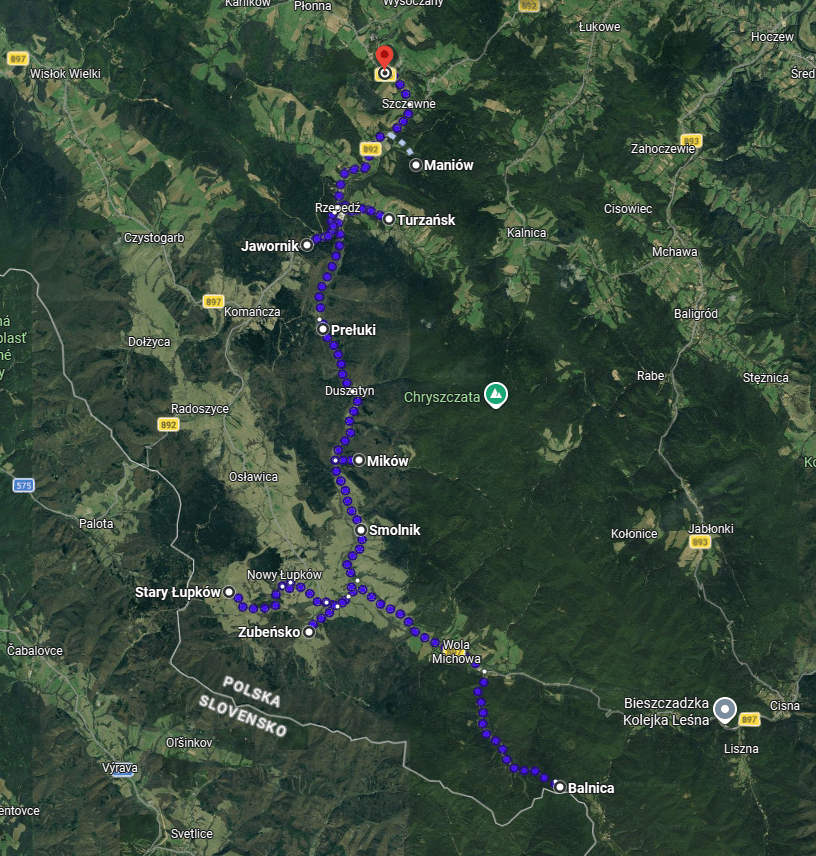
  2. LNNBU, f. 5, op. I, spr. 3974, Archiwum Ossolińskich, 1515 – 1731, k. 181, Najprawdopodobniej w tym czasie, tak jak to było w latach późniejszych, w skład dóbr Pobiedno wchodziła również Ratnawica. ↩︎
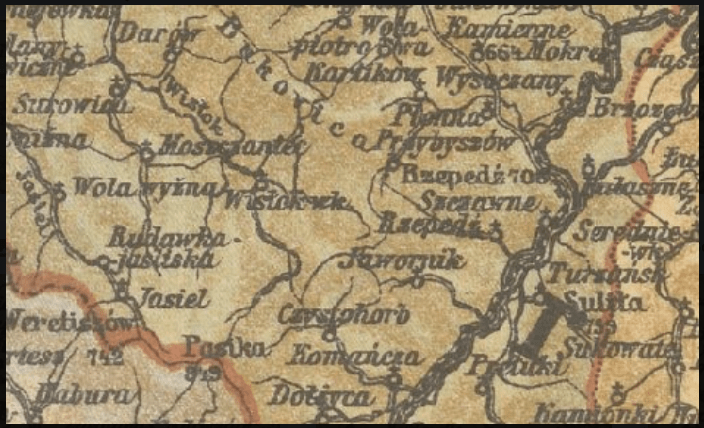
  3. W. Szczygielski, Józef Salezy Ossoliński h. Topór (ok. 1732 – 1789), PSB, t. XXIV, [online] www.ipsb.nina.gov.pl [dostęp: 07.07.2025]. ↩︎
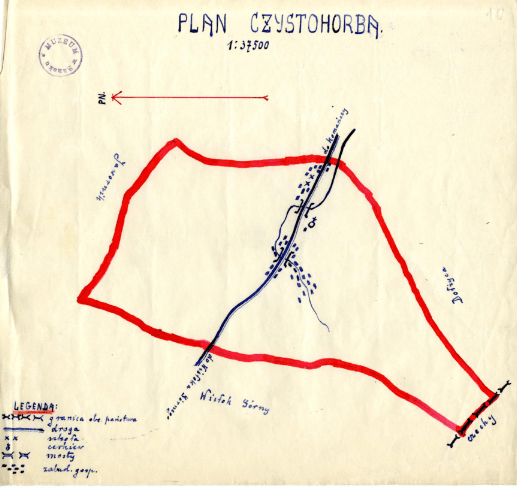
  4.  Występująca zarówno w źródłach historycznych jaki i w literaturze przedmiotu terminologia odwołująca się do nazw jednostek administracyjno-gospodarczych  poszczególnych dóbr ziemskich i zatrudnionych tam urzędników jest bardzo zróżnicowana. Wynika to z faktu, że organizacja zarządu poszczególnych dóbr choć podobna nie była jednakowa a każde większe kompleksy dóbr posiadały swego rodzaju autonomię gospodarczą, prawną i sądową. Z powodu tej mylącej różnorodności postanowiłem zastosować w tekście wyłącznie terminologię, którą stosowano w XVIII wieku w omawianych dobrach podgórskich. ↩︎
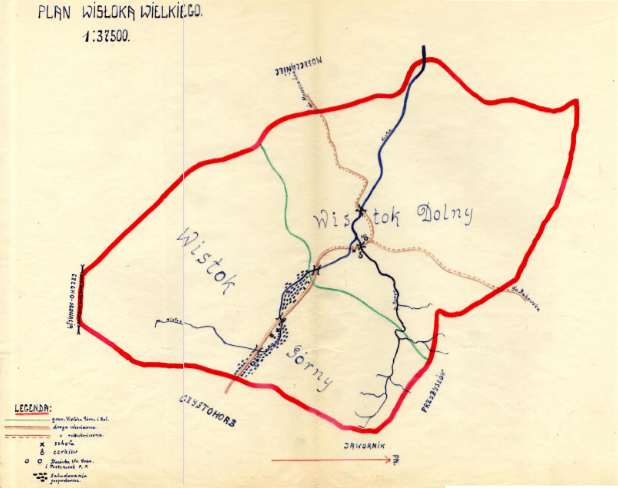
  5. Sąd dworski w Pobiednie był sądem dominialnym właściciela wsi. Był to sąd pierwszej instancji, którego jurysdykcja obejmowała sprawy mniejszej wagi poddanych a właściwość terytorialna obszar klucza pobiedzińskiego. Sąd ten nie posiadał prawa miecza (prawo do sądzenia spraw zagrożonych karą śmierci) więc nie mógł sądzić w tak ciężkich sprawach gardłowych, Por. „W sprawach poddanych mniejszej importancyi zachodzących, mają podstarościowie sumienne na gruncie czynić pomiarkowania, razem z przysiężnymi bez żadnej korupcji, wielkie zaś sprawy do zamku odsyłać, które zwierzchność decydować będzie.”, Archiwum Państwowe w Przemyślu (APP), Archiwum Zamku Leskiego Krasickich (dalej: AZLK), sygn. 415, Inwentarz miasta Liska z przyległymi wsiami, folwarkami etc. na skarb trzymanemi, przy oddaniu funkcji ekonomicznej i prowentu Iego Mości Panu Kopczyńskiemu wyprowadzony, s. 135 – 136; Zarówno sąd zamkowy (dominialny) jak i ławniczy (miejski) w Lesku były sądami drugiej instancji w stosunku do niego. Miały one prawo skazywać na karę śmierci. Trzecią instancją był sąd komisarski (dominialny), Por. “Jeżeliby się zaś kiedy akcja jaka kryminalna trafiła, – – do rezolucji Pańskiej, czyli postanowionego komisarza o nią się nieodwłocznie odezwać, a po tej nastąpionej, lub samemu rozsądzić, lub do sądu miejskiego takową oddać, aby się sprawiedliwości zadosyć stało”, APP AZLK, sygn. 13, Inwentarz dóbr podgórskich Liskich … ad fundum…niący się… nr 4, s. 469. ↩︎
  6. AGAD, Zbiór Czołowskiego (dalej: Czoł.), sygn. 306, Dyspozycja Pańska zaczęta d[ie] 14 July [14 lipca] a[nno] praesenti 1764 w Humennem, s. 42. ↩︎
  7. AGAD Czoł., sygn. 306, Inkwizycya o spaleniu poddanych pobiedzińskich na gruncie wyprowadzona, 15 8bris 1764 [15 X 1764] w Pobiednem, s. 58 – 59; Ibidem, A. Baczyński do Pana Dobrodzieja, 16 8bris 1764 [16 X 1764] z Pobiedna, s. 60. ↩︎
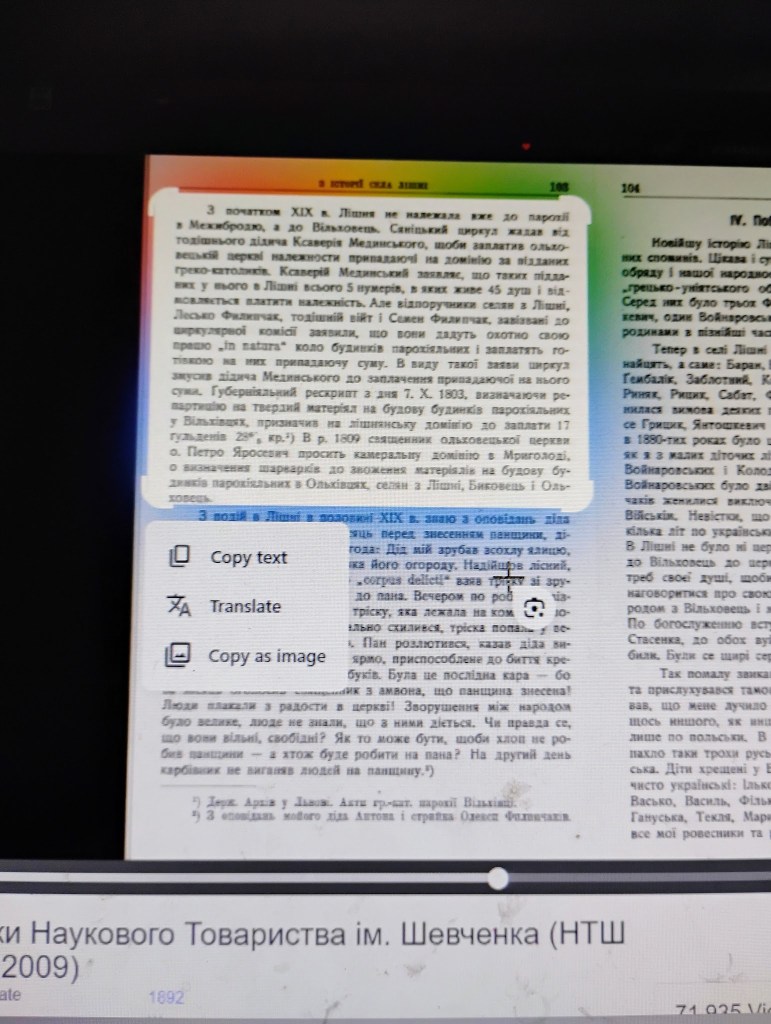
  8. LNNBU, f. 5, op. II, spr. 2790, Inwentarze klucza tokarskiego y płońskiego…XVIII w., k. 32 – 43. ↩︎
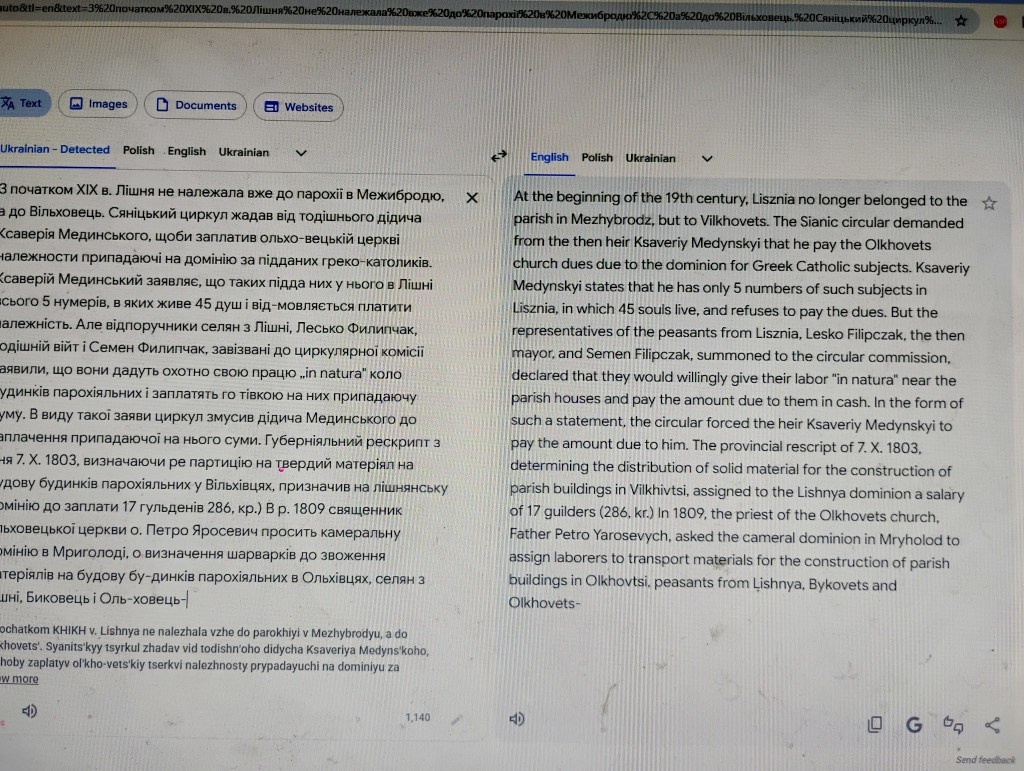
  9. 30 października 1760 roku plenipotent generalny, Antoni Wyczółkowski burgrabia grodzki mielnicki, zapłacił instygatorowi (oskarżycielowi publicznemu) grodzkiemu sanockiemu za przeprowadzenie inkwizycji w tej sprawie i sporządzenie wpisów do ksiąg, 77 zł i 18 gr, LNNBU, f. 141, op. I, spr. 179, Księga gospodarska Leska 1745 – 1765, k. 73v. ↩︎
  10. APP, Archiwum Grekokatolickiego Biskupstwa w Przemyślu (dalej: AGBP), sygn. 67, [Spisy dusz], s. 38 – 39; APP AGBP, sygn. 6705, [Kopie ksiąg metrykalnych parafii Pielnia z filiami Dudyńce, Pobiedno, Jędruszkowice, Markowice, Podgaj (dekanat Buków)], s. 1; Muzeum Narodowe w Krakowie, Biblioteka Książąt Czartoryskich (dalej: BCz.), 12129, Pobidno (11), 1770 – 1774, b.d.; Z. Budzyński, Ludność pogranicza Polsko – Ruskiego w drugiej połowie XVIII wieku, t. 2, Przemyśl – Rzeszów, 1993, s. 282. ↩︎
  11. APP AGBP, sygn. 67, [Spisy dusz], s. 38 – 39; Z. Budzyński, Ludność…, op. cit., s. 282. ↩︎
  12. LNNBU, f. 5, op. II, spr. 2790, Inwentarze…, op. cit., k. 32 – 43; BCz., 12129, Pobidno…, op. cit.; BCz., 12127, Tabela reprodukcji intraty pieniężney z aręnd dóbr podgórskich liskich od śródpościa anno 1754 ad anno 1755 oraz ab anno 1755 ad anno 1756 z wyrażeniem aukcji albo dyminucji jako sequitur; Ibidem,  Remonstracja intraty rocznej z dóbr podgórskich wszystkich – -. W zamku Liskim in mensis Februario anno nunc praesenti 1763tio. ↩︎
  13. W niektórych latach, 1747 – 1750 i 1755, podstarości pobiedzińscy zarządzali również folwarkiem w sąsiedniej Bełchówce.
    ↩︎
  14. Por. przyp. 5. ↩︎
  15. Nie udało się ustalić podstarościch z lat 1731 – 1743 i 1759 – 1761. ↩︎
  16. Miasto Chrzanów położone w ówczesnym woj. krakowskim wraz z przyległymi wsiami należało do Ossolińskich. Jałbrzykowski w czasie swojego urzędowania wszedł w ostry konflikt z mieszczanami chrzanowskimi i okolicznymi gromadami wiejskimi, BCz., 12132, Chrzanów, 1754. Jednak chłopi z Pobiedna i Ratnawicy nie zgłaszali na niego żadnych skarg a w jednym zdaniu można odnieść wrażenie, że wyrażono się o nim pozytywnie; W 1765 i 1768 roku Jałbrzykowski dzierżawił od Ossolińskich również klucz ustrzycki z miasteczkiem Ustrzyki, APP AZLK, sygn. 13, Inwentarz…, op. cit., s. 423; BCz., 12128, Ustrzyki 1768, Jasień 1768. ↩︎
  17. W roku 1762 – 63 jednorazowo obniżono (defalkowano) czynsz o 266 zł, BCz., 12127, Remonstracja…, op. cit. ↩︎
  18. Michał Białobrzeski dzierżawił również klucz płoński (Płonna, Wysoczany, Kożuszne, Osławica) od 1767 do 1773 lub 1776 roku, AGAD Czoł., sygn. 304, Supplement do punktów memoriałowych, circa ultimos mensis Martii 1771mo anno, w Budzimierzu wypisanych, s. 6 – 9; BCz., 12129, Płońsk, b.d.
    ↩︎
  19. BCz., 12127, Remonstracja intraty…, op. cit.; Ibidem,  Remonstracja percepty pieniężnej z dóbr w dzierżawach będących za rok 1776, jednych do śródpościa, drugich do św. Jana anni 1777mi  wyprowadzona i uformowana diebus mensis Octobris anno 1776to; BCz., 12129, Pobidno…, op. cit.; LNNBU, f. 141, op. 1, spr. 184, Księga gospodarcza folwarku pobidzińskiego 1749 – 1758; LNNBU, f. 5, op. II, spr. 2790, Inwentarze…, op. cit., s. 32 – 43; APP AZLK, sygn. 13, Inwentarz…, op. cit., s. 248 – 249 i 423; AGAD Czoł., sygn. 304, Supplement…, op. cit., s. 6 – 9; W 1767 roku z powodu dwukrotnego gradobicia i utraty zbiorów Białobrzeski uzyskał tzw. defalke, czyli obniżenie lub umorzenie czynszu dzierżawnego za kolejny rok,  BCz.,  12128, Pobidno, 1768; Ibidem, Ratnawica, 1768. ↩︎
  20. BCz., 12128, Pobidno, 1768; Ibidem, Ratnawica, 1768. ↩︎
  21. Termin używany w odniesieniu do czwartego tygodnia Wielkiego Postu albo w stosunku do środy lub niedzieli w czwartym tygodniu Wielkiego Postu. Również zwyczajowe określenie czasu trwania kontraktów dzierżawnych, “od śródpościa do śródpościa”. Termin początku lub końca dzierżawy przypadał na około połowę marca. ↩︎
  22. BCz., 12129, Pobidno…, op. cit.; Skarżyły się na niego również gromady z Płonnej i Wysoczan, czyli ze wsi, które także były w dzierżawie u Białobrzeskiego, Por. BCz., 12129, Płońsk b.d.; Ibidem, Wysoczany, 1696, b.d. (2). ↩︎
  23. Został mianowany komisarzem generalnym około 18.II.1763 roku, wcześniej pełnił funkcję marszałka dworu Józefa Kantego Ossolińskiego. AGAD Czoł., sygn. 320, JJ. Garnisz Raczkowski do Wiśniowskiego marszałka dworu, 18 Febr 1763 [18 II 1763] z Telesnicy Sannej, s. 11 – 13,  przesyła gratulacje z okazji awansu na komisarza generalnego. ↩︎
  24. BCz., 12129, Pobidno…, op. cit.; Ibidem, Wysoczany…, op. cit. ↩︎
  25. BCz., 12127, Reprodukcya pieniędzy w kasie u Pana Wilińskiego – -, 25 Junij 1749 [25 VI 1749] w Turzysku wyprowadzona; BCz., 12122, Józef z Tęczyna Ossoliński do W. Imć. Pana Skorupki podczaszego ziemi drohickiej i pisarza grodzkiego sandomierskiego, 31.XII.1760; AGAD Czoł., sygn. 304, Supplement…, op. cit., s. 6 – 9; Ibidem, Józef z Tęczyna Ossoliński do Skorupki, 03.III.1771, s. 10 – 14; AGAD Czoł., sygn. 319, Listy Imć Pana Skorupki y Imć Pana Wiktora, s. 5 – 18; Por. A. Gąsiorowski (red.), Urzędnicy województwa sandomierskiego XVI – XVIII wieku. Spisy, Kórnik 1993, s. 46 i 211, podaje imię Mateusz Skorupka. ↩︎
  26. AGAD Czoł., sygn. 304, Supplement…, op. cit., s. 6 – 9. ↩︎
  27. Nie udało się ustalić dokładnej daty awansu Augusta de Romainville na stanowisko komisarza generalnego. Jednak miało ono miejsce przed 29 sierpnia 1771. Por. LNNBU, f. 5, op. 3, spr. 3942, Archiwum Mniszchów. Papiery różne odnoszące się do wsi Rymanowo. s. 46 –  54, zawiera podpisy Augusta de Romainville komisarza generalnego pod dokumentami z listopada 1771 dotyczącymi rozliczeń za pobyt w Rymanowie pomiędzy 29 sierpnia a 20 listopada 1771. ↩︎
  28. Skargę wniosła zapewne cała gromada jednak w suplice z 21 stycznia 1772 z imienia i nazwiska wymienieni są jedynie przysiężni jako przedstawiciele wiejskich władz samorządowych. To oni z pewnością ponieśli karę cielesną. ↩︎
  29. Stojący na czele administracji terenowej komisarz generalny był tylko jeden (wówczas A. F. de Romainville). Natomiast komisarzami lub panami komisjonalnymi mogli być nazywani również inni urzędnicy wyższego szczebla, którzy powoływani byli do wypełniania określonych czynności w szczególności kontrolnych np. kontroli działania administracji określonego klucza dóbr. ↩︎
  30. BCz., 12129, Pobidno…, op. cit. ↩︎
  31. Bocianie gniazdo Pobiedno, gm. Bukowsko – kamera na żywo, [online]  www.youtube.com/watch?v=6lK_HV7z2wU [dostęp: 28.07.2025]. ↩︎
  32. Wydział do orania to wymierzony obszar gruntu, który należało zaorać w ciągu jednego dnia pańszczyzny. Chłopi skarżą się, że dzierżawca powiększył obszar wydziału dwukrotnie przez co potrzebują na obrobienie go dwóch a nawet trzech dni.  ↩︎
  33. robota ciągła – praca ze sprzężajem, czyli przy pomocy zwierząt pociągowych (woły, konie); robota piesza – praca bez sprzężaju ↩︎
  34. fomentował – podburzał  ↩︎
  35. mordowali – w tym znaczeniu, męczyli ↩︎
  36. półczwartej – trzy i pół ↩︎
  37. Obróbka konopii dostarczanej przez dwór była jedną z prac wykonywanych na rzecz dworu przez rodziny kmiece i zagrodnicze z Ratnawicy. Por. LNNBU, f. 5, op. II, spr. 2790, Inwentarze… op. cit., k. 42v, “Konopi co się tylko urodzi, bez pańszczyzny wymoczyć, wymiędlić i wyprawić powinni zarówno i zagrodnicy z ciągłymi”.  ↩︎
  38. Podstarosta Sikorski był urzędnikiem zarządzającym folwarkiem i kluczem pobiedzińskim w imieniu dzierżawcy, Michała Białobrzeskiego. ↩︎
  39.  Mowa tu o właścicielu dóbr podgórskich, Józefie Kantym Ossolińskim. ↩︎