By Leo Filipczak
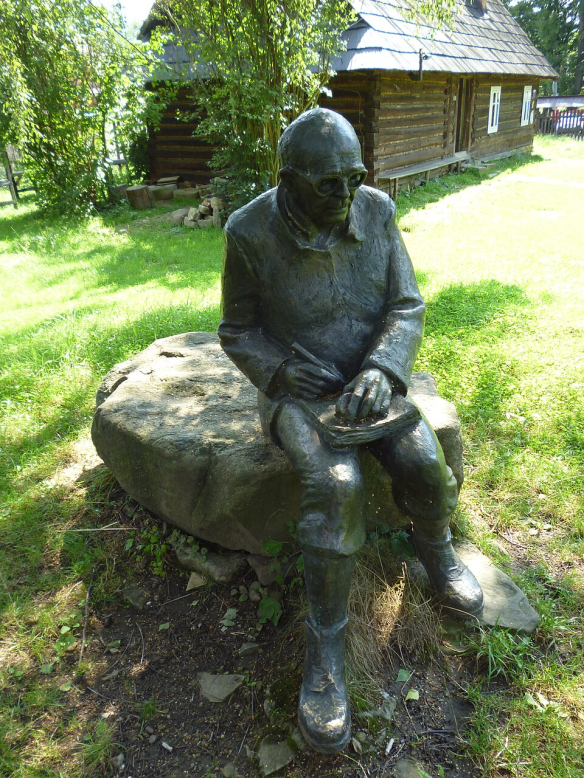
Roman Reinfuss (1910-1998) was an outstanding Polish ethnographer and photographer who devoted much of his time and energy to the Sanok Region. He first gained notoriety in the years just before the Second World War through his studies of ethnic subcultures in the Carpathians. Reinfuss was only in his twenties at the time, and his story is very interesting. As Sanok Genes encourages readers to explore sources in other languages, we suggest checking out the bibliography on his Polish wikipedia page. https://pl.wikipedia.org/wiki/Roman_Reinfuss
Around Sanok, Reinfuss is famous for his studies, and especially his photographs, of the Lemko and Boyko subcultures traditionally found in the Carpathians upriver from Sanok.
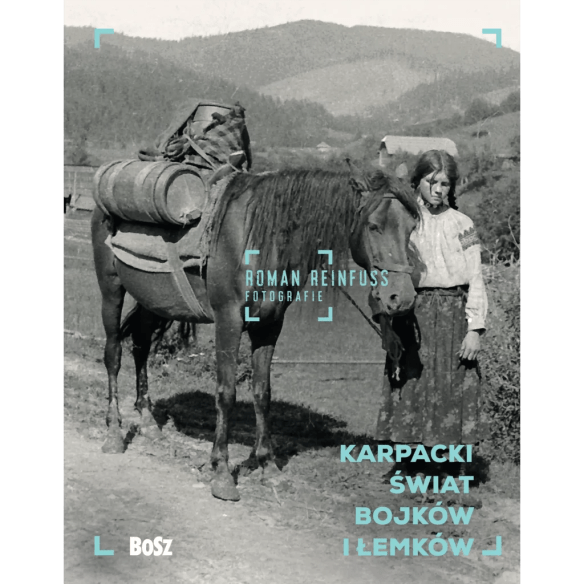
When I was at the Sanok Museum of Folk Architecture (Skansen) in October, I got to see several of these photographs blown up in high resolution. They are striking. If you get the chance to look at them, do it! I understand several are published in the book, The Carpathian World of the Lemkos and Boykos: the Photos of Roman Reinfuss (Bosz; 2015), though I haven’t had a chance to read it.
Several of Reinfuss’ photographs are said to depict a third group, neither Lemkos nor Boykos, but Dolinians (literally: “Valley Dwellers”). As the Dolinians are almost unknown in English-language scholarship, it is worth asking whether they represent an actual group of people, or if Reinfuss created them.
The Dolinians seem to first appear in Reinfuss’ 1936 article DOŁY SANOCKIE: the Rusyn People from the Sanok Area. To see it in the original Polish follow this link:
https://mbc.malopolska.pl/en/details/kuryer-literacko-naukowy-mieczyslaw-dabrowski-8731/
As the original version is now in the public domain, we will reproduce it here in translation. Afterward, I will follow up with some thoughts on the complicated nature of identity in Carpathian genealogy.
~~~~~~~~~~~~~~~~~~~~~~~~~~~~~~~~~~~~~~~~~~~~~~~~~~~~~~~~~~~~~~
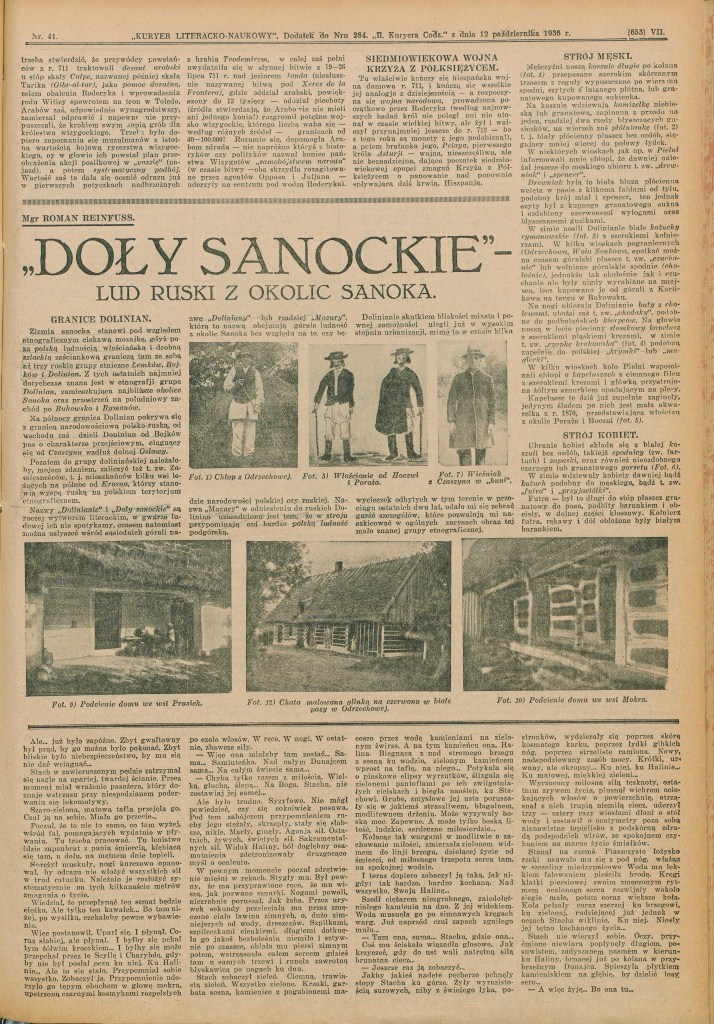
Kuryer Literacko-Naukowy : dodatek do Nru 284 “Ilustr. Kuryera Codziennego” z dnia 12-go października 1936 r. R. 12, Nr. 41.
~~~~~~~~~~~~~~~~~~~~~~~~~~~~~~~~~~~~~~~~~~~~~~~~~~~~~~~~~~~~~~~~~~~~~~
DOŁY SANOCKIE: the Rusyn People from the Sanok Area
Roman Reinfuss
The Sanok region is an interesting mosaic in terms of ethnography, because apart from the Polish peasant population and the small provincial gentry, there are three Ruthenian ethnic groups bordering each other: Lemkos, Boykos and Dolinians. Of the latter, the least known in ethnography so far is the Dolinian group, inhabiting the immediate vicinity of Sanok and the area to the southwest to Bukowsko and Rymanów.
In the north, the border of the Dolinians coincides with the Polish-Rusyn ethnic border, while from the east the Dolinians are divided from the Boykos by a transitional belt stretching from Czaszyn along the lower Osława.
In addition, the Dolinian group should, in my opinion, also include the so-called Zamieszniec, i.e. the inhabitants of several villages located north of Krosno, who constitute a Ruthenian island within Polish ethnographic territory.
The names “Dolinianie” and “Doly sanockie” are rather academic creations, we do not encounter them in folk dialect. However, sometimes you will hear among the neighboring highlanders the name “Doliniany” or less frequently “Mazury“, which is the name used by the highlanders to encompass all the people from the vicinity of Sanok regardless of whether they are of Polish or Ruthenian nationality. The name “Mazury” in reference to the Ruthenian Dolinianie is justified by the fact that in their costume they closely resemble the Polish people of the foothills.
Due to their proximity to the city and a certain level of affluence, the Dolinians have become highly urbanized. Nevertheless, during several trips to the area over the last two years, I have managed to gather a handful of details that allow me to sketch a general picture of this little-known ethnographic group.
MEN’S ATTIRE.
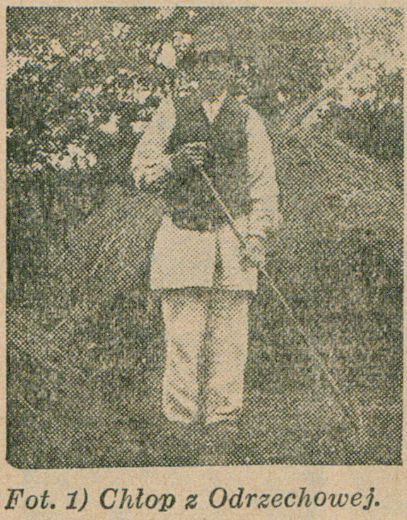
Men wear knee-length shirts (Fig. 1), girded with a wide leather belt and typically worn untucked over their trousers—which are sewn from linen canvas or from purchased navy-blue woolen cloth.
Fig. 1) Peasant from Odrzechowa.
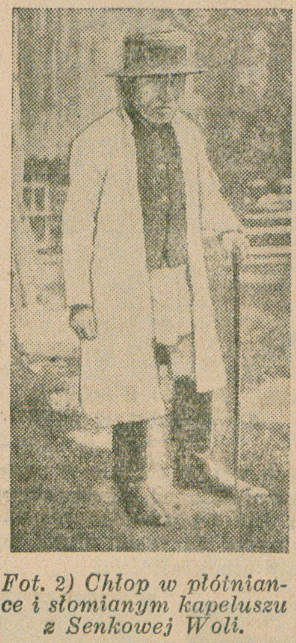
Over the shirt, they don a blue or navy-blue waistcoat, fastened at the front with a single—or less frequently, a double—row of shiny buttons; over this, they wear a “płótnianka” (Fig. 2)—that is, a plain, unadorned white linen coat reaching approximately to mid-calf.
Fig. 2) Peasant from Wola Sękowa wearing płótnianka and straw hat.
In certain villages—such as Pielnia—peasants informed me that, in times past, men’s attire also included the so-called… “Drewniak” and “Spencer”
The “drewniak” was a white linen blouse, fitted at the waist and featuring several pleats at the back; the “spencer” shared a similar cut, though it was fashioned from purchased navy-blue broadcloth and adorned with red facings and shiny buttons.
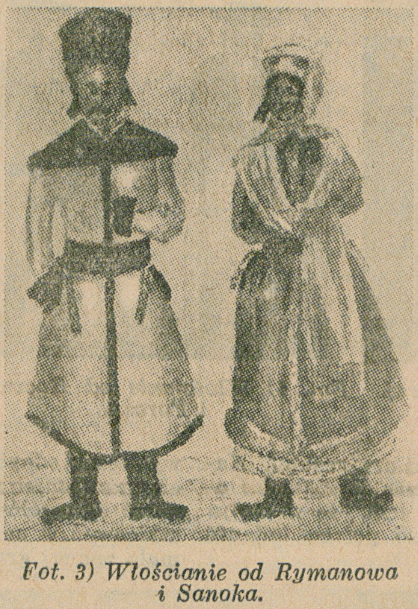
In winter, the Dolinians from Rymanów wore white sheepskin coats (Fig. 3), featuring wide collars. In several border villages (such as Odrzechowa and Wola Senkowa), one might occasionally encounter a Highlander-style coat—known as a “czuchania”—or woolen Highlander trousers (“chołośnie”); however, neither the “chołośnie” nor the “czuchanie” were ever produced locally, but were instead purchased from Highlanders from Karlików at the market in Bukowsko.
Fig. 3) Peasants from Rymanów and Sanok.
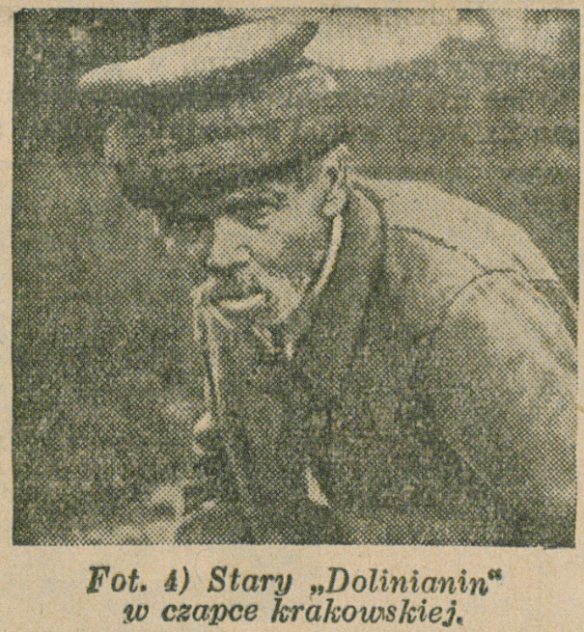
For footwear, the Dolinians wore high-booted shoes, while the poorer inhabitants wore so-called “chodaky”—footwear similar to the “kierpce” (moccasins) of the Podhale region. On their heads, they wore woven straw hats in the summer, featuring wide, flat brims; in winter, they wore the so-called “Kraków cap” (Fig. 4), which was virtually identical to the Polish “krymka” or “magierka.”
Fig. 4) An old “Dolinian” wearing a Krakow cap
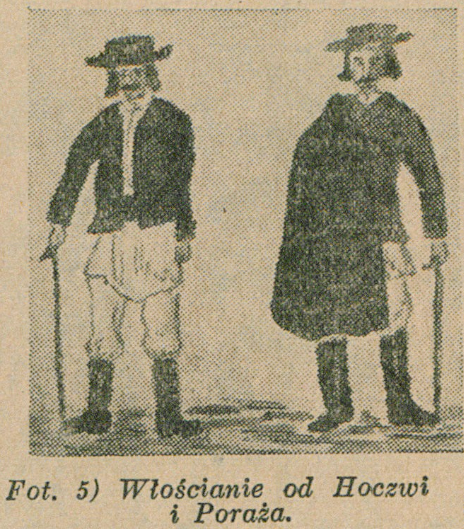
In several villages near Pielnia, peasants spoke of hats made of dark felt, featuring wide brims and a crown adorned with a yellow cord that hung down the wearer’s back
These hats have now vanished completely; the only remaining trace of them is a small watercolor painting from 1870, depicting peasants from the vicinity of Poraż and Hoczew (Fig. 5).
Fig. 5) Peasants from Hoczew and Poraż.
WOMEN’S ATTIRE
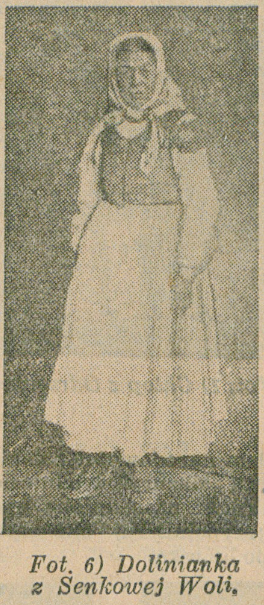
Women’s clothing consists of an unadorned white blouse, a matching skirt (known as a “fartuch”) and apron, as well as a plain black or navy-blue bodice (Fig. 6).
Fig. 6) Dolinian woman from Wola Sękowa.
In winter, women formerly wore either a sheepskin coat—similar to the men’s version—or the so-called “futra” and “przyjaciółka”.
The “futra” was a long, ankle-length coat—navy-blue down to the waist—lined with lambskin and fitted to the body, flaring out in a bell shape in the lower section. The collar, sleeves, and hem of the “futra” were trimmed with white lambskin.
The “przyjaciółka”—sometimes also referred to as a “kaftan” or “kaftanik”—bore a striking resemblance to the “futra” described above, with the sole difference being that it was significantly more modest. (It was not lined with lambskin, but rather padded, and instead of a fluffy fur collar, it featured a narrow, upright collar made of cloth).
The “przyjaciółka” and “futra” have by now vanished completely; however, the image of the “futra” has survived to the present day, having been preserved in one of the watercolors by Count E. Krasiński, which depicts peasants from the Sanok and Rymanów regions (Fig. 3).
Married women formerly wore caps made of green, red, or blue percale, over which they tied a white kerchief.
When heading to the market or to church, a woman from the Dolina region would drape a linen cloth—known as a “rąbek”—over her shoulders; this cloth measured 2 meters in length and 60 centimeters in width.
In its pure form, the Dolinian attire described here does not extend eastward beyond the line of the lower Osława River. As early as Morochów, Poraż, Czaszyn, Tarnawa Dolna, Tarnawa Górna, and Wielopole, foreign—specifically Boyko—elements begin to blend into the Dolinian costume.
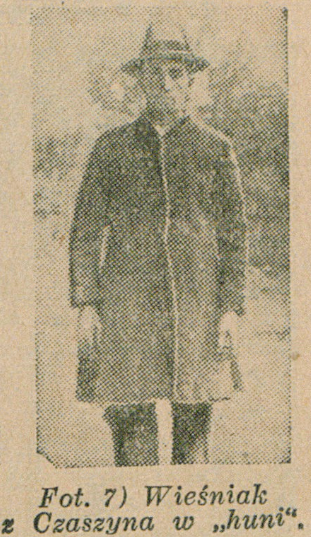
In the men’s attire of these localities, for instance, one finds the so-called “świty” or “hunie” (Fig. 7), which are entirely analogous to the Boyko “siraks”; conversely, in the women’s attire, one encounters semi-woolen skirts known as “burki”—indistinguishable from the “farbanki” worn by the Boyko women (“Bojarychy”) from the vicinity of Baligród.
Photo 7) Villager from Czaszyn in a “hunia”.
THE COTTAGE.
The cottages of the San Valley region are still predominantly built in an old-fashioned manner, featuring corner joints notched in the “na oblap” style (Rys. 1, II), the ends of which protrude 15–20 cm beyond the log frame of the cottage and are cut flush.
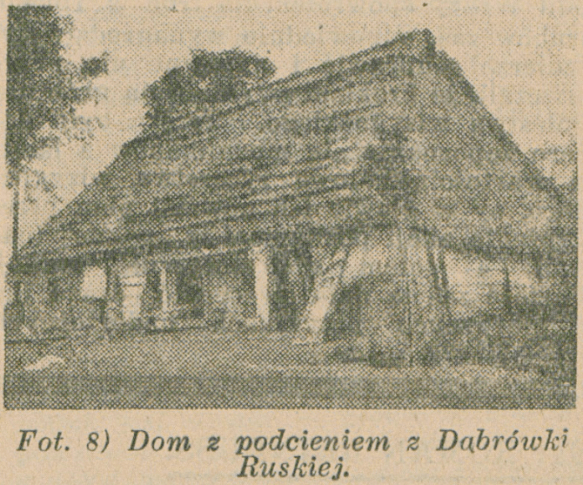
Fig. 8) House with podcienie from Dąbrówka Ruska.
A characteristic feature of cottages from the vicinity of Sanok (Dąbrówka Ruska and Polska, Mokre, and others) is the so-called “podcienie”—that is, a deep, rectangular recess in the front wall (Fig. 1, I; Photos 8, 9, 10), through which one gains access to the vestibule, the stable, and the threshing floor.
Fig 9) Podcienie of a house in the village of Prusiek.
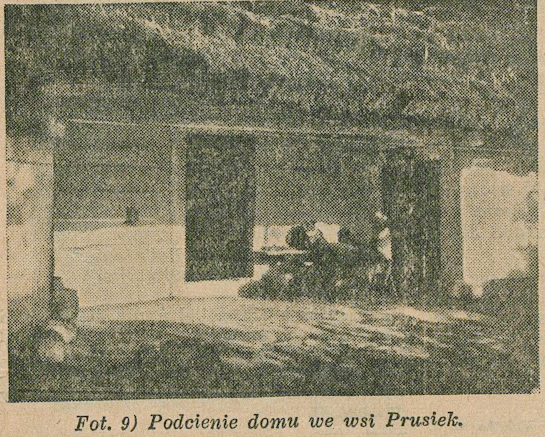
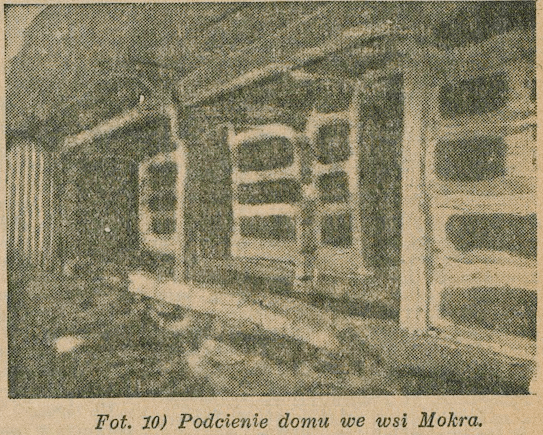
Fig 10) Podcienie of a house in the village of Mokre.
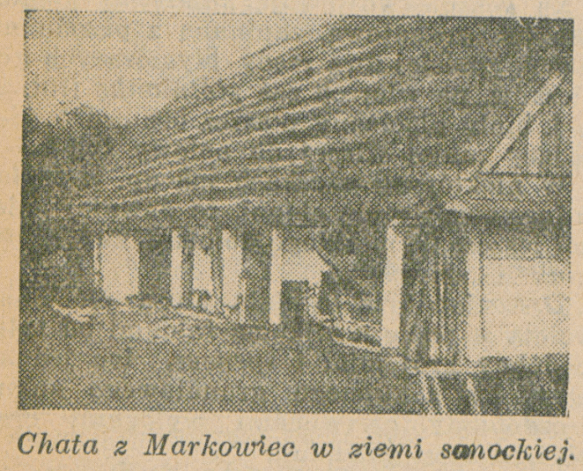
In its subsequent evolution, the “podcienie” transforms from a mere recess into a long porch running along the entire front of the cottage (Photo 11).
Cottage from Markowce in the Sanok region.
The building is surmounted by a high, four-pitched rafter roof covered with straw; thanks to an intriguing construction involving additional small rafters, the roofline forms a wide overhang encircling the entire cottage (Rys. 1, III).
The exterior walls of these homes were formerly painted with grey clay; today, however, they are predominantly whitewashed—though in Odrzechowa and Mokre, cottages painted red using fired clay still predominate (Fig 12).
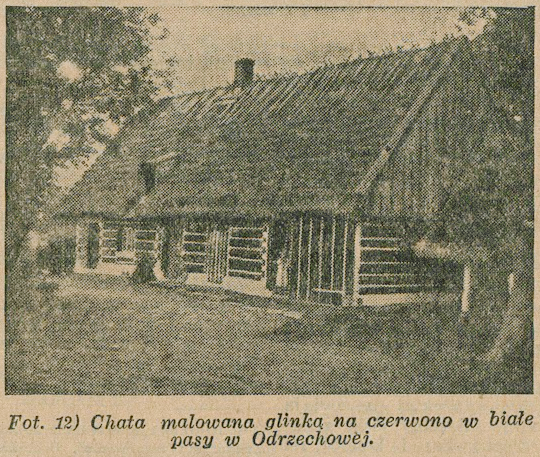
Fig. 12) A cottage in Odrzechowa, painted with red clay and white stripes.
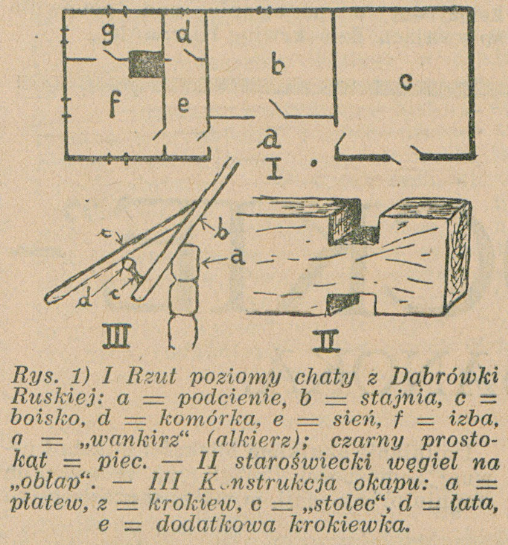
Rys. 1) I. Plan of a cottage from Dąbrówka Ruska: a—porch, b—stable, c—threshing floor, d—store-room, e—entrance hall, f—living room; a—”wankirz” (alcove); black rectangle—stove. II. Traditional corner jointing (“oblap”). III. Eave construction: a—purlin, z—rafter, c—support post, d—roof batten, e—auxiliary rafter.
Nowadays, the living quarters are, as a rule, whitewashed; in earlier times, however—when smoke-stoves (“kurne piece”) were still the norm—the walls were never whitewashed, but rather refreshed by scraping away the soot with a sharp knife.
AGRICULTURE.
Due to the extensive depletion of forests and the lack of vast mountain pastures, neither logging and timber transport nor large-scale cattle rearing can serve as occupations for the Dolinians. Their entire economy is based exclusively on crop cultivation.
On the fertile soil of the Sanok region, the Dolinians grow all varieties of grain, potatoes, and cabbage, as well as small quantities of flax and hemp for clothing.
In the vicinity of Sieniawa, Trepcza, and Besko, the peasants sow onions and garlic on a massive scale; in the autumn, they transport these crops by the wagonload to sell at fairs in towns both near and far.
POLISH INFLUENCES
As can be seen from the above description, the Dolinians are a typical lowland group, culturally completely distinct from the Lemko or Boyko highlanders.
However, this fact does not prevent some experts from including on their maps the entire Dolinian area discussed here from Bukowsko to Nowosielce and Dąbrówka Ruska to the indigenous Lemko region.
Meanwhile, the Dolinians, despite all the labels affixed by ethnographers, show far-reaching Polish influences, extending from the north. For example, the Dolinians’ costume does not differ much from the costume of Polish peasants from the areas of Jasło, Krosno or even Rzeszów.
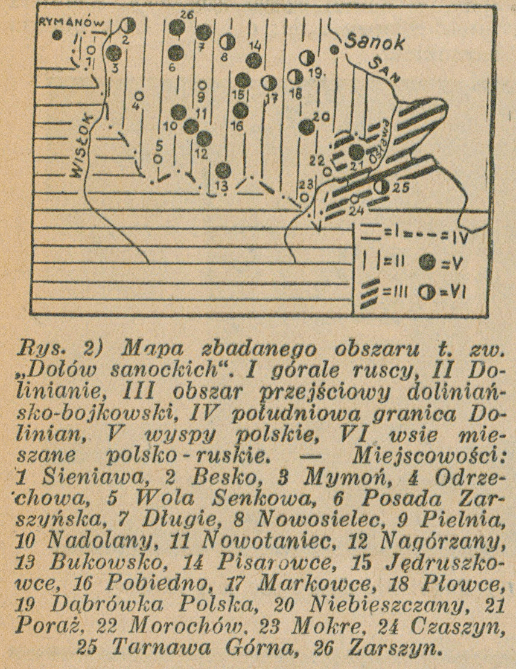
Rys. 2) Map of the surveyed area known as the “Sanok Valleys.” I – Ruthenian Highlanders, II – Dolinians, III – Dolinian-Boyko transitional zone, IV – Southern boundary of the Dolinians, V – Polish enclaves, VI – Mixed Polish-Ruthenian villages. Localities: 1 Sieniawa, 2 Besko, 3 Mymoń, 4 Odrzechowa, 5 Wola Senkowa, 6 Posada Zarszyńska, 7 Długie, 8 Nowosielec, 9 Pielnia, 10 Nadolany, 11 Nowotaniec, 12 Nagórzany, 13 Bukowsko, 14 Pisarowce, 15 Jędruszkowce, 16 Pobiedno, 17 Markowce, 18 Płowce, 19 Dąbrówka Polska, 20 Niebieszczany, 21 Poraż, 22 Morochów, 23 Mokre, 24 Czaszyn, 25 Tarnawa Górna, 26 Zarszyn.
This phenomenon is completely natural, if we take into account that the area inhabited by the Dolinians is densely interspersed with Polish islands (Fig. 2), but in order to explain this matter in detail, a few words should be devoted to the past.
FROM THE HISTORY OF SETTLEMENT IN THE SANOK LAND.
When, in 1340, Casimir the Great annexed the Cherven Towns to Poland, there were already many villages in the vicinity of Sanok (which was then a Rus border town) inhabited by the Ruthenian population. Casimir the Great densified this network of settlements by colonizing the empty parts of the Sanok Land with Germans brought from the west.
In the 15th century population of Iwonicz, Rymanów, Sanok, Jaćmierz, Zarszyn, Lalin etc. there was a fairly significant percentage of the German. Today’s Nowotaniec was then called Lobentanz, and the royal village, Poraż-Kunzendorf. In later times, Polish settlers came to the Sanok Land, they quickly assimilated the remnants of the German population based on their common Catholic Church (creating a difference of denominations and later rites), which survives to this day. For this reason, the map of Roman Catholic and Orthodox churches from the 15th century” (Fig. 3) matches the ethnic map of the area inhabited by the Dolinians.
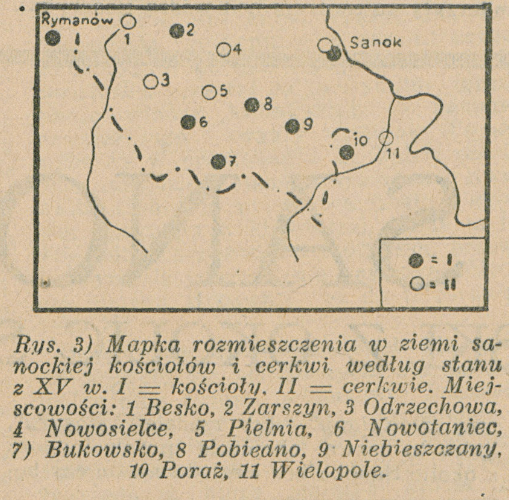
Rys. 3) Map showing the distribution of Roman Catholic churches (kościołów) and Orthodox churches (cerkwi) in the Sanok region as of the 15th century. I = Roman Catholic. II = Orthodox. Localities: 1 Besko, 2 Zarszyn, 3 Odrzechowa, 4 Nowosielce, 5 Pielnia, 6 Nowotaniec, 7 Bukowsko, 8 Pobiedno, 9 Niebieszczany, 10 Poraż, 11 Wielopole.
In addition to these old Polish islands, which are several centuries old, in almost every Ruthenian village there are now small or large Polish colonies. These were established in the second half of the last century as the former serfs were brought by the lords from various parts of Poland. With the fall of the manors, these servants bought land and settled permanently in Ruthenian villages.
These two waves of Polish settlement, one that came 500 years ago and the other 50 years ago, undoubtedly had an impact on the local Ruthenian population.
Over the course of many generations, the Ruthenians adopted many elements from the Poles, a detail that drew the attention of the highlanders (Hirmuks), who, as I mentioned above, sometimes call their northern neighbors Mazurs.
~~~~~~~~~~~~~~~~~~~~~~~~~~~~~~~~~~~~~~~~~~~~~~~~~~~~~~~~~~~~~~~~~~~~~~
ETHNIC POLITICS
Now to our question at hand: “Did Reinfuss invent the Dolinians?” It’s a straw-man because he admits to doing as much right in the fourth paragraph. Maybe a better question is, “Is it possible to classify the Carpathian peoples?” That is more complicated–and political.
In the 1930s, when Reinfuss did his research, Sanok was a battleground for competing national movements. Poland emerged from World War I with national independence. Ukraine did not. What is now Ukraine was split in four parts. The Soviet Union controlled central and eastern Ukraine. Poland held the western part (historic Galicia and Volhynia), while Romania and Czechoslovakia had smaller areas of the southwest.
Polish national leaders had not completely settled the question of whether Galician Ukrainians (Ruthenians) were an integral part of the Polish nation or whether they were something else. To Ukrainian national leaders, like my distant relative Ivan Fylypchak (Iwan Filipczak), they were decidedly something else. They were part of a separate Ukrainian nation that extended from the Carpathians to the Black Sea coast, to Kyiv, Kharkiv and beyond.
The San Valley was an especially complicated region. During Austrian times, the river was seen as the border between West Galicia where most villagers were Roman Catholic Mazurs and East Galicia, where the majority of villagers were Greek Catholic Rusyns. In interwar Małopolska, the Polish leadership (in coordination with the Vatican) certainly claimed the Mazurs on both sides of the river as Poles, and it would grudgingly admit the Rusyns east of the San were Ukrainians, but the Rusyns west of the San were a problem.
Therefore, the Polish Government used the umbrella term “Lemkos” rather than “Ukrainians” to describe the Greek Catholic and Orthodox believers residing west of the river. This would have made an ethnographer like Reinfuss cringe as in a scientific sense “Lemko” was only one of several Carpathian ethnographic divisions of the “Rusyn” ethnic group. Just within the Sanok region itself, there were also Boyko villages and others that evaded easy classification. Then there was the whole issue of the Dolinians near Sanok City who had a mix of influences, including Polish. To keep them from joining the Ukrainian movement, should they be polonized or “Lemko-ized?”
Further complicating matters was the internal battle within the Lemko region. Ivan Fylypchak was involved with the founding of the Ukrainophile Lemkivshchyna Society society in Sanok. With its newspaper Nasz Lemko, it attempted to spread Ukrainian identity west of the San. Here, they competed with the Russophile Lemko Union and its newspaper Lemko. This latter group had the financial support of the Polish Government and the Vatican. It was a case of strange bedfellows as many in the Lemko Union were Orthodox having risen out of pre-WWI “Old Rusyns” and the religious politics in North America, but that’s a whole other blog post. For our purposes here, it’s enough to say that they did not consider themselves part of the Ukrainian nation and preferred political union with Poland or Czechoslovakia to any future independent Ukraine.
I don’t get the sense that Reinfuss was trying to promote any particular national agenda. However, his article should be understood in the interwar context. Had it been written after the Second World War, it would have been much different. We know this because it was reprinted.
POST WORLD WAR II
In 1986, the editors of the yearbook of the Sanok Museum of Folk Architecture (Skansen) reprinted Reinfuss’ article for its 50th anniversary. The ethnographer was still living, and by that point, he had been collaborating with the museum for decades–mainly on less-controversial topics. The introduction to the reprint blames the War for preventing the article from gaining much traction when it was first published. It also hints at why little follow-up research was done on “The Dolinians.”
“The Second World War—and the bloody atrocities committed by UPA bandits—forced a portion of the local population to abandon these territories, relocating to the USSR or to Poland’s Western and Northern Territories. The folk culture of the Sanok region was subsequently devastated, and in the wake of post-war transformations, ultimately erased.”
This passage obliquely references the Volhynian Massacres, Polish-Ukrainian guerilla warfare, the “voluntary” deportations of Ukrainians across the Curzon Line under postwar Soviet occupation, and the Polish Communist Government’s 1947 Operation Vistula (Akcja Wisła) which forcibly resettled most of the remaining Greek Catholic and Orthodox populations to northern and western Poland. The corresponding resettlement of ethnic Poles from Soviet Ukraine, and the general upheaval of the War and its aftermath changed the ethnic character of the region forever. In other words, the Sanok of today does not have the same ethnic demographics as the Sanok our ancestors left 125 years ago.
The thaw of the 1980s and then the fall of communism led to renewed interest in pre-war ethnographic geography. Formerly taboo topics could be discussed again, and the historical politics of nationality remerged. Exiles in Ukraine pressed to recapture the legacy of the “Nadsyanian” Ukrainians.
Recent decades have also seen increased interest in North America in “Carpatho-Rusyns,” an umbrella term for people who are now typically called “Ukrainians” in Poland. My own hometown has an Orthodox church, and some of the families of Carpathian origin have started using the “Carpatho-Rusyn” identifier. Paul Robert Magosci, a leading academic and advocate for this Carpatho-Rusyn nationhood, provided Britannica.com with a map for its Rusyn article. In it, we see fingers of territory erupting west of Sanok from the core Lemko Region. If you look closely, however, it seems the Carpatho-Rusyn nation has made a point of bending around and excluding the Dolinians.
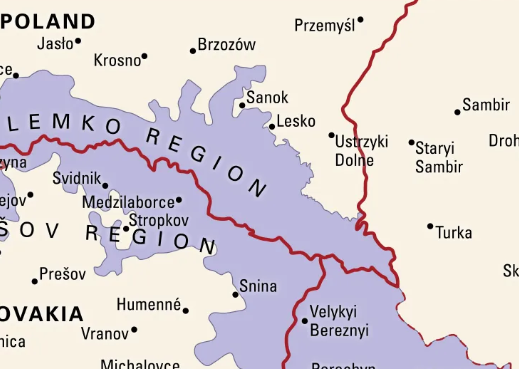
Groups east of the San are also excluded, so it seems the modern Carpatho-Rusyns don’t want the Boykos, Hutsuls, or my Słonne Mountain ancestors to be part of their nation. This wouldn’t seem so odd, if Magosci didn’t include seemingly more distant cultural groups in the Southern Carpathians in his “Rusyn” nation.
So what’s going on here? Back in October, I had the opportunity to meet with an Ethnography Professor from the University of Rzeszów who has done studies throughout the Carpathians. I also met with a Lemko historian in Komańcza. Both men spoke about the excitement surrounding the initial Carpatho-Rusyn international conference, but then both started to notice something at the subsequent conferences. They were becoming increasingly pro-Putin and anti-Ukraine. Some of the funding sources seemed a little mysterious and dubious. This is not to implicate the sincerity or outstanding research done by North American Carpatho-Rusyns. It is just to say that the Kremlin has a way of ruining everything in its quest to undermine Ukrainian identity. There is nothing new under the sun.
Given the brutal full-scale of Ukraine in 2022, how these identity debates will play out in the future is anyone’s guess.
SO DO I GET TO BE A DOLINIAN?
So, if I don’t get to be a Carpatho-Rusyn, do I at least get to be a Dolinian? My great-great grandmother Franciszka Michoń-Filipczak was from Zarszyn, which Reinfuss puts in the Dolinian region. Most of the surnames connected to her family appear in the church records of Greek Catholic churches in nearby villages. She was herself, Roman Catholic (i.e. Polish), but perhaps there is some more distant Dolinian ancestry. Zarszyn is one of the towns Reinfuss points to as bringing Polish influence to the Dolinians. Interestingly, though, he seems to state these “Poles” were actually ethnic Germans brought in by Casimir the Great and later slavicized. Does that mean many of the first Poles in Sanok were actually Germans? Franciszka’s grandmother, Clara Niemiec, having a surname literally meaning German, could indicate some of my ancestors fit that description.
(Judge Waldemar Niemiec wrote this fascinating book about the history of Sanok’s judiciary, and gave me lots of information about my great granduncle Judge Franciszek Filipczak. I was excited to tell Judge Niemiec when I discovered I was related to the Zarsyn Niemcy)
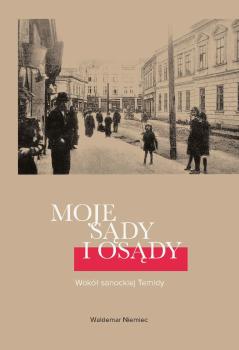
So was Franciszka’s husband, Michał Filipczak, a Dolinian? My great-great grandfather, a wheelwright in Sanok, was born in the village of Liszna in the Słonne Mountains across the river on the right bank of the San. Liszna was a mixed village that over time had “polonized” (gone from having a Greek Catholic majority to a Roman Catholic majority). Michał was baptized Roman Catholic, though his father was of the Greek rite. Their relative, Ivan Fylypchak from Liszna, was from a family that stayed Greek Catholic into the 20th century. He became a proud Ukrainian and self-identified as a Lemko, even though Liszna is excluded from Magosci’s map of the Lemko region. Ivan was likely thinking of “Lemko” more in the broader political sense of the 1920s and ’30s than in the hair-splitting ethnographic sense.
Reinfuss’ map of the Dolinians stops at the San River and the ethnographer defines the Dolinians as being a “lowland group” that lives by planting. This would seem to exclude the heavily forested mountainous Liszna, with its grazers and lumbermen, from being part of the Dolinian region.
There’s still hope, however! If you go to the Skansen, and look at their map of highland subgroups, they do extend the Dolinian region east of the San, and when they acquire buildings from the Słonne, they are put into the Dolinian section of the museum. On that same map, the Lemkos and Boykos are “Rusyn,” and the Dolinians are “Polish-Rusyn.”
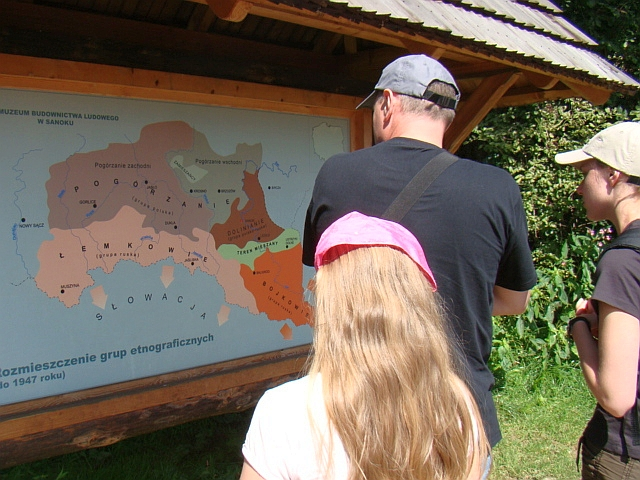
(A larger Dolinian region than Reinfuss’ shown on this map, with a Dolinian-Boyko transition zone around Zagorz and Lesko shown in light green. Wikimedia Commons)
Furthermore, the renowned Liszna-based folk band Lisznianie describes its music as “Dolinian,” and that’s good enough for me. I was lucky enough to meet Edward Filipczak, the 92-year old founder of Lisznianie while in Sanok, then later got to see the band rehearse.
Lisznianie: the best darn folk band in Poland!
Hooray, I’m a Dolinian!
“Not so fast,” says Piotr. Always one to rain on my parade, he informs me that while Dolinian is useful as an ethnographic descriptor (a Dolinian house, a Dolinian-style cap, Dolinian music, etc.), it is not really an ethnic group, and certainly not a national identity like Polish or Ukrainian. No one actually thinks of him or herself as being “a Dolinian.”
So what am I then? Well, Piotr and everyone else in Sanok would just say I’m an American and be satisfied with that. But I’m not satisfied with that! I live in Wisconsin. Multiple times a week, someone is going to ask me what nationality my surname is.
I suppose I’m Polish. After all, my Roman Catholic great grandfather considered himself a Pole when he came to America. However, that answer is not going to please my Ukrainian friends–the fans of Iwan Filipczak. It also misses the beautiful complexity and eventful (if often tragic) history that is the Sanok Lands.
So, how do you do? I’m Leo and I’m an American of Dolinian-Lemko-Nadsyanian-polonized German-Carpatho Rusyn-Mazur-Ukrainian-Polish-Galician-Red Ruthenian origins.
How ‘bout yourself?
~~~~~~~~~~~~~~~~~~~~~~~~~~~~~~~~~~~~~~~~~~~~~~~~~~~~~~~~
If this national identity stuff piques your interest, be sure to check out my debut book Beyond the San: National Identity in the Carpathian Borderlands. If it’s not your thing, don’t worry, not everything on Sanok Genes is about my identity crisis. Start with Piotr’s HOW STORKS WERE SHOT AT IN POBIEDNO. OR THE INTERESTING CASES OF POBIEDNO AND RATNAWICA IN THE YEARS 1731-1790.

