
Piotr Zelny
Historical Museum in Sanok
© 2025 Copyright Piotr Zelny
HOW STORKS WERE SHOT AT IN POBIEDNO. OR THE INTERESTING CASES OF POBIEDNO AND RATNAWICA IN THE YEARS 1731-1790.
(A contribution to research on the history of the Ossoliński family’s foothill estates).
Every great story is composed of many small stories, and these small stories are composed of a series of even smaller ones. Therefore, I decided to use the short episode about storks, which occurred one summer in 1764, as a pretext to weave it into the histories of certain villages, and these into the histories of certain landed estates, to present a fragment of the history of the largest 18th-century magnate lordship located in the Sanok land1 and neighboring lands.
Pobiedno and Ratnawica, for these are the villages that will be the subject of this story, were owned by the Ossoliński family from 1731 to 1790. When, on February 4, 1731, the very young Teresa Stadnicka married Józef Kanty Ossoliński, starosta2 of Sandomierz and Khmelnytskyi, son of a prominent politician, she brought him a vast inheritance as her dowry, which had been created by her grandfather, Jan Franciszek Stadnicki, voivode of Volhynia. He had purchased, among many other properties, the villages of Pobiedno and Ratnawica from the heirs of Andrzej Drohojowski, starosta of Łuków, in 1693.3 On April 17, 1731, Józef Kanty Ossoliński and his wife were intromitted, that is came into possession, of the Pobiedno estate.4 For the next 35 years, the couple jointly managed their estates located in the voivodeships of Red Ruthenia, Kraków, Sandomierz, Lublin, Masovia, Podlasie, Volhynia and Podolia. They also raised four children together. Teresa, although much younger, was the first to die in 1776. For Józef Kanty, this was an irreplaceable loss, and his grief over it is evident in his letters from this period. Józef died just four years later. In 1786, their children divided their inheritance. Pobiedno and Ratnawica along with other villages and towns passed into the hands of Józef Salezy Ossoliński (the third of his siblings), voivode of Podlasie, who died just three years later, followed a year later by his infant son, Józef Tymoteusz.5 Both villages were likely acquired by Teresa née Ossolińska (the fourth of her siblings) and her husband, Józef Potocki, krajczy koronny (crown carver) and starosta of Leżajsk. Thus, in 1790, Pobiedno and Ratnawica became the property of the house of Potocki.
During the Ossoliński era, both villages were part of a large complex of landed estates known as the Highland (Podgórze) Lordship, which collectively encompassed several cities (Lesko, Rymanów, Ustrzyki Dolne, Bukowsko, Dukla and Dynów) and over a hundred villages. The Highland Lordship was divided into three, and later five, smaller districts: Lesko, Rymanów, Przemyśl (also known as Ruthenian district), and, from 1779, Dukla and Dynów. These, in turn, were divided into a series of even smaller units called complexes of estates (Polish klucz dóbr).6
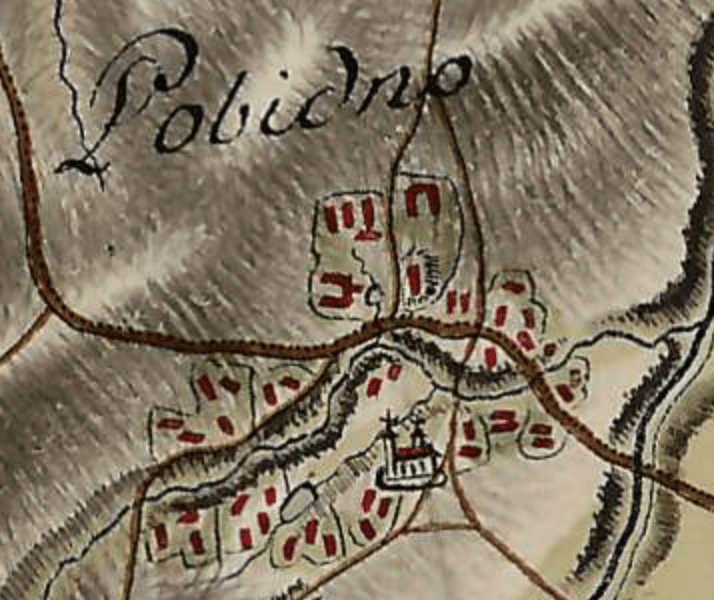
Pobiedno. The first military photograph of Galicia, the so-called Friedrich von Mieg map from 1779-1783, Kriegsarchiv Vienna.
Pobiedno and Ratnawica together formed just such a small section of the Lesko district of the Highland Lordship when, on October 15, 1764, a certain A. Baczyński appeared in Pobiedno. He had been sent here as an instigator by the commissioner general Stanisław Wiśniewski of Wiśniewo, miecznik (sword-bearer) of Gostyń. The commissioner general was a high-ranking official who headed the entire administration of Ossoliński’s Highland Lordship.
Baczyński’s task was to conduct an investigation in Pobiedno into a very serious case of suspected arson. Criminal offenses such as rape, robbery, arson, and home invasion were considered the most serious, and the perpetrator could face capital punishment. To make matters worse, the case caused quite a scandal because the suspect was the underage son of another high-ranking official in the same Lordship, Mr. Jan Kurpiewski. Kurpiewski served as a scribe general, and his immediate superior was the aforementioned Stanisław Wiśniewski of Wiśniewo. Therefore, the case could not be heard by the local court in Pobiedno, nor even by the castle court or the lay judges’ court of the city of Lesko.7 The peasants from Pobiedno submitted a supplication (a complaint or petition) to Ossoliński, who passed their case on to Mr. Jastkiewicz, the treasurer (also known as the cashier), who, together with his oral instructions, submitted it for consideration to the above-mentioned commissioner general:
As for the three subjects of Pobiedno, the deterioration, the damage so significant, a private is sent back to His Grace, Lord Wiśniewski, miecznik (sword-bearer). And in order to reach the most desirable, according to justice, conclusion about this [matter], it is also very important to remember this in accordance with the oral resolutions.8
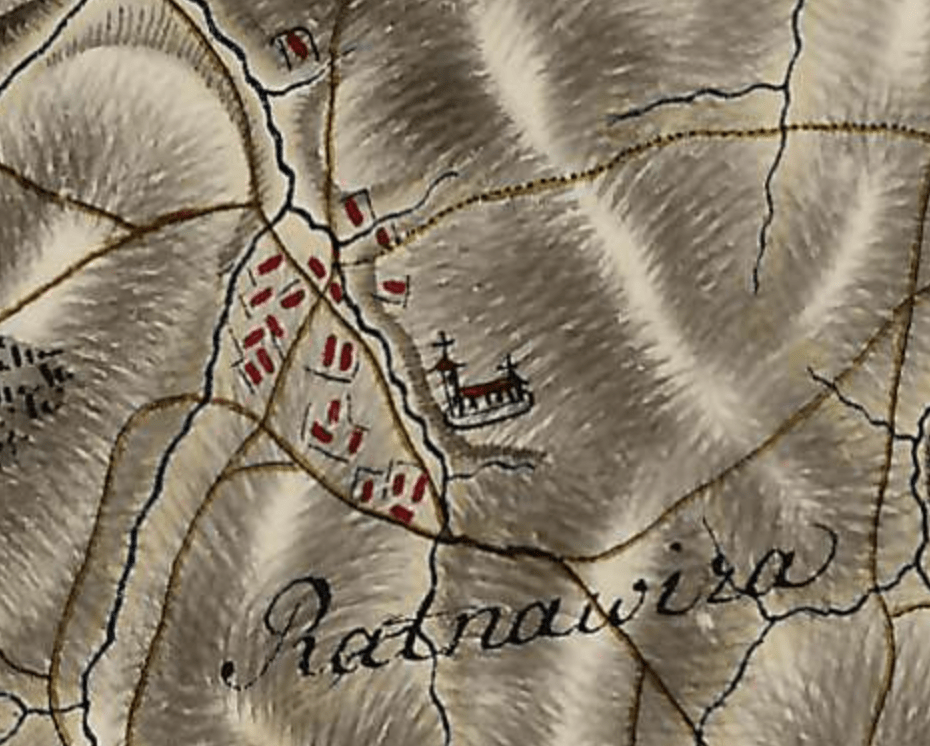
Ratnawica. The first military photograph of Galicia, the so-called Friedrich von Mieg map from 1779-1783, Kriegsarchiv Vienna.
Upon arriving in Pobiedno, Baczyński met with a local peasant, Jan Szelka, who was then serving as a village juror. Baczyński tasked him with convening the entire village community to conduct an investigation, obtain testimony, and resolve the dispute.
Detailed testimony was provided by eyewitness Jan Bednarz, a resident and, for a dozen years before, mayor of Pobiedno, juror Jan Szelka, and other village residents. Based on this, an investigation report was prepared
The incident took place in 1764, most likely in June, when storks nest in Poland, but the May haymaking season had already ended and mid-July had not yet begun. At that time, the aforementioned scribe general, Jan Kurpiewski, arrived in Pobiedno with his nine-year-old son, his clerks, and one soldier. The purpose of their visit to Pobiedno is unknown. In any case, the scribe general was responsible for, among other things, collecting rents, preparing inventories, and supervising landholdings and the other tenancies. He could also conclude or extend tenancy agreements on behalf of the commissioner general. From 1761 to 1767, Pobiedno and neighboring Ratnawica were leased by a certain Jałbrzykowski, podczaszy (cup-bearer) of Łomża. The visit may therefore have been related to some matters related to the tenancy of these villages.
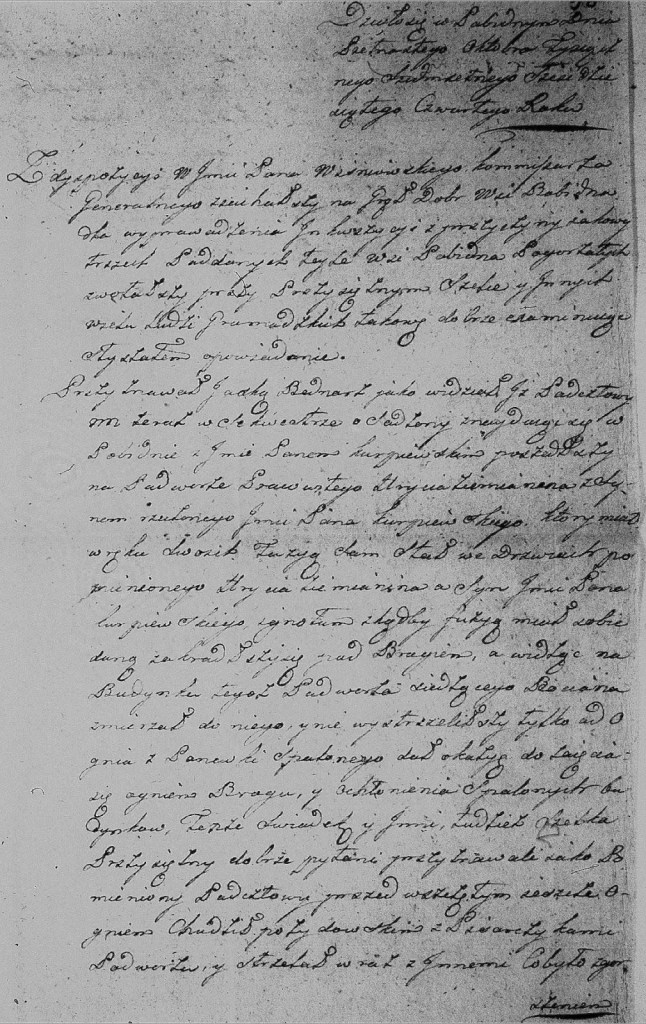
Protocol of the arson case in Pobiedno, October 15, 1764.
While Jan Kurpiewski was minding his own business, his son, a soldier, and some clerks were amusing themselves by running around the village with a rifle and shooting, probably at birds. They were seen, among other places, in the “Jewish courtyard.” At one point, they arrived at Hrycio Zemlanin’s house. The soldier stood in the doorway of his cottage, and Kurpiewski’s son, rifle in hand, crept under a haystack. Seeing a stork perched on the roof, he aimed at it and pulled the trigger. The rifle failed to fire because all the powder burned up. However, a spark from the burning powder landed on the dry hay and started a fire. The fire quickly spread to the houses of Hrycio Zemlanin and his neighbors, Szymek and Sobek. Fortunately, the fire was extinguished in time, and the rest of the village survived.
Total material losses were estimated at 171.9 zloty, although initial estimates were twice as high. By comparison, the annual rent for renting a quarter of a field, equivalent to the area of an average peasant farm at the time, was nearly 21 zloty, and the annual salary (excluding co-called ordinaria, the in-kind remuneration) of the sub-steward (podstarosta), who managed a manor farm and administered a small complex of estates (klucz dóbr – the smallest administrative unit), ranged from approximately 110 to 180 złoty. This was a considerable sum.
The direct perpetrator of the act, the son of the scribe general, was not held accountable due to his minor age; he was nine years old on the day of the incident. Although he certainly didn’t escape his father’s punishment, a beating, likely on the carpet, as befits a noble child. However, a soldier was arrested and deemed the ringleader for “scandalizing” the minor. We don’t know what specific punishment he received. It can be assumed that for setting a bad example and sowing scandal, he received the customary punishment of flogging, paid a fine to the court, and served some time in custody at the Lesko Castle.9
* * *
At about this time, in 1772, Pobiedno was inhabited by 63 peasant families (55 cmethos – full farmers, 5 cottagers, 3 chamber-dwellers) living in 54 cottages. Ratnawica was much smaller, with a total of 24 families (17 cmethos – full farmers, 2 cottagers, 5 chamber-dwellers) and 19 cottages.10
A dozen or so years later, in 1785, Pobiedno’s population reached 420, the majority being Catholic (69.1% Catholics, 28.3% Greek Catholics, and 2.6% Jews). The seat of the Catholic parish was in neighboring Dudyńce. Pobiedno, meanwhile, housed the seat of the Greek Catholic parish (Sanok deanery), with the Orthodox Church of the Exaltation of the Holy Cross, whose patrons were the Ossoliński family. However, from 1758 onward, the village had no parish priest for the next twelve years, and the church stood empty and fell into ruin. The last serving priest was killed. In 1760, an investigation was conducted, the details of which unfortunately remain unknown.11 Only in 1770 did Father Michał Skobielski take over the parish. Immediately upon assuming office, he sought Józef Ossoliński’s assistance in renovating the church (particularly the roof and ceiling), replacing missing elements of the iconostasis (the tsar’s gate), renovating the altars and paintings, purchasing missing church paraphernalia, and improving the parish’s endowment. Meanwhile, another fire, this time more serious, ravaged the village, destroying seven peasant cottages and the rectory barn. The priest and his congregation complained to Ossoliński that the village’s freeholder, Michał Białobrzeski, whom I discuss below, was not allowing them to take wood from the forest to rebuild the damaged buildings. Father Skobielski continued as parish priest at least until 1786.12
Ratnawica had a population of 153 people, and unlike Pobiedno, the overwhelming majority were Greek Catholics (91.5% Greek Catholics, 3.3% Catholics, 5.2% Jews). Ratnawica also had a parish church dedicated to St. Nicholas (Sanok deanery). In 1782, the priest commendator of the parish was Father Jan Starakiewicz, who was the parish priest in Zawadka Morochowska. The Catholic parish was located in nearby Niebieszczany.13
In Pobiedno, there was also a magnificent fir-wood drive-in inn, which also included a brewery with a malt house, a small granary, and a barn. The entire facility, along with the right to produce and sell alcohol (propination), was leased annually (brewery tenancy). The annual rent for the brewery tenancy was 900 zloty in 1754-1756 and 936 zloty and 16 groszy in 1762-1763. In 1772, the tenant of the inn and other buildings was a Jew named Dawid Lewkowicz. He also complained to Ossoliński, but about various troops passing through the village, who regularly took alcohol from the inn without payment. These were the years of the Bar Confederation, the Civil War, and Russian intervention. The innkeeper also reported the poor condition of the buildings, asking for help with renovation. An inspection conducted that same year and a description of the buildings provided did not indicate that they were in poor condition, although certain structural elements did require urgent repair. In any case, Lewkowicz requested a waiver of the tenancy payment due to losses caused by the military.14
In the northern part of Pobiedno stood a wooden manor house with a dining room, an office, three large rooms, two small rooms and a usable attic. Nearby were detached buildings housing the kitchen, the old and new manor stables, and in the adjacent courtyard were the farm buildings. The farm employed four permanent servants (a shepherd, two girls, and a swineherd). Local peasants from Pobiedno and Ratnawica also worked there as part of their labor pension, working in the fields, on the farm, or performing supervisory, transportation, and other duties. The manor house was the seat of a lower-level official in the local administration of Ossoliński’s Lordship. This was the manor farm manager and administrator, known as podstarosta – a sub-steward (also known as a “dispatcher” or “administrator”). The local sub-steward managed a small estate, co-called a complex of Pobiedno, which included the villages of Pobiedno with its manor house and farm, and Ratnawoca.15 He also headed the local court, whose territorial jurisdiction encompassed the area of the complex of Pobiedno.16 The sub-steward’s annual salary (usually paid in quarterly installments) was 150 zloty in the years 1749-1750 and 1753-1756, plus an additional 9 to over 13 zloty in natural products such as butter, cheese, and meat. He was, of course, provided with housing for his family in the manor. The sub-stewards of the complex of Pobiedno were: Żurowski from 1744 to 1748, Michalewski in 1748, Dębowicz from 1749 to September 12, 1755, and Szczygielski from September 28, 1755 to 1758.17 All of them reported to the governor general, based at Lesko Castle, who managed the Lesko district of the Highland Lordship. The legal status of Pobiedno and Ratnawica changed in 1761. The Pobiedno and Ratnawica estates, i.e., the sub-steward, were abolished, and the complex of Pobiedno was handed over to freeholders. These were short-term tenancies, lasting one, two or three years. The freeholder assumed complete management of the estate, while the Ossolińskis’ officials were left with only supervisory functions. The first freeholder, from 1761 to 1767, was Mr. Jałbrzykowski, podczaszy (cup-bearer) of Łomża, who had previously served as “commissioner” for the Chrzanów complex of estates in 1752 and 1754.18 He may have received the complex of Pobiedno tenancy as a reward for his faithful service. This was a fairly common practice. The annual tenancy rent specified in the contract for the years 1761-1764 brought the Ossoliński family an income of 4,516 zlotys.19 In the next contract, from 1764 to 1767, the rent was 4,430 zlotys, 21 groszy, and 1 1/2 shillings. In 1767, the tenancy was taken over by Michał Białobrzeski, the Wiślanski’s podstoliński, who held it until 1776.20 A total of four two-year contracts and one one-year contract were concluded with Białobrzeski, for the years 1767-1769, 1769-1771, 1771-1773, 1773-1774, and 1774-1776. In 1772, the annual tenancy rent was 4,445 zlotys and 11 groszy. In the years 1776-1778, for the same amount, the complex of Pobiedno was leased for two years to captain W. Hoffman.21
The year 1767 heralded misfortune for Pobiedno and Ratnawica. It began with two massive hailstorms that struck much of the Sanok region that year, including Pobiedno and Ratnawica, devastating crops. A total of 42 farmers and a propination leaseholder (innkeeper) from Pobiedno, as well as 20 farmers from Ratnawica, applied for assistance from the commissioner general. All received subsidies (so-called “zakład”) in the form of seed for sowing from treasury granaries from the districts of Lesko and Rymanów of the Highland Lordship, as well as some from the manor granaries of the current freeholder of the complex of Pobiedno, Michał Białobrzeski. Due to the disaster, grain was scarce both in treasury granaries and on the open market, so the administration rescued itself by purchasing grain for the peasants from the freeholder.22 The freeholder himself also received compensation in the form of a reduction or cancellation of rent for the following year because such natural disasters were covered by the guarantee in the tenancy contract.
However, an even worse misfortune than the hailstorm proved to be the new freeholder himself, who also23 signed a tenancy agreement for the complex of Pobiedno at the Midpost meeting that same year. This was the aforementioned Michał Białobrzeski, the village’s sub-stoolmaster. He leased Pobiedno and Ratnawica, much to the local population’s chagrin, for the next nine long years. During this time, the priest, innkeeper, and peasants from both villages submitted as many as five collective petitions (one missing) and at least seven individual petitions (requests, complaints) to the owner himself, Józef Kanty Ossoliński, and to commissioner generals of his Lordship.24 In these petitions, they asked for help, intervention, and release from the freeholder’s authority and transfer the village to the direct management of the district of Lesko of the Highland Lordship administration. Due to the events surrounding the Bar Confederation (1768-1772) and his involvement in its activities, Józef Ossoliński lived in exile from 1769 in the village of Budzimierz (now Budimir in Slovakia) and then in the city of Sebes (present-day Romania). Therefore, he was unable to personally monitor the situation and take decisive action.
The official responsible for taking such actions on his behalf was the commissioner general (also the general plenipotentiary). His responsibilities included general management of the estate, supervision of local administration, legal and property matters, and supervision of leases and the conclusion of lease contracts. Consequently, he also had jurisdiction over matters concerning violations of the lease contract, including misdemeanors, abuses, and crimes committed by freeholders against their peasants.
Until the autumn of 1770, Stanisław Wiśniewski of Wiśniewo, miecznik (sword-bearer) of Gostyń, served as commissioner general,25 but he died that year. His duties were assumed by Piotr Szawłowski, a county (grodzki) court judge in Sandomierz, who had a reputation among the peasants for corruption and bribery. A rumor circulated about him, repeated by peasants from Pobiedno, Ratnawica, and Wysoczany, that in exchange for his silence, he had accepted a pair of very expensive horses from Białobrzeski, worth 1,440 złoty (80 red zlotys):
We appealed to the late Honorable Lord Judge. [However] we received no results, because he, having received a pair of horses from the possessor (a freeholder) as a gift, for which 80 red zlotys were paid, did not claim our wrong. And Honorable Lord Regent Żłuchowski, was given a horse, all to our detriment.
Our late Honorable freeholder of [the complex of] Płonna, gave the judge a rein of horses so that he would have respect from him.26
It’s impossible to say what the truth was. In any case, Szawłowski didn’t manage to do anything about the peasants wronged by Białobrzeski, as he ruled for only a few months. In the winter of 1770/71, he slipped on a steep staircase in Lesko and broke his neck. His duties were taken over by Maciej Kazimierz Skorupka, cupbearer of the Ślepowron coat of arms, and podczaszy (cup-bearer) of Drohiczyn. Skorupka was a long-time employee of Ossoliński’s administration. His name first appears in 1749, and already at that time, he held a prominent position, likely as a plenipotentiary, performing legal and other duties on Ossoliński’s behalf. At the same time, he developed his professional career in the Sandomierz castle, where he served as regent in 1749, scribe in 1760, and then deputy starosta in 1771. It seems that Skorupka did not become the new commissioner general, but merely assumed the duties of the commissioner general as a temporary plenipotentiary until a new one was appointed. Nevertheless, together with Mr. Kopczyński, the governor general of the district of Lesko of the Highland Lordship, he strongly advocated for the peasants, thus gaining a good reputation among them.27
At the very beginning of his term as acting commissioner general, for the upcoming “mid-Lenten” (March) contracts of 1771, Ossoliński gave him three complexes of estates to contract: Sieniawa, Bukowsko, and Pobiedno (with Ratnawica). He was to choose one complex for himself as his office stipend and lease the remaining two, one to Father Dobrzański, a canon of Kraków, and the other to Michał Białobrzeski:
To Mr. Białobrzeski, the understeward, if he is punctual in his duties to the treasury and is not as oppressive as he has been told, then one of these two estates.28
As you can see, Białobrzeski’s case and his attitude toward the peasants were well known to everyone, including Ossoliński. However, as a paymaster, he faithfully fulfilled his obligations, which was not uncommon among freeholders during the turbulent times of the Bar Confederation, and this advantage prevailed. Left with little choice, Skorupka ceded Pobiedno and Ratnawica to Białobrzeski for the third time, much to the local population’s dismay. In March 1771, Skorupka signed a new lease with him for another two years.
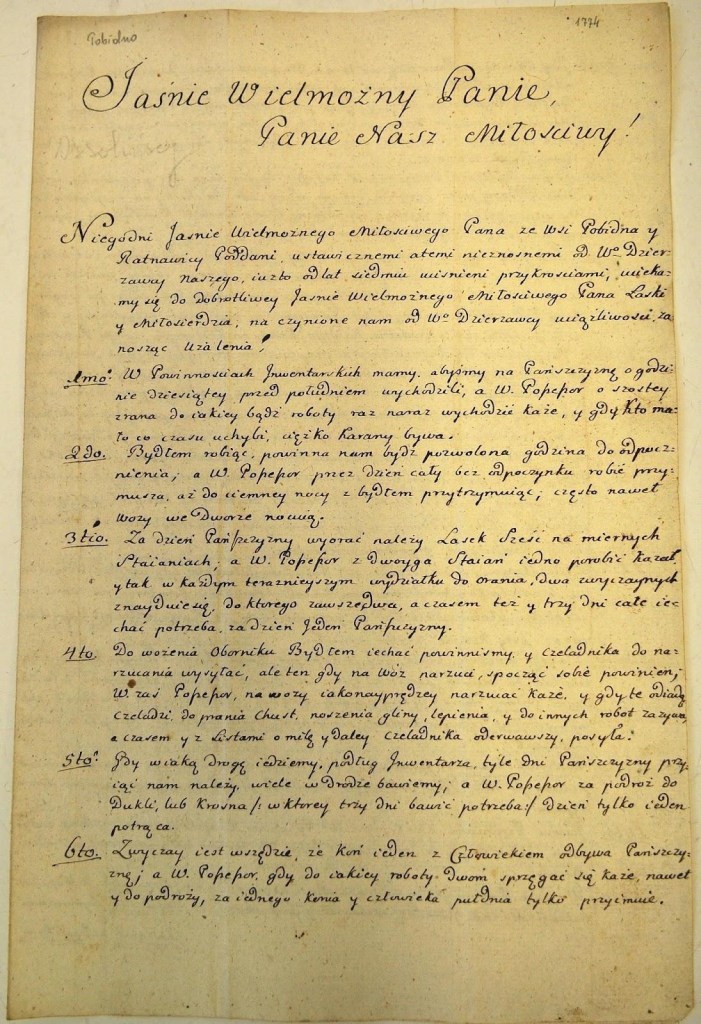
The first page of the collective complaint (suplication) of the village communities of Pobiedno and Ratnawica against the village tenant, Michał Białobrzeski, 1774.
A little later, around mid-1771, a new commissioner general was appointed. He was August Fryderyk de Romainville, a lieutenant in the Saxon army in 1771 and later a captain in the army of the Grand Duchy of Lithuania.29 Nevertheless, Maciej Skorupka continued to deal with the misdeeds of the freeholder Michał Białobrzeski.
The first known, though lost, collective complaint against Białobrzeski was filed by residents of Pobiedno and Ratnawica in late 1770 (some evidence suggests there were earlier complaints). As we know, the then commissioner general, Piotr Szawłowski, did not intervene against him in defense of the peasants. The situation changed only when Maciej Skorupka took up the matter. When another collective complaint was received by Ossoliński on January 21, 1772, he forwarded it, along with verbal instructions, to Mr. Skorupka, who finally took decisive action and simply revoked Białobrzeski’s lease. Pobiedno and Ratnawica became the property of the treasury, meaning they were directly administered by the administration of the Lesko district of the Highland Lordship. Direct management was assumed by the sub-steward of the neighboring complex of Niebieszczany. However, after just a week, the lease was returned to Białobrzeski. This likely occurred due to the consequences of breaking such a lease agreement, which would have provided grounds for initiating legal proceedings against Ossoliński in the Sanok county (grodzki) court. Perhaps from the outset, the action was intended merely to deliver a clear warning to Białobrzeski. Instead, it was calculated that it would be safer to wait a few more months until mid-January of the following year, i.e., March 1773, when the lease agreement was due to expire anyway. If so, Białobrzeski was unimpressed, and the result was that the peasants suffered the consequences, as the freeholder ordered 30 lashes administered to all those who filed a complaint.30 The situation was exacerbated by the local activities of the Bar Confederation, which the freeholder ruthlessly exploited to pacify both villages and exact revenge on the rebellious peasants. Jan Szelka narrowly escaped with his life when the confederates tried to hang him from a willow tree. Four farmers fled the village, likely with their entire families. Those who signed the petitions with the sign of the holy cross next to their names suffered particularly at the hands of Białobrzeski’s men and the Confederates. These were representatives of local communities, jurors, decimal officials (dziesiętnik), and wealthier farmers long established in the village and leading their communities—the local rural elites. The jurors, Jan Szelka, Maciej Stary, Sebastian Stary, Jędrzej Stary, Sebastian Brejta, Jan Adamski, Jan vel Iwan Pisaniak, and decimal official Jan Pawłowski—their signatures appear on the petitions. There was also one “black sheep” in Pobiedno. His name has not been established; sources refer to him as a “flatterer.” The “flatterer” advised and reported everything and everyone to Białobrzeski and undermined the activities of his community. He also reportedly sent denunciations (according to them, false) about his countrymen to the administration. Another clash soon followed. When the aforementioned lease was expiring in 1773, a “commissioner” arrived at the complex of Pobiedno on Ossoliński’s behalf, acting as a senior official, to conduct an inspection. Unfortunately, the name of this “commissioner” could not be identified.31 Complaints from peasants, and likely the poor condition of the inspected estates, led to a verbal altercation between Ossoliński’s commissioner and Białobrzeski. The two men apparently hated each other. The commissioner told Białobrzeski to look for another lease, as he certainly wouldn’t renew his current one. Białobrzeski, angrily, replied that he wouldn’t take it even if he were given it for free. However, when the time came for signing leases, around mid-March, Białobrzeski changed his mind and was ultimately able, surprisingly, to secure a contract for another year, and after that, for two more years of lease. In the process, Białobrzeski’s men beat up the local farm workers. It’s important to remember that the first partition of Poland took place at the same time as the events described. The partition caused not only social and political shock but also panic in the markets, especially in areas cut off from the rest of the country by the border cordon. Creditors began demanding accelerated repayments, and new investments were fraught with risk due to the unstable situation. It may therefore have turned out that in 1773, there was simply no one willing to lease Pobiedno and Ratnawica. When the local peasants learned that Białobrzeski was returning, they fell into despair. In a subsequent petition to Ossoliński from 1774, they listed 23 instances of abuse, fraud, misappropriation of property, destruction, beatings, imprisonment, intimidation, and even incitement to murder. Only in 1776 was Białobrzeski finally dispossessed, when the new freeholder was appointed, a captain W. Hoffman.32
* * *
And what happened to the storks? Oh, if only storks could not only bring babies but also talk. The storks of Pobiedno have survived the exploits of all the unruly teenagers and brutal freeholders, all the hailstorms, fires, uprisings, and wars. And today they are internet stars. You can watch the Pobiedno storks live at any time of day or night thanks to a camera placed above their nest. The video is available on YouTube.33

Stork nest in Pobiedno, July 28, 2025. Youtube channel.
APPENDIX
A humble supplication to the Most High Lord from the Pobiedzińska and Ratnawiecka congregation, 1774 to A[ nno ]
Original. National Museum in Krakow, Princes Czartoryski Library, 12129, Pobidno (11), 1770-1774, undated [supplication no. 7].
Your Honor
Our Merciful Lord!
Unworthy of the Most High, Gracious Lord of the villages of Pobiedna and Ratnawica, subjects of constant and unbearable troubles from our Most High, for seven years now, we have been oppressed by troubles from our Most High, Gracious Lord of Grace and Mercy, complaining about the hardships inflicted on us by our Most High, Leaseholder.
1st. In our livestock duties, we are to leave for serfdom at ten o’clock in the morning, and the Lord Possessor orders us to leave at six o’clock in the morning for some work, and whoever misses the deadline is severely punished.
2nd. When working with cattle, we should be allowed an hour to rest. The Possessor forces us to work all day long without rest, until dark night, keeping the cattle, often even spending the night in the manor.
3. For a day of serfdom, six fields must be plowed, each covering a meager number of stables. The Lord Possessor ordered one of two stables to be plowed. And so, in each current section for ploughing, two regular stables are found. It always takes two, and sometimes even three, whole days to reach it, for one day of serfdom.34
4. We should go to transport manure with cattle and send a journeyman to throw it, but once he has thrown it onto the cart, he should rest. The Lord Possessor orders the cart to be thrown as quickly as possible, and when they leave, he hires the servants to wash cloths, carry clay, model, and do other work, and sometimes, having detached the journeyman a mile away with letters, he sends them away.
5th. Whenever we travel on a given route, according to the inventory, we must accept so many days of serfdom, as we spend many days on the road. The Possessor deducts only one day for the journey to Dukla or Krosno (which requires three days of stay).
6th. It is a common practice everywhere that one horse and one man serve as serfs. And when the Lord Possessor orders two to be hitched to any work, even for travel, he will only accept half a day’s work for one horse and one man.
7th. When they’re dragging out the corvée, three overseers stand, two at the ends and the third in the middle, and just like through the bush [?], they constantly let the cattle and their drivers loose, beating and driving them all day long. And when the cattle return home from such work, they can’t come to their senses for two or three days. Ratnawica, on the other hand, often has to spend the night there, or in Zboiska, so much so that they can’t even get home.
8th. Whenever we do anything with cattle, the Lord Possessor orders us to insist without ceasing that no subject can have good harness, because even if he has helped himself to the best one, if he works out the serfdom in the spring, the cattle will probably be crippled in the autumn.
9th. Whether it’s continuous work or walking , when rain gets in the way towards evening and doesn’t allow for a full day, such work is always deemed worthless by the Lord Possessor. And even if it happens two or three days in a row, he never deducts a single day’s serfdom for it. And that’s why so much serfdom is paid to the serfs every year.35
10th. During continuous work, especially when transporting manure, it was customary to let the cattle graze. Under the Lordship of the Possessor, however, this never happened. One time, when manure was being transported to Błonia and the cattle had not eaten all day, the servants at the carts, already at dusk, would let the cattle loose among the manure piles. For this, the Lordship of the Possessor ordered each of them to receive ten lashes the next day, even after wearing summer clothes. As for Sobek Dudasz’s son, after complaining about his and others’ unjust punishment after receiving ten lashes, six more were added. For such an unnecessary punishment, no serf would ever support a journeyman’s servant; one could not even force one’s own child into serfdom.
11th. In the stable where the Herd of the Honorable Possessor would stand, whenever the mud became too deep, he would always order the mud to be dragged out through these troughs. Many cattle would bolt, and Jan Adamski’s mare would throw up her foal right at the trough.
12th. For this mud hauling, when the Lord Possessor ordered someone to go out with one horse, two servants with shovels should always go, and this was for one day of serfdom, and when one man left someone, even if he left not only with one horse, but also with a pair of cattle, he was only charged for half a day.
13th. A shepherd’s land was formerly granted to the community for grazing cattle, from which 28 złoty was paid annually. The Honourable Possessor turned it into a garden, and the rest he grazes with his horses.
14th. Ivan Pisaniak’s mare was used by the Honorable Possessor for heavy work and travel, and when she was sent to Jaćmierz with fodder for the oxen, she died on the way.
15th. During the revolution, after the arrival of the confederate commands, the Honourable Possessor constantly incited36 the crowd and stated that the confederates, when refusing to go with supplications, always beat and murdered37 people, and at the instigation of the Honourable Possessor they wanted to hang the old sworn Szelka on a willow.
16th. Ivan Bilas from Ratnawica went to serfdom for five days in one week, yet he wasn’t credited a single day, and this is how he did it. On Monday, he sent him to mow, and when he left the distant village around seven o’clock, the Honorable Possessor dismissed him , saying it wouldn’t be long. On Tuesday , he sent him to mow again, and after he had completed a few swaths, along with the others , he was dismissed because it was raining a bit. On Wednesday, he sent a mare to carry mud in a trough and two servants, who, after pulling mud out of the trough twice, got stuck and fell. The two servants asked the Honorable Possessor to find them some work on foot, but he ordered them and the mare to be sent home. On Thursday, they were ordered to leave in a ladder wagon, hitched to another servant to carry hay. And two servants from each left, bringing two loads of hay to the hayshed [ and ] then the Honorable Possessor didn’t order them to transport it so it would dry better, so they had to go home. However, they loaded the cart with three and a half38 heaps of hemp to distribute to the Ratnawice community.39 They arrived with this hemp at night, carrying it on their backs, tied to their backs. On Friday , finally, he sent them to thresh, but since the Honorable Possessor only ordered some to thresh, they had to return. And so, for five days, leaving and going to serfdom, he didn’t earn a single day.
17th. When the same Biłas’s farmhand went out to thresh grain for the serfdom, Sikorski, the deputy starosta,40 for no reason at all, hit him behind the ears with his fist so hard that blood immediately gushed from his mouth, nose and ears and flowed in a stream all the way to the doorstep. His whole body and clothes were covered with blood.
19th. Sobek Brejta, went first with supplications to the Honorable Szawłowski, then to the Honorable Skorupka, and finally to His Lordship. For the first received 30, for the second 40, and for the third nearly a hundred lashes from the Honorable Possessor.41
20th. Bartek Stary, severely punished by the Honourable Possessor, went beyond the Bieszczady Mountains and has not returned since.
21st. Ivan Tynik, who was given 30 lashes by the Honourable Possessor, went beyond the Bieszczady Mountains and died there.
22nd. Wawrzek Bednarz, persecuted by the Honourable Possessor, was put in shackles and chains several times, went to Brzozów and settled there.
23rd. Jan Kamiński, who had been determined to keep his farm, only now, when he learned that [the Honorable Possessor] would be staying on the estate, did he take up his duties with his wife, children and cattle and leave out of fear of the Honorable Possessor.
Therefore, having been burdened with these and countless other troubles from the Lord Possessor for seven years, we often resorted to the Lord Commissioners twice, and twice we were a nuisance to our Lord and Majesty Himself. Last year, when we were restored to obedience to the Lord Possessor, we heard that he was allowed to lease only one year, although we had experienced similar hardships in previous years, we did not bring any complaints or grievances to our superiors, only soothing all the hardships with the longed-for end of the year hope. But now, with the return of the Most Reverend Tenant from Hungary, when, although obedience has not yet been restored to him, we are already certain of great oppression, because not only he himself but also his servants order each of his subjects to don several skins, it is even more than in past years to tear these from us by threatening. Therefore, we resort to the kind grace and mercy of our Most Reverend Lord, begging at his feet to free us from this not-lease arrangement, but heavy yoke of slavery, because he deigns to free us from this, not of tenancy, but of the heavy yoke of slavery, because neither patience nor perseverance is sufficient, and we, having been answered in this request, will not cease to beg God for a long reign and the most virtuous health.
The most unworthy subjects of the Most High Gracious Lord, the group of the villages of Pobiedna and Ratnawica.
from Pobiedno and Ratnawica clusters
Papiery nowe = ex Fasciculo
45to = Sub N[umero] 22do
- Land (Polish ziemia) – a term used to refer to an administrative unit of the nobility’s local self-government during the 15th – 18th centuries. ↩︎
- Starosta – a senior royal administrative official ↩︎
- AGAD, Archives of the House of Potocki from Radzyń, file no. 376, Files of Jan Franciszek Stadnicki, concerning the Niebyszczany estate with its adjacent properties, acquired from the heirs of Andrzej Drohojowski [p. Sanocki], pp. 5-8. ↩︎
- LNNBU, f. 5, op. I, case 3974, Archives of the House of Ossoliński, 1515 – 1731, p. 181, Most likely at that time, as in later years, the estate of Pobiedno included two villages, Pobiedno and Ratnawica. ↩︎
- W. Szczygielski, Józef Salezy Ossoliński, Topór coat of arms (ca. 1732 – 1789), PSB, vol. XXIV, [online] www.ipsb.nina.gov.pl [access: 07/07/2025]. ↩︎
- The terminology used in both historical sources and the literature, referring to the administrative and economic units of individual estates and the officials employed there, varies considerably. This stems from the fact that the management organization of individual estates, while similar, was not uniform, and each larger estate complex possessed a certain degree of economic, legal, and judicial autonomy. Because of this confusing diversity, I have decided to use only the terminology used in the 18th-century Highland (Podgórze) Lordship discussed here. ↩︎
- The Pobiedno court was the dominion court of the village owner. It was a court of first instance, whose jurisdiction covered minor cases of the subjects, and its territorial jurisdiction covered the Pobiedno demesne. This court did not have the right of the sword (the right to judge cases punishable by death), so it could not adjudicate such serious capital cases. Cf. ” In matters of minor importance, the sub-starostes are to exercise due diligence on the ground, together with the jurors, without any corruption, while major matters are to be referred to the castle, which will be decided by the superiors. “, State Archives in Przemyśl (APP), Archives of the Krasicki Castle in Lesko (hereinafter: AZLK), file reference 415, Inventory of the town of Lisko with adjacent villages, farms, etc. held for treasury, with the economic function and provants transferred to His Majesty, Mr. Kopczyński, pp. 135–136; Both the castle (dominion) court and the lay judges’ (city) court in Lesko were courts of second instance in his case. They had the right to sentence to death. The third instance was the commissioner’s (dominion) court. Cf. ” If any criminal action should ever occur, immediately appeal to the Lord’s resolution, i.e., the appointed commissioner, and after that, either judge the case yourself or submit it to the city court so that justice may be done, ” APP AZLK, file no. 13, Inventory of the Podgórze Lisko Estates … ad fundum…niący się… no. 4, p. 469. ↩︎
- AGAD, Czołowski Collection (hereinafter: Czoł.), file no. 306, Lord’s Instruction started on July 14 , 1764 in Humenne, p. 42. ↩︎
- AGAD Czoł., file no. 306, Inquisition about the burning of Pobiedziński’s subjects on the ground, 15 August 1764 [15 October 1764] in Pobiedno, pp. 58 – 59; Ibidem , A. Baczyński to the Lord Benefactor, 16 August 1764 [16 October 1764] from Pobiedno, p. 60. ↩︎
- LNNBU, f. 5, op. II, review 2790, Inventories of the Płońsk lathe key… 18th century, pages 32 – 43. ↩︎
- On October 30, 1760, the plenipotentiary general, Antoni Wyczółkowski, burgrave of Mielnik, paid the instigator (public prosecutor) of Sanok for conducting an inquisition in this case and making entries in the books, 77 zlotys and 18 groszy, LNNBU, f. 141, op. I, case 179, Lesko Farm Book 1745-1765, p. 73v. ↩︎
- APP, Archives of the Greek Catholic Bishopric in Przemyśl (hereinafter: AGBP), file reference number 67, [Lists of souls], pp. 38 – 39; APP AGBP, file reference number 6705, [Copies of the parish registers of Pielnia with branches of Dudyńce, Pobiedno, Jędruszkowice, Markowice, Podgaj (Buków deanery)], p. 1; National Museum in Kraków, Princes Czartoryski Library (hereinafter: BCz.), 12129, Pobidno (11), 1770 – 1774, undated; Z. Budzyński, Population of the Polish-Russian borderland in the second half of the 18th century, vol. 2, Przemyśl – Rzeszów, 1993, p. 282. ↩︎
- APP AGBP, file no. 67, [Lists of souls], pp. 38-39; Z. Budzyński, Population…, op. cit., p. 282. ↩︎
- LNNBU, f. 5, op. II, case 2790, Inventories…, op. cit., pp. 32 – 43; BCz., 12129, Pobidno…, op. cit.; BCz., 12127, Table of reproductions of monetary income from leases of the Podgórze Liskie estates from the middle of the year 1754 to the year 1755 and from the year 1755 to the year 1756 with the expression of auction or diminution as a sequitur; Ibidem , Remonstrance of the annual income from all the Podgórze estates – -. In the Liskie castle in mensis Februario anno nunc praesenti 1763tio. ↩︎
- In some years, 1747 – 1750 and 1755, the Pobiedzin sub-starostas also managed the manor farm in neighboring Bełchówka.
↩︎ - See note 5. ↩︎
- It was not possible to identify the sub-stewards from the years 1731-1743 and 1759-1761. ↩︎
- The town of Chrzanów, located in the then Kraków voivodeship, together with the adjacent villages belonged to the Ossoliński family. During his term of office, Jałbrzykowski came into sharp conflict with the townspeople of Chrzanów and the surrounding village communities, BCz., 12132, Chrzanów, 1754. However, the peasants of Pobiedno and Ratnawica did not file any complaints against him, and one sentence gives the impression that he was spoken of positively; In 1765 and 1768 Jałbrzykowski also leased from the Ossoliński family the Ustrzyki demesne with the town of Ustrzyki, APP AZLK, file no. 13, Inventory…, op. cit., p. 423; BCz., 12128, Ustrzyki 1768, Jasień 1768. ↩︎
- In the year 1762-63 the rent was reduced (defalced) once by 266 zlotys, BCz., 12127, Remonstracja…, op. cit. ↩︎
- Michał Białobrzeski also leased the Płonna key (Płonna, Wysoczany, Kożuszne, Osławica) from 1767 to 1773 or 1776, AGAD Czoł., file no. 304, Supplement to memorial points, circa ultimos mensis Martii 1771mo anno, written down in Budzimierz, pp. 6-9; BCz., 12129, Płońsk, undated.
↩︎ - BCz., 12127, Remonstration of the income…, op. cit.; Ibidem , Remonstration of the monetary receipt from the leased estates for the year 1776, some to mid-Post, the other to St. John’s Day in 1777, derived and formed diebus mensis Octobris anno 1776to; BCz., 12129, Pobidno…, op. cit.; LNNBU, f. 141, op. 1, case 184, Economic book of the Pobidzina manor 1749 – 1758; LNNBU, f. 5, op. II, case 2790, Inventories…, op. cit., pp. 32 – 43; APP AZLK, call number 13, Inventory…, op. cit., pp. 248 – 249 and 423; AGAD Czoł., call no. 304, Supplement…, op. cit., pp. 6 – 9; In 1767, due to two hailstorms and loss of harvests, Białobrzeski obtained the so-called defalka, i.e. a reduction or cancellation of the lease rent for the following year, BCz., 12128, Pobidno, 1768; Ibidem , Ratnawica, 1768. ↩︎
- BCz., 12128, Pobidno, 1768; Ibidem , Ratnawica, 1768. ↩︎
- A term used to refer to the fourth week of Lent, or to Wednesday or Sunday in the fourth week of Lent. It also customarily referred to the duration of lease contracts, “from mid-Lent to mid-Lent.” The lease began or ended around mid-March. ↩︎
- BCz., 12129, Pobidno…, op. cit.; The communities from Płonna and Wysoczany, i.e. from the villages that were also leased to Białobrzeski, also complained about him, Cf. BCz., 12129, Płońsk undated; Ibidem , Wysoczany, 1696, undated (2). ↩︎
- He was appointed general commissioner around 18 February 1763, having previously served as marshal of the court of Józef Kanty Ossoliński. AGAD Czoł., file no. 320, JJ. Garnisz Raczkowski to court marshal Wiśniowski, 18 February 1763 [18 February 1763] from Telesnica Sanna, pp. 11-13, sends congratulations on his promotion to general commissioner. ↩︎
- BCz., 12129, Pobidno…, op. cit.; Ibidem , Wysoczany…, op. cit. ↩︎
- BCz., 12127, Reproduction of money in the cash register at Mr. Wiliński’s – -, 25 June 1749 [25 June 1749] taken out in Turzysk; BCz., 12122, Józef Ossoliński from Tęczyn to Grand Master Skorupka, cupbearer of the Drohicz land and Sandomierz town scribe, 31 December 1760; AGAD Czoł., call number 304, Supplement…, op. cit., pp. 6 – 9; Ibidem , Józef z Tęczyn Ossoliński to Skorupka, 03 March 1771, pp. 10 – 14; AGAD Czoł., call number 319, Letters of Grand Master Skorupka and Grand Master Wiktor, pp. 5 – 18; See A. Gąsiorowski (ed.), Officials of the Sandomierz voivodeship of the 16th – 18th centuries. Censuses, Kórnik 1993, pp. 46 and 211, gives the name Mateusz Skorupka. ↩︎
- AGAD Czoł., call number 304, Supplement…, op. cit., pp. 6 – 9. ↩︎
- The exact date of August de Romainville’s promotion to the position of commissioner general has not been determined. However, it took place before August 29, 1771. See LNNBU, f. 5, op. 3, case 3942, Mniszech Archives. Various documents relating to the village of Rymanowo. pp. 46-54, contains the signatures of August de Romainville, commissioner general, on documents from November 1771 concerning settlements for his stay in Rymanów between August 29 and November 20, 1771. ↩︎
- The complaint was likely filed by the entire community, but in the petition of January 21, 1772, only the sworn members are listed by name as representatives of the village local government authorities. They were certainly the ones who suffered the corporal punishment. ↩︎
- There was only one commissioner general (then A. F. de Romainville) at the head of the local administration. However, other higher-ranking officials could also be called commissioners or commissioners’ gentlemen, appointed to perform specific duties, particularly those related to control, e.g., overseeing the administration of a specific complex of estates. ↩︎
- BCz., 12129, Pobidno…, op. cit. ↩︎
- Stork’s nest Pobiedno, Bukowsko commune – live camera, [online] www.youtube.com/watch?v= 6lK_HV7z2wU [accessed: 28/07/2025]. ↩︎
- Wydział do orania to wymierzony obszar gruntu, który należało zaorać w ciągu jednego dnia pańszczyzny. Chłopi skarżą się, że dzierżawca powiększył obszar wydziału dwukrotnie przez co potrzebują na obrobienie go dwóch a nawet trzech dni. ↩︎
- robota ciągła – praca ze sprzężajem, czyli przy pomocy zwierząt pociągowych (woły, konie); robota piesza – praca bez sprzężaju ↩︎
- fomentował – podburzał ↩︎
- mordowali – w tym znaczeniu, męczyli ↩︎
- półczwartej – trzy i pół ↩︎
- Obróbka konopii dostarczanej przez dwór była jedną z prac wykonywanych na rzecz dworu przez rodziny kmiece i zagrodnicze z Ratnawicy. Por. LNNBU, f. 5, op. II, spr. 2790, Inwentarze… op. cit., k. 42v, “Konopi co się tylko urodzi, bez pańszczyzny wymoczyć, wymiędlić i wyprawić powinni zarówno i zagrodnicy z ciągłymi”. ↩︎
- Podstarosta Sikorski był urzędnikiem zarządzającym folwarkiem i kluczem pobiedzińskim w imieniu dzierżawcy, Michała Białobrzeskiego. ↩︎
- Mowa tu o właścicielu dóbr podgórskich, Józefie Kantym Ossolińskim. ↩︎

