By Leo Filipczak with help from Piotr Zelny
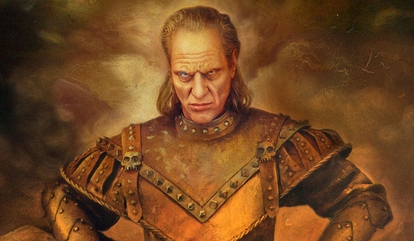
One of the the most common responses I get, when I tell people I have Carpathian ancestors, is, “You mean like Vigo the Carpathian?”
Vigo the Carpathian, the Scourge of Carpathia and the Sorrow of Moldavia, is, of course, a fictional vampire and the main villain in Ghostbusters II.
From Nosferatu to The Count from Sesame Street, this association between the Carpathians and vampires is strong in popular culture. Most of it stems, of course, from the title character in Bram Stoker’s 1897 novel Dracula, whose home was in the Transylvanian Carpathians.
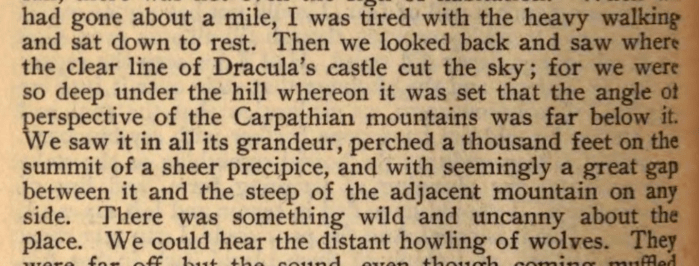
Stoker, Dracula: a Mystery Story (1897). pg 372
There is some controversy over where Stoker drew his inspiration. Some say Dracula is modeled on real-life bloodthirsty royal figures in European history like Countess Bathory and Vlad III “The Impaler” Drakula of Wallachia.
Others scholars emphasize that a stereotype already existed of the vampire as a member of the Eastern European noble class, an exile community often stereotyped in Western countries. The vampire as glamourous, but aloof and having a silly accent, was already common in Stoker’s time. Dracula, however, forever solidified the idea that vampires live in castles, are impeccably well-mannered, come from the Hungarian and German elite of present-day Romania, and have lots of money.
Stoker was correct to associate vampires with the Carpathians. Sanok is home to one of the many noted vampire (or anti-vampire) burial sites, and the word vampire itself comes to English from the Slavic languages. However, if the Dublin-born author wanted a truer picture of the vampire myth, he might have done better to set down his sensational novels about medieval counts and visit a rural village in his mother’s native County Sligo. There, he could have attended a raucous Irish wake and found a people with a very vivid, arguably beautiful, sense of death and the thin in-between zone that separates the world of the living from the world of the dead.
If he had traveled to the Carpathians, to Sanok, he would have seen rural Galicia also had this strong sense of the dead and the supernatural as being part of the everyday living world. Anyone who visits a cemetery in the region today, will see remnants of these beliefs in the sheer number of lanterns that adorn the graves. Some souls need all the help they can get, and sometimes, despite our best efforts, things can go wrong.
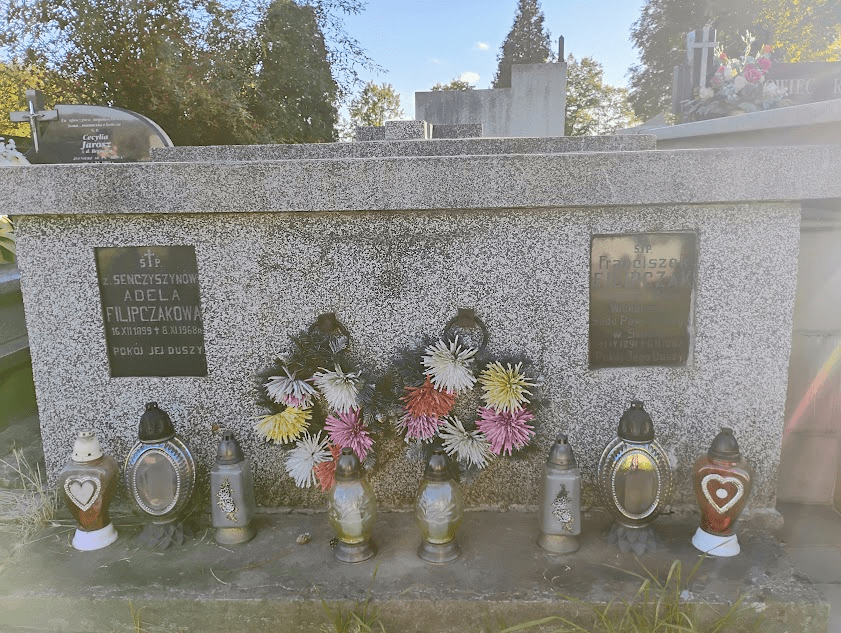
Sanok Cemetery, 2025 (photo by author)
The Sanok School Inspectorate Questionnaires
Thanks to a remarkable set of documents, we know that in Carpathian Poland, belief in the vampire (upiór) was still fairly common up to the eve of World War II. Between 1936 and 1939, the Sanok School Inspector’s Office sent out questionnaires to hundreds of villages and towns throughout the region. School staff were expected to provide information on their communities regarding a variety of subjects.
Today, the Sanok Museum of History holds files on 185 communities, and they are available online through the Sanok Digital Library. Eighty-four files contain long-form questionnaires with demographic and ethnographic information. The remainder contain correspondence or shorter questionnaires with a different set of questions
I wasn’t able to find an example of the original long questionnaire form, but we can infer from the responses that it contained seven sections: 1) Basic Demographic Information, 2) Anthropological Characteristics, 3) Topographical Characteristics, 4) Linguistic Issues, 5) Material Culture, 6) Spiritual Culture, 7) Social Culture
A fascinating study could be done on any of the seven, but for our purposes here, we will concentrate on 6) Spiritual Culture. This section contains several questions, which after looking at eighty-four of these, I can reconstruct as something like: What are beliefs relating to death? What superstitions do the people believe in? Are the people pious? Do they attend pilgrimages and religious festivals? What funeral rituals are observed? How is the cemetery maintained? What are some legends, fables and fairy tales, particularly related to landmarks or features of the landscape? What songs are sung at weddings?
For the purposes of this project, as painful as it is, we are limiting ourselves only to information relating to supernatural beings and beliefs about death, so even within the “Spiritual Culture” sections, lots of great stuff is being left out. We may revisit these topics later, but for now, we recommend finding your ancestral villages and having a look yourselves.
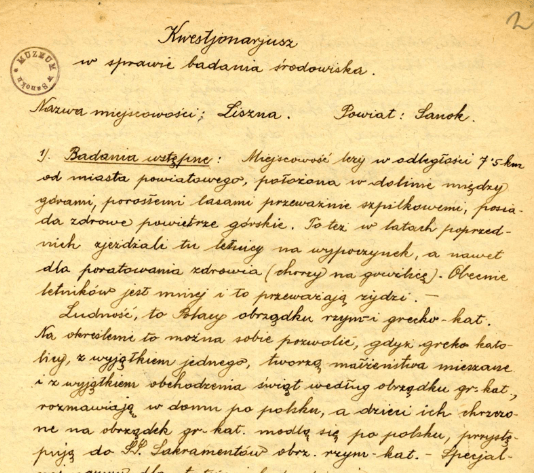
The questionnaires seem to be very much a part of the intense national competition that consumed Sanok’s intellectual culture in the 1930s. The School Inspectorate, as an arm of the Polish Government, was locked in a losing battle to keep Ukrainian national identity east of the San and away from the Lemkos west of the river. In the long-form questionnaire this goal is expressed subtly, but it is noticeable if you know what you are looking for. In the short form, it is much more obvious. That questionnaire, instead of asking about vampires and wedding songs, asks about what political organizations people belong to, what newspapers they read, and what their attitudes toward the Polish government are. Notably, the questionnaires overwhelmingly went to communities with Lemko/Ukrainian/Rusyn majorities, and only a handful of Polish-majority communities are represented.
We are going to stick mostly to vampires here–the focus of this blog is peasant culture in earlier centuries–but if you are interested in this national competition, check out our post on The Dolinians. If you are really interested, consider getting a copy of Beyond the San, which details the activities of my distant relative Ivan Fylypchak (Iwan Filipczak), a Ukrainian teacher and cultural leader who exactly the kind of person the School Inspectorate was trying to stop.
In 1936, the principal at the school in Fylypchak’s native Liszna reported on the monsters surrounding the village. Fylypchak himself was also interested in the “Spiritual Culture” of the mountain people. He had provided much the same information ten years earlier in his Ukrainian-language manuscript Monograph of the Polonized Village of Lishna, Sanok County. This document reads very similarly to the questionnaires, so we will include it here to give a taste of what is to come:
Since pagan mythological times, people in Liszna have believed in the “bohynka.”
A bohynka is a kind of supernatural maiden-goddess who lives in forests, by streams, brooks, and generally in empty, deserted places. The bohynka likes to play tricks, mostly on girls when they go to wash linens by the streams. It happens, girls say, “a bohynka stole my handkerchief or some other trinket,” when it actually floated away with the water due to carelessness. Small children are frightened by bohynki so that they do not wander into the forest, because there a bohynka will take them.
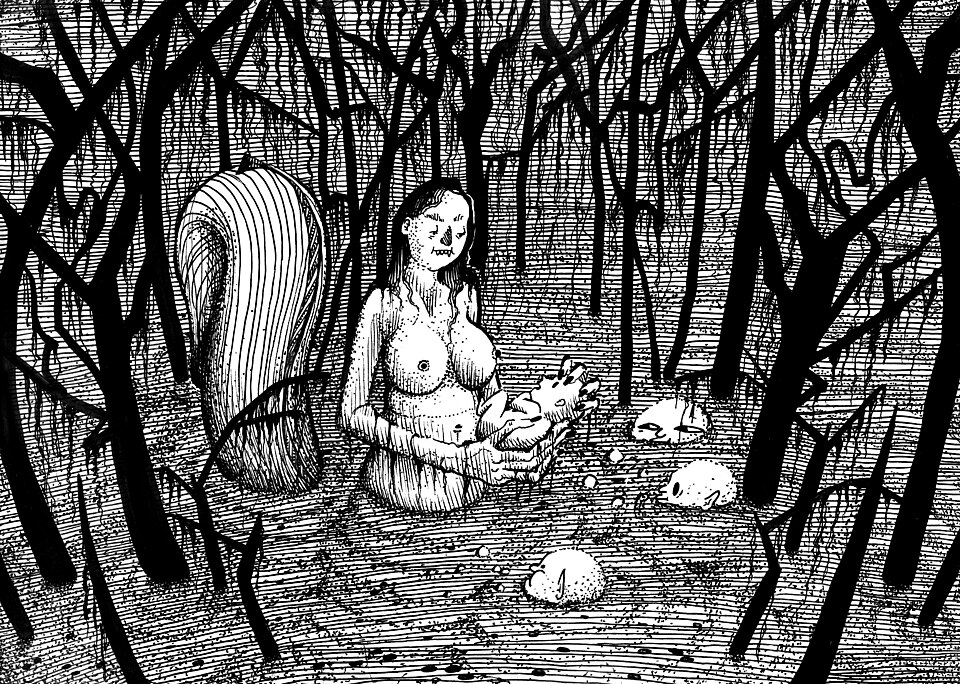
“Boginka” Graphic by Maria Apoleika (2018) and released through Creative Commons (Wikimedia)
A certain villager, in order to give himself greater respect, tells that he saw a “bohynka” in the forest, how she screamed, cried, and wailed. She wants to lead a man into some inaccessible thickets, mostly during evenings, nights, or early mornings, and wants so badly to choke him. Sometimes she mimics the crying of a little child, sometimes she pretends to be a shepherdess crying for lost cattle, or pretends to be a woman weeping over some loss. She appears to people mostly during bad weather, in a storm, a blizzard, while various split trees and broken limbs of storm-felled trees creak throughout the forests, making all kinds of sounds during the storm.
A man who moves sluggishly, is poorly accustomed to work, lacks agility, and whose work does not go well, is called by townspeople lelum-polelum: “Look how he works, like a lelum-polelum. Why did you freeze like a lelum-polelum?.” They believe in witches who steal milk from cows. After sunset, no one will be able to buy milk. An old, aged, unloved woman who lives apart, somewhere on the outskirts, and rarely shows herself to people, is called a witch, and they firmly believe that she steals milk from cows. An unloved old man who has amassed a fortune is called a devil. They considered one such old man, Sabat, to be like this; according to rumor, he carried a demon on his shoulders to the “Smorzhensky stream” and threw him into the dense thickets there.
They believe in a walking death at night, which some people have seen. She appears at night, white, clumsy, wrapped in a sheet, thin like a flax-braking board, taking people away. — They sit by the deceased all night, sing pious songs, tell stories about his soul, where it is now, whether already in heaven or in purgatory. The deceased is placed on a table on boards, or in a coffin, and a candle is lit. There is no cemetery in the village. Poles are buried in Mryholod [Mrzyglod]; they cross the San River by boat or transport the body by wagon through the water. There are cases where, due to carelessness, the coffin fell into the water, and then it is a real trouble to pull the coffin out. Rusyns are buried in Vilkhivtsi [Olchowce]. The deceased are angry, they walk after death and terrify wicked people.
[Original Ukrainian manuscript in Rylsky Ethnographic Archives, Kyiv]
Meet the Monsters
Fylypchak’s account shows that the upiór was not the only monster haunting the fields and forests, so before we get into the questionnaires, let’s meet some of the recurring characters. When present, we will link to longer descriptions in the Dictionary of Polish Folk Tales, edited by Violetta Wróblewska of Nicholas Copernicus University in Toruń.
upiór: a vampire creature with two hearts and two souls. One soul moves on to the next world while the other returns at night to terrorize people and livestock. Various measures are employed to stop it escalating from scattering poppy seeds around the grave to driving a stake through the skull. Note that most departed souls will make a brief return to the house before crossing to the other world. That does not necessarily mean they are upióry.
czarownica: a witch, not necessarily someone coming from another world, but more likely a neighbor woman consorting with evil. She will steal the milk out of your cows or inflict the “uroki” [evil eye] which causes your nausea and headaches. There are procedures to get her to reveal herself, but be careful, she may turn herself into an animal. In some villages, they may be called zamawiacy, prasorka, bisiurkinie, bosorkyni, or bisurmanka. They are everywhere. Do not trust your neighbor.
djabeł: not necessarily Big Satan himself, but a little house devil you can hatch from an egg. At the cost of your soul, this little horned guy will bring prosperity to your lands and children, but only if you treat him right, and he is notoriously hard to control.
śmierć: a gaunt, skeletal woman clad in all white, she is the grim reaper, the personification of death itself, cutting down her victims with a scythe.
boginka: though generally meaning “goddess” or “nymph” in modern Polish, the boginka around Sanok is a particular kind of evil female spirit. Her screams are heard from the forests, where she can be found washing her garments in the streams. She also may come in your house and switch your beautiful baby for her ugly one.
mułuchid: a stillborn child will return to its home seven years later. However, if you give it a name and some white cloth for a baptismal gown, it will leave you alone. This is different from the illegitimate child, murdered by his mother, who causes floods.
topielec: one of various “wodniki” [water spirits] the spirit of a drowned person hangs over the place where he or she drowned. Now, it will drown you if you are not careful.
gniećka: also called miedznich, the “presser” demon will visit in the night and sit on your chest until you suffocate.
mara: the nightmare will visit in your sleep, tangle the manes of your horses, and drive them into the forest.
błedne ogniki: an eerie light or fire rising from the swamp is a sign of something bad. Do not go there.
błąd: the “misleader” will enchant you and lead you in all directions as you try to make your way home.
białe baby: these old white crones may cackle on the road until they notice you. Then, they are gone as quickly as they appeared.
czeperheir: this supernatural bat will get in your hair and make it hopelessly tangled. It is best to keep your head covered.
płatenik: your neighbor up the road might look like a normal old man, but he is actually a “cloud catcher” and has the power to control the weather and call forth a storm.
morowiec and morowica: the black plague as a man and woman, few will escape them.
królu wężów: would you dare steal the diamond of the “king of snakes?”
wątkopak: some kind of human-eating monster. Your guess is as good as mine.
The Project
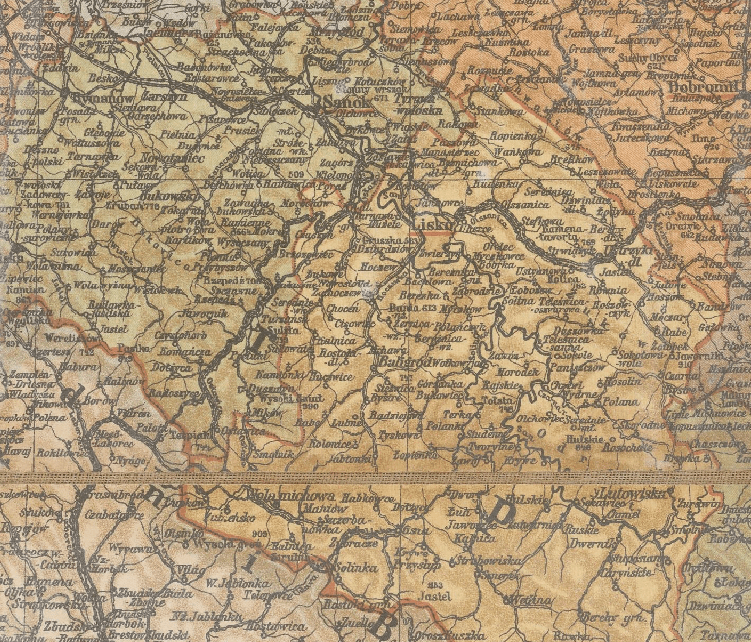
So, without further ado, here are accounts from the questionnaires, in five parts. Any communities shown will have a full questionnaire in the archive, so find your village and stary your investigation! As always, these are Google Translations, so take them with a grain of salt (or spit three times, cross yourself, and do a spell to ensure Google isn’t bewitched).

