The following is a translated excerpt from an article in the upcoming edition of Ziemia Sanocka, the annual publication of the Historical Museum in Sanok. In 2022, 156 silver coins were discovered buried in Bukowsko. In the longer Polish text, Piotr’s co-authors will describe the discovery and the coins. This excerpt concerns the history of the property and the people who lived there.
By Piotr Zelny, Historical Museum in Sanok
Copyright 2026, Piotr Zelny
The property at Henryka Sienkiewicza Street no. 2 (building plot no. 2204) in Bukowsko — on which the Volunteer Fire Department station now stands — was occupied by several buildings, including outbuildings, before World War II. A residential and commercial building stood at the site where the treasure of coins was hidden. The property was owned, at least from the mid-19th century until January 1943, by the Jewish, merchant family of Pinter, who may have been related to the Bukowsko family of famous rabbis bearing the same surname.
Due to military operations and fighting against the UPA (Ukrainian Insurgent Army) during World War II and immediately afterward, a significant portion of the records — including historical ones — from the offices operating in Bukowsko were destroyed. Consequently, the history of the treasure’s hiding place and the people who lived there, as reconstructed in this article, is incomplete. Basic information was provided by land registers (unfortunately, the supporting documents are missing) and the records of the municipal court in Bukowsko; maps and cadastral surveys were equally helpful. The notarial records of notaries operating in Bukowsko were used only to a limited extent. Although the house belonged to a Jewish family, valuable information was provided by the church registers and the vital books of the Bukowsko parish. Unfortunately, the records of the Jewish registry office in Bukowsko — which were very important for this research — have been virtually completely destroyed. For the entire district, we are aware of only 239 surviving copies of birth, marriage, and banns records.1 This fact makes it impossible to fully reconstruct the family connections of the property owners, and many important events in the family’s life have also been lost.
The first documented owner of the property where the treasure was found was Fejwel Pinter, who was likely born between the first and third decades of the 19th century. At that time, the property consisted of a wooden house, no. 72 (building plot no. 152) and a small garden located directly behind it and adjacent to the Sanoczek stream, then known as Stawki (ground plot no. 2943). It was one of many houses densely surrounding the main market square in Bukowsko, situated on its southeastern frontage. The house was occupied by a Christian couple, Jan Antoniewicz (b. 1813) with his wife Wiktoria (b. 1813) and their son Józef (b. 1840).2 Fejwel, on the other hand, lived in his second wooden house, no. 110, with a garden located almost exactly on the opposite side of the market square (building plot no. 178). He owned one more small plot of land, but it was encumbered by an easement and served as an access road. He did not own any farmland, meadows, or pastures, so he certainly did not make his living from farming. Perhaps he was a merchant, like his grandson later on. At least three other Pinter families (the families of Abraham Pinter, Mortka Pinter, and Peretz Pinter) also lived in the town, residing in houses near the market square.3
Between 1853 and 1878, Fejwel converted the garden behind his house from a ground plot into a building plot (no. 347) and sold a slightly larger portion of it (93.5 m², 12.1 m long × 7.75 m wide), which bordered the stream. The new, rather poor owners built a small house on it, literally squeezed between the stream, the street, and the small backyard of the Pinters’ house. In this unaltered form, the Pinters’ property — consisting of a spacious house with an area of 114.5 m² (length 15.9 m × width 7.2 m) and a tiny backyard measuring 60.5 m² (7.8 m long × 7.75 m wide), survived until World War II.4
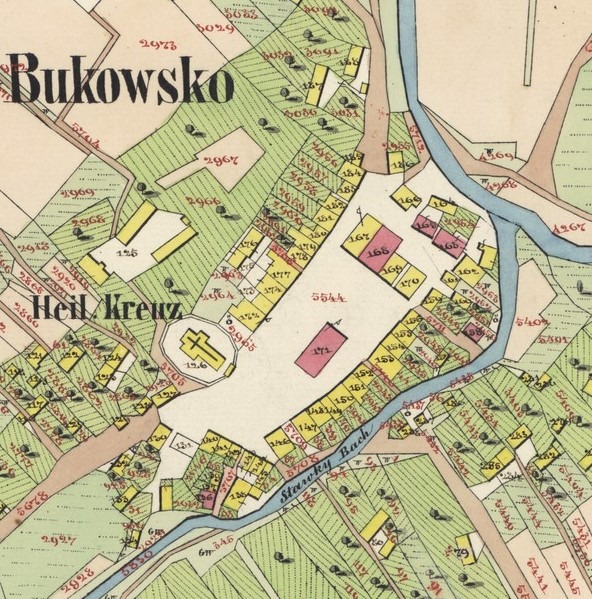
Cadastral Map of Bukowska, 1852, State Archives in Przemyśl.
After Fejwel, the house was inherited by Dawid (before 1894), presumably his son, who died in 1909. He and his wife Sara had at least four children: a daughter, Mariem, married to a man named Leiblank (first name unknown); Pesla, married to Beck; Chaya; and a son, Awigdor, also known as Wigdor (in some documents occurs the Polonized form Wiktor). Tenants also lived in the house: the Jewish Mendel family and, from around 1904 to around 1943, the Catholic Pieszczoch family, about whom we write below. We do not know exactly what Dawid did for a living; perhaps he was a merchant, as his son would later be. In January 1894, Dawid borrowed 157 zlotys and 32 cents from Lazar Regenbogen of Sanok, using the house as collateral. He did not redeem the promissory notes until December 1904. A year before his death, in July 1908, he again borrowed money from Lazar against a mortgage. This time, it was a very substantial sum of 986 crowns and 88 halers (equivalent to the former 1,973 Rhine zlotys and 76 cents). The debt passed to the children along with the benefit of inventory and then on to the grandchildren, and it was never fully repaid. Dawid left no will, so on December 30, 1909, the court, based on a decree of inheritance, awarded each sibling one-fourth of the estate and granted the widow a life interest in one-seventh. Over the next four years, a series of purchase and sale agreements were concluded, resulting in changes to the ownership structure among the siblings. In September 1910, the siblings bought out their mother’s life estate, and Benjamin Pinter (relationship unknown) purchased half of the shares due to Chaja and Mariem, respectively. Mariem then sold the remainder of her share to Simon Leiblank. In September 1913, Awigdor Pinter and Pesla Beck of the Pinter family purchased Simon Leiblank’s share and divided it equally between themselves. As a result, the property had four co-owners: Awigdor and Pesla each owned 1/3, and Chaja and Benjamin each owned 1/6 of the property. This arrangement remained in place until the death of one of them, Awigdor, in 1938, when further divisions of the estate took place.5
The head of the household remained Avigdor Pinter, born in 1881. His wife, Chaya Presser — five years his junior — whom he married in 1909. Together, they raised six children: David (born out of wedlock in Gorlice in 1909), Dima (born Sept. 12, 1912), Pinkas Meilech (born October 22, 1914), Mojżesz (born June 26, 1917), Abraham Hersch (born January 6, 1922), and Cypra (born October 9, 1925). Avigdor was a merchant and ran a fabric store on the ground floor of the house.6 He also dealt in money; particularly from the early 1930s onward, he was both a borrower and, less frequently, a lender. These included both ordinary cash loans and mortgages, denominated in both zlotys and dollars, at interest rates ranging from 6% to 10%. His son, Pinkas Meilech, helped him run the business; Pinkas later moved to Kraków.7 Avigdor died on April 29, 1938, at the age of 57. His widow and children (except for Dawid) became his heirs. According to an inventory drawn up in July 1938, his estate was in debt to the tune of 3,160 zł (assets totaling 603 zł), of which nearly half — 1,500 zł — was a mortgage debt inherited from his father, Dawid. The total value of the house, described as old and measuring 114.5 m², was appraised at 900 zł, while the land on which it stood in the town center, measuring 175 m², was valued at 600 zł. The widow Chaja Pinter, née Presser, became the lady of the house; the youngest children, Abraham Hersch and Cypra, remained under her care and financial guardianship. Mojżesz was already of legal age and lived in Bukowsko, though we do not know if he lived in the family home; Dima had left for an unknown destination and could not be contacted; and Pinkas Meilech settled in Kraków. Their aunt Pesla Beck, née Pinter, and Benjamin Pinter (relationship unknown) remained co-owners of the house, but we do not know whether they lived there.8
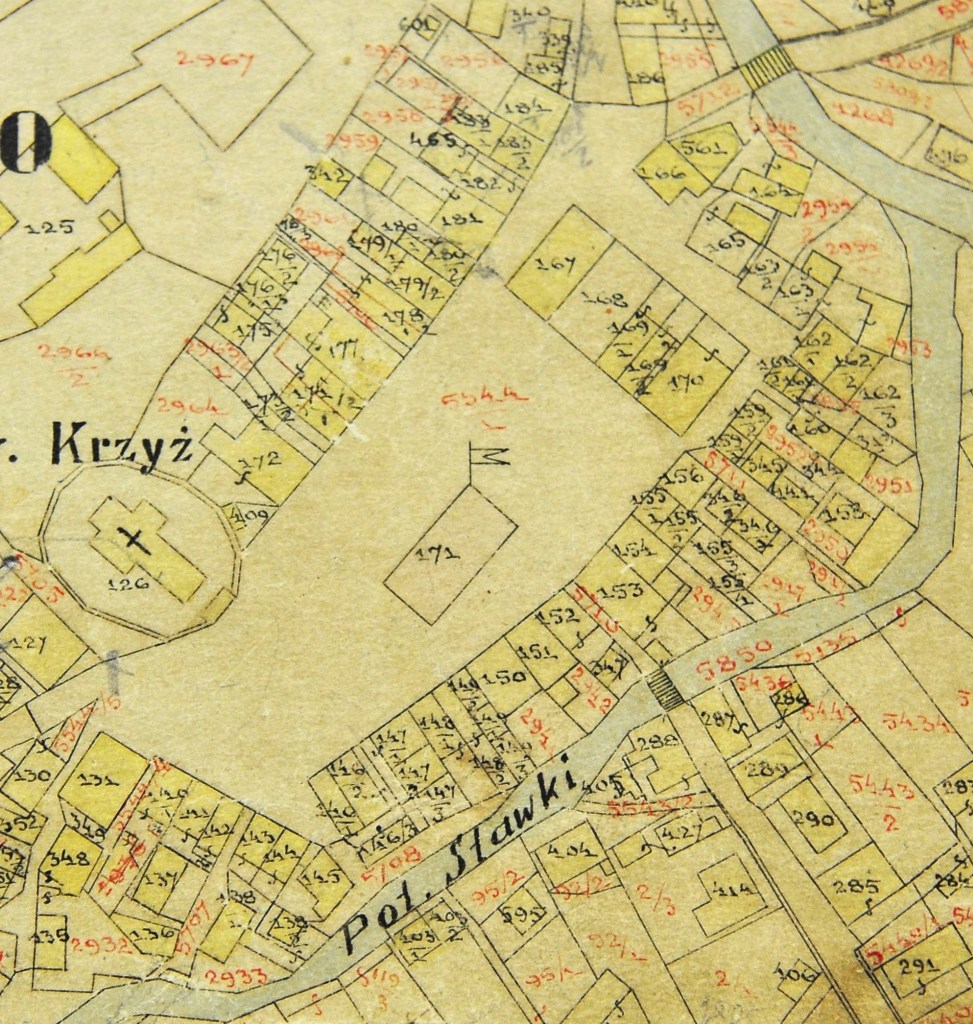
Cadastral Map of Bukowska, 1896, State Archives in Rzeszów, the branch in Sanok.
We do not know what became of the family during the Nazi occupation. The last mention of them dates from April 14, 1942; it is a resolution by the municipal court in Bukowsko regarding the registration of property rights in the land registry. They were likely killed or deported along with other Jews that same year or the next, perhaps to the Nazi German forced-labor and extermination camp in Zasław, to Bełżec, or to other camps.9 Between December 14, 1942 (the Sanok County Administrator’s resolution to seize ownerless property) and January 20, 1943 (registration in the land register), their house, as ownerless property, was seized by the German administration. The house was likely destroyed or demolished along with the remaining wooden structures on Market Square as a result of subsequent fighting with UPA units. By a decree of the Sanok District Court dated February 10, 1958, the vacant plot was transferred to the State Treasury, and as a result of land consolidation carried out in June 1995, it was merged with two other parcels.10
Although the Pinters were the sole owners of the property, for most of the time they rented out part of the house to outside tenants — or, as they were called at the time, “chamber-dwellers” (Polish komornik). As we have already mentioned, in the second half of the 19th century, these were the Antoniewicz family, who were Christian. At the turn of the 19th and 20th centuries, the tenants were the Jewish Fisch Mendel family. Unfortunately, we cannot say anything more about them. We also do not know how long they lived as lodgers with the Pinters. They were listed in the Bukowsko parish census only by the first and last name of the head of the family as residents of the house. Around 1904, another family, this time Catholic, became the tenants. The Pieszczochs were “Americans” — that’s how economic emigrants returning from the United States to Poland were referred to. Jan Pieszczoch was born in Bukowsko in 1867; his wife, Maria née Pleśniarska, born in 1870, was also from Bukowsko. It is not known exactly when they left for the United States; they do not appear on the arrival lists of the main immigration offices at Castle Garden (Clinton) and Ellis Island in New York.11 The vast majority of emigrants from Galicia went through immigration clearance at this very port, but that does not rule out the possibility that they may have arrived at a different port. They were married in the United States in 1897, so they certainly emigrated before that date. They settled in “Ferfield,” which may refer to Fairfield, Connecticut, in New England. There, their four children were born: Edward in 1898, Helena in 1900, Henryk in 1901, and Julia, the last to be born in the United States, on June 16, 1903. Julia died shortly thereafter on March 8, 1905, but this time in Bukowsko. These two dates thus mark the time of the Pieszczochs’ return to Poland and the beginning of their stay with the Pinters. In the following years, more children were born: Emilia Wiktoria in 1908, Franciszka Katarzyna in 1909, Jadwiga in 1914, and finally Janina Maria in 1917. Jan Pieszczoch’s wife, Maria, died in February 1934, and as early as September of that same year, the newly widowed Jan married the widow Wiktoria Pietrzycka. Jan died on July 27, 1938, and on April 11, 1941, his two-month-old granddaughter — the daughter of his eldest son, Edward — also died. The Pieszczoch family likely remained with the Pinters until the very end, that is, until the house was seized by the Third Reich in January 1943.12
The history of the family and the house alone, of course, will not provide us with a direct and definitive answer to the questions of who, when, and why the treasure was hidden. However, if we place it in the proper historical and archaeological context and incorporate technical aspects — such as the composition of the coins, their purchasing power in specific years, and the metal content — we will be able to obtain fairly reliable answers to the questions that puzzle us.
The youngest Austro-Hungarian crowns and Russian rubles in the hoard date from 1915 – 1916, so we assume that the hoard’s owners had been saving money in the cup up until that time. The later American 5 and 10-cent coins from 1919 were used as jewelry. However, they are very important to the find itself because, as the most recent artifacts, they determine the age of the hoard. This means that whoever hid the hoard must have done so no earlier than 1919. At that time — shortly after the end of World War I — ethnic and religious conflicts that had been simmering for years erupted, fueled by the catastrophic economic situation. In November 1918, fighting broke out between Poles and Ukrainians. That same month, some Jewish homes in Bukowsko were attacked and looted. Another looting incident occurred in 1922 following a major fire that destroyed 17 Jewish homes and one Christian home.13 Thus, there was no shortage of threats, and everyone likely tried to protect their belongings in one way or another.
Our treasure was likely also secured by its owners at the time. However, that was not when it was buried and eventually forgotten. If that had been the case, some very tragic events would have had to occur that would have prevented the owner from returning to claim his property — such as death, expulsion, or flight. However, nothing of the sort happened to either the Pinters or the Pieszczochs at that time; no one died, no one fled, no one was expelled — the owners were alive and running their business, the tenants continued to live there, and the house was neither burned down nor demolished (in the 1938 probate case following Awigdor’s death, the house is described as old). After the end of World War I, one of the main problems facing both Poland and all the former partitioning powers was rampant hyperinflation. In 1919, the annual inflation rate in Poland was 1,123.6% (by comparison, inflation in March 2026 was 3%), and the dollar exchange rate rose nearly 14-fold between November 1918 and December 1919. However, hyperinflation was only just gaining momentum, reaching 35,714.6% in 1923.14 In a situation of such extreme hyperinflation (by comparison, the memorable hyperinflation of February 1990 stood at 1,183%), hoarding cash made absolutely no sense. All the cash that the owners of the hoard had at their disposal in early 1919 — and which they had not managed to use to purchase any goods in the following months — became worthless in terms of purchasing power. Fortunately, the coins of that time were based on the silver standard, so the owners of the treasure kept the coins for the value of the silver itself, which had a total weight of ………… and a value of ………….. That silver was their treasure, a safety net for a rainy day in the event of another bout of hyperinflation, a crisis, a war, or other difficult situations. The cup containing the silver coins remained in the house throughout the entire interwar period and was hidden only when such a situation arose once again — namely, World War II.
There is no way to determine unequivocally and with absolute certainty which of the house’s residents hid the treasure; in this regard, we have only circumstantial evidence and speculation. However, it is highly probable that the treasure belonged to the Pinter family. They were the owners of the house and its primary residents; they ran a store, handled and managed cash, and everything indicates that they could simply afford to keep such a large amount of silver for so long — for example, as a safeguard for their business.15 The Pieszczoch family, on the other hand, spent quite a long time in the United States (before 1897 — until around 1904). It seems, however, that upon their return, they would not have kept the old Rhine zloty coins (a dozen or so), which by then had long since been out of circulation, even though they had the value of silver bullion. From them, we would rather expect dollars or crowns themselves, which, upon their return to their homeland, had already been the new and sole means of payment for 12 years. As chamber-dwellers (tenants), they were certainly much poorer than the Pinters, the owners of the house; that was usually the case under the circumstances of the time.
As for the person who hid the treasure, most evidence points to Chaya Pinter of the Presser family, who became the lady of the house and head of the family after the death of her husband, Avigdor. Perhaps one day between April 14, 1942 (the last mention) and January 20, 1943 (when the Third Reich seized the abandoned house), she hid the treasure behind the back wall of the house, finally tossing in her old bracelet strung with American cent coins from 1919, which she had previously worn on her wrist. We do not know what became of her afterward; perhaps she perished along with many others in the Holocaust, and the treasure remained buried for the next eighty years until a fortunate water main break in April 2022.
- State Archives in Przemyśl, Jewish Religious Communities — a collection of fragments of collections, courtesy of Deborah Greenlee. ↩︎
- Parish Office in Bukowsko, “Status animarum”, vol. I, house no. 72, courtesy of Deborah Greenlee. ↩︎
- State Archives in Przemyśl, Geodetic Archives, Series 127, ref. no. 1, 2, 3, 5, 9, and 0190M; State Archives in Rzeszów, the branch in Sanok, Cadastral Office in Sanok, ref. no. 397; The building plot number 152 remained unchanged until 1995, while the house number changed several times. In 1852, it was number 72, then 61 until around 1932, and finally 364, presumably until 1943–1946. ↩︎
- The mortgage book of the Pinter’s estate (lwh 413) contains no mention of these transactions, as the mortgage book was established between 1874 and 1894 — that is, after they had already taken place. For this reason, the findings were based on cadastral maps from 1852 and 1896, land registers (see note 3), and the inventory of Awigdor Pinter’s estate, see State Archives in Rzeszów, the branch in Sanok, Municipal Court in Bukowsko, ref. no. 391. This information is essential for a reliable and certain determination of land ownership at the site where the treasure was hidden.
↩︎ - State Archives in Rzeszów, the branch in Sanok, Land and Oil Registers of the Courts in Bukowsko, ref. no. 2, pp. 169–176; Parish Office in Bukowsko, “Status animarum”, vol. II, p. 113, courtesy of Deborah Greenlee. ↩︎
- The 1929 Polish Business Directory Project, Księga Adresowa Polski, 1929, pp. 634 – 635, www.jri-poland.org, [access: April 17, 2026]. ↩︎
- State Archives in Rzeszów, the branch in Sanok, The records of Notary Leon Jaworski in Bukowsko, ref. no. 3, file no. 210/37. ↩︎
- State Archives in Rzeszów, the branch in Sanok, Land and Oil Registers…, ref. no. 2, pp. 169 – 176; Ibid., ref. no. 1, pp. 317 – 323; State Archives in Rzeszów, the branch in Sanok, Municipal Court in Bukowsko, ref. no. 391. ↩︎
- An unidentified Abraham Pinter died in the Bukowsko ghetto. Another Pinter, whose first name is unknown, was captured and shot by the bridge over the Sanoczek stream or at the Jewish cemetery located in a nearby grove called “Parszywiec” or “ Tarniaczek,” along with about a hundred other Jewish people — mainly escapees from the Bukowsko ghetto — by military police and Gestapo officers from Sanok in June 1943, IPN (Institute of National Remembrance), Casualty Database, www.straty.pl [accessed: April 20, 2026]. ↩︎
- State Archives in Rzeszów, the branch in Sanok, Land and Oil Registers…, ref. no. 2, pp. 169 – 171. ↩︎
- Statue of Liberty Ellis Island Foundation, Arrival Records Collection, www.statueofliberty.org, [accessed: April 18, 2026]; Passenger lists of vessels arriving at New York: New York City, www.familysearch.org [accessed: April 20, 2026]. ↩︎
- Parish Office in Bukowsko, *Status animarum*, vol. II, p. 113, courtesy of Deborah Greenlee; State Archives in Rzeszów, the branch in Sanok, Civil Registry Records of the Roman Catholic Parish in Bukowsko, ref. no. 2, pp. 343, 376, 408, 498; Bukowsko Baptisms, Volume X, 1893–1940, www.semanchuk.com [accessed April 19, 2026]; Bukowsko Civil Death Records, Volume 7, 1889–1945, www.semanchuk.com [accessed: April 19, 2026]; The Pieszczoch family grave, where Jan, Maria (née Pleśniarska), Helena, and Emilia Wiktoria are buried, is located at the Bukowsko Cemetery, Bukowsko Cemetery Transcription (Sanok County, Poland), www.semanchuk.com [accessed: April 21, 2026]. ↩︎
- Encyclopaedia of Jewish Communities, Poland, Western Galicia, Silesia, Vol. III, Yad Vashem, Jerusalem 1984, s. 69 – 70. ↩︎
- T. Skrzyński, Walka z inflacją w Polsce w latach 1918 – 1927. Rola Władysława Grabskiego, Zeszyty Naukowe nr. 733, Akademia Ekonomiczna w Krakowie 2007, s. 217 – 228. ↩︎
- A visual inspection of the vessel in which the treasure was found did not reveal that it was a ritual Netilat Yadim cup (Hebrew for “hand washing”), which is used in Jewish culture for ritual hand washing. ↩︎
 SANOK STORIES