This is the fourth of five parts in our project translating information on pre-WWII beliefs in vampires, witches, monsters, demons, death rituals and superstitions in specific villages. This post focuses on modern-day Lesko County. The information was provided by local school officials to the Sanok School Inspectorate in the late 1930s. The original documents and metadata are available online from the Sanok Historical Museum through the Sanok Digital Library.
To learn more about the scope and purpose of this project, see Introduction: Vampires, Witches, and other Terrifying Creatures in the Sanok School Inspectorate Questionnaires
Part 2: Sanok County (minus Komańcza)
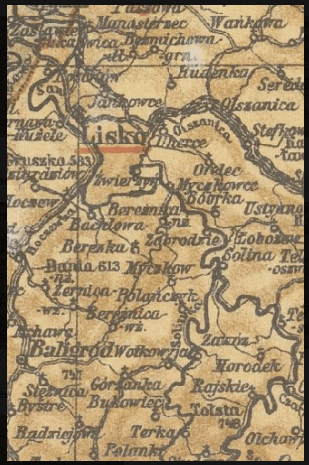
Olszanica
Wańkowa
The local people believe that after death, the deceased walks and visits their loved ones. Often after death, a person becomes an upiór, comes back to the cottage, and haunts it. To prevent this, they pour a handful of poppy seeds into the mouth of the deceased. The deceased wakes up at 12 o’clock at night and has until 1 o’clock to count those poppy seeds. Because there are many poppy seeds and they cannot manage to count them by one o’clock, they cease to be a upiór.
If the deceased is believed to return, traditional accounts suggest a relative might attempt to end the haunting through specific ritual movements. This involved tracing a path with clay from the grave to the home at midnight. Upon the figure’s return to the cottage at one o’clock, folklore describes the application of various physical measures or ritual interventions to ensure the spirit remains at rest. Money is often placed under the head of the deceased in the coffin. This tradition reflects the belief that the soul must be ferried across a river in the afterlife, with the coins serving as payment for the passage.
Rudenka
When someone is afraid of a dead person, they take the hands of the dead person and command them to squeeze their own fingers and hands, then they will no longer be afraid, just as the dead person is not afraid.
When they carry out the coffin, no one should leave the house ahead of the deceased, so that the dead person does not return to that house again.
New cottages are blessed with holy water. Before it is blessed, it is vulnerable to evil spirits. They protect an unblessed cottage against the entry of an evil spirit in this way: an old woman carries blessed items from the old house and places them in the coals…
…When a bride enters her husband’s house for the first time and does not want his parents to live, then as she crosses the threshold and sees his parents, she says to herself with great comfort: “Neither this one, nor that one, neither dad, nor mom.” Within a year, they die. Some of us are afraid that the bride might cast a spell on them, so when the husband brings the bride to their house, they quickly hide somewhere in the house, because they believe that if the bride crosses the threshold and does not see them, her wish will not come true.
To avoid fearing the deceased and to never see them again, people spit three times beneath the coffin as it is carried out of the house. If the corpse’s eyes are left open, it is believed that someone else in the household will soon die.
Questionnaires without monsters
Orelec, Paszowa, Uherce Mineralne
Lesko Gmina
Bezmiechowa Górna and Dolna
Old people believe in ghosts and haunted places, they are superstitious, the young do not believe in these things. They do not believe in spells and witchcraft, they do not go to fortune-tellers, they are religious, they like to go to indulgences.
Wola Postołowa
The common people believe in witchcraft and superstitions, such as: that someone can cast an evil eye on another; it is not good if someone sets out on a journey, to the field, or to the market, and is crossed by someone with empty water-pitchers, or by a priest, a hare, or a cat, for they will surely meet with some misfortune. They believe that in certain places something haunts at night or that a wandering spirit attaches itself to you. They believe that certain deceased individuals walk the earth…
…They believe in the inspirations of an evil spirit and the blowing of the wind…
Dziurdziów
a) A devil in the form of a dog, cat, or ram misleads a person from their path at night—leading them through forests, creeks, and wilderness—until the rooster crows at dawn.
b) At night, when horses graze outside the forest and the shepherds are asleep—the devil comes as the elusive mara—sitting on a horse—and drives the rest of the horses out of the pasture to inaccessible places. At night, these horses cannot be found; the shepherds will only find their horses when the sun shines.
c) While a person is asleep (especially in the attic), a “miedznich” comes and pins them down with its weight, leaving them unable to breathe; once the person realizes the cause of the pressure, they can drive the “miedznich” away using prayer and the sign of the cross.
d) Moonlit night – białe baby gather in the forest on a sandy road – they dance – they play with the sand like little children – and when they notice a human – they hold hands – they escape into the forest with the speed of lightning – Only the tracks of their feet remain on the sand.
Ghosts. The ghost of a deceased person comes home on the first night after the funeral – that is why candles are kept burning in the house throughout this night – a full small pot of water, bread, and salt stand on the table.The ghost of a mother especially appears very often after death – she comes to her children – feeds them – caresses them, and hums lullabies.Sometimes a ghost comes and calls beneath the window to one of the household members – one must remember not to answer the call – because otherwise, one can die within three days.
A deceased person who had two hearts during their lifetime, an “upiór,” walks after death among their family and acquaintances – causing mischief – To protect oneself from the upiór’s’ attack, one must carefully examine the face of the deceased to see if any red marks are visible, if so – drive a thorn under the deceased’s tongue, and then the upiór will become – harmless.”
Deceased children after death have a blue-gray or even black body –these are marks from being beaten with whips by angels for the sins of the mother.
Superstitions. a) The rainbow called “smuga” (streak) drinks water after rain from a river or a stream – if a person were there near the water – the “smuga” will drink the blood from them and the person dies.
b) Funeral participants, returning from the cemetery, wash themselves in a stream regardless of the time of year—so that the soul of the buried one may be free from sin sooner.
c) After confession and Holy Communion, one is not allowed to wash their hair for 7 days, because God’s grace is washed away. The whole day after confession and Holy Communion, one walks on crutches – it is forbidden to walk barefoot – because one insults Him who entered a sinful body – being Himself most holy.
d) There are “gards” on earth who have a foster child, a little devil in the form of a child- who works for the household and acquires property – but the soul of such a gard is already condemned. The foster child brings prosperity – one must feed them well, but without salt, and plenty to drink. If any food is salty or not tasty, he takes revenge – he plays tricks, e.g., mice carry away the grain or at night he drives the cattle into the forest.
e) A married woman always wears a headscarf so she doesn’t have to have her hair cut; because the “czeperheir” (bat) seeks out a woman without one and entangles itself in her hair. One can only be freed from the “czeperheir” by cutting the hair. For such a woman, this is a disgrace.
Fairy tales: “Boginki” once lived in mountain caves; when the household members went out to the fields to work, these beings would enter the homes, beat the older children with old brooms, and drink the milk left on the stove for the little ones. Sometimes they would take a quiet infant and leave their own screaming child in its place. They also used to go to the fields to steal peas; one could catch them by leaving a single boot among the plants. The goddesses would slip both feet into it—rendering them unable to flee—and when the farmer arrived and beat them, they would weep and beg for forgiveness. At night, these goddesses would wash their laundry in the stream by the forest.
Legends:
a) In ancient times, grains had very long ears –Once, a mother who had a surplus of bread used it to wash a bench–God became angry and began stripping the ears of grain with His hand – When the Mother of God saw this, she grabbed God’s hand – begging Him to leave at least enough for the birds and small creatures – God granted the request – which is why today the ears of grain are so short.
b) The Legend of the Shrine: Beyond Mount Gniwka in the forest (owned by Count Krasicki), a small shrine used to stand next to a beech tree, which fell into ruin over the years; for a long time, there was no shrine there. One day, a woman from Twierdza was walking to Dziurdziów to visit her brother. She noticed a grey-haired old man sitting under the beech tree. Approaching with fear, the old man told her: “Go, woman, to Count Krasicki and tell him to build a shrine here.” After saying these words, the old man vanished. The woman shared her vision with Count Krasicki, who shortly after placed a holy icon on that beech tree and promised to build a proper shrine soon.
c) The Tale of the Thief: There was a notorious thief in these parts nicknamed “Twardochlib” (Hardbread). One day, a gendarme caught him while he was cooking meat. The gendarme forced him into a cow’s hide and paraded him around the neighborhood, where he had to publicly confess his thefts to the local people.
Hoczew
In this local area, there are many roadside crosses and shrines. Their origins vary; some crosses are connected to stories from the time of the abolition of serfdom. – These crosses are specially protected and decorated with flowers and wreaths. They must not be touched, and underneath some of them, documents decreeing the abolition of serfdom are said to be buried. Crosses were also erected at the site of tragic accidents, e.g., death by lightning strike, the appearance of a vision, a ghost, etc.
Chapels, on the other hand, are built by order of a supernatural force: some father or grandfather dreamed that the Mother of God came to him and told him to build a chapel on that very spot. Immediately after such a dream, the chapel was built, and subsequent generations carefully protect and decorate them. In general, belief in ghosts, apparitions, and post-mortem spirits is very deeply rooted here. They believe that the deceased can appear or punish their loved ones. Immediately after death, they dress the deceased in garments specially kept for death in a chest. A man is dressed in trousers, a shirt, and shoes. They place a handkerchief with a coin (10 groszy) in his hand so that he has something to pay his way with in the next world.
They put the body into the coffin only just before it is carried out of the house; they also give the deceased a cap and a cane decorated with a ribbon. Girls are dressed in wedding attire for the coffin, and a small coin is also given. In the evening, neighbors gather at the cottage of the deceased man or woman and recite funeral prayers from prayer books. Boys and girls sing funeral songs. These evening services and prayers are called a “pogrzeb” (funeral)…
…They also believe that some women take away cows’ milk. A cow suddenly stops giving milk, and they rush with a roar toward the barn of that housewife who allegedly took her milk, and roar demands to return the milk, thereby exposing the woman who took this milk from her. Vigilante justice over such a witch is sometimes very severe. They also believe in a kind of demon you can breed yourself: You take a chicken egg and the master of the house carries this egg under his arm for six weeks. A devil hatches, and if you give him food and drink, he brings happiness and wealth in the home…
… No fairy tales or legends have been noticed in this locality.They tell each other stories in the evenings, about upiory and ghosts. They willingly recount adventures they have experienced,either their own or those of their neighbors.
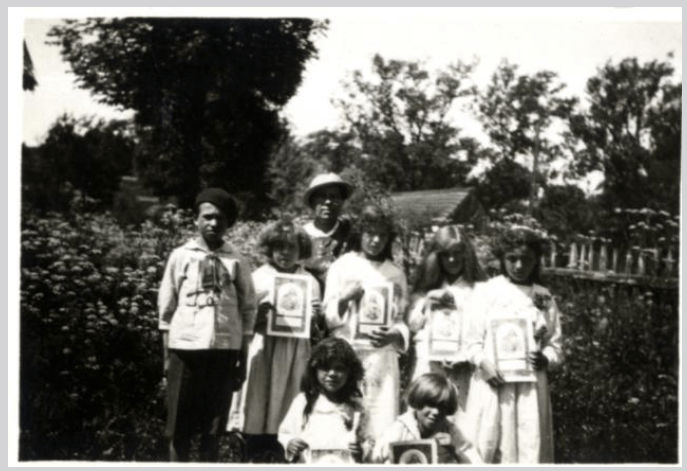
First Communion 1935, Hoczew
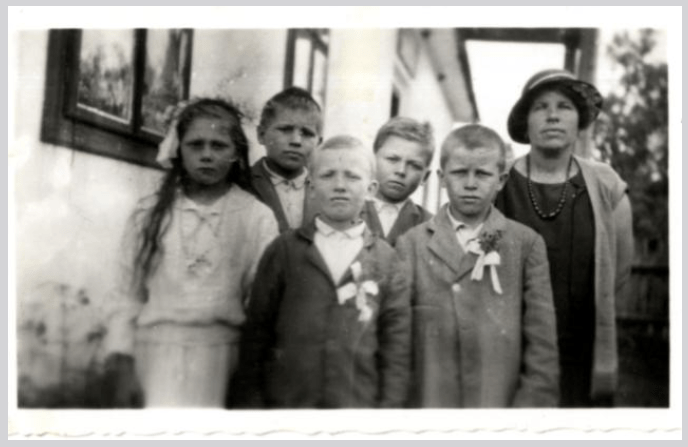
First communion 1933, Hoczew
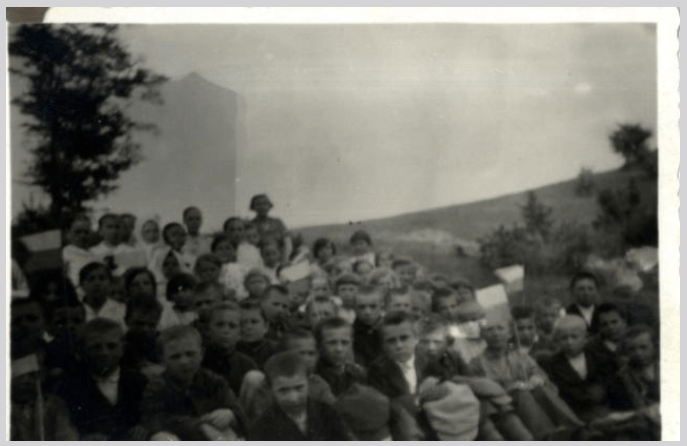
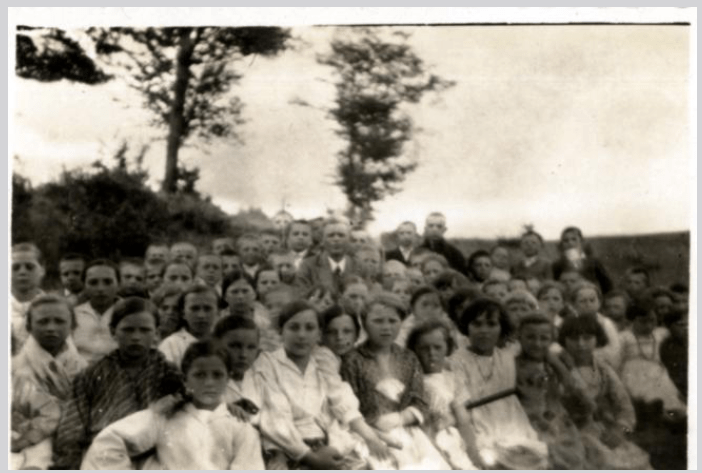
Forest Festival 1934, Hoczew
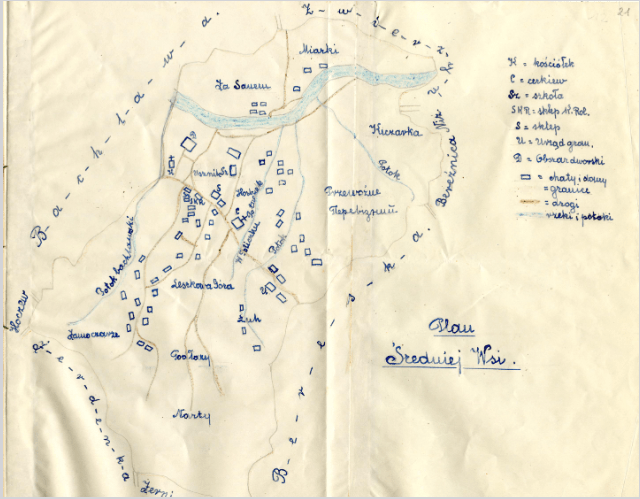
Średnia Wieś
An interesting and funny tale circulates about one of the local homesteads. Years ago, an old man is said to have lived in this homestead. He raised a devil for himself by carrying a chicken egg under his armpit for a long time. This little devil was said to be a great friend to his guardian. He protected him from misfortunes, helped with work, and even entertained children in the old man’s family. Before his death, the old man gave this devil to his children. And so the horned one lived in the homestead until recently, taking care of the old man’s descendants. Lately, he has become a great prankster, tormenting all the neighbors around. Namely: he would take various pieces of their underwear and clothing, tear them into narrow strips, and store them in his master’s attic, where he would allegedly see the master. The householder finally grew tired of this, because his neighbors would suspect him of theft; so he spread the word that he wanted to get rid of the devil and would gladly sell him.
After some time, with the help of a middleman, a wealthy gazda from the mountains in the vicinity of Cisna, approached the devil’s owner, declaring that he wanted to buy the devil (true fact). After some bargaining, again through the middleman, the for the devil was agreed upon for 60 złoty–whereby the middleman made 20 złoty. It was packed tightly into an old pot, and the satisfied buyer drove away.
After some time, however, the devil enthusiast arrives back in Średnia Wieś and announces with regret that the devil has escaped him. Nobody could help him with this, however, because the devil could not be caught a second time, and he settled contentedly back in his old place.To this day, they say, the farmer lives with the devil and does quite well for himself. Only he and his family are pale, as if lifeless, of a gloomy disposition; and his sons are mentally dull (though they went to school). The father does not go to church, and everyone predicts a miserable end for him, because “once someone falls into the devil’s claws, they will never break free from them.”
People here also believe that upiórs (vampire in Rusyn) live among them. This upiór cannot be recognized during his lifetime because he is just like any other person; however, they maintain that he has two hearts and harms ordinary people. After death, however, upiórs must do penance within their homestead for as long as it takes for the family to make some offering to God, or order a Holy Mass for his soul.
There are still “płanetnicy” among the inhabitants here, who rule over weather changes, direct hail and great storms. When one of them dies, and God does not allow another to appear, then great hailstorms and tempests prevail.
The majority of the population believes that this year’s hail was so destructive only because a month ago an old farmer died, who, according to everyone’s belief, was a “płanetnik.”
Despite these superstitions, the local people are devout, claiming that one must not anger God, nor irritate the devil.

Questionnaires without monsters
Łukawica, Postołów
Solina
Bereska
The local population believes that on the first night after the funeral, the soul of the deceased comes back to ask for help, which is why they place bread, salt, and water on the table. The items remain there until morning, after which they are given to the poor.
They put poppy seeds into the coffin. They believe that the deceased returns, so to prevent them from having time to come back, they give them poppy seeds. The deceased counts them from the evening, and before they can finish counting, midnight passes, causing them to stay in the grave.
They place water and a cloth on the windowsill, believing that the soul of the deceased comes to wash itself. It is a local custom during the first week to offer a Holy Mass for the soul of the deceased, so that the soul from the other world does not return.
They believe that a cat crossing the road portends misfortune and failure. If someone walking is crossed by a person carrying an empty bucket, they also predict misfortune and failure. Seeing a priest walking or driving past, when going on some business to an office etc., portends misfortune; to reverse this, they throw straw onto the bare ground. A passing Jew portends good luck. On Christmas, boys are the first to walk among the cottages, and as “pobażnicy” they bring good luck for the whole year, whereas the arrival of a girl is not welcomed, because it portends bad luck.
After Christmas Eve, they extinguish a candle; if the smoke from the flame turns toward the door, someone will die, but if it whirls around the candle, it portends a wedding.
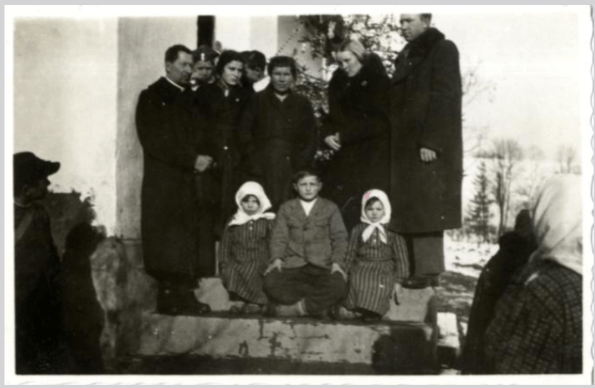
Christmas celebration, Bereska, 1936
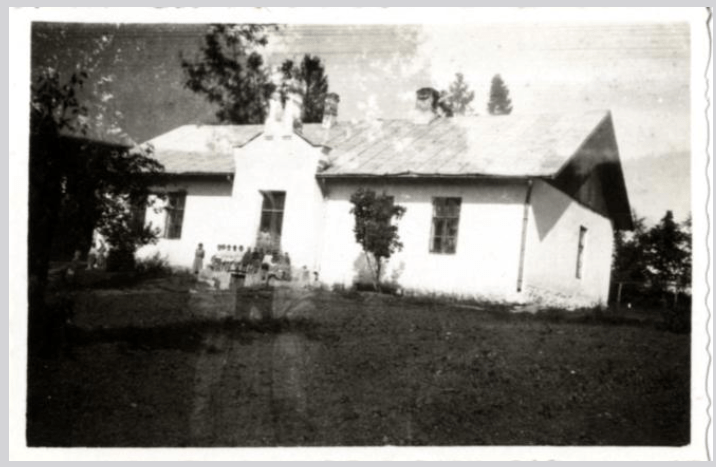
Easter in Bereska
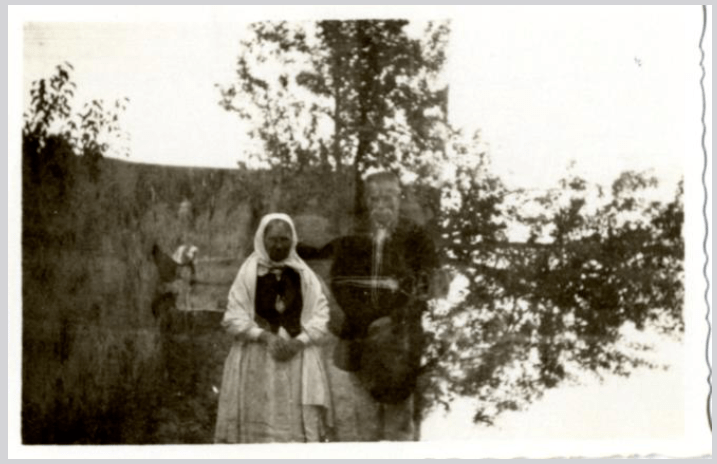
Festive attire, Bereska
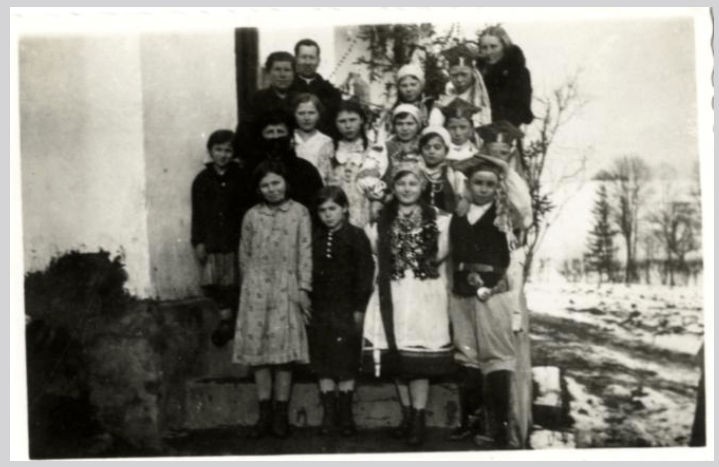
Nativity play “Szopka krakowska,” Bereska, 1936
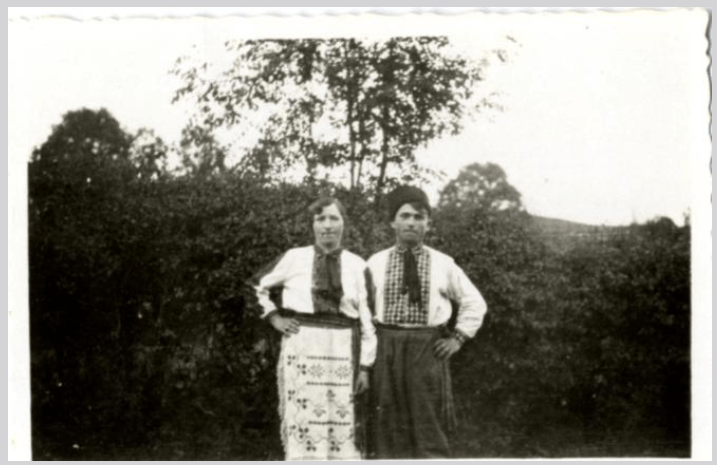
Festive attire of the youth in Bereska
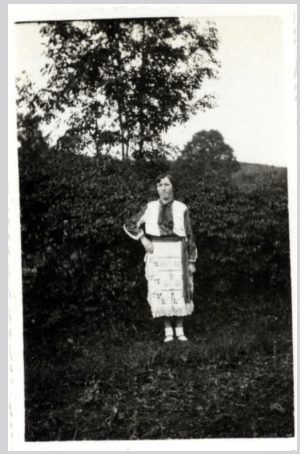
A girl in national dress, Bereska
Myczków
There are very many divinations and superstitions among the local people. On long winter evenings, it is not the threads of fairy tales or legends that gather everyone by the fireplace to listen, but rather fears of ghosts and spooks flow from the mouths of old people. If someone dies, a bowl of water and a handkerchief are left on the table in the room for the night, so that the little soul can wash itself; and it has happened–this one and that one has seen it–the bowl has moved and the handkerchief too, and they believe it. Everyone believes in this. They like to chat about it in the evenings.
A child was born stillborn. They buried it and forgot it. After six years someone spoke of a ghost appearing under the windows of the cottage. It was the soul of that child, demanding baptism, so one must throw it a piece of linen cloth and make the sign of the cross over this little soul, and it will stop returning because it will become a little angel in heaven.
Zawóz
In the “olden times”, when people drank vodka by the cupful, stories arose about ghosts and terrors created by the alcohol-clouded mind. Today, they no longer believe in this. Only beliefs in upiory persist. An “upiór” is a dead person who had two hearts. He walks after death and terrifies people, most of all his family. To prevent this, a harrow tooth is driven into his skull. Since the upiór only walks until midnight, poppy seeds are poured into his mouth. Before the upiór can sort through the poppy seeds, midnight passes, and he no longer has time to walk.
They believe more in superstition. For example, if someone dies in the village, nothing can be sown, because then that crop will also die. You also cannot sow during a new moon, because just as the moon is empty, the ear of grain will be empty too.The days of the week are divided into “men’s” and “women’s”. There are two women’s days: Wednesday and Saturday (they also include…). Women’s days are not lucky. For example, broad beans planted on a woman’s day will never grow!…
…Several dozen years ago, a great number of “reptiles” could be found here. They could be encountered everywhere: in the barn, in the stable, even in the hallway. Because of this, the fable “of the king of snakes” has survived to this day. Such a king has a diamond of immense value on his forehead. Sometimes the king goes to the river to bathe, and then he takes off the diamond. Many a brave soul has already tried to steal the diamond. However, the snake-king always noticed it in time. At his whistle, all the snakes would gather and kill the brave soul.
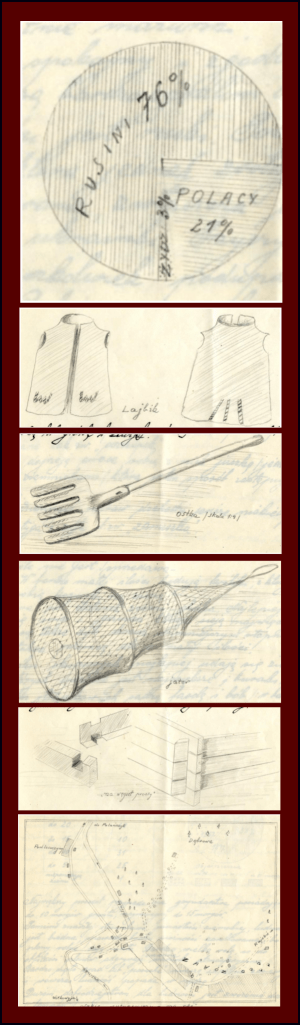
Bukowiec
If a deceased person has feathers under their armpit or if their body does not stiffen after death, they are considered an upiór. A harrow-tooth stake is driven into such a deceased person’s head, and poppy seeds are poured into their mouth. When the coffin is carried from the house to the church, poppy seeds are scattered along the entire path to prevent the upiór from returning home; for if it tries to come back, it must pick up every single seed, and by the time it finishes, the rooster crows, forcing the dead to return to the grave. An upiór’s grave can be recognized because on the very first night after the funeral, upon leaving the grave, he leaves a hole. When the procedure with the poppy seeds and the harrow peg has not been performed, they drive a peg wrapped in straw or hay into this hole in the grav.. According to belief, a stillborn child will wander the earth for seven years; to prevent this, a band made of new linen—sprinkled with holy water—is placed on the child, and they are given a name and some money. Then, the “mułuchid” will no longer haunt the living, for upon rising from the grave, it will find its name and return to its resting place.
A housewife whose cows milk well is a witch–she knows her way with cows. You must not show her butter or milk from another cow, or she will steal that cow’s milk. On the Feast of the Annunciation of the Blessed Virgin Mary, witches go around stables and steal milk from cows. On this day, witches also make butter. On Ash Wednesday, women are not allowed to enter someone else’s house, because they would steal milk from the cows and eggs from the hens. On this day, women and girls stay at home. In order for cows to breed well and milk well, on October 1st on “Pokrow”, cattle are grazed all day, and they do not milk cows because they dedicate the milk to the Mother of God. Anyone whose cattle do not breed well makes a promise that they will not consume milk on any Monday. This promise is made during confession.
On the eve of the holiday, i.e., on the eve of the annual holiday, they place nettles, an axe – a hatchet, and a plowshare into the stable. In this way, they protect themselves against witches. Then the witches then have no access to the stable. Witches deliberate, meaning they gather for “evening parties” where three borders meet. There, on windy nights, upiory fight each other.
As for the piety of the local people, one must acknowledge their deep reverence for all things sacred. They pray and attend the cerkiew, frequently receiving the sacraments—though this applies mostly to the older generation, as the youth are of a different spirit. Yet, this piety is strangely intertwined with curses and imprecations—invoking God’s wrath or lightning strikes, or calling down monstrous curses upon others—using epithets like “you spotted viper” and other names too foul to mention. They attribute natural phenomena—such as winds, storms, hail, and lightning—to God’s punishment for sin; for instance, they believe hail causes damage when a young woman buries an illegitimate child, as the rain and hail must wash those children out of the earth…
… Old folk say that 200–300 years ago, a morowica and a morawiec—representing the black plague—passed through the village. They came to the river and asked a farmer named Drozd to carry them across the water. As Drozd was carrying them across the river, they felt as heavy as the world itself because they held dominion over the entire world. Once they were on the other side of the river, they ordered Drozd to light a candle every year through the entire Christmas Eve night. The morowica went into an empty house in the forest, where she began to dance with the morawiec and sing: “Let there be no terliczyk, let there be no tendiawa, so that all the children will be ours.” Terliczyk and tendiawa are herbs that protect against the plague. To this day, Drozd’s descendants light a candle on Christmas Eve.
This same Drozd did not want to believe that Easter is the greatest day of the year. On Easter Sunday, he went out into the field to plow with oxen, and there he, along with his oxen, turned to stone. This stone can still be seen on the border. As a punishment, all of his descendants still light a candle on Easter night, from Sunday into Monday.
Terka
The local population of the village believes in upiórs and witches. An upiór is recognized by the fact that when he dies, he has feathers under his armpit, while an upiór’s grave can be recognized by the fact that the magical being, leaving the grave on the first night after the funeral, leaves a hole in the grave. Immediately after death, a harrow tooth must be driven into the vampire’s head, and poppy seeds must be scattered during the procession to the cemetery, because if he wants to return, he must gather all the poppy seeds. A witch is usually what they call an old woman who has highly productive milk cows. You must not show her milk or butter, or she will steal the magic. In this village, there is one such woman considered to be a witch, and they say she goes at night to crossroads, or where three borders meet, and there she fights with other witches. The next day, this woman is weak and has bruises on her body.
No work should be started on a Monday, because it will not succeed, and it will have to be repeated throughout the entire week. Crop failures occur when Polish and Rusyn holidays coincide in the same year.
When cattle produce little milk, the farmer makes a vow that he will fast from milk every Monday. Children are generally breastfed for a long time, usually up to 2 or 3 years. A child should not be weaned at any other time except when the beeches are budding.
At Christmas, if someone from the household goes out into the yard, walks around the entire house three times while touching the corners, and looks through the window, they can see who will get married, die, etc. this year. The local people are pious in their own way. They attend the church and take part in feast days, sometimes in distant villages. Despite this, religious morality remains low. People consider all natural phenomena to come from God’s will. Everything is generally seen as a punishment for sins. For example, hail only destroys crops when girls bury illegitimate children. Rain must wash away the bodies of these children. People say prayers daily, but often distort them in their own way.
There is a story about a “wątkopak” (kupaku). A woman was washing clothes “in the dead” at the stream and a wątkopak arrived, a huge beast that devoured people. It said that it would eat this woman when she finished washing.She was very scared and washed for a very long time. Out of fear, she turned into stone and remained there at the stream as a large stone, which people still show each other to this day.
Rajskie
If a mother has a small child that dies unbaptized, it returns to the mother after 7 years to weep under the doors. This phantom is called ‘maluchid’. So that such a child does not haunt, a linen band is placed on its chest, a coin is placed underneath, it is sprinkled with holy water, and it is given a name. When the child returns after 7 years to haunt, it finds its name and returns to the grave.
They believe that inside every toad a witch is hidden by spells, and every toad can spoil a cow’s milk. If someone were to cut off, for example, the leg of a toad in which a witch resides, then that woman will be missing a leg. Witches wander most before the feast of St. George and before the feast of]the Most Holy Virgin Mary; they wander through stables and steal milk, which is why farmers guard the stables by sleeping in the yard. So that the cattle will give milk well, on “Pokrow” cows stay out in the field the whole day without being milked; the milk from this day is offered to the Mother of God. There are cases when someone’s cattle do not thrive well, then the housewife swears to the priest during confession to always fast with the whole family on Mondays, and they keep to this.
…According to their view, all natural phenomena come from God; God also sends a good harvest, misfortunes upon people, such as diseases, etc. Lightning strikes where girls bury illegitimate children.
Questionnaires without monsters
Bóbrka, Górzanka, Myczkowce, Polańczyk, Solina
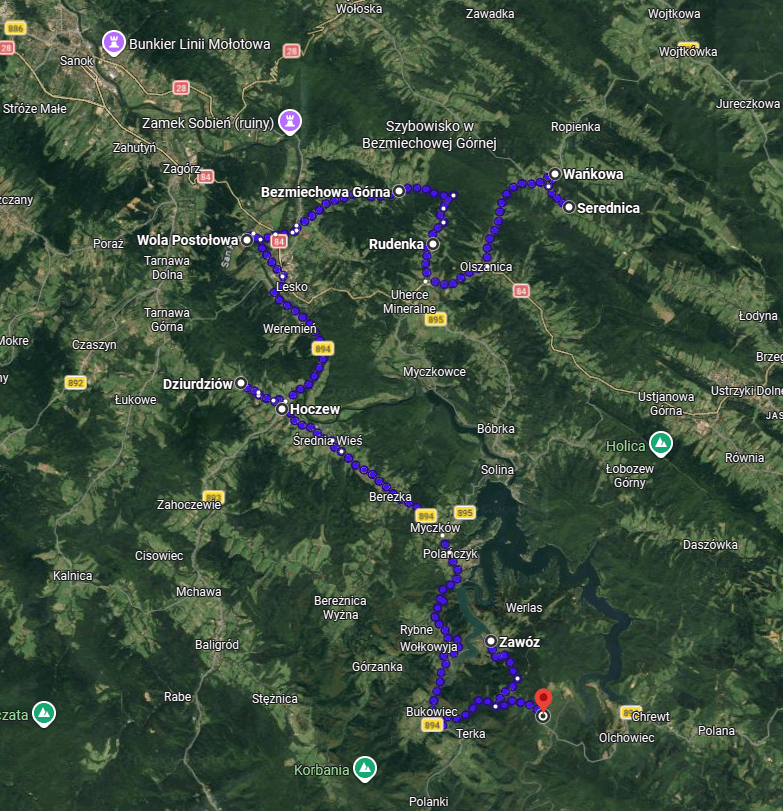
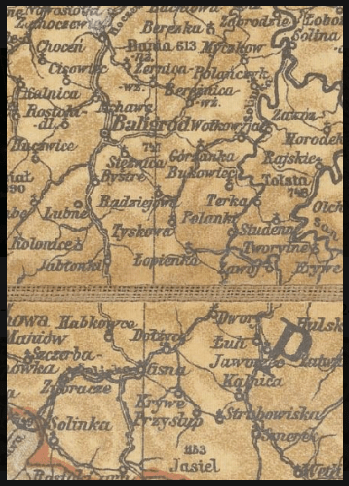
Baligród
Żernica Wyżna
The soul of the deceased returns home for an entire week, and during this time, a bowl of water must be left out because the soul washes away its sins at night. If a father or a mother dies, it is forbidden to strike even a single corner in the cottage for a whole year.
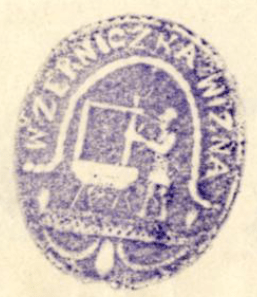
Stężnica
Regarding the deceased, they believe here, for example, that if a hen were set on eggs in the year a household member died, it would be hard for the deceased to lie in the grave, as they would feel a heavy weight on their chest.They also do not plant garlic in the year of a household member’s death, because it would not grow for seven years. A small bowl of water is placed on the window sill so that the soul of the deceased can bathe.
Rabe
The population is very superstitious and suspicious. After a husband’s funeral, they wash their hands and faces in a stream, and in winter with snow. At home, they touch the stove with their hands. To prevent the deceased from coming back, they throw poppy seeds into the grave. If there is a flood, they say that a woman buried a child in the ground and the water must wash it out. If there is no rain, they throw poppy seeds into the stream, and this is supposed to bring rain. If someone’s breeding of cows or sheep does not go well, whoever they bought them from gave them with an “evil hand.” They will not bring butter to another village, or their own will run out. They put nettles into the hearth so there will be no mice in the house. When a child is born, they put an object into its hand so it will love working later on. They wash the bathwater depending on the gender—if it is a boy, they use peas so he will have curly hair, and if it is a girl, they use rye. Superstition is encountered here at every turn…
…There are few legends and fairy tales. Barely one legend is known. In the forest, there is a stone, and around it an anthill. The elders say that a very long time ago, on Easter Sunday, an orphan girl was pasturing sheep and spinning flax. God punished her in such a way that He turned the girl into a stone and the sheep into the anthill’s mounds.
Questionnaires without monsters
Kołonice, Mchawa, Nowosiółki, Roztoki Dolne, Zahoczewie, Żerdenka, Bystre and Łubne
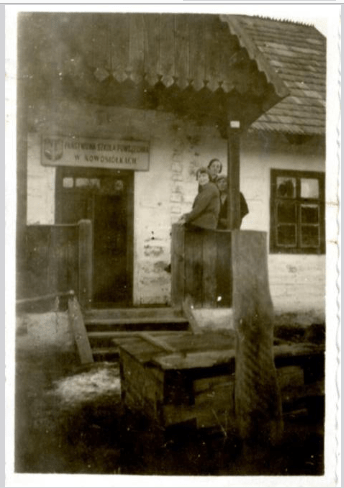
School in Nowosiółki
Cisna
Dołżyca
People believe that there are witches who take away butter and milk from cows, and on St. John’s Day, they weave wreaths of yellow flowers and put them on the cows’ heads. It is then that the witches enter among the cows and take away the milk—these witches are called ‘bosorkyni’. From the stable, she will take a piece of the threshold or a piece of coal. The witches dress in black skirts, a white blouse, and a white headscarf tied under the chin. They go into the stable and into the field—they say there are six ‘bosorkyni’ in this village. They know the appropriate herbs…
…They believe that the dead walk—that people have two souls—and that they haunt the living; even now, the soul walks and haunts. In one room in this village, there is said to be a presence that strangles women—it has already strangled four—and every year a corpse must appear in that room; someone is bound to die there, and the walls of the room must not be washed for a full year. They mourn for a year and are not allowed to go to weddings, sing, or wear fine clothes.
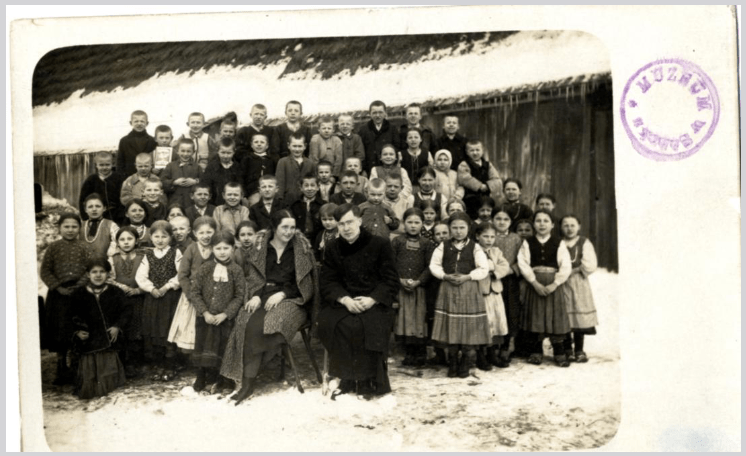
Smerek
The spiritual culture of the local people lies entirely within the richness of their songs (kołomyjki), fairy tales, and parables. These reflect a person’s worldview, formed on the basis of self-generated principles. When characterizing the general worldview of such a person, it is difficult to find an appropriate scientific term to define it. In any case, it is based on idealism, rarely breaking away from it, except for moments of fearful fatalism. Conservatism, lack of activism, and indifference in certain areas of life—these are the terms that would approximately define the worldview and character of the man of the mountains. In the field of folk creativity, there have been preserved until now songs, fairy tales, a wide stock of imagination, not very rich phrases or comparisons, but deep in terms of sentimental feelings. I will give a few such songs just as an example, heard directly…
… On this, one could conclude the illumination of the worldview of the mountain people regarding the manifestations of life, reflected in the examples of the above kolomyikas.
And now we shall proceed to new sources. These are customs and traditions, beliefs and superstitions. Belief in the afterlife is authentically closely linked with the belief in spirits. The appearance of the spirits of certain people is firmly established here, although real details to confirm them are lacking. But before we move on to discussing them, we shall return to the local funeral custom.
If a family member dies at home, the oldest member immediately notifies the local priest “paroch” in the meaning of a parish priest. Next he goes to the church servant; the sexton, who gives him light from the cerkiew and announces the death of a community member by tolling the bells. From the moment of death until the time of the funeral, the residents of the house affected by the tragedy of death are required to walk without hats, which they strictly observe. The bell-ringer, announcing a person’s death, strikes only a single bell. Upon hearing its sound, no one makes the sign of the cross, because otherwise, their hand would wither. Once these first formalities are taken care of, they proceed to dress the deceased. The deceased is bathed in a large wooden vat or tub, washing the body with a wet cloth and soap (soap being an item almost never used in daily life). — Next, they dress him in a white shirt, tied at the neck with a narrow ribbon called “ołonecza”, and pull white linen trousers, “gacie”, over the lower part of the body. On the feet, they pull white stockings, purchased in town or sewn from homemade linen. The dressed deceased is laid on a bench under the window, after spreading a linen sheet beneath him and folding another under his head. Candles burn at the head on both sides. The poor, who cannot afford this, take small jars of butter from the cerkiew—donated by people—and these substitute for candles. In front of the deceased’s head, they place a cross with the Crucified Christ. As a sign of mourning, they do not sweep the rooms for as long as the corpse lies in the cottage. After making the coffin—which is mostly done by the masters of the house themselves—and after digging the grave at the cemetery (this task is performed sequentially, cottage by cottage), they proceed to the funeral. Into the coffin next to the deceased, they place various of their favorite objects. Little boys are given small wooden axes, little girls a wreath on their head and a handkerchief in their hand (a symbol of marriage). Infants are given money in their hands so that they have something to ransom themselves with in heaven. When nailing the coffin lid, they cover it with a piece of linen cloth, which then becomes the property of the parish priest. To the church banners, they tie strands of linen yarn so that the deceased does not walk naked in the afterlife. At children’s funerals, instead of yarn, they give white handkerchiefs symbolizing innocence. When carrying the coffin out of the room, it is struck three times against the threshold as a sign of farewell. On the road, they place the coffin on a sleigh, from where it is pulled by oxen or horses all the way to the cemetery. Upon moving from the spot, they pour a bucket of water behind the coffin, symbolizing the tears of the household members. While moving towards the cemetery, and even before that, the household members, or hired people, express their laments for the deceased. These wails are called “jojkania.” As an example, I will quote a short excerpt from these laments. Most often, such laments are led by two people, competing to find the most painful expressions. Here is an example.
First Mourner: Oh, mother, our mother, why did you die to us so soon.
Second Mourner: Oh, mother, my mother, who are you leaving us to?..
First Mourner: Oh, dear mother, when will you return to us?..
Second Mourner: Oh, dear mother, what will we do without you?..
First Mourner: Oh, our little dove, our dove! Why didn’t you tell us that you were going to die!?..
Second Mourner: Oh, why didn’t you manage to let us know,
First Mourner: Oh, will we see you again at the Last Judgment!?…
Second Mourner: Oh, will we see you, dear mother, in the Valley of Josaphat… etc.
And now about the details related to life beyond the grave. As I mentioned previously, the spirits of the deceased wander here. These spirits are good and bad. The latter cause harm to people, and they can even kill. The first procedure aimed at driving them away is to say prayers over the grave and sprinkle the rooms with holy water. If this does not help and the spirit continues to terrorize the household members, one must dig up his grave and cut off his head, placing it between his legs, or drive an iron stake into the head. It is easy to understand that a person can be driven to such barbaric actions only by a panic fear of spirits. Besides spirits, they also believe in evil forces. These can manifest in the form of the devil, or his power incarnated in a human being. A witch (bisurmanka) is the only power that can steal a cow’s milk, curse a family, or bring down natural disasters upon them, such as diseases, hailstorms, and floods. Herbs play a major role in such practices. Poisonous herbs, which bring illness or madness upon a person, are known only to a few. Therefore, such people evoke general fear and admiration among the masses… Medicinal herbs, of which many grow in the mountains, do not, however, have enthusiasts who would utilize them for the benefit of human health. They say that sorcerers go to gather herbs (mostly harmful ones) on St. John’s Night to the so-called “Rjabu Skała”, which is located in the area. How much truth there is in this is difficult to investigate, because so far no one has caught anyone engaged in such magical practices. Many magical and fortune-telling practices and methods are preserved with special care. Betrayal of these secrets would threaten serious consequences for such a person.
Therefore, it is understandable and clear that bringing them to light and including them in this questionnaire is currently impossible. Perhaps, when the people realize their “ridiculousness” and “ineffectiveness,” they will speak about them on their own without being questioned about what is now difficult to extract.
Questionnaires without monsters
Buk, Cisna, Łopienka, Solinka, Strubowiska, Żubracze
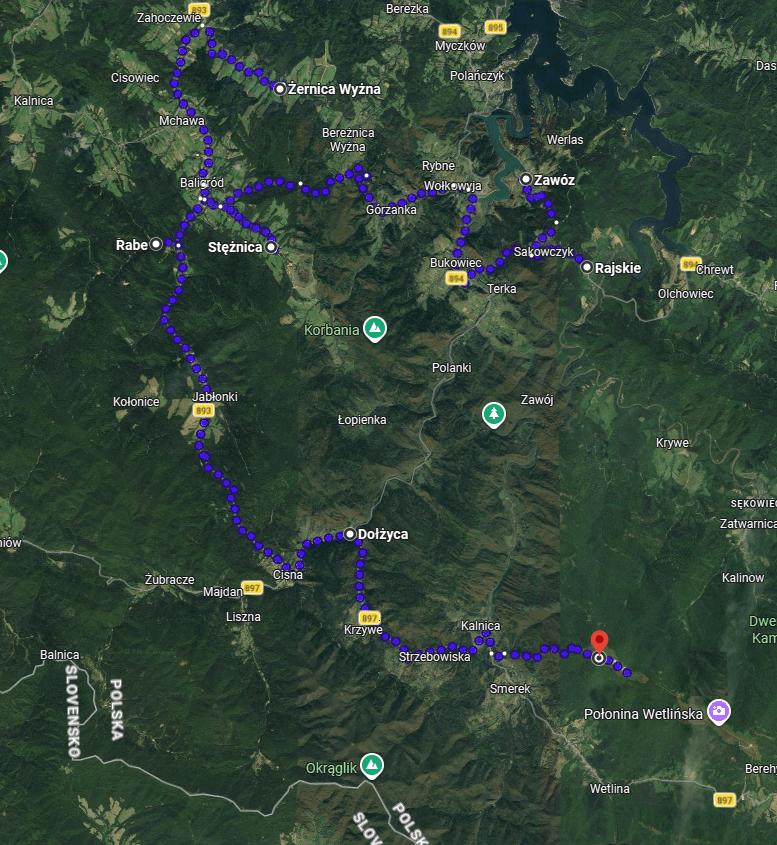
Images are found within the questionnaires, themselves, and are in the public domain. Please credit the Sanok Digital Library, not this site. Route maps from Google, vintage Galicia map from polona.pl, translations by Google.
<– Previous: Komancza Gmina
Bieszczady County: Next –>

