Wola Postołowa is a village in Lesko Commune, Lesko County.
Wola Postołowa– wieś w gminie Lesko, w powiecie leskim.
Transcript: Google-Powered
Warning: this transcription may be terrible. It was done electronically by someone who can speak neither Polish nor Ukrainian/Lemko. Do you wish to see it improve? You can help! Contact us.
Uwaga: ta transkrypcja może być fatalna. Została wykonana automatycznie przez osobę, która nie zna ani języka polskiego, ani ukraińskiego/łemkowskiego. Chcesz, żeby była lepsza? Możesz pomóc! Skontaktuj się z nami.
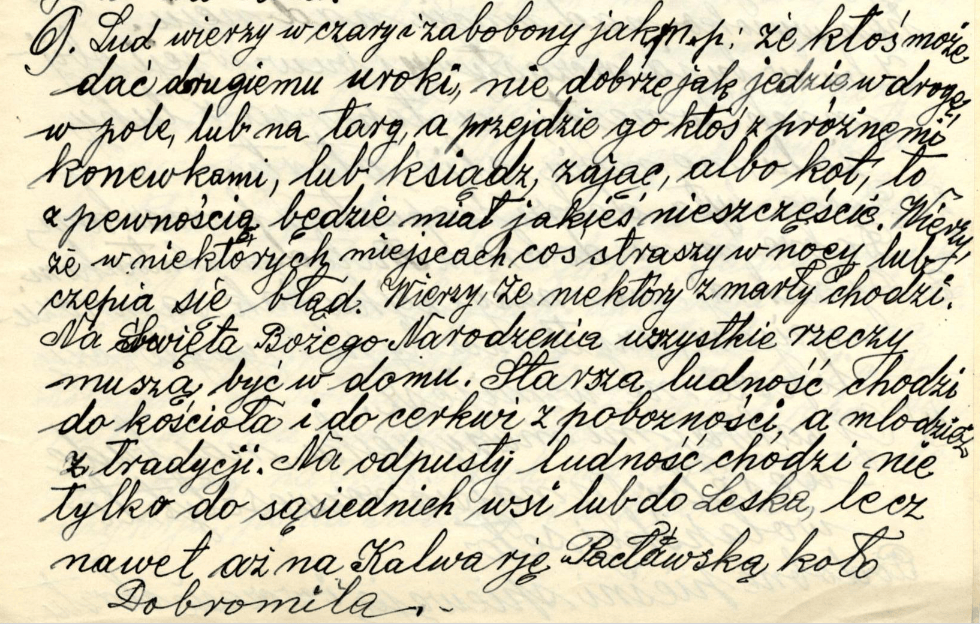
6). Lud wierzy w czary i zabobony, jak np: że ktoś może dać drugiemu uroki; nie dobrze, jak jedziesz w drogę w pole, lub na targ, a przejdzie go ktoś z próżnemi konewkami, lub ksiądz, zając, albo kot, to z pewnością będzie miał jakieś nieszczęście. Wierzy, że w niektórych miejscach coś straszy w nocy lub czepia się błąd. Wierzy, że niektóry zmarły chodzi. Na Święta Bożego Narodzenia wszystkie rzeczy muszą być w domu. Starsza ludność chodzi do kościoła i do cerkwi z pobożności, a młodzież z tradycji. Na odpusty ludność chodzi nie tylko do sąsiednich wsi lub do Leska, lecz nawet aż na Kalwarię Pacławską koło Dobromila.
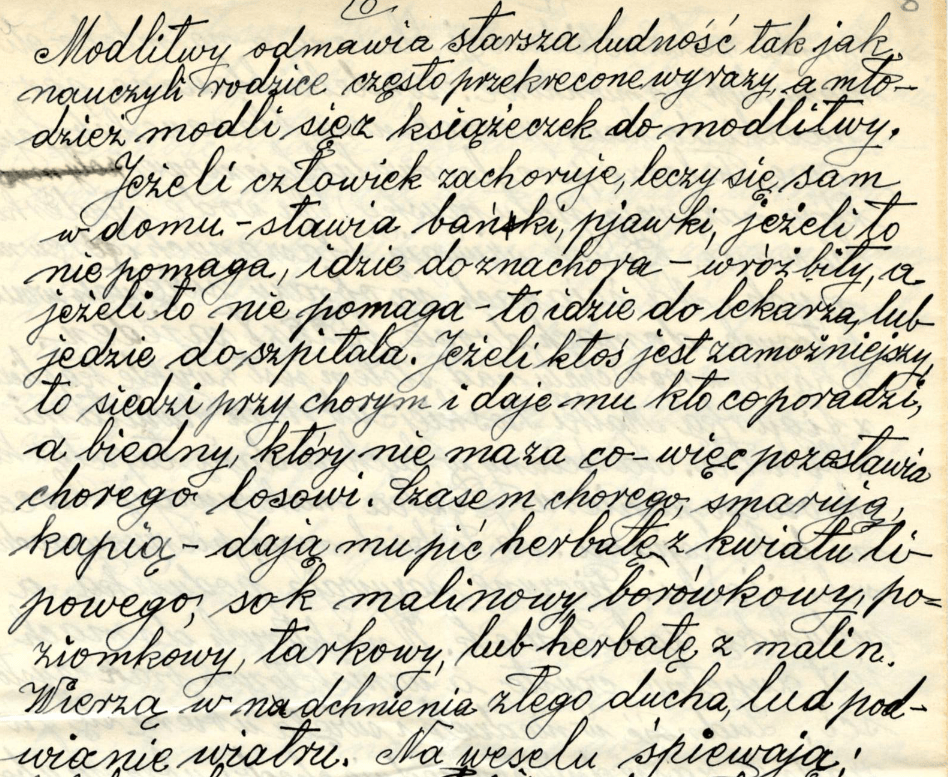
Modlitwy odmawia starsza ludność tak jak nauczyli rodzice często przekręcone wyrazy, a młodzież modli się z książeczek do modlitwy.
Jeżeli człowiek zachoruje, leczy się sam w domu – stawia bańki, pijawki, jeżeli to nie pomaga, idzie do znachora – wróżbity, a jeżeli to nie pomaga – to idzie do lekarza, lub jedzie do szpitala. Jeżeli ktoś jest zamożniejszy, to siedzi przy chorym i daje mu kto co poradzi, a biedny, który nie ma za co – więc pozostawia chorego losowi. Czasem chorego smarują, kąpią – dają mu pić herbatkę z kwiatu lipowego, sok malinowy, borówkowy, poziomkowy, tarkowy, lub herbatę z malin. Wierzą w natchnienia złego ducha, lud podwianie wiatru. Na weselu śpiewają:
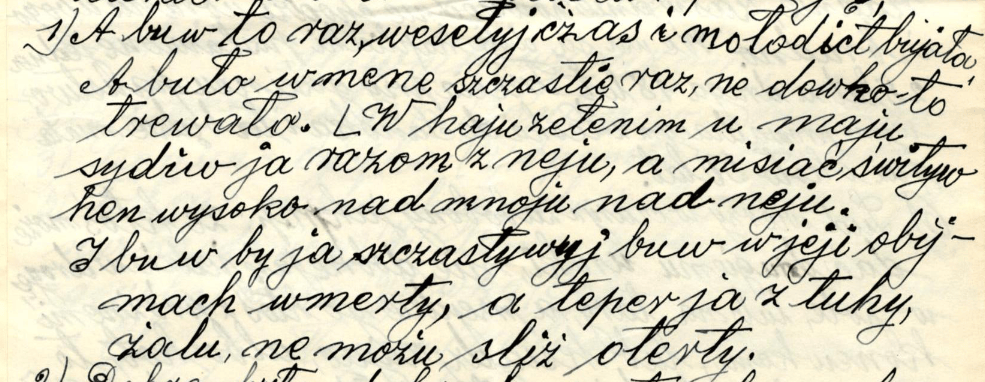
- A buw to raz, weselyj czas i molodicł bujała. A buło w mene szczastie raz, ne dowko to trewało. W haju zełenim u maju sydiw ja razom z neju, a misiać śwityw hen wysoko nad mnoju nad neju. I buw by ja szczastywyj buw w jeji obijmach wmerty, a teper ja z tuhy, żalu, ne możu śliz oterty.
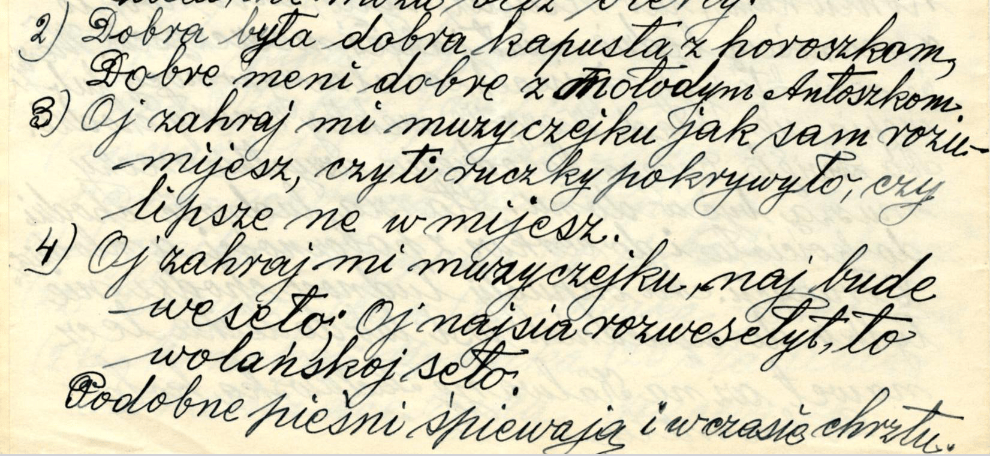
- Dobra była dobra kapusta z poroszkom, Dobre meni dobre z mołodym Antoszkom.
- Oj zahraj mi muzyczejku jak sam rozumijesz, czy ti ruczky pokrywyło, czy lipsze ne w mijesz.
- Oj zahraj mi muzyczejku, naj bude weselo. Oj najsia rozweselyt, to wolańskoj selo.
Podobne pieśni śpiewają i w czasie chrztu.
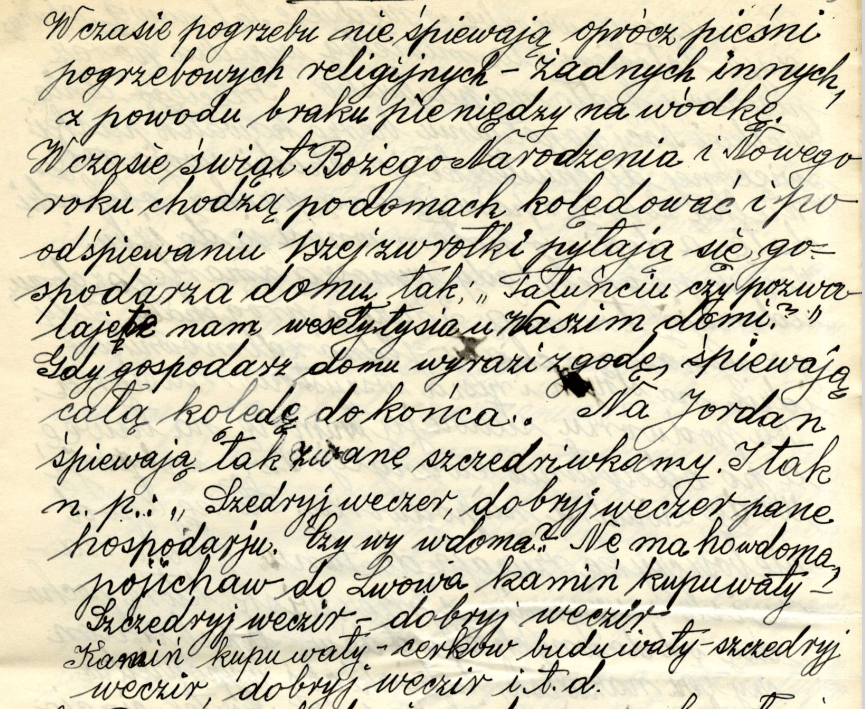
W czasie pogrzebu nie śpiewają oprócz pieśni pogrzebowych religijnych – żadnych innych, z powodu braku pieniędzy na wódkę. W czasie świąt Bożego Narodzenia i Nowego roku chodzą po domach kolędować i po odśpiewaniu jednej zwrotki pytają się gospodarza domu tak: „Tatuńciu czy pozwalajecie nam weselny tysia u waszym domi?”. Gdy gospodarz domu wyrazi zgodę, śpiewają całą kolędę do końca. Na Jordan śpiewają tak zwane szczedriwka my. I tak n. p.: „Szczedryj weczer, dobryj weczer pane hospodarju. Czy wy wdoma? Ne ma ho wdoma, pojichaw do Lwowa kamin kupuwaty? Szczedryj weczir – dobryj weczir kamin kupuwaty – cerkow buduwaty – szczedryj weczir, dobryj weczir i t. d.
English Translation: Google-Powered
Warning: this translation may be terrible. It was done electronically by someone who can speak neither Polish nor Ukrainian/Lemko. Do you wish to see it improve? You can help! Contact us.
Uwaga: to tłumaczenie może być fatalne. Zostało wykonane automatycznie przez osobę, która nie zna ani języka polskiego, ani ukraińskiego/łemkowskiego. Chcesz, żeby było lepsze? Możesz pomóc! Skontaktuj się z nami.
6). The common folk believe in sorcery and superstitions—for instance, that one person can cast a spell or “evil eye” upon another. It is considered a bad omen if, while setting out for the fields or the market, one encounters a person carrying empty pails, a priest, a hare, or a cat; such an encounter is certain to bring misfortune. They believe that in certain places, spirits haunt the night or that one might be led astray by a malevolent force. They also believe that the dead sometimes walk the earth. During the Christmas season, all household belongings must be kept indoors. The older generation attends church—whether Latin or Greek—out of genuine piety, while the youth do so out of tradition. For religious festivals (indulgences), people travel not only to neighboring villages or the town of Lesko, but even as far as Kalwaria Pacławska, near Dobromil.
The older generation recites prayers just as they were taught by their parents—often with distorted words—whereas the youth pray using prayer books.
When someone falls ill, they first attempt home remedies, such as applying cupping glasses or leeches. If these prove ineffective, they turn to a folk healer or a fortune-teller; should that also fail, they seek out a doctor or go to a hospital. Those who are better off may stay by the sick person’s side, offering various remedies suggested by others, while the poor—lacking the means—are often forced to leave the patient to fate. Sometimes, the sick are treated with ointments or baths, or given herbal teas—such as linden blossom tea—or juices made from raspberries, blueberries, wild strawberries, or sloe berries. They believe in the influence of evil spirits, or in the notion that a person might be “blown upon” (afflicted) by the wind. At weddings, they sing:
- Once upon a time, in a merry season, a young woman went out to roam. I once knew happiness, though it did not last long. In a green grove, in the month of May, I sat with her, while the moon shone high above us both. I would have been happy to die in her embrace; now, consumed by longing and sorrow, I cannot wipe away my tears.
- The cabbage with seasoning was good—oh, how good—and being with young Antoshko was good, too.
- Oh, play for me, musician—play however you know how; or have your hands grown stiff—or perhaps you simply don’t know any better?
- Oh, play for me, musician—let there be merriment! Let the whole village of Volanske be filled with joy.
Similar songs are also sung during baptisms.
At funerals, apart from religious funeral hymns, no other songs are sung—simply because there is no money for vodka. During the Christmas and New Year season, people go from house to house singing carols; after singing one verse, they ask the head of the household: “Dear father, do you grant us permission to bring joy into your home?” If the host consents, they sing the entire carol. During the Feast of the Epiphany (Jordan), they sing what are known as shchedrivky (well-wishing songs). For example: “A bountiful evening, a good evening to you, master of the house! Are you at home? He is not at home—he has gone to Lviv to buy stone. A bountiful evening, a good evening—to buy stone, to build a church—a bountiful evening, a good evening,” and so on.
Sanok Genes seeks to create a database of transcripts and English translations from the “Kultura Duchowa” sections from the 1936 Sanok School Inspectorate Questionnaires. The original documents are held by the Sanok Museum of History and digitized by the Sanok Digital Library. To learn more, see the project description.
Sanok Genes stawia sobie za cel stworzenie bazy danych zawierającej transkrypcje oraz tłumaczenia na język angielski fragmentów dotyczących „kultury duchowej”, pochodzących z kwestionariuszy Inspektoratu Szkolnego w Sanoku z 1936 roku. Oryginalne dokumenty znajdują się w zbiorach Muzeum Historycznego w Sanoku i zostały zdigitalizowane przez Sanocką Bibliotekę Cyfrową. Więcej informacji można znaleźć w opisie projektu.

