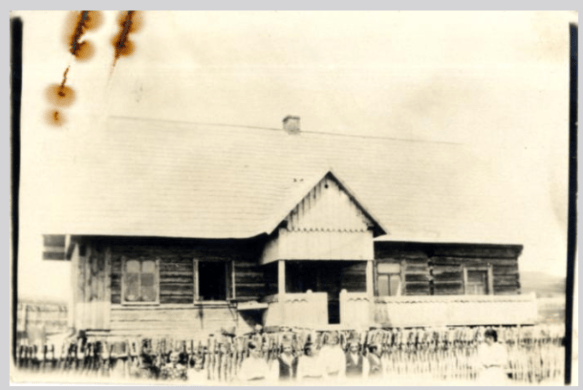
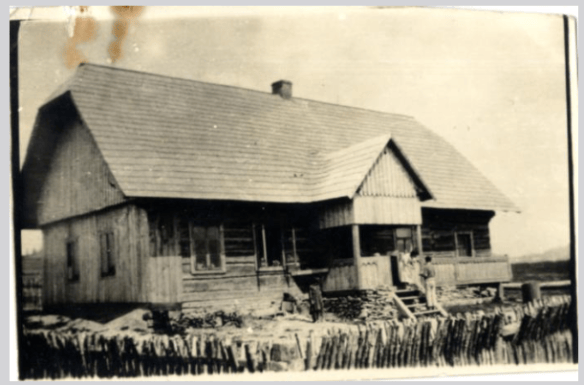
Rosochate is a village in Czarna Góra Commune, Bieszczady County.
Rosochate to wieś w gminie Czarna Góra, w powiecie bieszczadzkim.
Transcript: Google-Powered
Warning: this transcription may be terrible. It was done electronically by someone who can speak neither Polish nor Ukrainian/Lemko. Do you wish to see it improve? You can help! Contact us.
Uwaga: ta transkrypcja może być fatalna. Została wykonana automatycznie przez osobę, która nie zna ani języka polskiego, ani ukraińskiego/łemkowskiego. Chcesz, żeby była lepsza? Możesz pomóc! Skontaktuj się z nami.
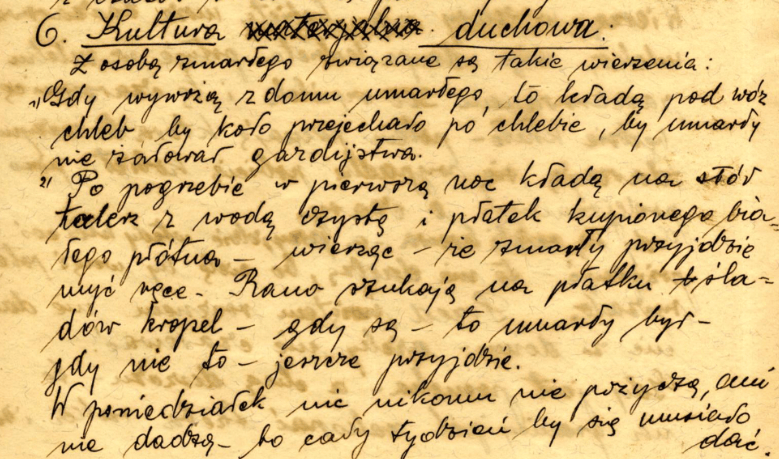
Z osobą zmarłego związane są takie wierzenia:
- Gdy wywożą z domu umarłego, to kładą pod wóz chleb by koło przejechało po chlebie, by umarły nie żałował gazdostwa.
- Po pogrzebie w pierwszą noc kładą na stół talerz z wodą czystą i płatek kupionego białego płótna – wierząc – że zmarły przyjdzie umyć ręce. Rano szukają na płatku śladów kropel – gdy są – to zmarły był – gdy nie to – jeszcze przyjdzie.
W poniedziałek nic nikomu nie pożyczą, ani nie dadzą – bo cały tydzień by się musiało dać.
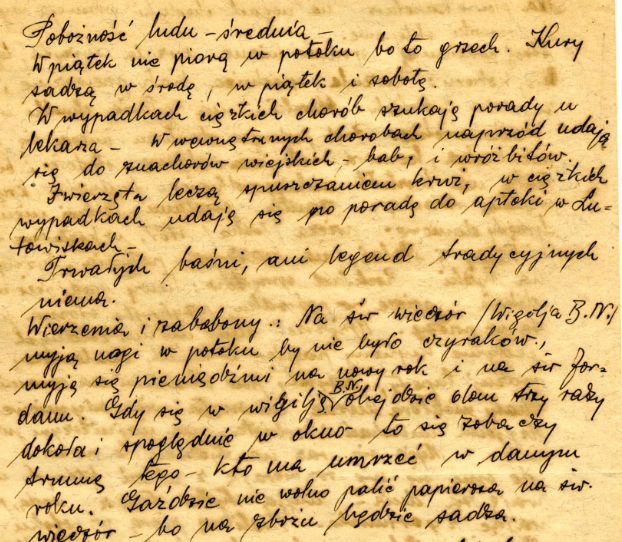
Pobożność ludu – średnia.
W piątek nie piorą w potoku bo to grzech. Którzy sadzą w środę, w piątek i sobotę.
W wypadkach ciężkich chorób szukają porady u lekarza – w lżejszych chorobach najprzód udają się do znachorów wiejskich – bab, i owczarzów. Zwierzęta leczą upuszczaniem krwi, w ciężkich wypadkach udają się po poradę do apteki w Lutowiskach.
Trwałych baśni, ani legend tradycyjnych nie ma.
Wierzenia i zabobony: Na św. wieczór /Wigilja B. N./ myją nogi w potoku by nie było osypisków, myją się pieniędzmi na nowy rok i na św. Jordan. Gdy się w wigilją B. N. obejdzie oborę trzy razy dokoła i spojrzy się w okno to się zobaczy strzygę tego – kto ma umrzeć w danym roku. Gazdzinie nie wolno palić papierosa na św. wieczór – bo na zbożu będzie sadza.
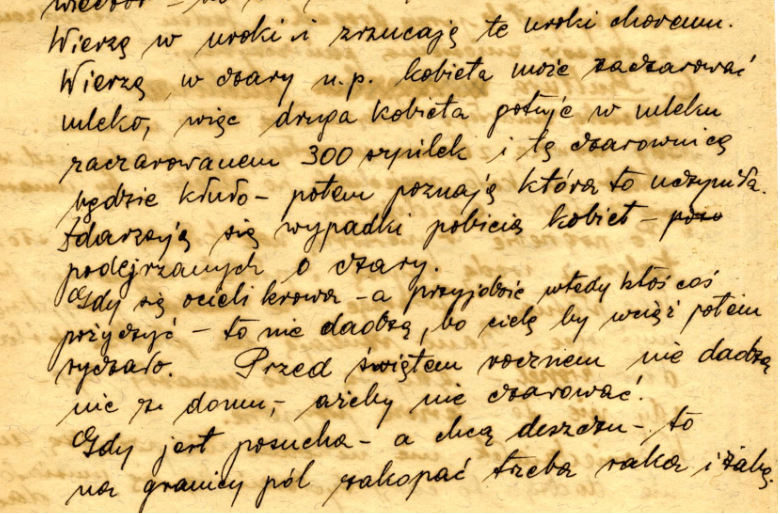
Wierzą w uroki i rzucają te uroki słowem.
Wierzą w czary n.p. kobieta może zaczarować mleko, więc druga kobieta gotuje w mleku zaczarowanem 300 szpilek i tę czarownicę będzie kłuło – potem poznają która to uczyniła. Zdarzają się wypadki pobicia kobiet podejrzanych o czary.
Gdy się ocieli krowa – a przyjdzie wtedy ktoś coś pożyczyć – to nie dadzą, bo cielę by wciąż potem ryczało. Przed świętem rocznem nie dadzą nic z domu, ażeby nie czarować.
Gdy jest posucha – a chcą deszczu – to na granicy pól zakopać trzeba raka i żabę.
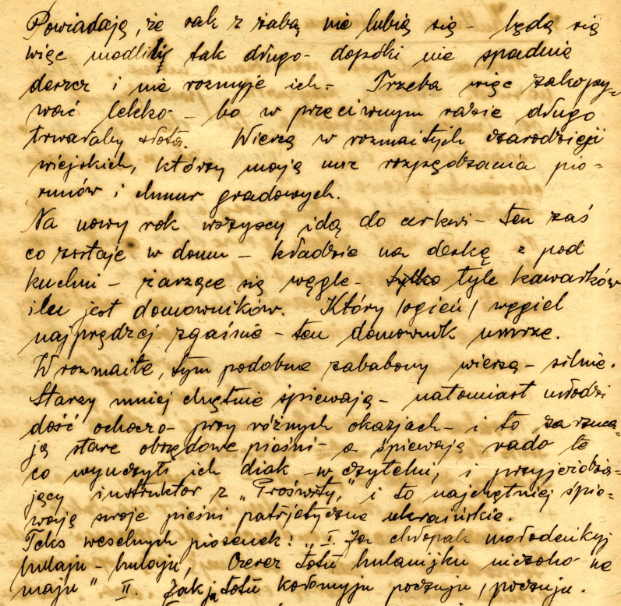
Powiadają, że rak z żabą nie lubią się – będą się więc modlili tak długo, dopóki nie spadnie deszcz i nie rozmyje ich. Trzeba więc zakopywać lekko – bo w przeciwnym razie długo trwałyby słoty. Wierzą w rozmaitych czarodzieji miejskich, którzy mają moc rozpędzania piorunów i chmur gradowych.
Na nowy rok wszyscy idą do cerkwi – ten zaś co zostaje w domu – kładzie na deskę z pod kuchni – rzucające się węgle – tylko tyle kawałków ile jest domowników. Który ogień i węgiel najprędzej zgaśnie – ten domownik umrze.
W rozmaite, tym podobne zabobony wierzą – silnie.
Starzy mniej chętnie śpiewają – natomiast młodzi dość ochoczo, przy różnych okazjach – i to za[wsze] są stare obrzędowe pieśni – a śpiewają rado to co wyczyta ich dysk w czytelni, i przyswoi jący instruktor z “Proswity,” i to najchętniej śpiewają swoje pieśni patrjotyczne ukraińskie.
okis wesołych piosenek: (i tu chłopak młodzieńczyk)
I. Hulażu – hulażu, Oreser tobi hulańsku nieoko na maju.
II. Jak ja sobie kożuszku podwyżu i podwyżu.
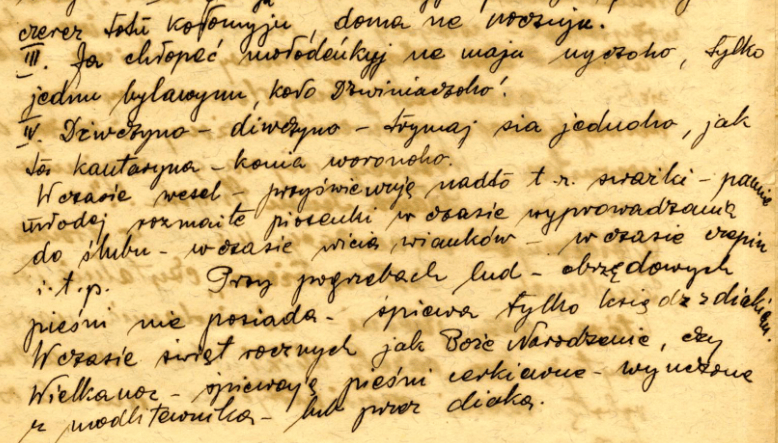
czerez tobi kożuszku doma ne noczju.
III. Ja chłopiec młodzieńczyk na maju wysoko, tylko jedne byławym koło Dwiwiazdko!
IV. Dziwoczno – diwoczno – trzymaj sia jednoho, jak ta kasztana konia woronoho.
W czasie wesel – przyśpiewują nadto t. zw. swatki – pannie młodej rozmaite piosenki w czasie wyprowadzania do ślubu – w czasie wicia wianków, w czasie czepin itp.
Przy pogrzebach lud – obrzędowych pieśni nie posiada – śpiewa tylko ksiądz z diakiem
W czasie świąt rocznych jako Boże Narodzenie, czy Wielkanoc – śpiewają pieśni cerkiewne – wyjęte z modlitewnika – lub żywot diaka.
English Translation: Google-Powered
Warning: this translation may be terrible. It was done electronically by someone who can speak neither Polish nor Ukrainian/Lemko. Do you wish to see it improve? You can help! Contact us.
Uwaga: to tłumaczenie może być fatalne. Zostało wykonane automatycznie przez osobę, która nie zna ani języka polskiego, ani ukraińskiego/łemkowskiego. Chcesz, żeby było lepsze? Możesz pomóc! Skontaktuj się z nami.
There are several beliefs associated with the deceased:
When the deceased is being taken from the house, a loaf of bread is placed under the wagon so that the wheel rolls over it; this is done to ensure the deceased does not pine for their farm or household.
On the first night after the funeral, a plate of clean water and a piece of white linen cloth are placed on the table, based on the belief that the deceased will come to wash their hands. In the morning, they check the cloth for water droplets—if any are found, it means the deceased has visited; if not, they are expected to come later.
Nothing is lent or given away to anyone on a Monday, as doing so would necessitate giving things away throughout the entire week.
The level of religious devotion among the people is moderate.
Washing laundry in the stream on a Friday is considered a sin. Planting is done on Wednesdays, Fridays, and Saturdays.
In cases of serious illness, people seek advice from a doctor; for milder ailments, they first turn to village healers—specifically elderly women or shepherds. Animals are treated by bloodletting, though in severe cases, people seek advice from the pharmacy in Lutowiska.
There are no enduring traditional folktales or legends.
Beliefs and superstitions: On Christmas Eve, people wash their feet in the stream to prevent skin eruptions; they also “wash” themselves with coins on New Year’s Day and on the Feast of the Epiphany (St. Jordan’s Day). It is said that if one walks around the barn three times on Christmas Eve and looks through a window, one might see the strzyga (a malevolent spirit or omen) of someone destined to die that year. A woman of the household is forbidden from smoking a cigarette on Christmas Eve, as it is believed this would cause soot to appear on the grain crops. They believe in spells and cast them using words.
They believe in sorcery—for instance, a woman might bewitch milk; in response, another woman might boil 300 pins in that bewitched milk, which causes the witch to feel sharp, stabbing pains—thereby revealing her identity. There have even been instances where women suspected of witchcraft were beaten.
If a cow gives birth to a calf, and someone happens to come by to borrow something, they will refuse—fearing that the calf would otherwise bellow incessantly. Before an annual religious holiday, they will not lend anything from their household, lest they inadvertently cast a spell.
During a drought, if they desire rain, they must bury a crayfish and a frog at the edge of their fields.
It is said that crayfish and frogs do not get along; thus, they will “pray” [struggle against one another] until rain falls and washes them away. They must be buried only shallowly, however—otherwise, the wet weather might persist for too long. They also believe in various “urban” sorcerers who possess the power to disperse lightning and hailstorms.
On New Year’s Day, everyone goes to the Orthodox church; those who remain at home take glowing embers—one for each member of the household—and place them on a board taken from beneath the kitchen stove. The person whose ember goes out first is destined to die.
They hold a firm belief in these and various other similar superstitions. Older people are less inclined to sing, whereas the young do so quite readily on various occasions—though these are almost always traditional ritual songs. At the same time, they also sing whatever they might come across in a reading room or learn from an instructor from the “Prosvita” society; most of all, they enjoy singing their own Ukrainian patriotic songs.
A selection of lighthearted songs: (sung by a young man)
I. Revelry, oh revelry—because of you, I have no peace!
II. Because of you, my sheepskin coat, I cannot spend the night at home!
III. I am a young lad—and I’ve been all over, even as far as Dviviazdko!
IV. Maiden, oh maiden—hold fast to your chosen one, just as one holds the reins of a spirited black horse!
During weddings, the swatky (matchmakers/wedding guests) sing various songs for the bride—while she is being led to the ceremony, while the wedding wreaths are being woven, during the chepyny (the ritual of replacing the bride’s wreath with a married woman’s cap), and so on.
At funerals, the common folk have no specific ritual songs of their own; only the priest and the diak (cantor/clerk) sing.
During annual religious holidays, such as Christmas or Easter, they sing church hymns—taken from prayer books—or texts concerning the lives of saints, as recited by the diak.
Sanok Genes seeks to create a database of transcripts and English translations from the “Kultura Duchowa” sections from the 1936 Sanok School Inspectorate Questionnaires. The original documents are held by the Sanok Museum of History and digitized by the Sanok Digital Library. To learn more, see the project description.
Sanok Genes stawia sobie za cel stworzenie bazy danych zawierającej transkrypcje oraz tłumaczenia na język angielski fragmentów dotyczących „kultury duchowej”, pochodzących z kwestionariuszy Inspektoratu Szkolnego w Sanoku z 1936 roku. Oryginalne dokumenty znajdują się w zbiorach Muzeum Historycznego w Sanoku i zostały zdigitalizowane przez Sanocką Bibliotekę Cyfrową. Więcej informacji można znaleźć w opisie projektu.

