Hoczew is a village in Lesko Commune, Lesko County.
Hoczew – wieś w gminie Lesko, w powiecie leskim.


Transcript: Google-Powered
Warning: this transcription may be terrible. It was done electronically by someone who can speak neither Polish nor Ukrainian/Lemko. Do you wish to see it improve? You can help! Contact us.
Uwaga: ta transkrypcja może być fatalna. Została wykonana automatycznie przez osobę, która nie zna ani języka polskiego, ani ukraińskiego/łemkowskiego. Chcesz, żeby była lepsza? Możesz pomóc! Skontaktuj się z nami.
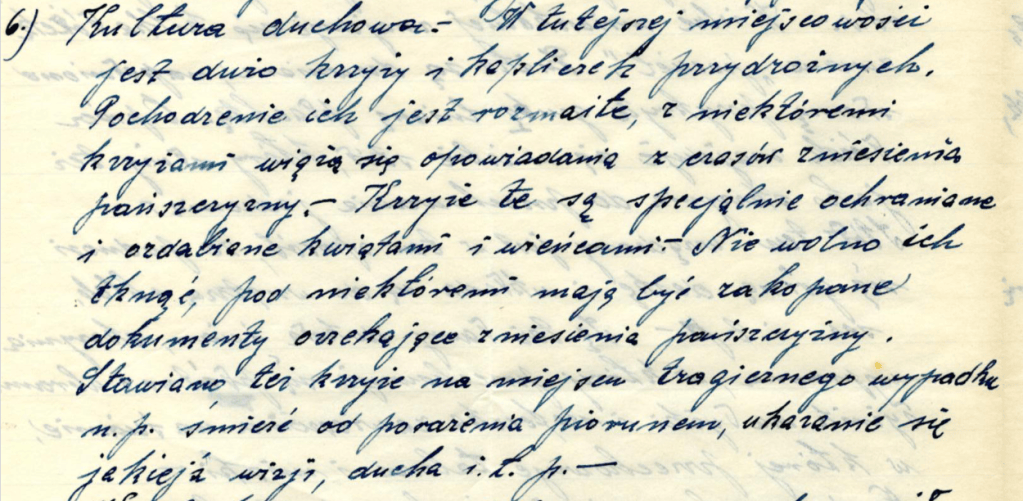
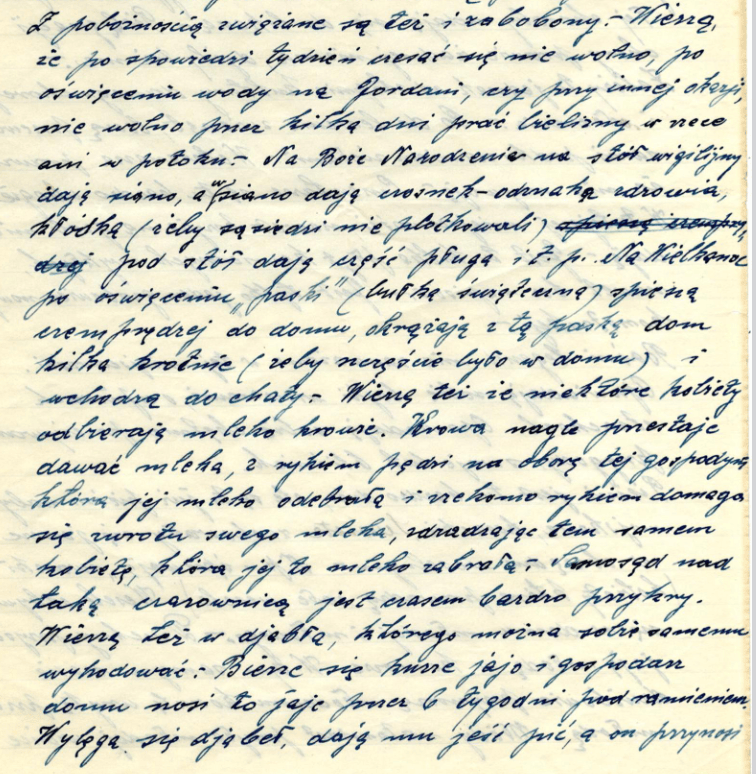
6.) Kultura duchowa. – W tutejszej miejscowości jest dużo krzyży i kapliczek przydrożnych. Pochodzenie ich jest rozmaite, z niektóremi krzyżami wiążą się opowiadania z czasów zniesienia pańszczyzny. – Krzyże te są specjalnie ochraniane i ozdabiane kwiatami i wieńcami. Nie wolno ich tknąć, pod niektóremi mają być zakopane dokumenty orzekające zniesienie pańszczyzny. Stawiano też krzyże na miejscu tragicznego wypadku n. p. śmierć od porażenia piorunem, ukazanie się jakiejś wizji, ducha i. t. p. –
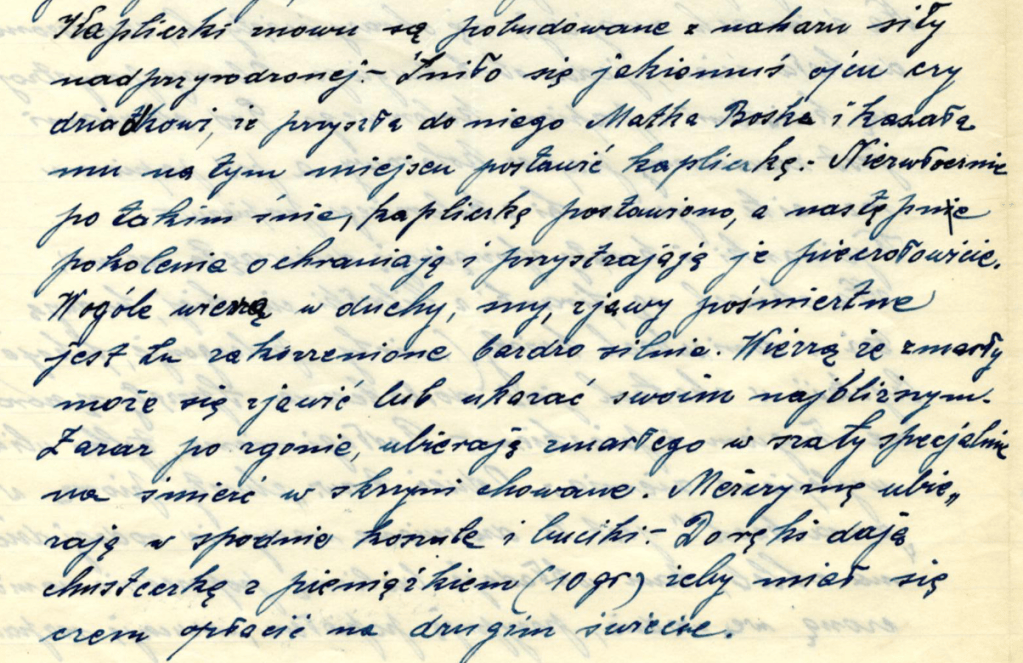
Kapliczki znowu są pobudowane z nakazu siły nadprzyrodzonej:- Śniło się jakiemuś ojcu czy dziadkowi, że przyszła do niego Matka Boska i kazała mu na tym miejscu postawić kapliczkę. Niezwłocznie po takim śnie, kapliczkę postawiono, a następne pokolenia ochraniają i przystrajają je pieczołowicie. W ogóle wierzą w duchy, sny, zjawy pośmiertne jest tu zakorzenione bardzo silnie. Wierzą że zmarły może się zjawić lub ukazać swoim najbliższym. Zaraz po zgonie, ubierają zmarłego w szaty specjalnie na śmierć w skrzyni chowane. Mężczyznę ubierają w spodnie konopne i buciki:- Do ręki dają chusteczkę z pieniążkiem (10 gr) iżby miał się czem opłacić na drugim świecie.
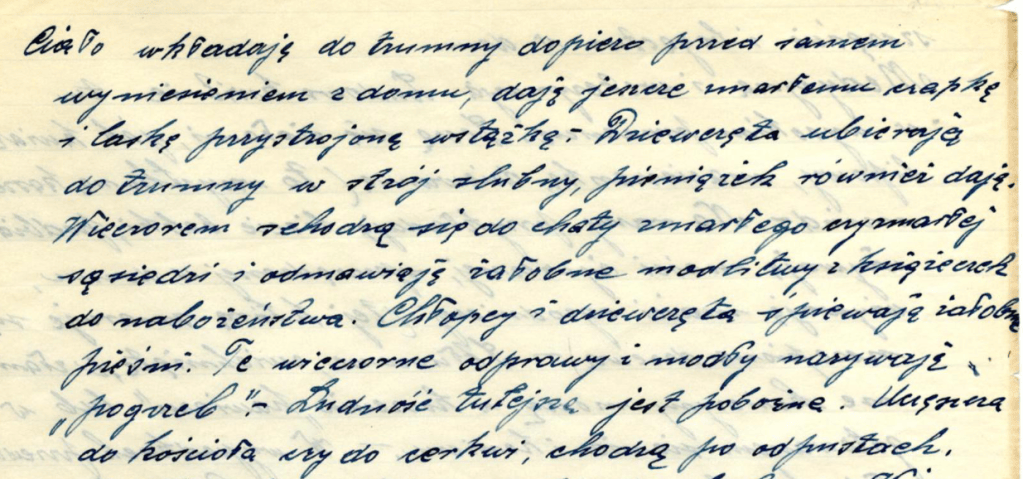
Ciało wkłada się do trumny dopiero przed samym wyniesieniem z domu, dają jeszcze zmarłemu czapkę i laskę przystrojone wstążką. Dziewczęta ubierają do trumny w strój ślubny, pierścionek również dają. Wieczorem schodzą się do chaty zmarłego czy zmarłej sąsiedzi i odmawiają żałobne modlitwy z książeczek do nabożeństwa. Chłopcy i dziewczęta śpiewają żałobne pieśni. Te wieczorne odprawy i modły nazywają „pogrzeb”. Ludność tutejsza jest pobożna. Uczęszcza do kościoła czy do cerkvi, chodzą po odpustach.
Z pobożnością związane są też i zabobony. Wierzą, że po spowiedzi tydzień czesać się nie wolno, po oświęceniu wody na Jordanie, czy przy innej okazji nie wolno przez kilka dni prać bielizny a nece ani w potoku. Na Boże Narodzenie na stół wigilijny dają siano, a pod siano dają czosnek – odznakę zdrowia, kłódkę (żeby sąsiedzi nie plotkowali), a pierwej i czepiec, dalej pod stół dają część pługa itd. Na Wielkanoc po oświęceniu „paski” (bułka świąteczna) spieszą czempiej do domu, okrążają z tą paską dom kilka krotnie (żeby szczęście było w domu) i wchodzą do chaty. Wierzą też, że niektóre kobiety odbierają mleko krowie. Krowa nagle przestaje dawać mleka, z rykiem pędzi na oborę tej gospodyni, która jej mleko odebrała i rzekomo rykiem domaga się zwrotu swego mleka, zdradzając tem samem kobietę, która jej to mleko zabrała. Samosąd nad taką czarownicą jest czasem bardzo przykry. Wierzą też w djabła, którego można sobie samemu wyhodować: Bierze się kurze jajo i gospodarz domu nosi to jajo przez 6 tygodni pod ramieniem. Wylęga się djabeł, dają mu jeść, pić, a on przynosi szczęście i bogactwo w dom.
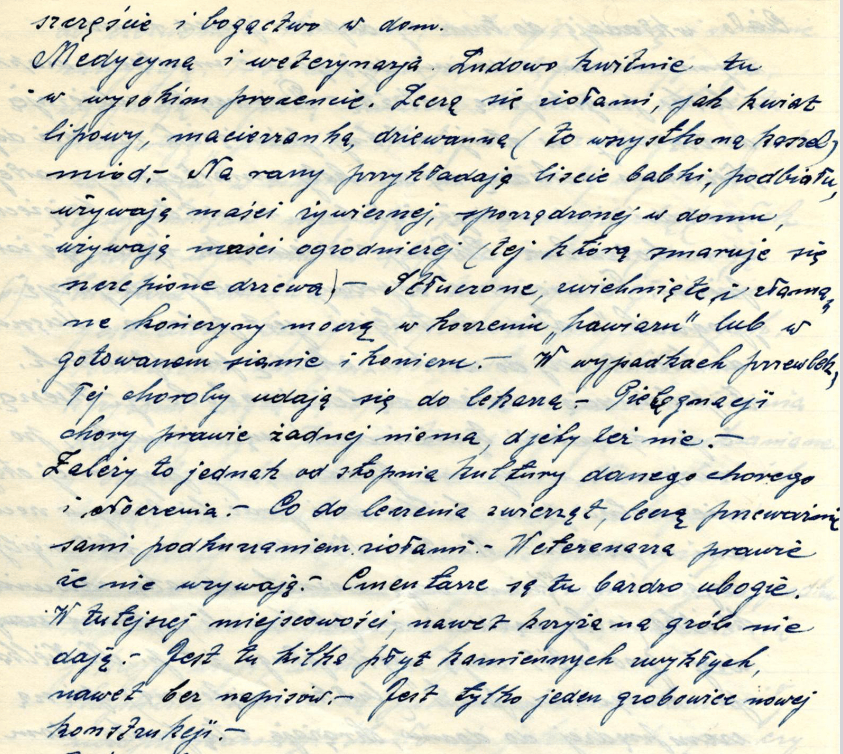
Medycyna i weterynarya ludowa kwitnie tu w wysokim procencie. Leczą się ziołami, jak kwiat lipowy, macierzanka, dziewanna (to wszystko na kaszel), miód. — Na ramy przykładają liście babki, podbiału, używają maści żywicznej sporządzonej w domu, używają maści ogrodniczej (tej, którą smaruje się szczepione drzewa). — Stłuczone, zwichnięte i złamane kończyny moczą w korzeniu „kawiaru” lub w gotowanem sianie i koniczem. — W wypadkach przewlekłej choroby udają się do lekarza. — Pielęgnacyi chorego prawie żadnej niema, ażeby łez nie. —
Zależy to jednak od stopnia kultury danego chorego i otoczenia. — Co do leczenia zwierząt, leczą przeważnie sami podkurzaniem i ziołami. — Weterynarza prawie że nie używają. — Cmentarze są tu bardzo ubogie. W tutejszej miejscowości nawet krzyża na grób nie dają. — Jest tu kilka płyt kamiennych wykłutych, nawet bez napisów. — Jest tylko jeden grobowiec nowej konstrukcji. —
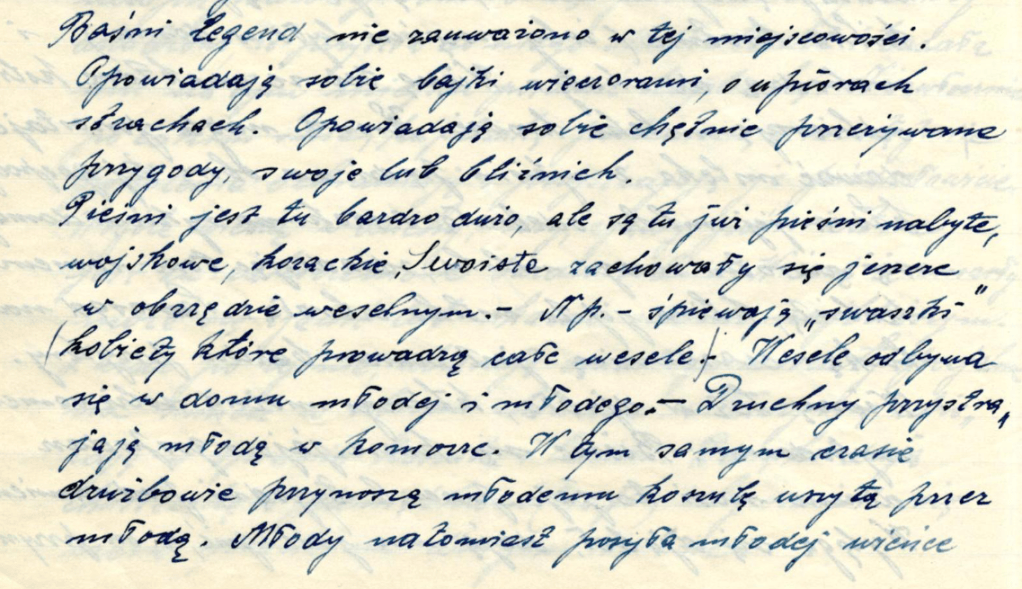
Baśni, legend nie zauważono w tej miejscowości. Opowiadają sobie bajki wieczorami, o upiorach i strachach. Opowiadają sobie chętnie przeżywane przygody, swoje lub bliźnich.Pieśni jest tu bardzo dużo, ale są tu już pieśni nabyte, wojskowe, kozackie. Swoiste zachowały się jeszcze w obrzędzie weselnym. – N.p. – śpiewają „swaszki” (kobiety które prowadzą całe wesele). Wesele odbywa się w domu młodej i młodego. – Druhny przystrajają młodą w komorze. W tym samym czasie drużbowie przynoszą młodemu koszulę uszytą przez młodą. Młody natomiast posyła młodej wieniec z wstążkami (teraz gdzie niegdzie welon) a sam jedzie lub idzie z korowajom i drużbami do młodej.
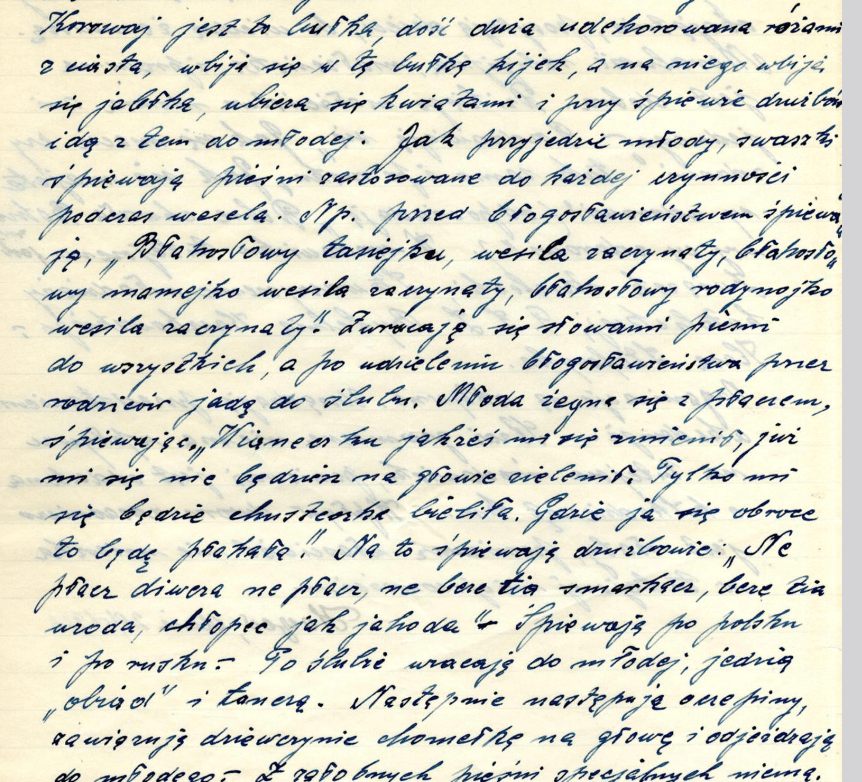
Korowaj jest to bułka, dość duża udekorowana różamiz ciasta, wbija się w tę bułkę kijek, a na niego wbija się jabłko, ubiera się kwiatami i przy śpiewie drużbów idą z tem do młodej. Jak przyjedzie młody, swaci śpiewają pieśni dostosowane do każdej czynności podczas wesela. Np. przed błogosławieństwem śpiewają:„Błahosłowy tatejku, wesila zaczynaty, błahosło-wy mamejku wesila zaczynaty, błahosłowy rodnojkowesila zaczynaty!” Zwracają się słowami pieśni do wszystkich, a po udzieleniu błogosławieństwa przez rodziców jadą do ślubu. Młoda żegna się z domem,śpiewając: „Wianeczku jakieś mi się zmienił, już mi się nie będzie na głowie zielenił. Tylko mi się będzie chusteczka bieliła. Gdzie ja się obrócę to będę płakała.” Na to śpiewają drużbowie: „Ne płacz diwera ne płacz, ne bere tia smartyca, bere tia uroda, chłopiec jak jagoda.” Śpiewają po polsku i po rusku. Po ślubie wracają do młodej, jedzą „obiad” i tańczą. Następnie następuje oczepiny,zawiązują dziewczynie chustkę na głowę i odjeżdżają do młodego. Z żałobnych pieśni specjalnych niema.
Na Boże narodzenie śpiewają kolędy takie jak wszędzie, na Wielkanoc tylko wielkanocne pieśni kościelne.
English Translation: Google-Powered
Warning: this translation may be terrible. It was done electronically by someone who can speak neither Polish nor Ukrainian/Lemko. Do you wish to see it improve? You can help! Contact us.
Uwaga: to tłumaczenie może być fatalne. Zostało wykonane automatycznie przez osobę, która nie zna ani języka polskiego, ani ukraińskiego/łemkowskiego. Chcesz, żeby było lepsze? Możesz pomóc! Skontaktuj się z nami.
6.) Spiritual culture. – In this locality, there are many roadside crosses and small shrines. They have various origins; some of the crosses are associated with stories dating back to the time when serfdom was abolished. These crosses are specially protected and adorned with flowers and wreaths. They must not be touched; it is said that documents declaring the abolition of serfdom are buried beneath some of them. Crosses were also erected at the sites of tragic accidents—for instance, where someone died after being struck by lightning—or where a vision or a spirit appeared.
As for the small shrines, they were often built following a command from a supernatural power: a father or grandfather might dream that the Mother of God appeared to him and instructed him to build a shrine on a specific spot. Immediately after such a dream, the shrine would be constructed, and subsequent generations have continued to protect and carefully decorate it. In general, a belief in spirits, dreams, and post-mortem apparitions is deeply rooted here. People believe that the deceased can appear or reveal themselves to their loved ones. Immediately after a death, the deceased is dressed in garments—kept in a chest specifically for this purpose—intended for the afterlife. A man is dressed in hemp trousers and small boots; a handkerchief containing a coin (10 groszy) is placed in his hand so that he may have the means to pay his way in the next world.
The body is placed in the coffin only just before it is carried out of the house; the deceased is also provided with a cap and a walking stick, both adorned with ribbons. Young women are dressed in wedding attire for their burial, and a ring is placed on their finger. In the evening, neighbors gather at the home of the deceased to recite funeral prayers from prayer books, while young men and women sing mournful hymns. These evening gatherings and prayers are referred to as the “funeral.” The local population is devout; they attend church—whether Latin or Greek—and participate in religious festivals (indulgences).
This piety is intertwined with various superstitions. It is believed that one must not comb one’s hair for a week following confession, and that for several days after the blessing of water—such as on the Feast of the Epiphany (Jordan)—one must not wash laundry in a stream or brook. On Christmas Eve, hay is placed on the table, with garlic tucked underneath as a symbol of health, along with a padlock (to prevent neighbors from gossiping)—and in the past, a woman’s cap was also included, while a part of a plow might be placed beneath the table. At Easter, after having their paska (festive bread) blessed, people hurry home, circle the house several times with the bread—to ensure good fortune within the home—and then enter the dwelling. There is also a belief that certain women can “steal” a cow’s milk. If a cow suddenly stops producing milk, it may run, bellowing, toward the barn of the woman who supposedly took the milk; the animal’s cries are interpreted as a demand for the return of its milk, thereby exposing the person responsible. The summary justice meted out to such an alleged “witch” can, at times, be quite severe. They also believe in a devil that one can raise oneself: one takes a chicken egg, and the head of the household carries it under his arm for six weeks. A devil hatches from it; they provide it with food and drink, and in return, it brings good fortune and wealth to the household.
Folk medicine and veterinary practices are quite prevalent here. People treat ailments with herbs—such as linden blossoms, wild thyme, and mullein (all used for coughs)—as well as honey. For wounds, they apply plantain or coltsfoot leaves, homemade resin-based ointments, or even horticultural grafting paste (the kind used on grafted trees). Bruised, dislocated, or broken limbs are soaked in a decoction of “kaviar” (a local term for a specific root) or in a boiled mixture of hay and clover. In cases of chronic illness, they may consult a doctor. There is, however, almost no formal nursing care for the sick—lest it invite tears [or bad luck].
This, of course, depends on the level of education and cultural background of the individual and their social circle. As for animals, the people generally treat them themselves using herbal remedies and the practice of “smoking” (fumigation). They rarely, if ever, seek the services of a veterinarian. The local cemeteries are very modest; in this area, they do not even place crosses on graves. There are a few carved stone slabs, though they bear no inscriptions. Only one tomb of a more modern design exists here.
No traditional fairy tales or legends were noted in this locality. In the evenings, people share stories about ghosts and terrifying apparitions. They also enjoy recounting personal experiences—adventures that either they or their neighbors have lived through. There is a great abundance of songs, though many are of more recent origin, including military and Cossack-style songs. Distinctive customs have been preserved within the wedding ritual. For instance, the swaszki—women who oversee the entire wedding proceedings—sing traditional songs. The wedding celebrations take place at the homes of both the bride and the groom. In a private chamber, the bridesmaids help the bride get dressed and adorned. Meanwhile, the groomsmen bring the groom a shirt that the bride has sewn for him. The groom, in turn, sends the bride a wreath decorated with ribbons (nowadays, in some places, a veil is used instead), and then travels—either by vehicle or on foot—to the bride’s home, accompanied by his groomsmen and carrying the korowaj (a ceremonial wedding bread).
A korowaj is a large loaf of bread decorated with dough roses; a small stick is inserted into the loaf, topped with an apple and adorned with flowers. Accompanied by the singing of the groomsmen, the party carries it to the bride. Upon the groom’s arrival, the matchmakers sing songs tailored to each specific wedding ritual. For instance, before the parental blessing, they sing: “Give your blessing, dear father, to begin the wedding; give your blessing, dear mother, to begin the wedding; give your blessing, dear kin, to begin the wedding!” Through these songs, they address everyone present; once the parents have given their blessing, the wedding party departs for the marriage ceremony. The bride bids farewell to her home, singing: “Oh, my little wreath, how you have changed—you shall no longer bloom green upon my head. Now, only a white kerchief shall rest there. Wherever I turn, I shall weep.” To this, the groomsmen respond: “Do not weep, maiden, do not weep; it is not death that takes you, but beauty—and a young man as sweet as a berry.” They sing in both Polish and Ruthenian. Following the ceremony, they return to the bride’s home for a feast and dancing. Then comes the oczepiny (the ritual unveiling of the bride), during which a kerchief is tied around her head, after which they depart for the groom’s home. There are no specific songs for mourning.
At Christmas, they sing carols, much like everywhere else, while at Easter, they sing only Easter-themed religious hymns.
Sanok Genes seeks to create a database of transcripts and English translations from the “Kultura Duchowa” sections from the 1936 Sanok School Inspectorate Questionnaires. The original documents are held by the Sanok Museum of History and digitized by the Sanok Digital Library. To learn more, see the project description.
Sanok Genes stawia sobie za cel stworzenie bazy danych zawierającej transkrypcje oraz tłumaczenia na język angielski fragmentów dotyczących „kultury duchowej”, pochodzących z kwestionariuszy Inspektoratu Szkolnego w Sanoku z 1936 roku. Oryginalne dokumenty znajdują się w zbiorach Muzeum Historycznego w Sanoku i zostały zdigitalizowane przez Sanocką Bibliotekę Cyfrową. Więcej informacji można znaleźć w opisie projektu.

