Terka is a village in Solina Commune, Lesko County.
Terka– wieś w gminie Solina, w powiecie leskim.
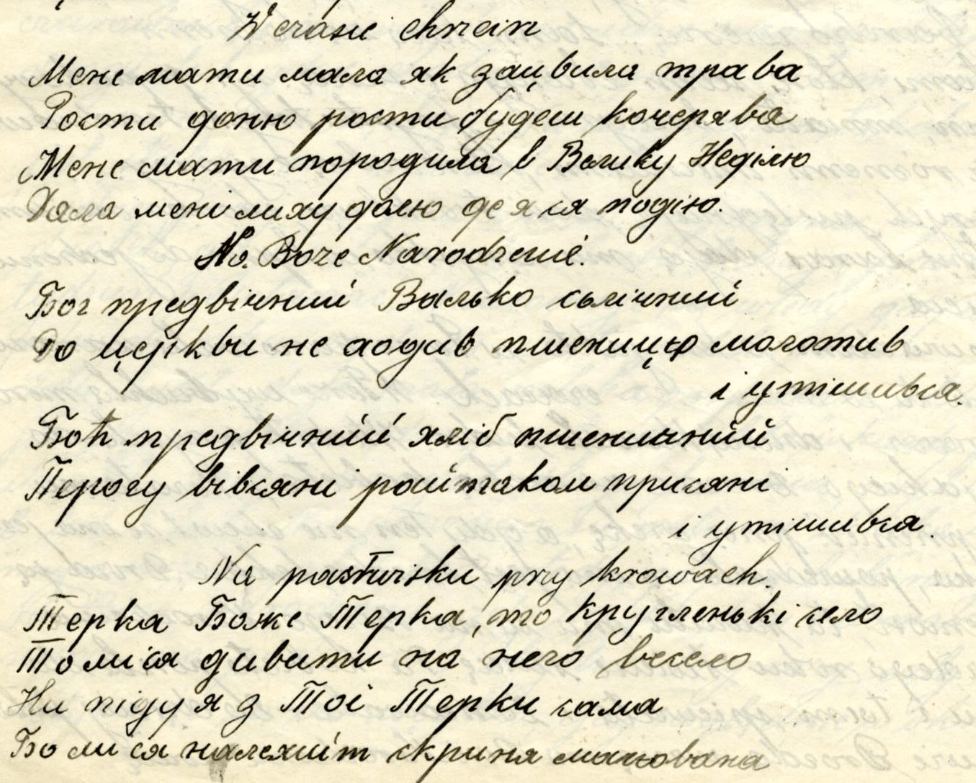
Transcript: Google-Powered
Warning: this transcription may be terrible. It was done electronically by someone who can speak neither Polish nor Ukrainian/Lemko. Do you wish to see it improve? You can help! Contact us.
Uwaga: ta transkrypcja może być fatalna. Została wykonana automatycznie przez osobę, która nie zna ani języka polskiego, ani ukraińskiego/łemkowskiego. Chcesz, żeby była lepsza? Możesz pomóc! Skontaktuj się z nami.
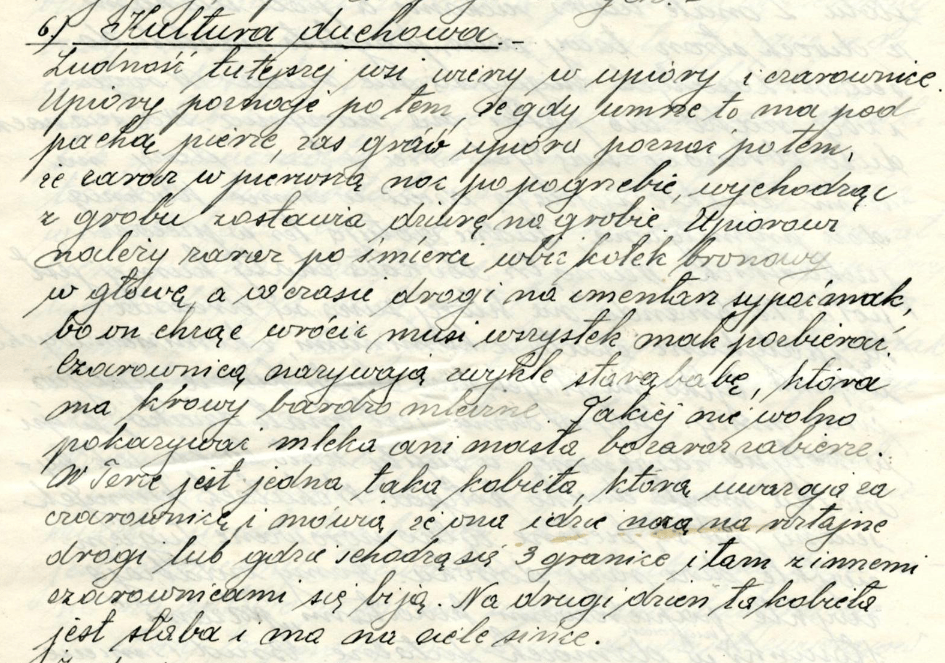
- Kultura duchowa.
Ludność tutejsza uwierzy w upiory i czarownice. Upiory poznaje po tem, że gdy umrze to ma pod pachą pierś, zaś grób upiora poznać po tem, że zaraz w pierwszą noc po pogrzebie, wychodząc z grobu zostawia dziurę na grobie. Upiorowi należy zaraz po śmierci wbić kołek bronowy w głowę, a w czasie drogi na cmentarz sypać mak, bo on chcąc wrócić musi wszystek mak pozbierać. Czarownicą nazywają zwykle starą babę, która ma krowy bardzo mleczne. Takiej nie wolno pokazywać mleka ani masła bo zaraz zabierze. W Sercu jest jedna taka kobieta, którą uważają za czarownicę i mówią, że ona idzie nocą na rozstajne drogi lub gdzie schodzą się 3 granice i tam z innemi czarownicami się biją. Na drugi dzień ta kobieta jest słaba i ma na ciele since.
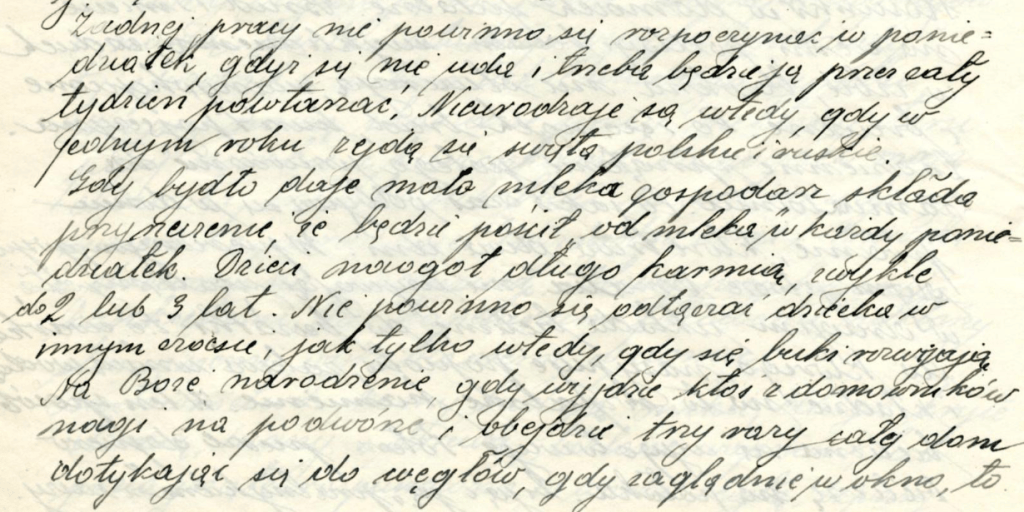
Żadnej pracy nie powinno się rozpoczynać w poniedziałek, gdyż się nie uda i trzeba będzie ją przez cały tydzień powtarzać. Nieurodzaje są wtedy, gdy w jednym roku zejdą się święta polskie i ruskie.
Gdy bydło daje mało mleka gospodarz składa przyrzeczenie, że będzie pościł od mleka w każdy poniedziałek. Dzieci nowgół długo karmią, zwykle do 2 lub 3 lat. Nie powinno się odłączać dziecka w innym czasie, jak tylko wtedy, gdy się buki rozwijają.
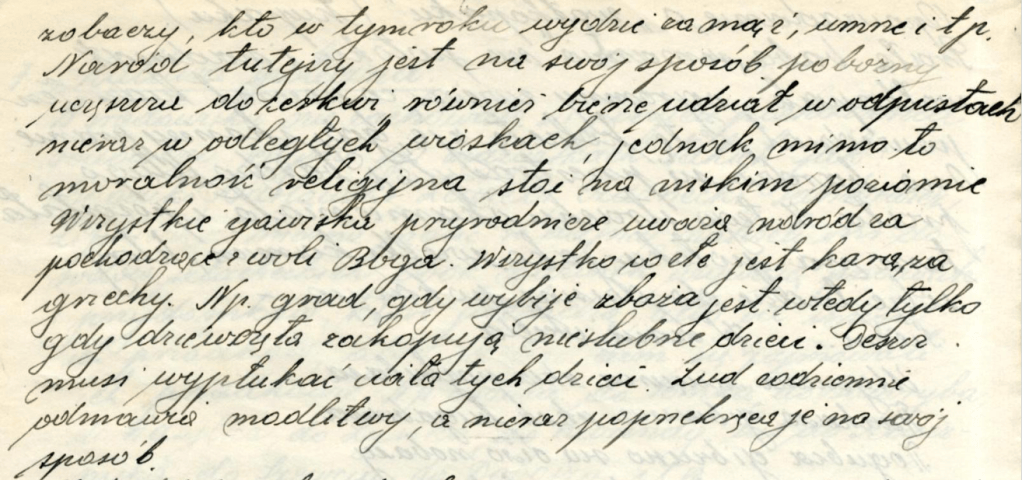
Na Boże narodzenie gdy wejdzie ktoś z domowników nowy na podwórze i obejdzie trzy razy cały dom dotykając się do węgłów, gdy zaglądnie w okno, to zobaczysz, kto w tym roku wyjdzie za mąż, umrze i t.p. Naród tutejszy jest na swój sposób pobożny,uczęszcza do kościoła, również bierze udział w odpustach nieraz w odległych wioskach, jednak mimo to moralność religijna stoi na niskim poziomie.Wszystkie zjawiska przyrodnicze uważa naród za pochodzące z woli Boga. Wszystko co złe jest karą za grzechy. Np. grad, gdy wybije zboża jest wtedy tylko gdy dziewczęta zakopują nieślubne dzieci. Deszcz musi wypłukać ciała tych dzieci. Lud codziennie odmawia modlitwy, a nieraz po przekręca je na swój sposób.
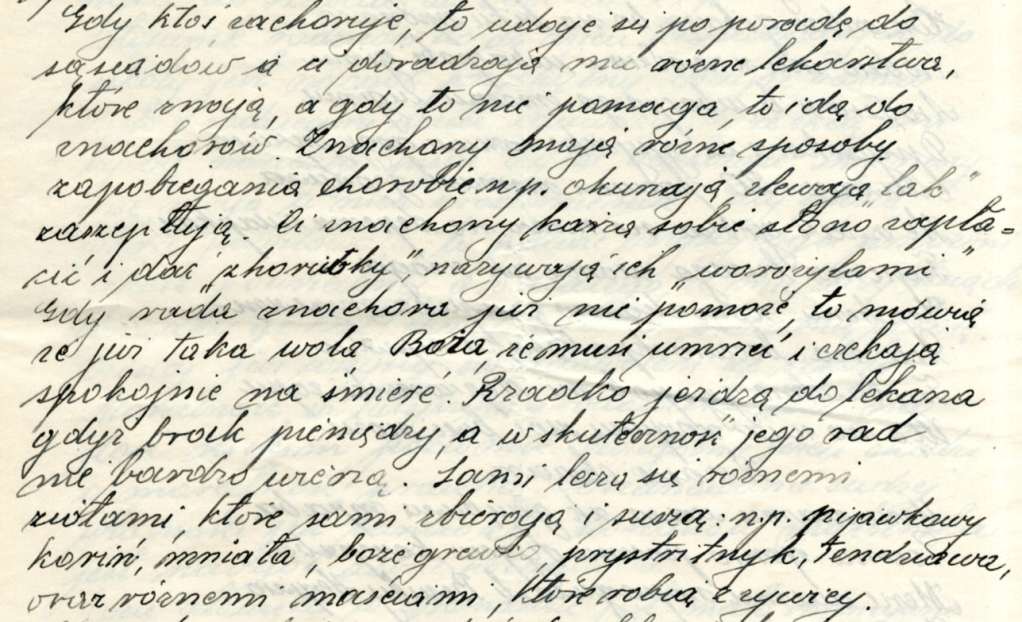
Gdy ktoś zachoruje, to udaje się po poradę do sąsiadów a ci doradzają mu różne lekarstwa, które znają, a gdy to nie pomaga, to idą do znachorów. Znachorzy mają różne sposoby zapobiegania chorobie np. okadzają, zlewają tak zaszepują. Ci znachorzy każą sobie słono zapłacić i dać „z horitky” nazywają ich „worozitami”. Gdy rada znachora już nie pomoże to mówią że już taka wola Boża że musi umrzeć i czekają spokojnie na śmierć. Rzadko jeżdżą do lekarza gdyż brak pieniędzy, a w skuteczność jego rad nie bardzo wierzą. Sami leczą się różnemi ziołami, które sami zbierają i suszą: np. pijawkowy korzeń, mniata, boże drzewko, prystrypnyk, tendruwa, oraz różnemi maściami, które robią z żywicy.
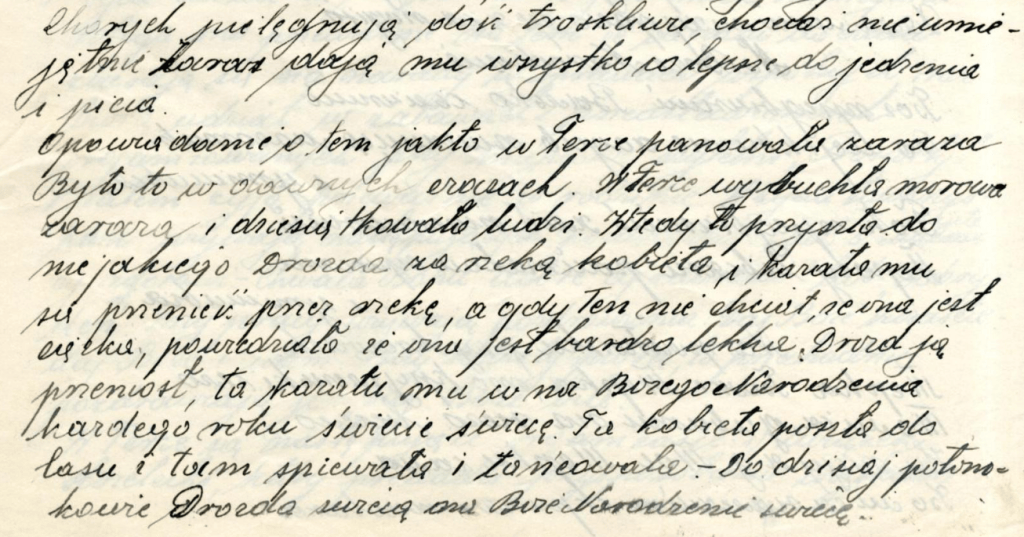
Chorych pielęgnują; dłoń troskliwe, chociaż nie umiejętne zaraz dają mu wszystko co lepsze do jedzenia i picia.
Opowiadanie o tem jak to w Terce panowała zaraza Było to w dawnych czasach. W Terce wybuchła morowa zaraza i dziesiątkowała ludzi. Wtedy to przyszło do niejakiego Drozda za rzeką kobieta i kazała mu się przenieś” przez rzekę, a gdy ten się chwiał, że ona jest ciężka, powiedziała że ona jest bardzo lekka. Drozd ją przeniósł, ta kazała mu w na Boże Narodzenie każdego roku świecić świecę. Ta kobieta poszła do lasu i tam śpiewała i tańcowała. – Do dzisiaj potomkowie Drozda święcą na Boże Narodzenie świecę.
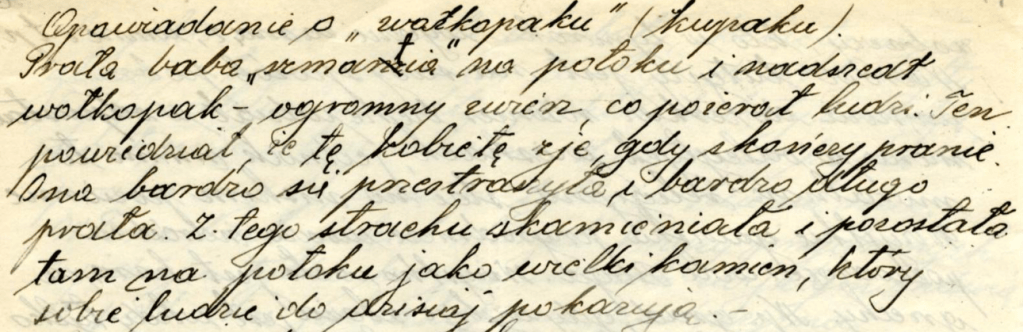
Opowiadanie o „wołkopaku” (kupaku). Prała baba „szmatia” na potoku i nadszedł wołkopak – ogromny zwierz, co pożerał ludzi. Ten Powiedział, że tę kobietę zje, gdy skończy pranie. Ona bardzo się przestraszyła i bardzo długo prała. Z tego strachu skamieniała i pozostała tam na potoku jako wielki kamień, który sobie ludzie do dzisiaj pokazują. –
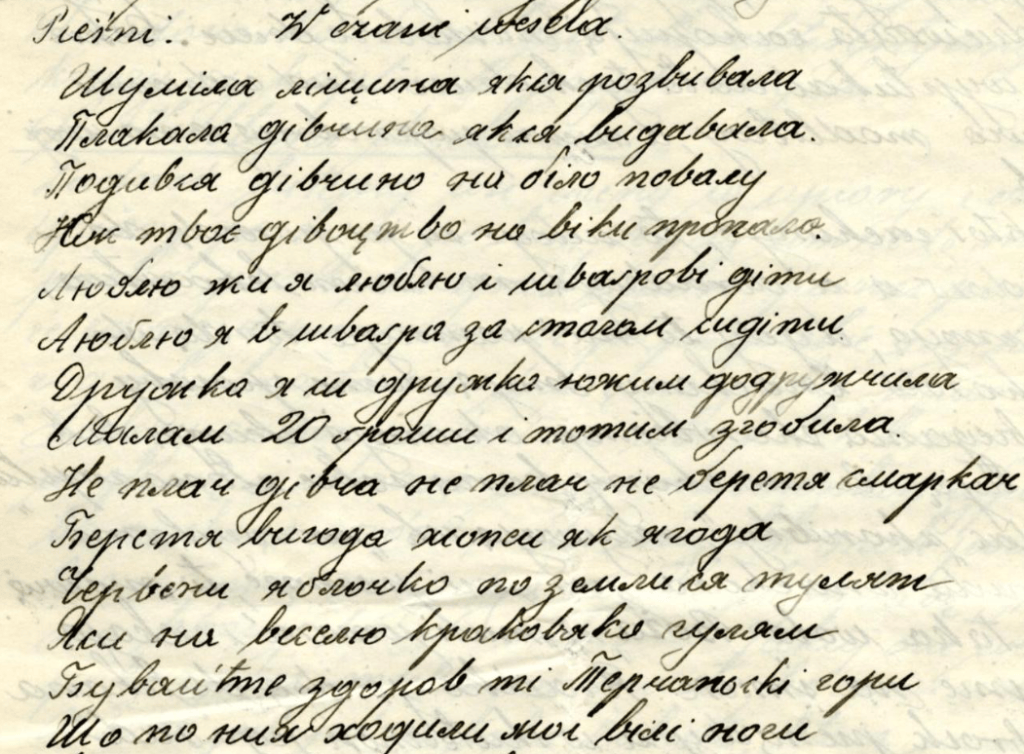
Pieśni. W czasi wesela.
Шуміла ліщина яка розвивала
Плакала дівчина яка видавала.
Подивися дівчино на біло повалу
Гіж твоє дівоцтво на віки пропало.
Люблю жи я люблю і швагрові діти
Люблю я в швагра за столом сидіти
Дружка я ли дружки ніжним годружила
Симпам 20 гроши і тотим згодила.
Не плач дівча не плач не бере тя смаркач
Бере тя вигода хлопец як ягода
Червени яблочко по земли ся тулят
Аси на весело краковяка гулят
Бувайіте здоров мі Терпанські гори
Що по них ходили моі білі ноги
W czasie chrzcin
Мене мати мала як зацвила трава
Рости доню рости будеш кочерява
Мене мати породила в Велику Неділю
Дала мені лиху долю де я ся подію.
Na Boze Narodzewie
Бог предвічний Велико сличний
До церькви не ходив пшеницю молотив і утішився.
Бог предвічний хліб пшеничний
Пироги вівсяни росолом прискані і утішився.
Na pastushku pry krowach
Терка Боже Терка, то кругленькі село
То ми ся дивити на него весело
Ни піду я з тої Терки сама
Бо ми ся належит скриня мальована
English Translation: Google-Powered
Warning: this translation may be terrible. It was done electronically by someone who can speak neither Polish nor Ukrainian/Lemko. Do you wish to see it improve? You can help! Contact us.
Uwaga: to tłumaczenie może być fatalne. Zostało wykonane automatycznie przez osobę, która nie zna ani języka polskiego, ani ukraińskiego/łemkowskiego. Chcesz, żeby było lepsze? Możesz pomóc! Skontaktuj się z nami.
- Spiritual culture.
The local population believes in upiory and witches. A upiór can be identified after death by the presence of a breast-like growth under its armpit; its grave can be recognized because, on the very first night after the funeral, the creature leaves a hole in the ground as it emerges. Immediately after death, a harrow-peg should be driven into the upiór’s head, and poppy seeds should be scattered along the path to the cemetery—for if the creature wishes to return, it must first gather every single seed. A witch is typically understood to be an old woman who happens to own cows that produce an abundance of milk. One must never show milk or butter to such a person, lest she take it away. In the village of Serce, there is one such woman considered to be a witch; it is said that at night, she travels to crossroads—or to places where three territorial boundaries meet—to engage in fights with other witches. The following day, the woman appears weak and bears bruises on her body.
No work should be begun on a Monday, as it will not succeed and will have to be repeated throughout the entire week. Poor harvests occur when Polish and Ruthenian religious holidays fall on the same day in a given year.
When livestock yield little milk, the owner may make a vow to abstain from dairy products every Monday. Children are generally breastfed for a long time—usually until the age of two or three. A child should only be weaned at the time when the beech trees begin to bud. At Christmas, if a member of the household goes out into the yard and walks around the entire house three times—touching the corners—and then peers through a window, one can foresee who will get married, who will die, and so on, in the coming year. The local people are pious in their own way; they attend church and participate in religious festivals, sometimes even in distant villages—yet, despite this, their religious morality remains at a low level. They attribute all natural phenomena to the will of God, viewing every misfortune as a punishment for sin. For instance, they believe that hail destroys crops only when young women have buried illegitimate children; the rain, they say, must wash away the bodies of those infants. The common folk pray daily, though they often alter the prayers to suit their own understanding.
When someone falls ill, they seek advice from neighbors, who suggest various remedies they happen to know. If these prove ineffective, the sick person turns to folk healers—known locally as vorozity—who employ methods such as ritual fumigation or pouring water over the patient to “cast out” the ailment. These healers demand high payment, often including a bottle of spirits. If even a healer’s counsel fails, the people conclude that it is simply God’s will—that the person is destined to die—and they await the end with resignation. They rarely consult a medical doctor, both due to a lack of money and a deep-seated skepticism regarding the efficacy of professional medical advice. They treat themselves using various herbs that they gather and dry—such as pijawkowy korzeń (leech root), mint, southernwood (boże drzewko), prystrypnyk, and tendruwa—as well as various ointments made from resin.
They care for the sick; with solicitous, if unskilled, hands, they immediately offer them the best food and drink available.
A story about a plague in Terka: Long ago, a deadly plague broke out in Terka, decimating the population. At that time, a woman approached a man named Drozd, who lived across the river, and asked him to carry her across. When he hesitated, fearing she might be too heavy, she assured him that she was, in fact, very light. Drozd carried her across, and in return, she instructed him to light a candle every year on Christmas. The woman then went into the forest, where she sang and danced. To this day, the descendants of Drozd continue to light a candle at Christmas.
A story about a “wołkopak” (or “kupak”): A woman was washing laundry in a stream when a wołkopak—a monstrous beast that devoured humans—appeared. It told her that it would eat her once she finished her washing. Terrified, the woman kept washing for a very long time. Out of sheer fear, she turned to stone, remaining in the stream as a large boulder that people still point out to one another today.
Songs. During a Wedding.
The hazel bush rustled as it unfurled its leaves,
The maiden wept as she was given away.
Look up, maiden, at the white ceiling—
Your maidenhood is gone forever.
I love—oh, how I love—my brother-in-law’s children;
I love sitting at the table at my brother-in-law’s place.
I treated the bridesmaids—oh, how I treated them kindly!
I gave them twenty groschen each, and that satisfied them.
Do not weep, maiden, do not weep—no mere brat is taking you;
A fine catch is taking you—a lad as lovely as a berry.
Red apples roll along the ground,
And people dance the krakowiak at the wedding.
Farewell, O Terkanski Mountains,
Where my fair feet once walked.
During a Christening.
My mother bore me when the grass began to bloom;
“Grow, daughter, grow—you shall have curly hair.”
My mother gave birth to me on Easter Sunday,
But she gave me a wretched fate—where am I to go?
At Christmas.
God Eternal, most magnificent—
He did not go to church; He threshed wheat and found joy.
God Eternal, wheat bread—
Oatmeal dumplings sprinkled with broth—and He found joy.
While Herding Cows.
Terka, O God, Terka—that round little village;
It is a joy for us to gaze upon it.
I shall not leave Terka alone,
For a painted chest belongs to me.
Sanok Genes seeks to create a database of transcripts and English translations from the “Kultura Duchowa” sections from the 1936 Sanok School Inspectorate Questionnaires. The original documents are held by the Sanok Museum of History and digitized by the Sanok Digital Library. To learn more, see the project description.
Sanok Genes stawia sobie za cel stworzenie bazy danych zawierającej transkrypcje oraz tłumaczenia na język angielski fragmentów dotyczących „kultury duchowej”, pochodzących z kwestionariuszy Inspektoratu Szkolnego w Sanoku z 1936 roku. Oryginalne dokumenty znajdują się w zbiorach Muzeum Historycznego w Sanoku i zostały zdigitalizowane przez Sanocką Bibliotekę Cyfrową. Więcej informacji można znaleźć w opisie projektu.

