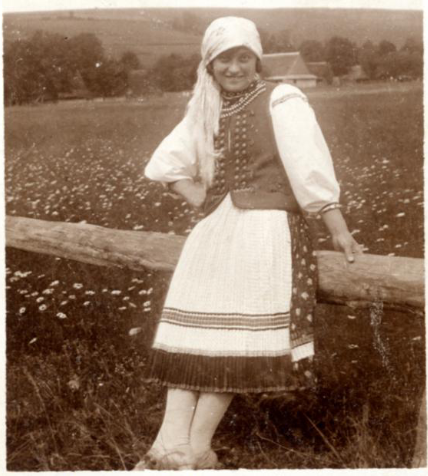
Maniów is a village in Komańcza Commune, Sanok County.
Maniów to wieś w gminie Komańcza, w powiecie sanockim.
Transcript: Google-Powered
Warning: this transcription may be terrible. It was done electronically by someone who can speak neither Polish nor Ukrainian/Lemko. Do you wish to see it improve? You can help! Contact us.
Uwaga: ta transkrypcja może być fatalna. Została wykonana automatycznie przez osobę, która nie zna ani języka polskiego, ani ukraińskiego/łemkowskiego. Chcesz, żeby była lepsza? Możesz pomóc! Skontaktuj się z nami.
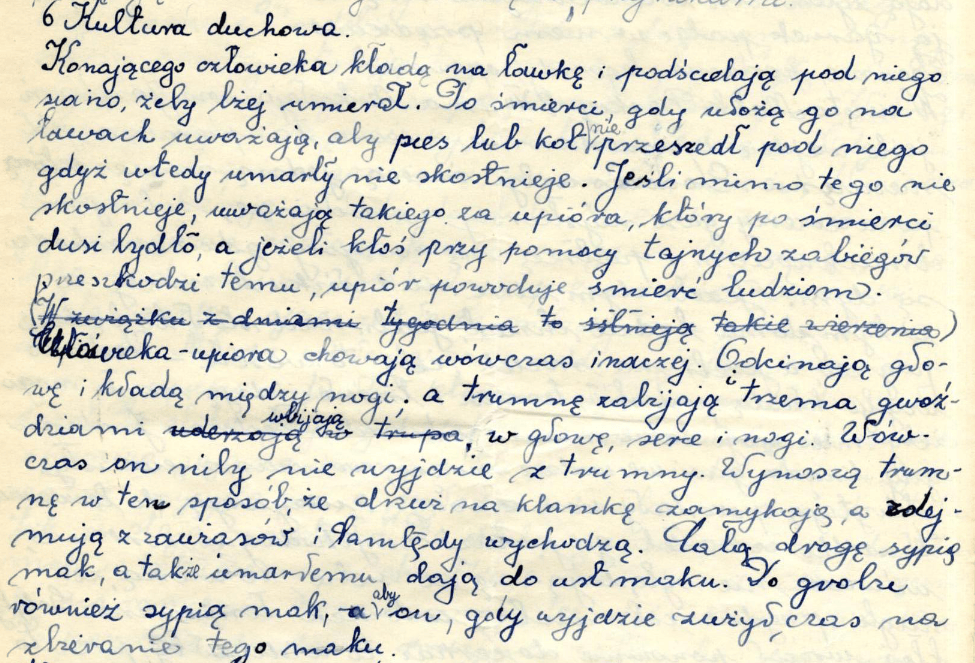
6 Kultura duchowa.
Konającego człowieka kładą na ławkę i podścielają pod niegosiano, żeby lżej umierał. Po śmierci, gdy ułożą go na ławkach uważają, aby pies lub kot nie przeszedł pod niego gdyż wtedy umarły nie skostnieje. Jeśli mimo tego nie kostnieje, uważają takiego za upióra, który po śmierci dusi bydło, a jeżeli ktoś przy pomocy tajnych zabiegów przeszkodzi temu, upiór powoduje śmierć ludziom.
Człowieka-upióra chowają wówczas inaczej. Odcinają głowę i kładą między nogi, a trumnę zabijają trzema gwoździami, wbijając trupa w głowę, serce i nogi. Wówczas on niby nie wyjdzie z trumny. Wynoszą trumnę w ten sposób, że drzwi na klamkę zamykają, a zdejmują z zawiasów i tamtędy wychodzą. Całą drogę sypią mak, a także umarłemu dają do ust maku. Do grobu również sypią mak, a aby on, gdy wyjdzie zużył czas na zbieranie tego maku.
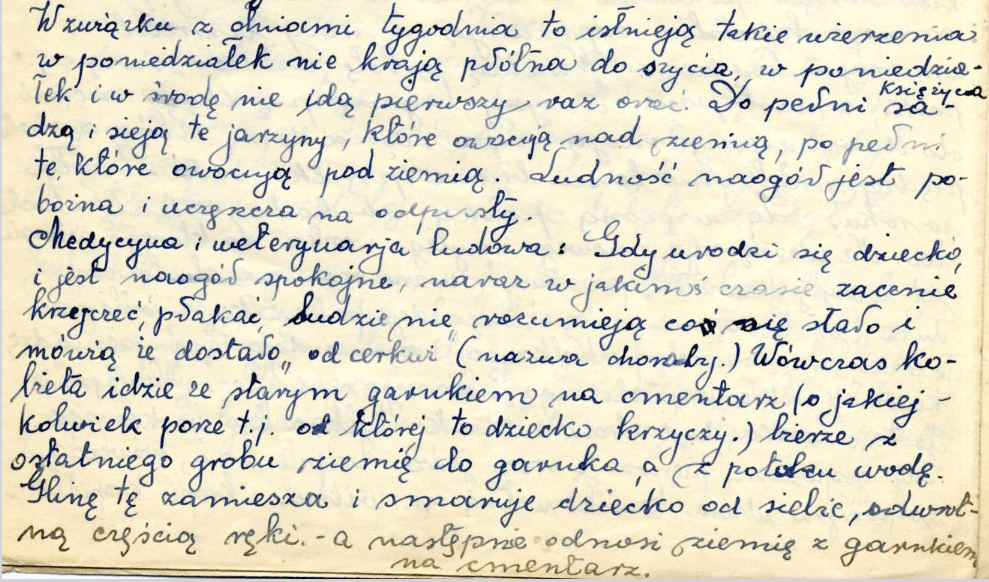
W związku z dniami tygodnia to istnieją takie wierzenia w poniedziałek nie krają płótna do szycia, w poniedziałek i w środę nie idą pierwszy raz orać. Do pełni księżyca sadzą i sieją te jarzyny, które owocują nad ziemią, po pełni te, które owocują pod ziemią. Ludność naogół jest pobożna i uczęszcza na odpusty.
Medycyna i weterynarja ludowa:
Gdy urodzi się dziecko i jest naogół spokojne, naraz w jakimś czasie zacznie krzyczeć, płakać, ludzie nie rozumieją co się stało i mówią że dostało „od cerkwi (nazwa choroby.) Wówczas kobieta idzie ze starym garnkiem na cmentarz (o jakiejkolwiek porze t.j. od której to dziecko krzyczy.) bierze z ostatniego grobu ziemię do garnka a z potoku wodę.
Glinę tę zamiesza i smaruje dziecko od siebie, odwrotną częścią ręki. – a następnie odnosi ziemię z garnkiem na cmentarz.
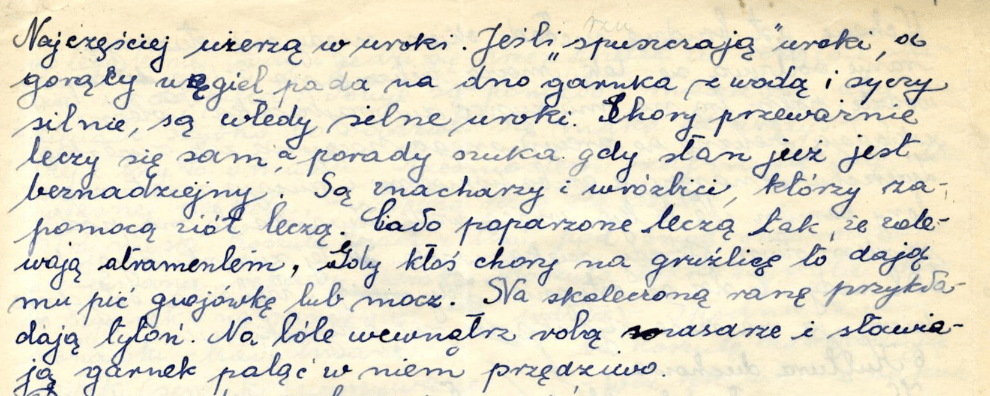
Najczęściej wierzą w uroki. Jeśli „spuszczają” uroki, ob gorący węgiel pada na dno garnka z wodą i syczy silnie, są wtedy silne uroki. Chory przeważnie leczy się sam, a porady szuka gdy stan jego jest beznadziejny. Są znachorzy i wróżbici, którzy za pomocą ziół leczą. Ciało poparzone leczą tak, że zalewają atramentem. Gdy ktoś chory na gruźlicę to dają mu pić gnojówkę lub mocz. Na skaleczoną ranę przykładają tytoń. Na bóle wewnątrz robią zamawianie i stawiają garnek paląc w niem przędziwo.
Baśnie, podania, legendy, opowieści:
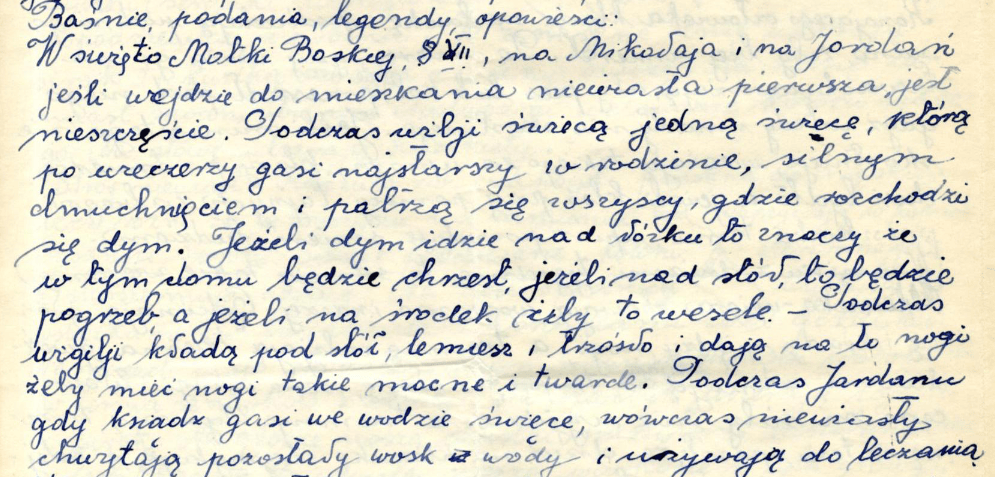
W święto Matki Boskiej, 8/XII, na Mikołaja i na Jordan jeśli wejdzie do mieszkania niewiasta pierwsza, jest nieszczęście. Podczas wilji świecą jedną świecę, którą po wieczerzy gasi najstarszy w rodzinie, silnym dmuchnięciem i patrzą się wszyscy, gdzie rozchodzi się dym. Jeżeli dym idzie nad łóżko to znaczy że w tym domu będzie chrzest, jeżeli nad stół, to będzie pogrzeb a jeżeli na środek izby to wesele. Podczas wigilji kładą pod stół, lemiesz i trzósło i dają na te nogi żeby mieć nogi takie mocne i twarde. Podczas Jordanu gdy ksiądz gasi we wodzie świece, wówczas niewiasty chwytają pozostały wosk z wody i używają do leczania.
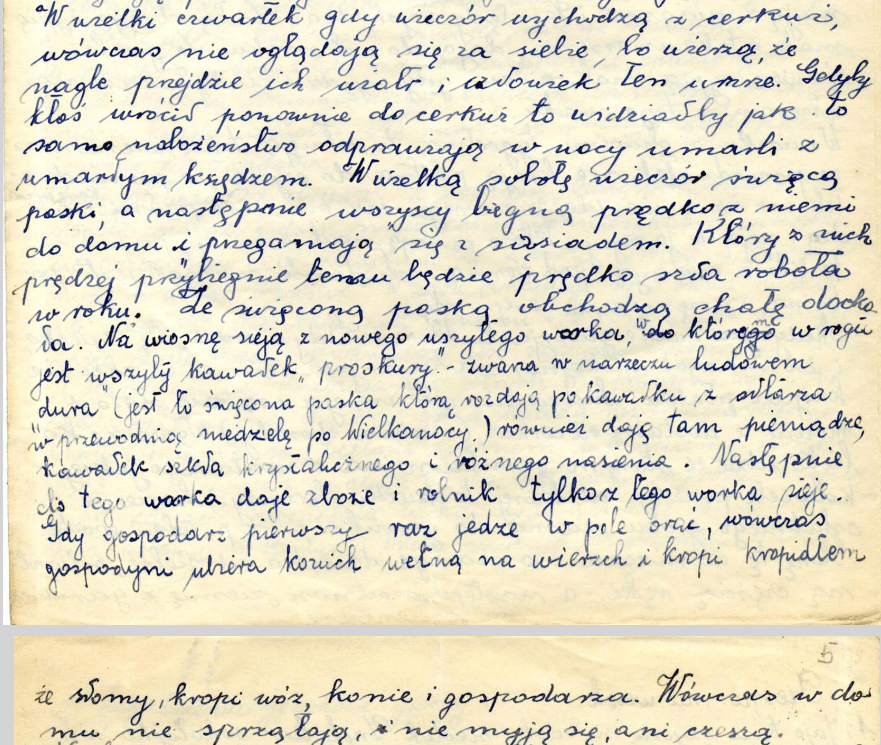
W wielki czwartek gdy wieczór wychodzą z cerkwi, wówczas nie oglądają się za siebie, bo wierzą, że nagle przyjdzie ich uroki, i człowiek ten umrze. Gdyby kto wrócił ponownie do cerkwi to widziałyby jak to samo nabożeństwo odprawiają w nocy umarli z umarłym księdzem. Wszelką sobotę wieczór świecą paski, a następnie wszyscy biegną prędko z niemi do domu i przymują się z sąsiadem. Który z nich prędzej przybiegnie temu będzie prędko szła robota w roku. Ze święconą paską obchodzą chatę dookoła. Na wiosnę sieją z nowego uszytego worka, do którego w rogu jest wszyty kawałek proskury – zwana w narzeczu ludowem dura (jest to święcona paska którą rozdają po kawałku z ołtarza w przewodnią niedzielę po Wielkanocy). Również dają tam pieniądze, kawałek szkła kryształowego i różnego nasienia. Następnie do tego worka daje zboże i rolnik tylko z tego worka sieje. Gdy gospodarz pierwszy raz jedzie w pole orać, wówczas gospodyni ubiera koniom wełną na uszach i kropi kropidłem ze słomy, kropi wóz, konie i gospodarza. Wówczas w domu nie sprzątają, i nie myją się, ani czeszą.
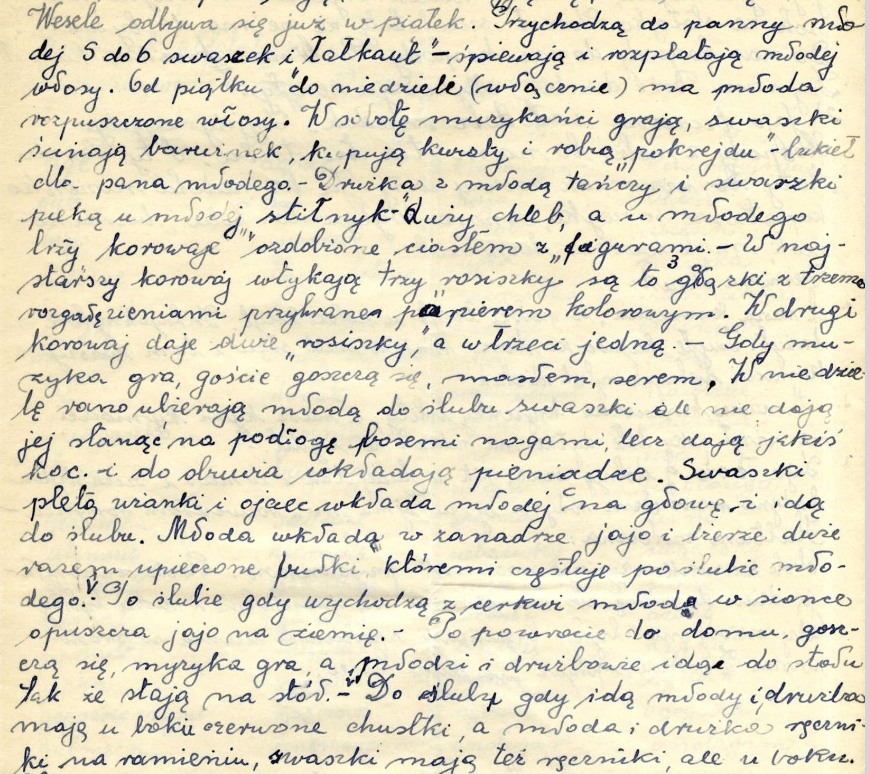
Wesele odbywa się już w piątek. Przychodzą do panny młodej 5 do 6 swaszek i „tatkaut”– śpiewają i rozplatają młodej włosy. Od piątku do niedzieli (włącznie) ma młoda rozpuszczone włosy. W sobotę muzykanci grają, swaszki wiją korowaj, kupują kwarty i robią „pokrejdu” – bukiet dla pana młodego. – Drużba z młodą tańczy i swaszki pukają u młodej „stitnyk”. Duży chleb, a u młodego trzy korowaje ozdobione ciastem z figurami. W najstarszy korowaj wtykają trzy „rosiszky”, są to gałązki z trzema rozgałęzieniami przybrane papierem kolorowym. W drugi korowaj daje dwie roszczki, a w trzeci jedną. – Gdy muzyka gra, goście goszczą się miodem, serem. W niedzielę rano ubierają młodą do ślubu swaszki, ale nie dają jej stanąć na podłogę bosemi nogami, lecz dają jakiś koc i do obuwia wkładają pieniądze. Swaszki plotą wianki i ojciec wkłada młodej na głowę i idą do ślubu. Młoda wkłada w zanadrze jajo i bierze duże razem upieczone bułki, któremi częstuje po ślubie młodego. Po ślubie gdy wychodzą z cerkwi młoda w sionce opuszcza jajo na ziemię. – Po powrocie do domu gorszą się, muzyka gra, a młodzi i drużbowie idą do stołu tak że stają na stół. – Do ślubu gdy idą młody i drużba mają u boku czerwone chustki, a młoda i drużka ręczniki na ramieniu, swaszki mają też ręczniki, ale u boku.
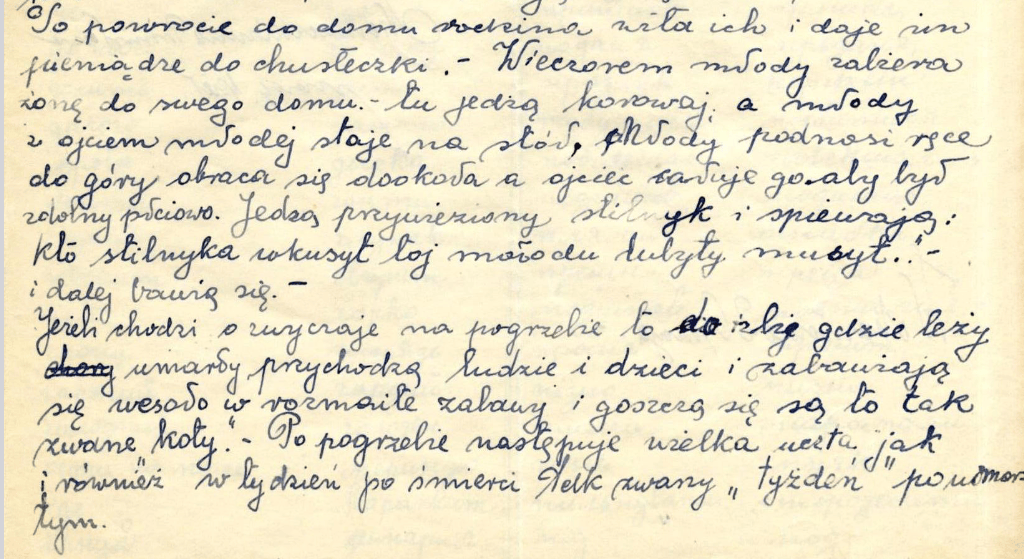
Po powrocie do domu rodzina wita ich i daje im pieniądze do chusteczki. – Wieczorem młody zabiera żonę do swego domu. – Tu jedzą korowaj, a młody z ojcem młodej staje na stół, młody podnosi ręce do góry obraca się dookoła a ojciec bawi go aby był zdolny płciowo. Jedzą przywieziony stilnyk i śpiewają: kto stilnyka rokusyt toj mołodu lubłyty musyt..” – i dalej bawią się.-
Jeżeli chodzi o zwyczaje na pogrzebie to do izby gdzie leży umarły przychodzą ludzie i dzieci i zabawiają się wesoło w rozmaite zabawy i goszczą się są to tak zwane „koły”. – Po pogrzebie następuje wielka uczta, jak i również w tydzień po śmierci tak zwany „tydzień” po martwym.
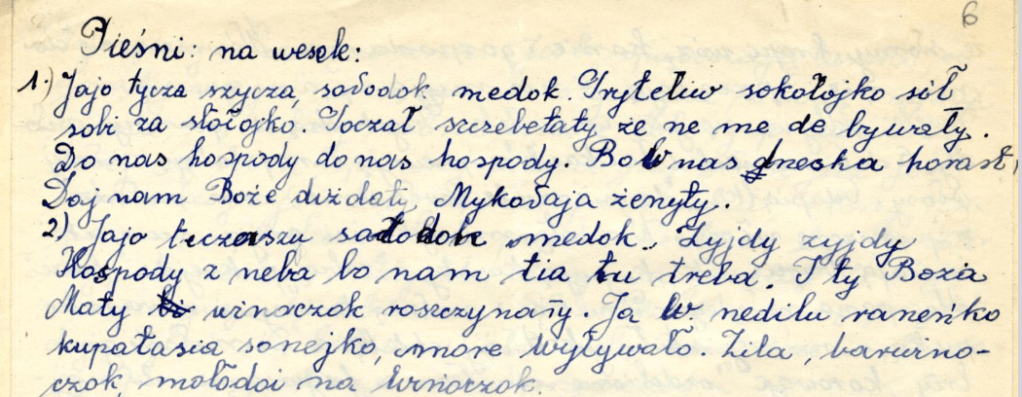
Pieśni: na wesele:
1.) Jajo tycza szycza, sadodok medok. Tryteliw sokołojko sił sobi za stołojko. Poczał szczebetaty że ne me de bywały. Do nas hospody do nas hospody. Bo w nas hreszka horast, Daj nam Boże dizdaty, Mykołaja żenyty.
2.) Jajo teczaszu sadodok omedok. Zyjdy zyjdy Hospody z neba bo nam tia tu treba. I ty Boża Maty winszczok roszczynaty. Ja w nedilu ranenko kupatasia sonejko, more wyływało. Zila, barwinoczok mołodoi na winszczok.
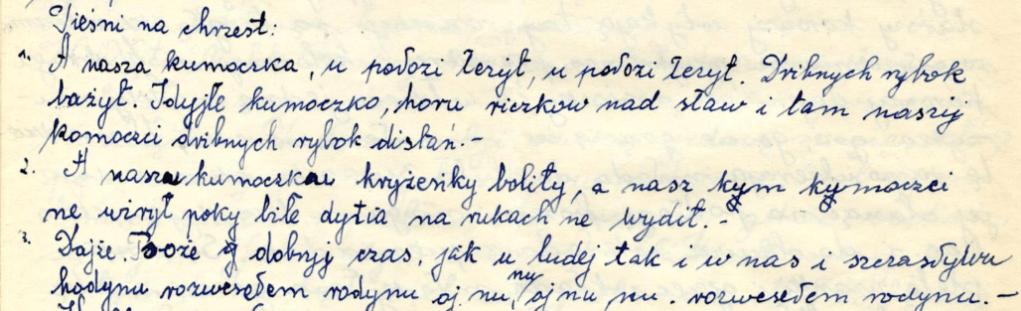
Pieśni na chrzest
1.) A nasza kumoczka, u podozi łeżyt, u podozi łeżyt. Dribnych rybok bażyt. Idyjle kumoczko, horu rierkow nad staw i tam naszyj komoczce dribnych rybok distań.
2.) A nasza kumoczka kryżesiky bolity, a nasz kym kymowi ne wirył poky bile dytia na rukach ne wydił.
3.) Dajie Boże dobryj czas, jak u ludej tak i u nas i szczasływu hodynu rozweselym rodynu oj nu, oj nu nu rozweselym rodynu.
English Translation: Google-Powered
Warning: this translation may be terrible. It was done electronically by someone who can speak neither Polish nor Ukrainian/Lemko. Do you wish to see it improve? You can help! Contact us.
Uwaga: to tłumaczenie może być fatalne. Zostało wykonane automatycznie przez osobę, która nie zna ani języka polskiego, ani ukraińskiego/łemkowskiego. Chcesz, żeby było lepsze? Możesz pomóc! Skontaktuj się z nami.
Spiritual Culture.
A dying person is placed on a bench with hay spread underneath, to make the passing easier. After death, once the body has been laid out on benches, care is taken to ensure that no dog or cat passes underneath; if one does, the deceased will fail to stiffen (rigor mortis will not set in). If the body still fails to stiffen, it is believed that the person has become an upiór (a type of revenant or vampire) that strangles livestock after death. If someone intervenes—using secret rituals—to prevent this, the upiór will instead cause the deaths of living people.
Such a revenant is buried differently: the head is severed and placed between the legs, and the coffin is secured with three nails driven through the corpse—into the head, the heart, and the legs—to ensure it cannot leave the coffin. When carrying the coffin out, the door is removed from its hinges rather than opened by the handle, and the pallbearers exit through that opening. Poppy seeds are scattered along the entire route to the grave, and some are also placed in the mouth of the deceased. Poppy seeds are likewise strewn inside the grave, so that should the revenant emerge, it will be forced to spend its time gathering them.
Regarding the days of the week, there are various beliefs: for instance, fabric is not cut for sewing on a Monday, and the first plowing of the season is never begun on a Monday or a Wednesday. Crops that bear fruit above ground are planted or sown during the waxing phase (leading up to a full moon), while those that bear fruit underground are planted after the full moon. The local population is generally devout and frequently attends religious festivals (odpusty). Folk medicine and veterinary practices:
When a child who is generally calm suddenly begins to scream and cry, and people cannot understand why, they say the child has been struck by “the church” (a specific term for this ailment). In such a case, a woman takes an old pot to the cemetery—at the very time of day when the child’s crying usually begins—and collects soil from the most recent grave, along with water from a stream. She mixes this earth into a paste and smears it onto the child, using the back of her hand. Afterward, she returns the pot and the soil to the cemetery.
There is a strong belief in the “evil eye” (uroki). To “draw out” the evil eye, a hot coal is dropped into a pot of water; if it hisses loudly, it is believed that a powerful evil eye is at work. Typically, a sick person attempts to treat themselves, only seeking outside help when their condition has become hopeless. There are also folk healers and diviners who use herbs for treatment. Burns are treated by pouring ink over them. Those suffering from tuberculosis are sometimes given liquid manure or urine to drink. Tobacco is applied to open wounds. For internal pain, healers may perform incantations or place a pot over the affected area, burning raw flax fiber inside it.
Folk tales, myths, legends, and stories:
On the Feast of the Mother of God (December 8th), St. Nicholas Day, and the Feast of the Epiphany (Jordan), it is considered a bad omen if a woman is the first person to enter a home. On Christmas Eve, a single candle is lit; after the meal, the eldest member of the family extinguishes it with a sharp, strong breath, and everyone watches to see which way the smoke drifts. If the smoke drifts over the bed, it signifies that there will be a baptism in the household; if it drifts over the table, there will be a funeral; and if it moves toward the center of the room, there will be a wedding. On Christmas Eve, a plowshare and a sheaf of grain are placed under the table, and people rest their legs upon them, believing this will make their own legs strong and sturdy. During the Feast of the Epiphany (Jordan), when the priest extinguishes candles in the water, the women collect the remaining wax and use it for healing purposes.
On Maundy Thursday, when leaving the church in the evening, people do not look back, for they believe that a malevolent spell might suddenly be cast upon them, leading to their death. It is said that if one were to return to the church, one might witness the dead—led by a deceased priest—performing the very same liturgy during the night. Every Saturday evening, people have their paska (Easter bread) blessed; they then hurry home with it, racing against their neighbors. Whoever arrives home first is believed to be destined for swift and efficient work throughout the coming year. They carry the blessed paska all the way around their cottage. In the spring, when sowing, they use a newly sewn sack into which a piece of proskura—known in the local dialect as dura—has been stitched into one corner (this refers to the blessed Easter bread distributed in pieces from the altar on the Sunday following Easter). They also place money, a shard of crystal glass, and various types of seeds inside. The grain to be sown is then poured into this sack, and the farmer sows exclusively from it. When the head of the household heads out to the fields to plow for the first time, the mistress of the house adorns the horses’ ears with wool and sprinkles the wagon, the horses, and the farmer himself using a sprinkler made of straw. On this day, no one in the house cleans, washes, or combs their hair.
The wedding celebrations begin as early as Friday. Five or six swashky (bridesmaids/matrons) and a tatkaut (a ceremonial figure) arrive at the bride’s home; they sing and unbraid her hair. From Friday through Sunday (inclusive), the bride wears her hair loose. On Saturday, musicians play, and the swashky (wedding attendants/matrons) prepare the korovai (ceremonial wedding bread); they also purchase spirits and craft a pokreyda—a decorative bouquet for the groom. A groomsman dances with the bride, while the swashky present a stitnyk—a large loaf of bread—to the bride’s family. On the groom’s side, there are three korovai loaves, adorned with dough figures. Into the largest korovai, they insert three rosishky—branches with three offshoots, decorated with colored paper. Two such branches are placed into the second korovai, and one into the third. As the music plays, guests are treated to honey and cheese. On Sunday morning, the swashky help the bride dress for the wedding; they ensure her bare feet do not touch the floor by placing a blanket beneath them, and they tuck money into her footwear. The swashky weave bridal wreaths, which the bride’s father places upon her head before they depart for the wedding ceremony. The bride tucks an egg into her bodice and carries large, baked loaves of bread, which she will offer to the groom after the ceremony. Upon leaving the church, the bride drops the egg onto the ground in the church vestibule. Back at the home, the festivities continue with music, and the newlyweds, along with their attendants, climb onto the table. On the way to the wedding, the groom and his groomsman carry red handkerchiefs at their sides, while the bride and her bridesmaid wear towels draped over their shoulders; the swashky also carry towels, though they keep them at their sides.
Upon their return home, the family welcomes them and places money into their handkerchiefs. In the evening, the groom takes his wife to his own home. – Here, they eat the korovai (wedding bread), and the groom, together with the bride’s father, stands upon a table. The groom raises his arms and spins around, while the father playfully jostles him—a ritual intended to ensure his virility. They eat the stylnyk (a honeycomb or a specific ritual bread) that has been brought, singing: “Whoever breaks the stylnyk must love the young bride…”—and the merrymaking continues.
As for funeral customs, people—including children—gather in the room where the deceased lies. They engage in lively games and enjoy refreshments; these gatherings are known as koly. Following the funeral, a grand feast takes place, and another is held one week after the death—a tradition referred to as the “week” (commemoration) for the departed.
Songs: for a wedding:
1.) Yayo tycha sycha, sadodok medok. A falcon has come to sit at the table. He begins to chirp, telling of places he has visited. “Come to us, O Lord, come to us! For we have a fine hreshka (a type of ritual cake/bread). Grant us, O God, the joy of living to see the day when we marry off Mykola.”
2.) Yayo techashu, sadodok omedok. “Descend, O Lord, from the heavens, for we have need of You here. And You, Mother of God, come to bless the vinschok (a ritual wreath or bread).” On a Sunday morning, the sun bathed itself, and the sea overflowed. Herbs and periwinkle—for the young bride’s vinschok.
Songs for a baptism:
1.) “Our kumochka (godmother) lies there, holding something in the hem of her skirt—she is longing for tiny fish. Go, kumochka, up the path toward the pond, and catch some tiny fish for our kumochka.”
2.) And our friend didn’t have any balls on her hands, and our kymowi didn’t move the ball on her hands.
3.) God grant you a good time, both for the people and for us, and happy birthday, happy family, oy, happy family.
Sanok Genes seeks to create a database of transcripts and English translations from the “Kultura Duchowa” sections from the 1936 Sanok School Inspectorate Questionnaires. The original documents are held by the Sanok Museum of History and digitized by the Sanok Digital Library. To learn more, see the project description.
Sanok Genes stawia sobie za cel stworzenie bazy danych zawierającej transkrypcje oraz tłumaczenia na język angielski fragmentów dotyczących „kultury duchowej”, pochodzących z kwestionariuszy Inspektoratu Szkolnego w Sanoku z 1936 roku. Oryginalne dokumenty znajdują się w zbiorach Muzeum Historycznego w Sanoku i zostały zdigitalizowane przez Sanocką Bibliotekę Cyfrową. Więcej informacji można znaleźć w opisie projektu.

